
Charity partner engagement is the practice of building measurable, mutually valuable relationships with nonprofits, usually anchored in employee participation rather than a one-time check. The fastest route to real results is a 90-day pilot built around an inclusive activation, like an employee movement challenge, with clear KPIs from day one. Benchmarks from CECP’s Giving in Numbers™ and platforms like Charity Miles show this approach beats broad, unmeasured philanthropy programs.
TL;DR:
- Employee movement challenges are highly effective because they are inclusive, easy to measure, and motivate participation regardless of fitness levels.
- Building strong charity partnerships requires clear alignment, ongoing vetting, and structured governance, including a simple MOU and regular check-ins.
- Measuring success depends on tracking both activity outputs and tangible outcomes like employee engagement or brand perception, not just donation counts.
- Initiate partnerships with a 90-day pilot focused on a narrow activation to gather data, with multi-year commitments only after satisfactory results.
- Use straightforward tools like activity trackers and shared documents to manage collaboration, ensuring transparency and consistent data sharing.
Table of Contents
- What Makes a Charity Partnership High-Impact?
- How Do You Find and Approach the Right Charity Partner?
- Structuring the Relationship: Governance and Terms
- How Do You Measure Charity Partnership Impact?
- Should You Pilot First or Commit Multi-Year?
- Getting Employees and Leadership on Board
- What Legal and Reputational Risks Should You Watch For?
- Client Case Study: How Charity Miles Drove an 11x Participation Jump
- A 90-Day Pilot Checklist You Can Launch This Week
- How Should You Communicate With Partners Ongoing?
- How Do You Handle Conflict Without Losing the Partnership?
- What Tools Help Manage Charity Partner Collaborations?
- What Should a Partnership Plan and Communications Template Include?
- How Should Co-Branding and Joint Marketing Work?
- How Do You Know a Partner Truly Fits Your Mission?
- Why Strategic Discipline Beats Good Intentions
- Run Your First Employee Challenge With Charity Miles
- Sources
- FAQ
What Makes a Charity Partnership High-Impact?
Not every activation deserves equal attention. Some ideas cost little and produce fast, visible engagement; others demand more coordination but build deeper skill-based value. Ranking them by effort versus payoff helps you pick a pilot that actually gets approved.
Employee movement and wellness challenges sit at the top of that list because they are inclusive by design. Anyone can walk, bike, or log a lunchtime stretch, which means participation isn’t gated by fitness level or seniority. Platforms like Charity Miles convert those miles into donations automatically, so tracking outcomes doesn’t require a spreadsheet marathon. You can see charity partnership ideas that deliver results for more activation formats worth testing.
Beyond movement challenges, several other activation types consistently perform well:
- Skills-based volunteering and pro-bono engagements — matching employee expertise (marketing, finance, IT) to a nonprofit’s operational gaps builds deeper ties than a one-off donation drive.
- Cause-linked promotions — tying a percentage of sales or a customer action to a donation, which works well for retail and consumer brands with existing loyalty programs.
- Payroll giving and matching programs — low-effort to administer, and matching gifts often double an employee’s personal contribution.
- In-kind donations and event-based activations — donating products, space, or expertise around a single flagship event, useful for building initial momentum before a longer commitment.
Each of these can run alongside an employee-engagement pilot rather than instead of it. Start with movement or wellness, since it’s the easiest to measure and the hardest for any employee to opt out of.
How Do You Find and Approach the Right Charity Partner?
Alignment matters more than charisma. A nonprofit with a compelling mission but no operational capacity to manage a corporate partnership will drain your team’s time. Before reaching out, run through this sequence:
- Build an alignment checklist first. Score potential partners against your company’s strengths, employee interest data (surveys, past giving patterns), and mission overlap. GlobalGiving’s partnership framework suggests rating fit across relationship, execution, and resourcing on a simple 1 to 5 scale.
- Source candidates broadly. Pull from internal employee surveys, established charity networks, professional nonprofit listings, and referrals from other corporate partners in your industry.
- Pitch the business problem, not your budget. Lead with what you’re trying to solve, retention, recruitment, ESG reporting, then position the partner as a specific solution. Harvard Business Review argues this reframing is what separates strategic partnerships from transactional ones.
- Vet with direct questions. Ask how they measure impact, who their point person will be, and whether they’ve managed a corporate pilot before. Vague answers to any of these are a red flag worth taking seriously.
Structuring the Relationship: Governance and Terms
A lightweight memorandum of understanding beats a heavy legal contract for most pilots. Keep it focused on scope, deliverables, data sharing terms, sponsorship payment structure, and a clear exit clause if either side wants out after the pilot period.
Governance cadence matters more than most teams expect. A standing 30-minute monthly check-in for the first six months keeps small issues from becoming partnership-ending ones, after that, quarterly check-ins are usually enough to maintain momentum without adding meeting overhead.
Sponsorship terms should specify the rate per mile, hour, or dollar matched, a total cap, and whether funds go to an employee’s chosen charity or a company-selected cause. Assign one internal owner, not a committee, to manage the relationship day to day.
- Vague deliverables with no numbers attached
- No named point person on the nonprofit side
- Reporting duties left undefined until something goes wrong
Pro Tip: Write the exit clause before you need it. Partnerships that skip this step tend to drag on past their useful life simply because no one wants to be the one to end it.
How Do You Measure Charity Partnership Impact?
Outputs and outcomes are not the same thing, and confusing them is the most common measurement mistake in corporate giving. Outputs are activity counts: miles logged, dollars donated, volunteer hours served. Outcomes are the changes those activities produce: employee retention shifts, brand sentiment, or measurable improvement in the nonprofit’s own program.
CECP’s 2025 Giving in Numbers™ data found that 80% of companies now collect both outputs and outcomes data, and 76% track specific program activities when evaluating partnerships. That’s the benchmark your reporting should be measured against, not just a feel-good recap email.
For a typical employee movement pilot, track these KPIs:
- Participation rate (percentage of eligible employees who log at least one activity)
- Dollars donated per employee
- Total volunteer or activity hours logged
- At least one outcome indicator, like a post-pilot engagement survey score
Data collection is simpler than it sounds. Platform exports handle activity and donation totals, HR systems supply headcount and participation baselines, and a short participant survey fills the outcome gap. Assign metric ownership clearly: HR usually owns participation data, finance owns sponsorship spend, and the nonprofit partner owns their own program outcomes.
Package results in a one-page executive summary. Lead with the participation rate and total raised, follow with one outcome data point, and close with a recommendation to continue, expand, or adjust. Stakeholders read one-pagers; they skim decks.
Should You Pilot First or Commit Multi-Year?
Start every new partnership as a 90-day pilot. It’s long enough to gather real data and short enough that a mediocre fit doesn’t become a two-year headache.
- Scope the pilot narrowly. Pick one activation, one business unit or location, and one clear success metric, like a 30% participation rate.
- Set decision gates in advance. Define both quantitative thresholds (participation, dollars raised) and qualitative signals (employee feedback, ease of nonprofit collaboration) before you launch, not after.
- Review at day 90 with both sides present. Bring the data, not just impressions.
- Negotiate multi-year terms only after the pilot clears its gates. Use the pilot’s numbers to set realistic sponsorship caps and governance cadence for the longer commitment.
Getting Employees and Leadership on Board
A partnership only works if people beyond HR actually notice it. Leadership endorsement needs to come before launch, not after participation stalls. Brief managers directly so they can answer basic questions, and build simple onboarding materials, an email, a one-page flyer, a short team meeting mention, so no one discovers the challenge by accident.
Momentum fades around week three for most challenges. Counter it with employee ambassadors in each department, small recurring asks rather than one big push, and visible recognition for milestones, not just the final leaderboard.
- Leadership endorsement announced before launch
- Manager briefings scheduled the week prior
- Ambassador network named early
- Recognition moments built into the calendar, not left to chance
External storytelling should mirror that same honesty. Share real numbers alongside the narrative, and avoid framing modest results as sweeping impact. Transparent reporting protects credibility far longer than an inflated headline does.
What Legal and Reputational Risks Should You Watch For?
Most partnership risk clusters around four areas: fund misuse, data privacy, volunteer liability, and brand mismatch, a nonprofit’s public stance conflicting with your company’s values mid-partnership.
Practical mitigation rarely requires a legal team for a small pilot. Clear MOU clauses on fund use, a limited data-sharing agreement specifying exactly what employee information gets shared, and a quick insurance check for any in-person volunteer events usually cover the basics. Naming-rights guardrails, spelling out who can use whose logo and where, prevent awkward marketing surprises later.
Escalate to legal counsel when sponsorship dollars cross a meaningful threshold, when the partnership involves international operations, or when any data-sharing clause touches health or financial information. For a straightforward 90-day movement challenge, the MOU clauses above are typically enough.
Client Case Study: How Charity Miles Drove an 11x Participation Jump
HARMAN launched its Charity Miles team in 2021 to boost employee engagement around wellness and giving. The result: an 11x increase in employee participation, with more than 1,200 employees generating over $120,000 for charity.
The jump didn’t come from a bigger budget. It came from removing the barrier to entry: any movement counted, and every employee could see their own miles turning into real donations in real time.
Three elements drove that outcome, and each is replicable:
- Inclusive tracking. Walking counted the same as running, so no one felt excluded by fitness level.
- Configurable sponsorship. HARMAN set its own rate per mile and total cap, keeping budget predictable.
- Team-based challenges. Friendly competition between departments sustained participation past the typical week-three drop-off.
A 90-Day Pilot Checklist You Can Launch This Week
- Days 0 to 7: Secure internal sponsorship (budget and leadership sign-off) and confirm your nonprofit partner.
- Weeks 2 to 3: Finalize the MOU, lock sponsorship terms, and prepare launch communications for managers and employees.
- Weeks 4 to 12: Run the activation, check participation metrics weekly, and adjust messaging if engagement lags.
- Day 90: Present findings to leadership and decide whether to scale, adjust the format, or end the pilot.
Pro Tip: Check participation numbers every Friday, not just at the finish line. A dip in week two is easy to fix; the same dip discovered in week eleven usually isn’t.
How Should You Communicate With Partners Ongoing?
Communication frequency matters less than communication clarity. A monthly 30 minute check-in only works if both sides come with something specific: a metric update, a blocker, or a decision that needs input. Vague “how’s it going” calls waste everyone’s time and quietly erode goodwill.
Set a shared document, not a chain of emails, as the single source of truth for metrics, action items, and decisions. Both the corporate and nonprofit side should be able to check it without waiting on a reply. This matters more than most teams expect: Candid’s partnership planning guidance notes that stewardship and consistent data-sharing are what actually retain corporate partners over time, not the size of the initial gift.
Assign a named point person on each side, and make sure that person has real authority to make small decisions without escalating everything. Partnerships stall when every minor adjustment needs three layers of sign-off.
Finally, separate operational updates from relationship-building conversations. A quarterly call focused purely on “how is this partnership serving both of us” surfaces friction that a metrics-only check-in never will. Nonprofits are often reluctant to raise concerns proactively, especially with a corporate funder, so build in the space for that conversation rather than assuming silence means satisfaction.
How Do You Handle Conflict Without Losing the Partnership?
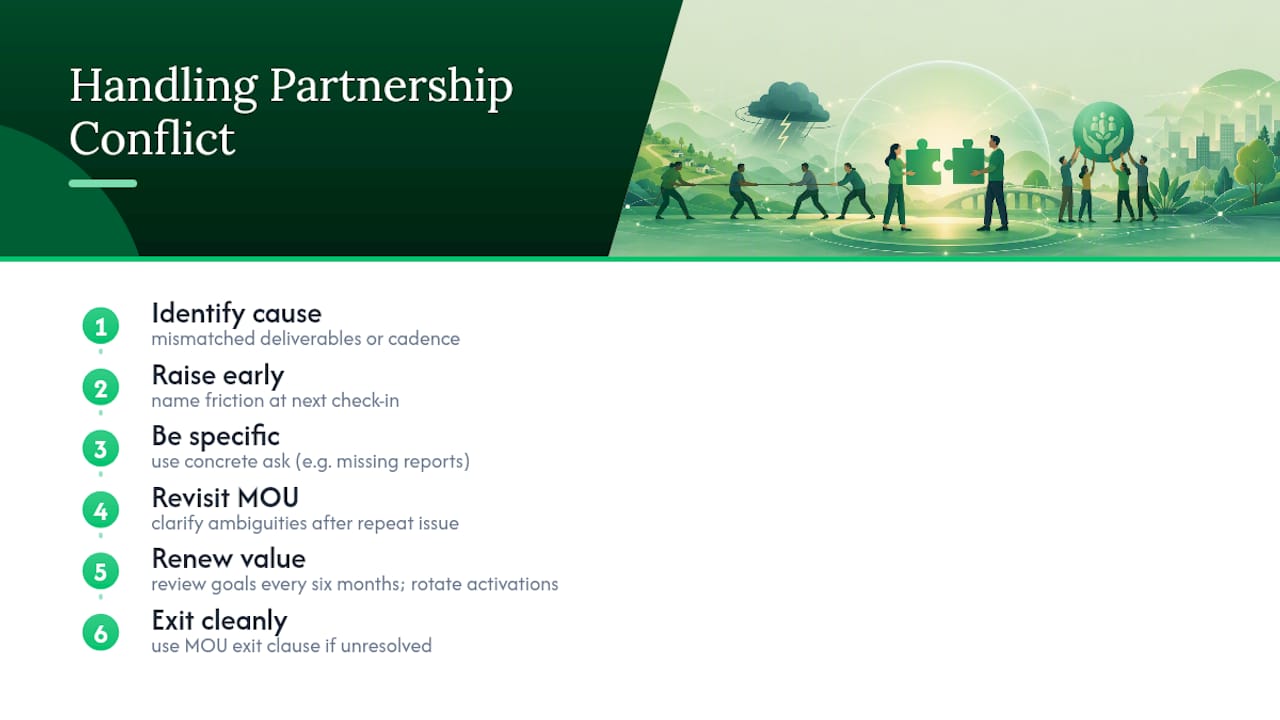
Most partnership conflict traces back to one of two things: mismatched expectations about deliverables, or a breakdown in communication cadence. Rarely is it a values conflict severe enough to end things, though brand mismatch does happen and should be addressed directly when it does.
When friction shows up, name it in the next scheduled check-in rather than letting it fester until the quarterly review. A specific ask, “we expected quarterly impact reports and haven’t received one,” resolves faster than a general complaint about the relationship feeling off.
Revisit the MOU when disagreements repeat. If the same issue surfaces twice, the original agreement probably left something ambiguous, and clarifying it in writing prevents a third round of the same argument.
Long-term engagement survives on renewed value, not inertia. Revisit goals every six months even in a partnership that’s going well, since employee interests shift and a challenge that felt fresh in year one can feel stale by year three. Rotating activation formats, alternating a movement challenge with a skills-based volunteering event, keeps the relationship from running on autopilot.
If a partnership genuinely isn’t working after good-faith attempts to fix it, the exit clause in your MOU exists for exactly this reason. Ending a mismatched partnership cleanly protects both organizations’ reputations more than dragging it out does.
What Tools Help Manage Charity Partner Collaborations?
Managing a partnership well requires visibility into three things: activity data, communication history, and financial tracking. Few teams need enterprise software to get this right, but relying purely on email and memory is how details slip.
Activity-tracking platforms like Charity Miles automatically log participation and donation totals, removing the need for a volunteer to manually tally miles or hours. For skills-based volunteering, a shared project tracker (even a simple spreadsheet with assigned owners and deadlines) works better than status updates buried in email threads.
For communication management, a shared folder or lightweight project management tool keeps the MOU, meeting notes, and metric reports in one place both organizations can access. This matters most during staff transitions. Partnerships often stumble when a key contact leaves and nothing was documented outside their inbox.
Financial tracking should live wherever your finance team already tracks sponsorship spend, tied to the caps and rates set in the MOU. Keeping this separate from general marketing budget makes year-end reporting far less painful.
The right tool is the one your team will actually use consistently. A sophisticated platform nobody logs into is worse than a simple shared spreadsheet that gets updated every week.
What Should a Partnership Plan and Communications Template Include?
A written engagement plan doesn’t need to be long, but it does need specific sections: goals, activation type, timeline, sponsorship terms, communication cadence, and success metrics. Write it as a shared document both organizations sign off on, not an internal memo the nonprofit never sees.
Launch communications should include an announcement email from leadership, a one-page flyer explaining how to join, and a short FAQ addressing the obvious questions (does this cost anything, how does my activity turn into a donation, who do I ask if something breaks). Charity Miles clients often model these off existing team-building communication templates built for similar HR activations.
Mid-pilot updates work best as a short, consistent format: current participation percentage, dollars raised so far, and one highlight, a team that’s leading, a milestone reached. Consistency matters more than length here; a predictable weekly or biweekly update beats a longer message that arrives unpredictably.
Your day-90 report template should mirror the executive one-pager described earlier: participation rate, total impact, one outcome data point, and a clear recommendation. Keep the same template for every future pilot so leadership can compare results across activations without relearning a new format each time.
How Should Co-Branding and Joint Marketing Work?
Co-branding a charity partnership means both organizations’ names and visual identities appear together in public communications, and getting the terms wrong early causes more friction than almost anything else in the relationship.
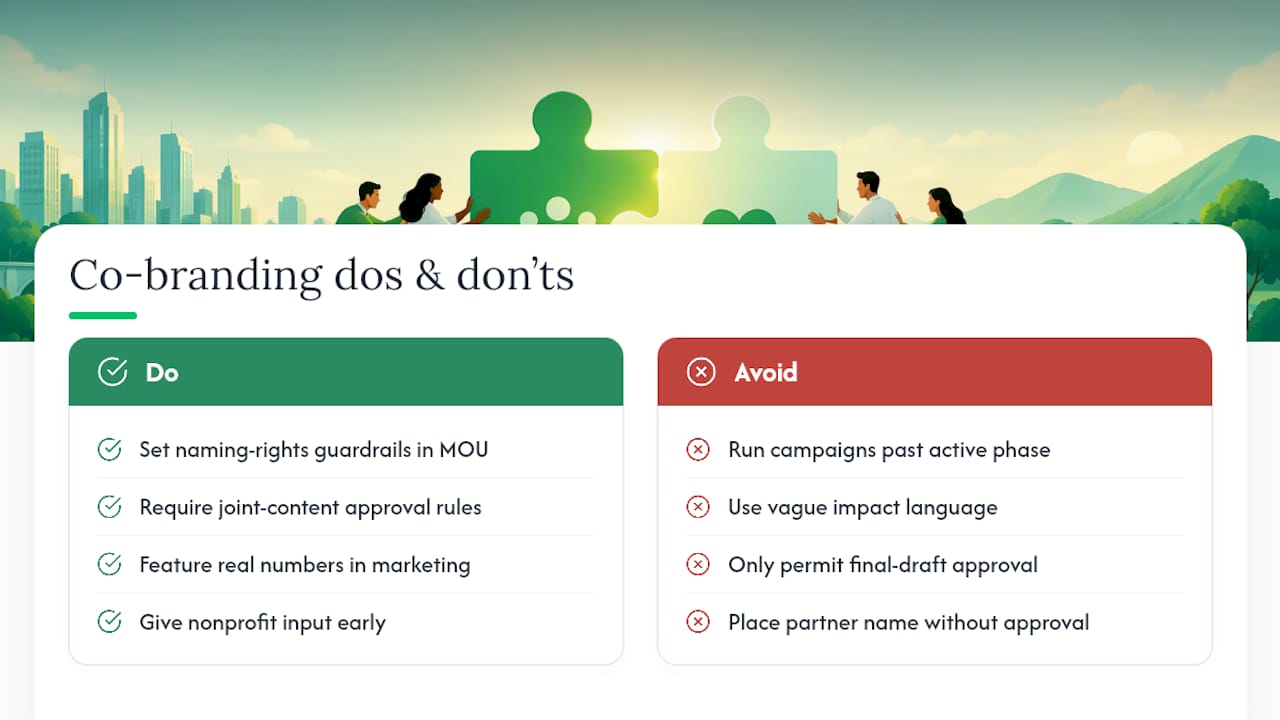
Set naming-rights guardrails in the MOU before any marketing material goes out: who approves joint content, where each logo can appear, and whether either party can reference the partnership in unrelated campaigns. This prevents the awkward scenario where a nonprofit’s name shows up in a promotional context the corporate partner never approved.
Joint marketing works best when it highlights real numbers rather than vague impact language. A social post citing an actual participation rate or dollar total performs better and holds up better under scrutiny than a general “proud to partner with” statement.
Give the nonprofit partner real input into messaging, not just approval rights over the final draft. Nonprofits often understand their own audience and mission framing better than a corporate marketing team does, and involving them early avoids messaging that reads as tone-deaf or extractive.
Keep joint campaigns tied to the actual pilot or activation timeline rather than running indefinitely. A campaign that outlives the partnership’s active phase risks implying ongoing work that isn’t happening, which edges toward the impact-washing problem covered earlier in this guide.
How Do You Know a Partner Truly Fits Your Mission?
Values alignment sounds abstract until you turn it into specific questions. Does the nonprofit’s mission statement connect logically to something your company already does or claims to care about? A vague thematic connection (both organizations like “community”) isn’t alignment; a direct link between your business and their program is.
Check public statements and past campaigns for consistency with your company’s own values, especially around politically sensitive topics. A mismatch discovered after launch is far more damaging than one caught during vetting.
Ask how the nonprofit measures its own program outcomes, separate from how they’ll report on your partnership. A nonprofit that can’t articulate its own theory of change is a harder partner to build credible joint reporting with, regardless of how compelling its mission sounds.
Revisit alignment periodically, not just at the start. GlobalGiving’s assessment approach treats fit as something to score across relationship, execution, and resourcing on a recurring basis, since organizations change, leadership turns over, and a strong initial fit can drift. Building that review into your quarterly governance cadence keeps alignment from becoming a one-time checkbox you never revisit.
Why Strategic Discipline Beats Good Intentions
Most charity partnerships fail quietly. Not from scandal, from neglect. A partnership signed with genuine enthusiasm slowly loses attention because nobody built in a way to measure whether it was actually working, and measurement discipline is what separates partnerships that compound in value from ones that fade into an annual line item nobody remembers approving.
The pilot-first approach isn’t caution for its own sake. It’s the fastest way to find out if a partnership deserves the multi-year commitment everyone hopes it will earn. and.
— Gene
Run Your First Employee Challenge With Charity Miles
Charity Miles gives HR and CSR teams a faster path to a measurable pilot than building a wellness challenge and donation tracker from scratch. The Employee Empowerment Program lets you create a private team for employees, run movement-based challenges, and set your own sponsorship terms, rate per mile, total cap, and whether donations go to each employee’s chosen charity or a cause your company selects.
Employees just walk, run, or bike, and the app handles the tracking. If you’re weighing a 90-day pilot against building something internal, the Employee Empowerment Program removes most of the setup work HR teams underestimate at the planning stage. Explore corporate sponsorship opportunities or visit the Employee Empowerment Program page to scope your first pilot.
Sources
- Treat nonprofits as strategic partners, not just philanthropic recipients — Harvard Business Review
- Corporate-nonprofit partnership guidance — GlobalGiving
- Corporate partnership planning: a nonprofit’s guide to success — Candid (For Momentum)
FAQ
What Is Partnership Engagement?
Partnership engagement is the ongoing process of building, managing, and measuring a collaborative relationship between a company and a nonprofit, rather than a one-time donation. It includes governance, communication cadence, and shared measurement of both outputs and outcomes, as outlined in CECP’s benchmarking data.
What Is the 30/70 Rule for Charities?
Definitions of this rule vary across the nonprofit sector, and there’s no single standardized version widely agreed upon. Rather than rely on an unverified ratio, focus on the outputs versus outcomes framework covered earlier in this guide, which has clearer, sourced backing for how companies actually evaluate partnership spending.
Why Do Nonprofits Want Monthly Giving Programs?
Recurring monthly gifts, sometimes marketed at low entry points, give nonprofits predictable revenue instead of relying on one-time campaigns that spike and fade. Predictable income lets a nonprofit plan programming further in advance, which matters more to their operations than any single gift size.
What Are Some Examples of Impactful Nonprofit Partnerships?
Employee movement challenges are among the most consistently effective, since they combine low barriers to entry with automatic impact tracking. HARMAN’s partnership with Charity Miles produced an 11x increase in employee participation and raised more than $120,000, illustrating how an inclusive activation can outperform a traditional one-time fundraising event.
How Much Does the Charity Miles Employee Empowerment Program Cost?
Charity Miles doesn’t publish standard pricing for the Employee Empowerment Program, since sponsorship terms and program scope vary by company. Current details are available directly through the Employee Empowerment Program page.