
A cause marketing activation is a time-bound, promotional campaign that ties a brand’s product, purchase behavior, or employee action directly to a nonprofit outcome. The activations that perform best link something the brand already does well (a product, a distribution channel, employee time) to a mission it can support with a straight face. Product-linked donations, employee movement challenges, point-of-sale roundups, and experiential pop-ups consistently outperform one-off check-writing because they give the audience something to do, not just something to watch.
An activation works when it has:
- Mission alignment between brand and nonprofit
- A clear, simple ask for the participant
- A measurable outcome tied to both funds and reach
- Promotion across owned, paid, and earned channels
- A shared audience the brand and nonprofit both already influence
Key Takeaways
Cause marketing activations succeed when the brand’s core product logic maps directly to the nonprofit’s mission, and when both sides track funds raised alongside business metrics from day one.
| Point | Details |
|---|---|
| Alignment beats donation size | A tight product-to-mission fit persuades consumers more than a large check alone. |
| Pilot before you scale | Test a small co-activation, document outcomes, then negotiate a bigger partnership. |
| Track both KPI sets | Report funds raised and participation alongside conversion lift and PR impressions. |
| Transparency prevents backlash | Publish donation terms, caps, and a post-campaign impact report every time. |
| Movement challenges sustain engagement | Charitymiles’ Employee Empowerment Program turned an 11x participation increase into over $120,000 raised for HARMAN’s employees. |
Table of Contents
- What Are Cause Marketing Activations, Exactly?
- Why Do Cause Marketing Activations Actually Work?
- What Are the Best Cause Marketing Activation Ideas?
- How Do You Choose the Right Nonprofit Partner?
- How Do You Measure a Cause Marketing Activation?
- What Do Cause Marketing Activations Cost, and How Long Do They Take?
- How Should You Promote and Launch an Activation?
- What Are the Ethical Risks in Cause Marketing?
- How Does a Movement-Based Employee Challenge Actually Perform?
- Bring Movement-Based Activations Into Your Cause Marketing Plan
- Frequently Asked Questions
- Sources
What Are Cause Marketing Activations, Exactly?
Cause marketing is a for-profit brand’s marketing-driven partnership with a nonprofit cause, built to move product or build brand equity while generating real support for that cause. It’s distinct from corporate social responsibility or philanthropy, which tend to be programmatic, budget-driven giving with no expectation of a sales or brand lift. CSR is a company writing a check because it’s the right thing to do. Cause marketing activations are commercial campaigns where the giving is the hook.
Common activation formats include:
- Point-of-sale donation prompts or roundups
- Product-aligned campaigns (a percentage of sales goes to a cause)
- Volunteer activations tied to a public event
- Employee movement or fitness challenges with sponsored miles
Pro Tip: If you can’t explain the connection between your product and the cause in one sentence, the activation will read as opportunistic. Fix the “why” before you fix the creative.
Why Do Cause Marketing Activations Actually Work?
Businesses get brand loyalty, media coverage, a short-term conversion lift, and a genuine bump in employee morale when the campaign gives staff something to rally around. Nonprofits get fundraising dollars, name recognition with a new audience, volunteer pipelines, and access to corporate resources they couldn’t otherwise afford.
On the business side:
- Stronger repeat-purchase behavior among consumers who feel their spending “does something”
- Earned media and social shares that paid campaigns rarely generate on their own
- Higher employee engagement when staff can participate directly, not just watch from the sidelines
- A short-term sales lift during the activation window
On the nonprofit side:
- New donor and volunteer acquisition from an audience outside their usual base
- Access to corporate distribution, media relationships, and in-kind resources
- Credibility by association with a recognized brand
Companies increasingly lean on nonprofit data and third-party tools to measure and improve their performance on stakeholder and ESG questions, which makes a well-run activation useful well beyond the campaign window. That measurement habit, once built, tends to make every future partnership faster to launch.
What Are the Best Cause Marketing Activation Ideas?
The strongest activations are the ones where the brand’s core offer naturally maps to what the nonprofit does. Here are ten formats worth testing, with the execution details that separate a memorable one from a forgettable one.
1. Percentage-of-sales product tie-in. Pick a specific product line, not the whole catalog, and commit a defined percentage of sales for a limited window. Track redemption by SKU so you know exactly what moved.
2. Point-of-sale roundup. Ask customers to round up their purchase at checkout. Train retail and call-center staff on the ask; the opt-in rate lives or dies on how confidently a cashier delivers the line.
3. Limited-edition co-branded product. BoxLunch built its entire retail model around this: every $10 spent funds a meal donated through Feeding America, baked into the transaction rather than bolted on as an add-on ask.
4. Employee movement challenge. Sponsor miles walked, run, or biked by staff, with funds flowing to employee-chosen or company-selected charities. Track participation rate and total miles logged as your fastest-moving KPI.
5. Peer-to-peer fundraising. Give employees or customers a personal fundraising page tied to the brand campaign. Social sharing does most of the promotional lift for you.
6. Volunteer events with on-the-ground PR. Pair a hands-on volunteer day with local press outreach. A photo of employees actually doing the work outperforms a press release every time.

7. Experiential pop-ups with donation prompts. A branded activation at an event or storefront where an action (a photo, a signature, a sample redemption) triggers a donation.
8. Social hashtag campaigns with a match. A branded hashtag paired with a corporate match for every post, share, or use. GivingTuesday remains the clearest proof that a timed, high-participation calendar moment can generate outsized social amplification.
9. In-kind product drives. Customers or employees donate goods rather than dollars; the brand handles logistics and visibility.
10. Cause-driven loyalty perks. Let loyalty members redeem points as charitable donations instead of discounts, deepening the emotional tie to the program.
Dove’s long-running Real Beauty campaign works because self-esteem messaging maps directly onto a personal-care brand’s product category. American Express has built years of goodwill through Small Business Saturday, a promotional day where its core payments business and its cause (local commerce) are the same story.
The most persuasive activations don’t need a large check to work. They need a business offer whose logic already lines up with the nonprofit’s mission, so the “why” answers itself before anyone asks the question.
Pro Tip: Before locking creative, ask whether a stranger could guess the nonprofit partner just by looking at your product. If not, the alignment isn’t tight enough yet.
How Do You Choose the Right Nonprofit Partner?
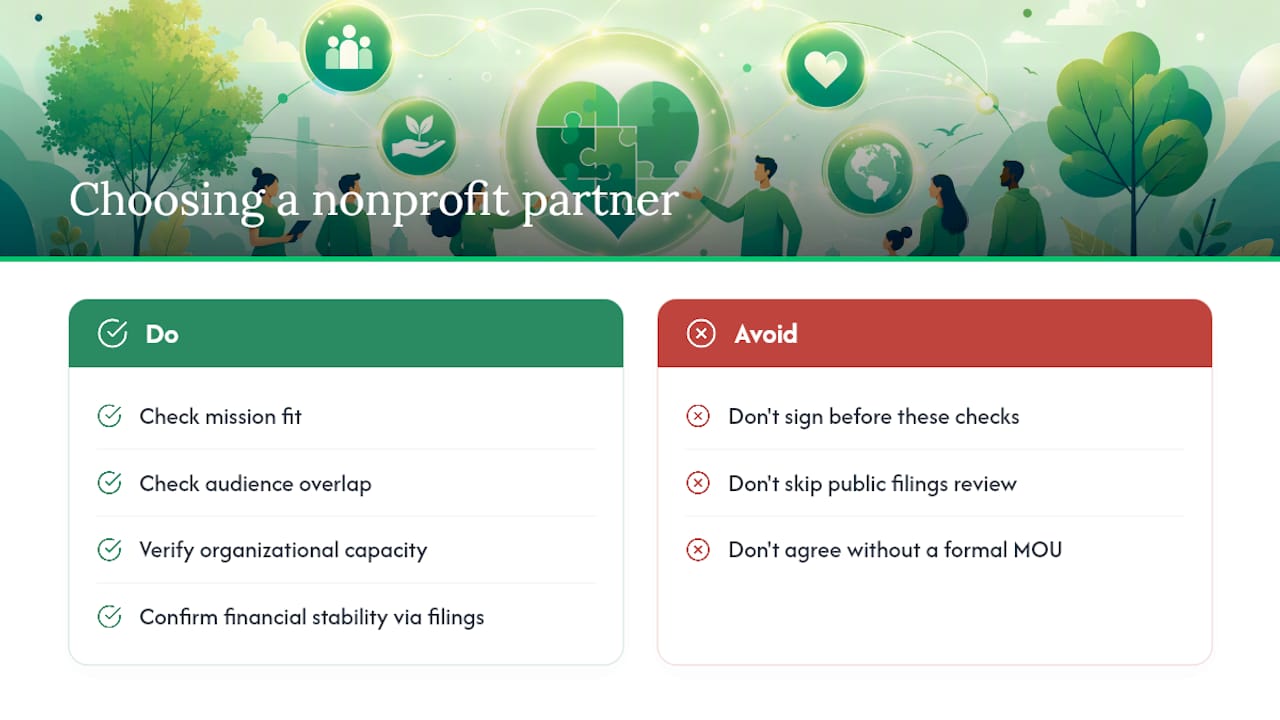
Vet a potential partner against a short checklist before drafting any creative:
- Mission fit with your brand’s actual product or service
- Audience overlap with your customer or employee base
- Organizational capacity to handle co-marketing volume
- Collaboration style and responsiveness during planning
- Public reputation and, for larger commitments, a review of the nonprofit’s Form 990 filings to confirm financial stability
A structured selection process that checks alignment and shared end-goals up front produces partnerships that hold up under scrutiny later. Once you’ve picked a partner, put the relationship in writing. Your MOU should spell out roles and responsibilities, the financial flow (including any donation caps), co-marketing and logo usage rights, data-sharing terms, reporting cadence, and renewal conditions.
Pro Tip: Run a small co-activation before signing a multi-year deal. A single pilot campaign with documented results gives both sides real evidence to negotiate from, instead of guessing.
How Do You Measure a Cause Marketing Activation?
Track two parallel sets of numbers: what the activation did for the cause, and what it did for the business. Primary impact KPIs include funds raised, people served, volunteer hours logged, and program units delivered. Secondary business KPIs include conversion lift, average order value, PR impressions, and employee participation rate.
A logic model keeps both sides honest: activity leads to outputs, outputs lead to outcomes, and outcomes eventually show up in business results. Report weekly during launch, summarize monthly, and close with a full post-campaign impact report.
- Tag every incoming donor or customer by activation source
- Compare business metrics against a pre-campaign baseline
- Document participation and funds so channel-specific ROI is repeatable next time
| KPI | Definition | Data Source | Reporting Cadence |
|---|---|---|---|
| Funds raised | Total dollars generated for the cause | Payment processor, donation platform | Weekly during launch |
| Participation rate | Percentage of eligible audience who acted | CRM, app, or POS system | Weekly, then monthly |
| Conversion lift | Sales increase versus pre-campaign baseline | Sales/POS data | Monthly |
| PR impressions | Media mentions and estimated reach | Media monitoring tool | Post-campaign |
What Do Cause Marketing Activations Cost, and How Long Do They Take?
Budgets scale with ambition, but four cost buckets show up in nearly every activation: creative production, media and promotion, partner fees or donation match commitments, and measurement/reporting.
- Small activations (single-location or regional): modest creative and media spend, short planning cycle
- Medium activations (multi-location or national digital push): dedicated creative production, paid social support, formal partner agreement
- Large activations (national retail or multi-channel): significant media spend, executive sign-off, dedicated reporting infrastructure
| Scale | Typical Timeline | Key Milestone |
|---|---|---|
| Small | 4 to 6 weeks | Partner agreement, simple creative, local promotion |
| Medium | 8 weeks | Creative production, retail/staff training, paid amplification |
| Large | 4 to 6 months | Legal review, executive approvals, multi-channel launch |
Pro Tip: Build a contingency line into every budget tier, and get internal legal and finance sign-off before the creative locks. Approval delays are the single most common reason a launch date slips.
How Should You Promote and Launch an Activation?
Prioritize channels in this order: owned first (email, CRM, in-store signage), then earned (PR, influencer, organic social), then paid (paid social, paid search) to extend reach once organic traction proves the concept.
Pre-launch checklist:
- Finalize creative assets and tracking links
- Confirm partner approvals on messaging and logo use
- Train customer service and retail staff on the ask
- Brief employees internally before the public launch
Launch checklist:
- Stand up a monitoring dashboard for real-time participation
- Prepare a rapid-response plan for partner or brand issues
- Schedule an amplification calendar for the full campaign window
Quick promotional experiments worth testing include a receipt-upload sweepstakes, a limited-time matched-donation window, or an internal leaderboard teaser that builds anticipation before an employee challenge opens.
Pro Tip: Stagger your amplification calendar so earned coverage lands before paid media ramps up. Press picks up organic momentum better than a campaign that looks paid from day one.
What Are the Ethical Risks in Cause Marketing?
Cause-washing, where a campaign donates a token amount relative to the media spend behind it, is the fastest way to lose consumer trust. Watch for a misaligned partner, opaque fund flows, or a nonprofit that can’t fulfill the impact promised once the campaign ends.
Build transparency in from the start:
- State donation terms clearly, including any caps or maximums
- Publish an impact report once the campaign closes
- Offer donors a receipt or confirmation where relevant
Pro Tip: For larger campaigns, bring in third-party verification of the reported impact. An independently confirmed number carries more weight with skeptical audiences than a brand’s own press release.
How Does a Movement-Based Employee Challenge Actually Perform?
HARMAN launched a private employee movement challenge through Charity Miles in 2021, sponsoring employee miles toward employee-chosen charities.
A step challenge only works if people stick with it past week two. Tying movement to a cause employees actually care about is what keeps participation climbing instead of fading out.
Running a private challenge follows a simple sequence: onboard employees into a private team, configure sponsorship terms (rate per mile, total cap, charity choice), and recognize top participants publicly to sustain momentum.
- Set a sponsorship cap the finance team is comfortable with upfront
- Let employees choose their own charity, or direct funds to a company cause
- Recognize participation weekly, not just at the campaign’s end
Pro Tip: Movement challenges include every fitness level by design. A daily walk counts the same as a run, which is why participation rates tend to outperform athletic-only step contests.
Balancing Brand Goals With Nonprofit Mission Integrity
Mission integrity is what keeps a partnership alive past its first campaign. The moment a nonprofit senses it’s being used purely for brand halo, the relationship starts to erode, and so does the audience’s trust in both parties.
Start with a pilot, document what actually happened, and only scale once both sides can point to a measurable win. Early buy-in from employees and internal stakeholders matters more than a splashy launch. Their skepticism, if unaddressed, sinks bigger activations later.
Bring Movement-Based Activations Into Your Cause Marketing Plan
Running an employee movement challenge from scratch means building tracking, sponsorship logic, and reporting yourself. Charitymiles gives you that infrastructure already built, so your team spends its time on the cause and the creative, not on GPS tracking or donation math.
The Employee Empowerment Program lets you launch a private team challenge in days, not months. You set the sponsorship rate per mile, cap the total spend, and choose whether donations go to employees’ own charities or a cause you select. HARMAN’s team saw an 11x jump in participation after launching its challenge, generating over $120,000 for charity from more than 1,200 employees. Every fitness level counts equally, from a lunchtime walk to a weekend run, which is part of why participation tends to hold rather than fade after the first week.
If you’re planning an activation that leans on employee engagement rather than a pure retail promotion, visit the Employee Engagement Solution page to see how the program is structured and request a walkthrough for your team.
Frequently Asked Questions
What’s the difference between cause marketing and CSR?
Cause marketing is a promotional campaign tied to sales or consumer action, built to move product while supporting a cause. CSR is programmatic corporate giving without an expectation of a direct sales lift.
How much does a cause marketing activation typically cost?
Costs scale with scope. A small regional activation might need only modest creative and media spend over four to six weeks, while a national retail activation can require months of planning and a dedicated reporting budget.
How do I find the right nonprofit partner for a cause marketing activation?
Check mission fit, audience overlap, organizational capacity, and financial stability through public filings before signing anything, and document terms in a formal MOU.
What KPIs matter most for cause marketing activations?
Track funds raised and participation rate as primary impact KPIs, alongside conversion lift, average order value, and PR impressions as business KPIs.
Can employee movement challenges count as cause marketing activations?
Yes. Sponsoring employee miles through a platform like Charitymiles ties a wellness activity directly to charitable outcomes, functioning as both an internal engagement tool and a public-facing cause marketing effort.
Sources
- 7 steps for finding the right nonprofit partner — EarthShare
- How companies can partner with nonprofits — HBR
- Strategic partnerships for new nonprofits (2026 guide) — Zeffy