

Cause-based wellness is a way of supporting health by tying healthy habits to a cause people care about. In practice, an employee walks, runs or bikes, and each mile triggers a donation to a charity. Wellness gets a purpose beyond the individual, and giving gets a daily routine. It is not the same as “root-cause wellness,” a clinical idea about finding why a symptom developed. If you landed here from that search, we cover the difference below, then focus on what HR, CSR and wellness leaders can build.
TL;DR
- Cause-based wellness connects everyday healthy behavior, such as walking, to a charitable cause. Root-cause wellness is a different, clinical concept.
- Research on workplace giving links it to stronger values alignment and intent to stay, and a small pilot study found that donation incentives got workers moving.
- Real programs show the pattern: Principal’s employees logged 2 million miles in a Charity Miles challenge, and Insight Global’s Field Day raised $140,567.
- The programs that last are inclusive (any movement counts), transparent about where money goes, and tied to the company’s CSR goals.
- We can help you set one up with private teams, company-set sponsorship terms and reporting.
Table of Contents
- What cause-based wellness means
- Why a cause changes the wellness equation
- What the evidence shows
- How real organizations put it into practice
- Perspective
- How to build a cause-based wellness program
- Making it inclusive, transparent and credible
- Measuring whether it works
- Start a cause-based program with Charity Miles
- FAQ
- Sources
What cause-based wellness means
The phrase has two common readings, and they point in very different directions.
Cause-based wellness (our meaning) is a program design. Someone does something good for their body or mind, and that action also supports a cause: a charity, a community need, a mission. The wellness activity is the engine and the cause is the reason to keep going.
Root-cause wellness is a clinical approach. One clinic describes it as evaluating symptoms alongside medical history, lifestyle, nutrition, sleep, stress, medications and lab findings to identify what contributes to a patient’s health concerns, and says it complements conventional diagnosis rather than replacing it. Another practice frames it as looking beneath a symptom to see how metabolism, hormones, digestion, immune function, sleep and stress connect. That is medical care, and questions about it belong with a licensed clinician.
The two ideas share one instinct: look past the surface. Root-cause care asks why a person feels unwell. Cause-based wellness asks what makes someone want to move in the first place, and answers that a shared purpose often does more than a leaderboard alone.
Why a cause changes the wellness equation
Most wellness programs ask people to do something for themselves. That works for the already motivated and loses everyone else around week three. A cause adds a second reason to show up, and it is a social one: your walk helps something, and your team sees it.
The wellness field has long treated health as more than the physical. New Jersey’s Department of Human Services lists eight dimensions of wellness: physical, spiritual, social, emotional, intellectual, occupational, environmental and financial. The National Center for Complementary and Integrative Health describes whole person health as looking at biological, behavioral, social and environmental factors together, with self-care, lifestyle and behavioral interventions helping people move toward health.
A cause-based program touches several of those dimensions at once:
- Physical: the daily walk, run or ride.
- Social: teammates cheering each other on, across departments and offices.
- Emotional: the lift that comes from knowing effort helped someone.
- Occupational: a stronger sense of connection to the employer and the work.
- Financial and environmental: donations that support causes in these areas, if the company chooses them.
No single step challenge covers that range. A step count is a number. A mile that funds a cause is a story people tell at lunch.
What the evidence shows
The research on pairing activity and giving is encouraging, and it is still early. Here is what we can say, with sources.
A small study with a clear signal
A 2019 Move-A-Thon demonstration project invited 10 workers to earn charitable donations by reaching 3,000 daily steps over two weeks. Eight completed it, averaging 9,330.8 steps a day, more than triple the threshold, and generated US$202 in donations. The authors concluded that the donation incentive worked for promoting physical activity in this small group and that future worksite projects with this kind of incentive are indicated. It is a proof of concept, and the authors called for larger studies. We read it as a promising starting point for pilots.
Workplace giving and how employees feel about work
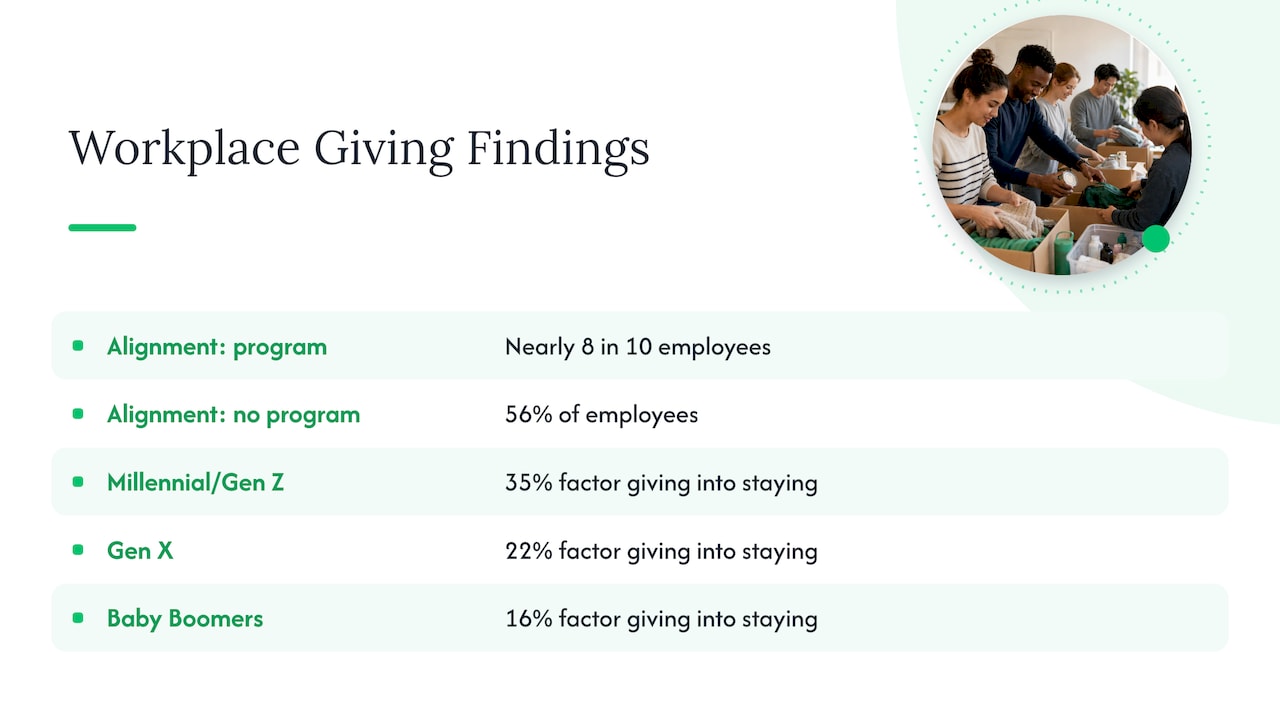
Fidelity Charitable’s Giving in the Workplace research found that nearly 8 in 10 employees at companies with a workplace giving program say their company’s values align with their own, compared with 56% at companies without one. It also found that 35% of Millennial and Gen Z workers say giving programs factor into their decision to stay, compared with 16% of Baby Boomers and 22% of Gen X. The report notes that this sense of connection matters more as remote work becomes the norm.
Giving back and feeling better
A 2013 Forbes piece on a Cause Integration study reported that over three-quarters of employees who volunteered in the prior year felt healthier, and 94% reported improved moods. That study is about volunteering rather than movement, but it points the same way: contributing to something outside yourself shows up in how people feel.
Program design matters
A 2025 academic review by Chen and Fang recommends that hybrid models combining individual and group approaches, with managerial and digital support, work best for workplace physical activity programs. It also suggests that placing these programs inside ESG and CSR frameworks can make workplace health promotion sustainable. That is a useful blueprint: let people move on their own schedule, add a team layer, and give leaders a role.
For readers interested in the mental side, this look at mental wellbeing at work covers how organizations can move from assessing needs to taking concrete action.
How real organizations put it into practice
The examples below come from the organizations’ own reports, so figures are theirs.
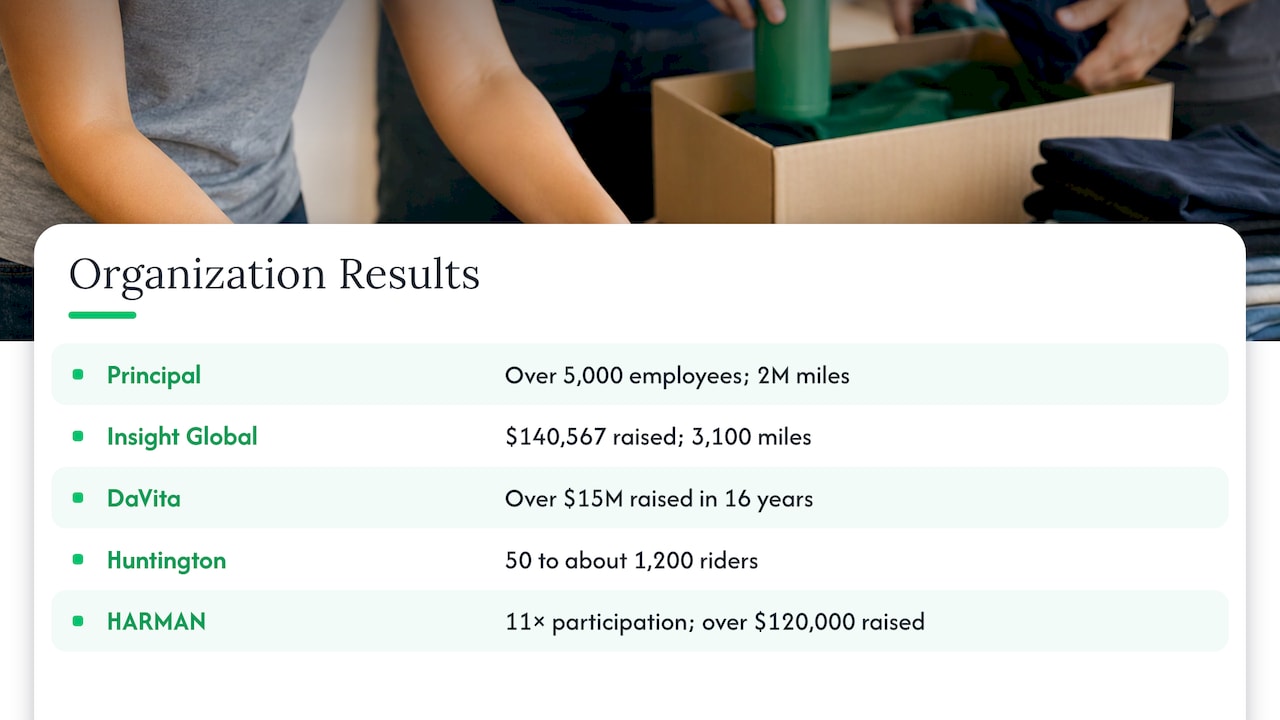
Principal. In 2025 the company ran a company-wide Charity Miles challenge. According to Principal’s own account, over 5,000 employees logged 2 million miles, double the 1 million-mile goal, which aimed to raise $1 million for the V Foundation.
Insight Global. Its 2024 Field Day raised $140,567 for OneWorld Health. Nearly 400 employees each completed 2.6 miles, the average distance a patient travels to reach a OneWorld Health clinic, for 3,100 total miles. Tying the distance to the mission made the activity mean something.
DaVita. Its Move It With Purpose program has raised over $15 million in 16 years with Bridge of Life. Participants can unlock a $250,000 donation by tracking movement in the event app, or take part through direct donations, fundraising or regional events.
Huntington Bancshares. Its Pelotonia cycling team grew from 50 riders in 2010 to about 1,200, and the CEO estimated that about 1,100 got into cycling because of the program. Walking challenges with pedometers were part of the broader wellness program.
HARMAN. Since launching its Charity Miles team in 2021, HARMAN saw an 11x increase in employee participation, with 1,200+ employees generating over $120,000 for charity. We unpack the pilot in our HARMAN playbook for HR.
Beyond the corporate world
Charities use the same idea to reach grassroots supporters. First Descents’ Out Living It Project lets supporters host their own events, and the organization’s 2026 media deck says over 20% of its funding comes from people hosting events. Hansei Solutions runs a Miles for Mental Health challenge each May on the Charity Miles app, where participants’ miles add up to a collective goal and trigger a donation to the Change Your Brain Foundation.
Perspective
Wellness programs usually fail for a simple reason: they ask people to care about a metric. A step count does not mean much to most people on a Tuesday afternoon. A mile that supports a cause they chose does.
That is why we built Charity Miles around any movement, not only athletic movement. A lunchtime walk counts. So does a bike commute. Nobody has to be a runner to belong, and that is what keeps participation broad instead of limited to the usual fitness enthusiasts.
We also believe the company should control its own terms. In our Employee Empowerment Program, companies create private teams, run friendly challenges, and can choose the rate per mile, the total sponsorship cap, and whether donations go to each employee’s chosen charity or a company-selected cause. Wellness, philanthropy and team building live in one platform, so HR, CSR and people teams are not running three separate programs.
Our view: cause-based wellness works best when it is woven into everyday routines and company culture, not staged as a one-off event.
Gene
How to build a cause-based wellness program
Here is a practical sequence we recommend. It follows the hybrid pattern the research favors: individual freedom plus team support.
- Pick a cause with a clear link to your people. Insight Global tied each person’s distance to a patient’s journey. A direct link beats a generic one. Let employees pick their own charity where possible, or choose a company cause when you want one shared goal.
- Set a goal people can see. A collective target, like Principal’s million-mile goal, gives every individual mile a place to go.
- Make every kind of movement count. Walking, wheelchair rolling, running and cycling should all register. Inclusive rules are what turn a pilot into a habit.
- Create teams. Private teams let colleagues compete in a friendly way across departments, offices and remote setups. Our guide to corporate step challenges walks through the setup, and our piece on four-week fitness challenges shows how to pace one.
- Decide the sponsorship terms up front. Rate per mile, total cap and donation destination should be settled before launch, so there is no ambiguity about what a mile is worth.
- Report back. Share miles, totals and what the money did. People stay engaged when they see the result.
- Run it repeatedly. A single event creates a spike. Recurring challenges, such as an annual month-long push, build routine. For more formats, see our overview of fitness challenge ideas and corporate wellness ideas.
A simple rate-and-cap example
Suppose your team wants to understand the budget before committing. The math is easy to model. Take a sponsorship rate per mile, multiply it by your expected participants and their average monthly miles, and compare it to the cap you set. The cap is what keeps the budget predictable, however enthusiastic the team turns out to be. Choose figures that fit your own budget; the Employee Empowerment Program lets you set both.
Making it inclusive, transparent and credible
A cause-based program asks employees to trust you with their effort. A few design choices protect that trust.
Inclusive. Not everyone can run, and not everyone should be compared against a marathoner. Count any movement, offer team-level goals as well as individual leaderboards, and let people take part without sharing health data they would rather keep private. Recognize participation, not just top distance. Keep the challenge optional, and never tie it to performance reviews.
Transparent. Say plainly what each mile is worth, who pays, what the cap is, and which charity receives the money. If a cap is reached before the challenge ends, say so ahead of time and explain what happens next. Publish the final total.
Credible. Choose causes your leadership truly supports, and make the connection to your CSR strategy explicit. The Chen and Fang review suggests integrating these programs within ESG and CSR frameworks to make them sustainable, which also helps a program survive a change in leadership or budget. Our pages on CSR initiatives for employers and CSR activities for teams go further on alignment.
Safe. If walking is the activity, think about where people walk. Our case on workplace walking safety covers practical steps for CSR leaders.
Measuring whether it works
Pick three or four measures before launch and keep them the same each time you run the program:
- Participation rate: the share of eligible employees who log at least one mile.
- Repeat activity: how many are still logging in week four compared with week one.
- Impact: total miles and dollars donated, reported against the goal.
- Sentiment: a short pulse survey on connection to colleagues and to the company.
Be realistic about what you attribute. The Move-A-Thon pilot was small and its authors asked for more research, so treat your own results as your own data, and compare year to year. Our ROI guide to corporate wellness benefits can help you frame the numbers for leadership.
Start a cause-based program with Charity Miles
Charity Miles is a free iOS and Android app that tracks walking, running and biking by GPS and pedometer, and money is donated to a charity of the member’s choice for every mile. It is free for members and free for charities. For companies, our Employee Empowerment Program adds private teams, friendly intra-company challenges and optional sponsorship on your terms, including reporting for enterprise clients.
If you want to see how the app works for individuals first, start with how Charity Miles works. If you are a brand looking to activate a community, explore our corporate sponsorship opportunities, or visit charitymiles.org to get started.
FAQ
Is cause-based wellness the same as root-cause wellness?
No. Root-cause wellness is a clinical approach that looks at the factors behind a person’s symptoms, such as sleep, stress, nutrition and lab results, and it is delivered by clinicians. Cause-based wellness is a program design that links healthy activity to a charitable cause. If you have a health concern, talk to your doctor.
What counts as a cause-based wellness activity?
Any activity that supports health and also benefits a cause. Walking, running and biking with donations per mile are the most common, and the model also covers volunteering days, relay events and team fitness challenges. In our program, any movement counts, not only athletic activity.
Does a cause-based program need a big budget?
Not necessarily. Companies using Charity Miles choose their own rate per mile and a total sponsorship cap, so spending stays within a limit you set. The app itself is free for members. Contact us about Employee Empowerment Program details for your company size.
How do we keep participation going after the first event?
Run challenges on a recurring schedule, keep teams active between events, and report results back to employees. The research on program design favors combining individual and group elements with manager and digital support. Linking each challenge to a cause employees chose also gives them a reason to return.
Sources
- Root Cause Wellness and Longevity Care in Tucson
- What Is Root-Cause Medicine? The Complete Guide
- Step by Step: Eight Dimensions of Wellness, New Jersey Department of Human Services
- Whole Person Health: What It Is and Why It’s Important, NCCIH
- A Move-A-Thon Event: A Workplace Demonstration
- Giving in the Workplace, Fidelity Charitable
- Doing Good Keeps the Doctor Away, Forbes
- Sustainable Workplaces and Employee Well-Being, PMC
- Raising funds one mile at a time, Principal
- Insight Global’s Field Day Raises $140,000 for OneWorld Health
- Move It With Purpose Sponsor Brochure, Bridge of Life
- Huntington CEO Steve Steinour pushes Pelotonia
- An Introduction to First Descents, 2026 media deck
- Miles for Mental Health 2026, Hansei Solutions
- Mental wellbeing at work