

A BYOD (bring your own device) wellness program lets employees track steps or workouts with the phone or wearable they already own, instead of a device the company hands out. The best version also gives each mile a purpose. Charity Miles is built for that: a free app for iOS and Android that tracks walking, running and biking by GPS and pedometer, with our Employee Empowerment program adding private company teams, challenges and optional sponsorship of employees’ miles.
TL;DR
- A BYOD program means participants use a device or app of their choice to track activity, which removes tracker costs and shipping from the budget.
- The Bipartisan Policy Center (BPC) toolkit warns that significant tracker fees can discourage participation, and lists BYOD as an alternative.
- Keep challenges to roughly 4 to 12 weeks, with goals that fit every fitness level.
- Collect only the activity data you need, and check federal and state privacy rules before you launch.
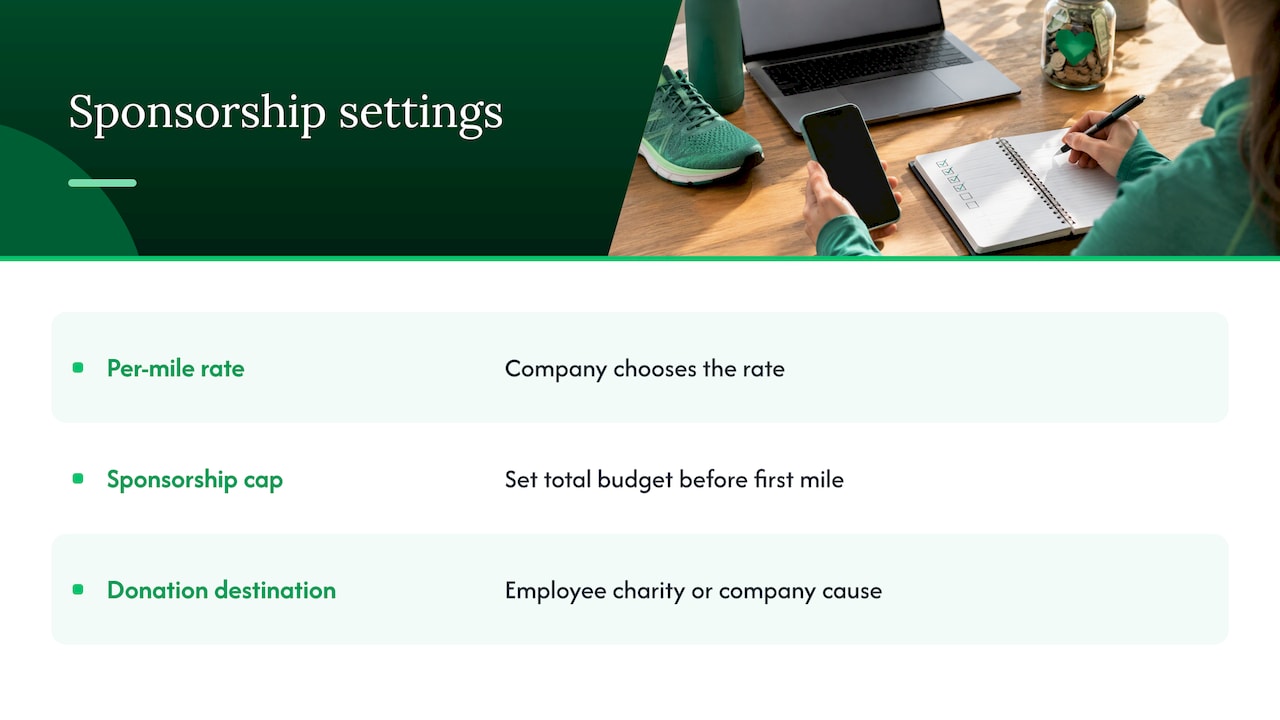
- Charity Miles lets companies set the rate per mile, the sponsorship cap and where donations go.
Table of Contents
- What a BYOD wellness program is
- Why add charity to a BYOD challenge
- How to set up a BYOD wellness program: step by step
- Privacy and legal basics for U.S. employers
- Make participation easy before you add rewards
- Start your team
- FAQ
- Sources
What a BYOD wellness program is
In a BYOD program, employees track activity with a smartphone app or wearable they choose. The BPC’s physical activity challenge toolkit describes this alongside employer-provided or subsidized devices and manual self-reporting with a basic, low-cost pedometer.
The same toolkit advises against significant tracker fees because they can discourage people from joining. BYOD answers that directly: nobody has to buy anything to take part.
There is one practical wrinkle. The toolkit notes that devices count steps differently and use different algorithms to turn cycling or swimming into steps, so differences should be kept in mind when you read results. A distance-based approach avoids much of the confusion. Every employee’s walk, run or bike ride is measured in miles, so a lunchtime stroll and a long commute ride are comparable and easy to explain.
Why add charity to a BYOD challenge
A step count alone gives people little reason to keep going after the first fortnight. A donation attached to each mile gives movement a purpose beyond a leaderboard. Charitable donations also appear as one possible incentive category in the 2025 Employer Well-being Strategy Survey from Business Group on Health, which tracks physical-activity challenges among employer physical-health offerings.
With Charity Miles, members walk, run or bike, and money is donated to the charity of the member’s choice for every mile logged. The app is free for members and free for charities. Because any movement counts, a lunchtime walk is as welcome as a marathon training run, which keeps the program inclusive of all fitness levels.
How to set up a BYOD wellness program: step by step
1. Define the goal and who it is for
Decide what you want to see: more participation, better morale, a stronger CSR story, or all three. Name the audience too. A program built for everyone, not just the already active, needs goals that anyone can hit.
In the BPC’s 2016 study, 36% of surveyed non-enrollees said they already exercised on their own, and 30% said they did not know about the challenge. Both numbers point to the same fix: communicate early, and make the program add something to what people already do. Counting every mile, whatever the activity, does that.
2. Let people use the device they have
Publish a short list of accepted ways to join. With Charity Miles, employees download the app and join their company’s private team. Nothing needs to be purchased or mailed, so launch day is about the message, not logistics.
3. Choose the challenge format
The BPC toolkit recommends challenges of 4 to 12 weeks with achievable goals, personal-improvement or team goals, interim milestones and broad participation. In the 2016 study, employees valued teamwork, competition, goal-setting and reaching goals. Some said logging took too much effort or that the challenge ran too long, and some preferred shorter, more frequent challenges.
A practical reading of that evidence:
- Run a 4 to 6 week challenge, then repeat it with a new theme.
- Offer both a team goal and a personal goal.
- Post milestones along the way so progress is visible.
- Make logging automatic. GPS and pedometer tracking in the app means employees do not type in their numbers.
For more formats, see our guide to fitness challenge ideas for workplace wellness and our piece on wellness challenges that give back.
4. Decide how the company gives
This is where Charity Miles takes work off your plate. Companies can optionally sponsor employees’ miles on their own terms: they choose the rate per mile, the total sponsorship cap, and whether donations go to each employee’s chosen charity or to a company-selected cause. Setting a cap means the budget is known before the first mile is logged.
HARMAN is one example. Since launching its Charity Miles team in 2021, it saw an 11x increase in employee participation, with 1,200+ employees generating over $120,000 for charity.
5. Launch with private teams and friendly competition
Companies create private teams for their employees and run intra-company challenges. Departments, offices or mixed groups can compete, which taps the teamwork and competition employees said they valued. Because it is woven into company culture rather than a one-off event, it can run season after season.
6. Measure and adjust
Count participation, but do not stop there. A 2025 SJSU evaluation project recommends looking at participation, employee satisfaction, organizational support, health behavior, productivity and value on investment, with baseline data and participant feedback gathered over time. A 2020 peer-reviewed study of wellness champions found that teams with stronger implementation had higher reported satisfaction and more physical-activity minutes.
In practice: survey employees before launch, check in at the midpoint, and compare afterward. Charity Miles offers reporting for enterprise clients, so participation and miles are available to share with leadership. If you also want to pick your engagement metrics carefully, a clear set of email and communication tools for nonprofits can help you plan how to reach charity partners and participants.
Privacy and legal basics for U.S. employers
BYOD does not remove the need to think about data. This is general information, not legal advice. Talk with your employment counsel or benefits adviser before launch, especially if the program touches health plans.
- Which laws apply depends on structure. SHRM’s 2025 compliance overview notes that ERISA may apply to programs providing medical care, HIPAA requirements may apply when incentives depend on health status, and ADA requirements may apply when a program asks disability-related questions or involves medical exams.
- HIPAA is not automatic. HHS explains that HIPAA covers health plans and their business associates, not employers acting solely as employers. Information in a wellness program offered through a group health plan is protected; a program run directly by the employer outside the plan is not covered by HIPAA’s rules, though other federal or state laws may apply.
- Wearables draw attention. The EEOC issued a wearable-device fact sheet in December 2024. Groom Law Group’s summary says collecting health-condition data through wearables may count as an ADA medical examination or disability-related inquiry, and that medical information must stay confidential. It also notes the fact sheet is nonbinding guidance and suggests reviewing what data is collected, its accuracy, storage, cybersecurity and vendor terms.
- State law matters. Akerman’s 2025 analysis says wearable biometric data may trigger state privacy rules, and that Illinois BIPA calls for written notice, informed consent and retention and destruction policies for covered collection.
A simple guardrail from SHRM: restrict access to any medical data to administrators, keep it out of personnel records, and explain access limits to participants. A distance-and-miles program that asks for no medical information keeps the data footprint small, which is one more reason to centre the challenge on movement rather than health metrics.
Make participation easy before you add rewards
People join what is simple. Free for members, no hardware, any activity counts: those three points remove most barriers before incentives even enter the picture. Our article on workplace wellness program participation goes deeper on access before rewards, and our corporate wellness program overview shows where a challenge fits in a wider plan.
Our perspective
We built Charity Miles on a simple idea: movement means more when it helps someone else. A BYOD program works best when the barrier to entry is zero, and the app is free for every employee. Employees already carry a phone; what they often lack is a reason to use it for a walk at lunch.
That is why we count all movement, not just athletic activity. A colleague who walks twice a week and a colleague training for a half marathon can sit on the same team and both move the total forward. Companies keep full control of sponsorship terms: the rate per mile, the cap, and where the money goes.
The result we point to is HARMAN, where participation grew 11x and 1,200+ employees generated over $120,000 for charity. Wellness, giving and team building can live in one program, and employees feel good about themselves and their company with every mile.
Gene
Start your team
If you want a BYOD challenge that employees can join in minutes and that supports the causes they care about, our Employee Empowerment program gives your company private teams, intra-company challenges and optional sponsorship on your terms. Individuals can also download the free app and start logging miles for charity today.
FAQ
Does a BYOD wellness program cost employees anything?
No. Employees use a phone or wearable they already own, and the Charity Miles app is free for members. The BPC toolkit specifically cautions that significant tracker fees can discourage participation.
Do different phones and trackers produce comparable results?
Not always for steps. The BPC toolkit notes that devices count steps differently and convert cycling or swimming into steps with different algorithms. Charity Miles tracks distance in miles for walking, running and biking, which gives everyone the same unit.
How long should a BYOD challenge run?
The BPC toolkit suggests 4 to 12 weeks. Participants in its 2016 study sometimes found challenges too long, and some preferred shorter, more frequent ones, so many teams start with four to six weeks and repeat.
Can the company decide where donations go?
Yes. With the Employee Empowerment program, a company chooses the rate per mile, the total sponsorship cap, and whether donations go to each employee’s chosen charity or to a company-selected cause.
Sources
- BPC CEO Council Physical Activity Challenge Toolkit (2015)
- Results From the Bipartisan Policy Center’s CEO Council Physical Activity Challenge (2016)
- 2025 Employer Well-being Strategy Survey, Business Group on Health
- HHS: HIPAA Privacy and Security and Workplace Wellness Programs
- SHRM: Workplace Wellness Programs, Health Care and Privacy Compliance
- Groom Law Group: Wellness Programs Under Scrutiny in EEOC’s New Wearable Fact Sheet
- Akerman: Fitbits at Work, Legal Risks of Wearables in Corporate Wellness Programs
- Examining the Impact of Wellness Champions (American Journal of Health Promotion)
- SJSU project on evaluating an employee wellness program