

The best bike to work challenges do three things: they make the first ride easy, they give people a reason to keep riding, and they connect every mile to something bigger than a leaderboard. If you run HR, CSR or wellness at a company, the simplest way to get there is a private team challenge where every commute mile can also become a donation. That is what our Employee Empowerment program is built for. Below are the formats, check-ins, prizes and giving mechanics that work, whether you are an employer, a charity or a rider organizing your own challenge.
TL;DR
- Start with low-barrier goals, such as a set number of car-replacement rides, so new riders can finish and feel proud.
- Add a morning energizer station, theme days or ride-matching so the challenge feels like an event and not a chore.
- Tie miles to giving: a donation per mile, a donation when a team hits a ride count, or personal pledges from friends.
- Count every kind of movement and every kind of commute, so no one is left out.
- Celebrate at the end with awards and share results with leadership.
Table of Contents
- Start with goals people can actually hit
- Make the commute feel like an event
- Count every rider, not just the athletes
- Prizes, points and progress that keep people going
- Turn commute miles into giving
- Perspective
- Run it with Charity Miles
- A simple four-week plan
- FAQ
- Sources
Start with goals people can actually hit
Most people who skip a bike challenge do so because the bar looks high. Public challenges set a good example here. Trek’s Ride Club app runs a Bike to Work Week challenge that is completed by doing three car-replacement rides in the week, and its Earth Day challenge counts a bike commute of at least one mile. Great Cycle Challenge USA lets riders pick a September target of 25, 250 or 1,000 miles with no minimum.
Borrow that structure. Offer tiers (for example, one ride, three rides, every workday) and let each person choose. Washington Bikes’ toolkit also suggests setting goals for teams, for new riders and for number of trips, which gives beginners and veterans each a target of their own.
Make the commute feel like an event
Energizer stations and pit stops
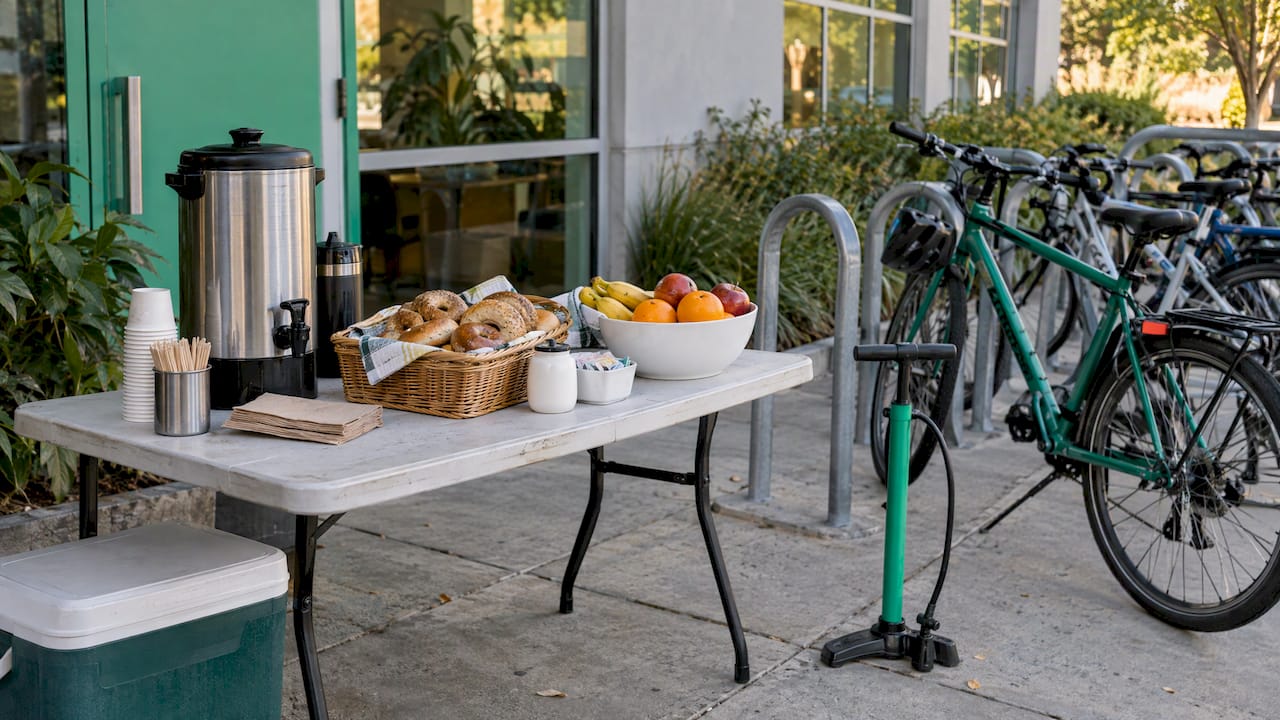
The Colorado Department of Transportation recommends a morning energizer station with coffee, bagels and fruit, which can grow to include swag, tire pumps and a repair stand. Chicago’s Bike to Work Challenge uses sponsor-hosted pit stops with water bottles, swag and free bike repair checks, and its 2025 sponsorship deck reports nearly 750 participating organizations.
At a single workplace, a table by the bike rack with coffee and a pump is enough.
Theme days and kickoffs
Washington Bikes’ toolkit lists a kickoff breakfast, an end-of-month awards ceremony, a bike-commuting roundtable lunch and theme days such as business suits, tutus and super heroes. Pick two or three. Too many themes turn a challenge into a calendar nobody follows.
Convoys, buddies and department contests
Colorado DOT suggests commuter convoys, department-versus-department contests with a prize pot and “I biked to work today” stickers. Washington Bikes adds ride-matching, pairing new commuters with experienced riders. PeopleForBikes describes buddy programs for new riders among its no-cost ideas. A buddy who knows the safest route removes the biggest unknown for a first-timer.
Count every rider, not just the athletes
A challenge that only rewards long, fast commutes shrinks every week. Better models count any trip. Greater Houston’s Biketober is open to all experience and fitness levels and lets any ride anywhere count, while workplaces compete in size categories so a 50-person office is not up against a campus of thousands. Get There Southwest Washington counts commuting or errands, on conventional or e-bikes.
Some employees live too far away, have no safe route or cannot bike on a given day. Let them log walking or running miles toward the team total. The EPA’s bike-day guide notes that commute events also help new riders learn a satisfactory route alongside experienced cyclists, and they highlight barriers such as high-speed roads and missing secure parking. If you collect that feedback, you learn what to fix.
If you are welcoming nervous riders, guidance on cycling accident compensation shows what riders worry about, and it is a reminder to pair your challenge with route tips, helmets and lights.
Prizes, points and progress that keep people going
How you score decides whether people stay. The National Bike Challenge gives 20 points for each day you bike at least a mile, plus one point per mile. That rewards showing up often more than riding far, which suits commuters.
Biketober’s prizes show how many kinds of reward you can mix: a $3,000 grand-prize getaway, a $250 bike service prize for logging at least one trip, workplace cash prizes for a coffee-and-pastry celebration, and $50, $250 and $500 prizes for recruiting one, five or 10 riders. Get There Southwest Washington enters anyone who logs at least two trips a week into weekly random drawings, so a slow start never disqualifies anyone.
A simple recipe for a company challenge:
- Weekly random drawing for everyone who logs two trips.
- A team prize that goes to the group’s favorite cause.
- A closing celebration with awards, plus a short results report for senior leadership.
Turn commute miles into giving
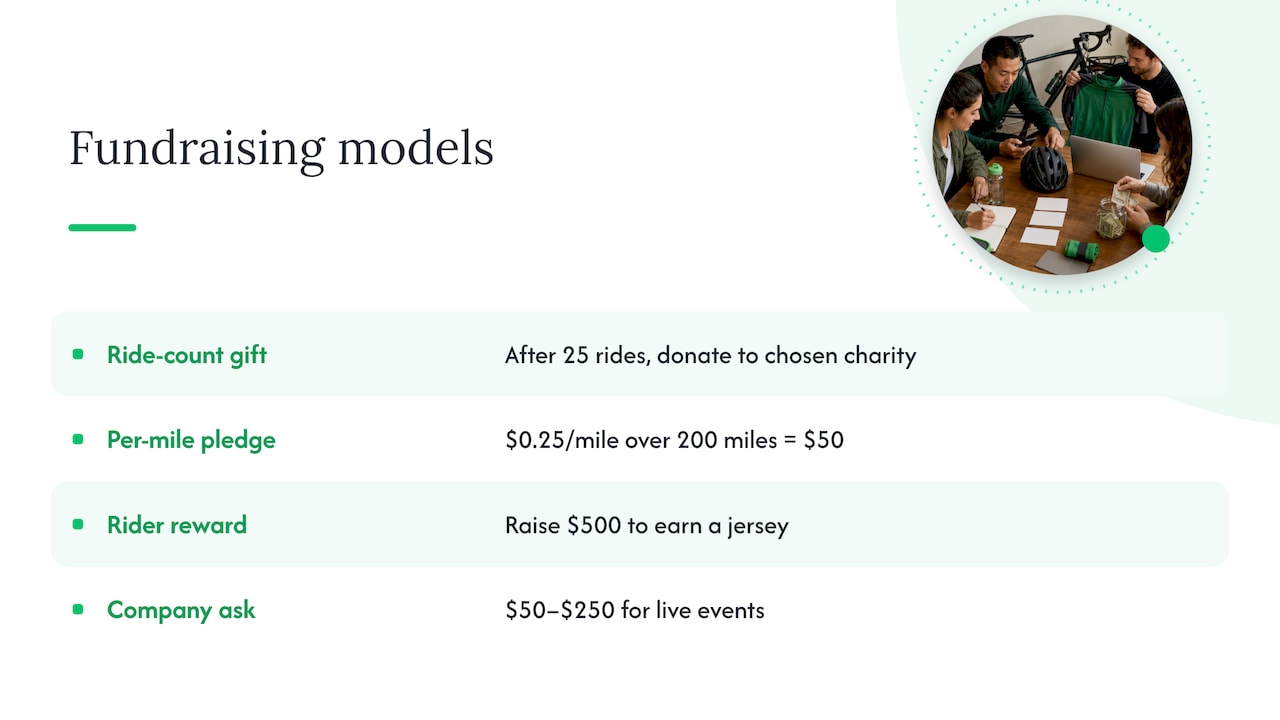
This is where a bike challenge becomes a CSR program. PeopleForBikes suggests that companies move from no-cost recognition to ongoing benefits, including a donation tied to ride counts, such as a pledge that after 25 rides a donation goes to the employee’s designated charity.
Charities have their own playbook. Community Bike Works runs a Mileage Challenge with teams of up to 10, individual and team fundraising goals and per-mile pledges, such as $0.25 a mile over 200 miles for a $50 gift. Non-riders can donate to any team. Great Cycle Challenge USA gives every rider a personal fundraising page, and riders who raise $500 earn a jersey.
The EPA’s guide adds low-tech tactics for live events: asking companies for $50 to $250, a contribution checkoff box on flyers and passing money jars through the crowd.
For fundraising nights that pair well with a challenge finale, a local fundraiser night format is a model charities can adapt for workplace teams.
Perspective
We built Charity Miles on a simple belief: people move more when the movement means something. A leaderboard works for the people already at the top of it. A mile that becomes a donation works for the person who rides once a week, the one who walks to the train and the one who bikes on weekends.
That is why we think a bike to work challenge should never stand alone as a one-week event. When a company chooses the rate per mile, the total cap and whether gifts go to each employee’s charity or a company-selected cause, the challenge becomes part of how the company shows its values. Employees feel good about themselves and their company with every mile.
The results are encouraging. Since launching its team in 2021, HARMAN saw an 11x increase in employee participation, with more than 1,200 employees generating over $120,000 for charity. Gallup research shows companies with engaged employees are 21% more profitable, and we think shared purpose is a big part of why.
Gene
Run it with Charity Miles
Our app is free for members: they walk, run or bike, the app tracks distance by GPS and pedometer, and money goes to the charity they choose for every mile. For companies, the Employee Empowerment program adds private teams, friendly intra-company challenges and optional sponsorship on your terms, with the rate per mile, the cap and the destination of donations in your hands. Because any movement counts, a bike commute, a lunchtime walk and a weekend run all add to the same team total. See our corporate bike challenge playbook for a step-by-step plan, or explore corporate sponsorship opportunities.
A simple four-week plan
| Week | Focus | Example activity |
|---|---|---|
| 1 | Kickoff | Breakfast, team sign-up, buddy matching |
| 2 | Participation | Energizer station, theme day |
| 3 | Momentum | Department contest, weekly drawing |
| 4 | Celebration | Awards, donation total announced, results shared with leadership |
FAQ
How long should a bike to work challenge run?
One week works for a first try, and many public challenges run a full month. Washington Bikes’ challenge starts May 1 and ends with an end-of-month awards ceremony. A month gives people time to build a habit and gives you time to share results.
What if employees cannot bike to work?
Let walking and running miles count toward team totals. Challenges that accept any trip, including errands, keep more people involved and still add up to a bigger result.
How can a challenge support a charity?
Use per-mile pledges, a donation after a set number of rides, or personal fundraising pages. Community Bike Works and Great Cycle Challenge USA both use these approaches.
Do we need a big budget?
No. PeopleForBikes lists no-cost ideas such as recognition in staff meetings, group lunch rides, buddy programs, a short grace period to shower and flex time on good-weather days.
Sources
- Trek Ride Club challenges
- Great Cycle Challenge USA: How the challenge works
- Washington Bikes Workplace Toolkit
- Colorado DOT promotion ideas
- Active Transportation Alliance 2025 sponsorship deck
- PeopleForBikes: Low cost ways to improve bike culture at work
- H-GAC Commute Solutions news
- EPA: How to organize a bike day
- PBS Wisconsin: National Bike Challenge
- Community Bike Works Mileage Challenge