

The best anti-cheating step challenge is not the one with the strictest policing. It is the one designed so that cheating buys almost nothing: results are about the team and a cause rather than one person’s rank, tracking has a margin for honest error, and there is a clear, private way to settle a dispute. Do that and you spend your time cheering people on instead of auditing them.
This guide is for HR and CSR leads, charity organizers and anyone running a walking or running challenge for a workplace, a community or a cause. It covers what counts as cheating, how trackers fail honestly, the tricks organizers should expect, rules that hold up and how to handle a suspected case without humiliating anyone.
TL;DR
- Most odd step totals are tracker error, not cheating. Wrist trackers and phones use different algorithms and can differ noticeably from the true count.
- Shaking a phone, strapping a tracker to a pet or twirling it on a string are the usual tricks. Prevent them with design (caps, team scoring, charity-first goals), not suspicion.
- Leaderboards help sedentary people and can discourage already-active ones, so make rankings one part of the challenge, not the whole thing.
- Publish rules before day one, include an appeals step and keep medical details private.
- Our Employee Empowerment Program lets a company set its own per-mile rate and total sponsorship cap, so you control what any single participant can influence.
Table of Contents
- What counts as cheating, and what is just a bad count
- The tricks organizers should expect
- Why detection alone will not save your challenge
- Design a challenge where cheating pays almost nothing
- Rules to publish before day one
- How to handle a suspected cheat
- What this looks like in a company challenge
- A simple launch checklist
- Our approach to fair play
- Put it into practice
- FAQ
- Sources
What counts as cheating, and what is just a bad count
Start by separating two things that look the same on a spreadsheet: deliberate manipulation and measurement error. Treating the second as the first is how a friendly challenge turns sour.
Trackers are imperfect by design. A peer-reviewed comparison of wearable devices found step-count accuracy ranging from about 99% on the best device to about 80% on the weakest, with some devices deviating more than 15% from observed counts. Wrist-worn devices rely on accelerometers and proprietary algorithms, so they can count arm movements as steps and miss steps when your arms are still, for example when pushing a cart or carrying groceries. Different brands also apply different thresholds, so two colleagues walking together can end the day with different totals.
A useful working definition for your rules:
- Honest variance: differences caused by device type, where the device is worn, slow walking, chores or stationary arms. Nobody is at fault.
- Gray-area choices: pacing around the living room to close a gap before midnight. This is real movement. Decide in advance whether it counts. (We would say yes: it is walking.)
- Manipulation: generating motion that is not walking, running or biking, or faking location data.
Writing those three categories into your rules does more for fairness than any detection tool, because people know where the line is before they get near it.
The tricks organizers should expect
You do not need to teach anyone to cheat, but you should know what an unusual total might point to. Media roundups of step-counter tricks describe trackers worn on an ankle during a bike ride, twirled on a string, attached to a pet’s collar or fixed to vibrating machinery. Software testers have shown the same weakness at the sensor level: in one test, a phone on a bicycle crank arm logged 1,277 steps in 10 minutes, and spoofed GPS can fool apps that depend on location.
Two patterns follow from this:
- Motion without a person walking. Totals that look impossible: hundreds of thousands of steps in a few days, steps logged during a flight or a commute, perfectly even bursts overnight.
- Gaming the rules instead of the sensor. Logging every errand as a workout, splitting one walk across several entries or manually editing entries.
The first needs data review. The second needs clearer rules. Neither needs an accusation to begin with.
Why detection alone will not save your challenge
It is tempting to want software that catches every cheat. The research shows why that is harder than it sounds. In a PLOS ONE study of smartphone activity recognition, 14 volunteers tried to fool a classifier, for example by shaking the phone while seated. A model trained only on normal behavior identified the true activity about 38% of the time. After it was trained on examples of deceptive behavior, accuracy rose to about 84%. In other words, detection can improve, but only by learning from the very tricks people invent, so it is always a step behind.
For an organizer, the practical lesson is to put most of your effort into the structure of the challenge and keep detection as a light safety net.
Design a challenge where cheating pays almost nothing
The strongest anti-cheating measures are reward design choices. Each one lowers the payoff of gaming the system, so fewer people try.
Score the team, not just the individual
When the headline is the top individual, one inflated number takes all the attention. When teams compete on participation or on a shared goal, one outlier barely moves the result, and teammates tend to notice and quietly correct anything absurd. Team averages also stop one very active colleague from deciding the outcome. For more ideas on keeping boards motivating, see our guide to wellness challenge leaderboards that keep employees moving.
Be careful how much you lean on leaderboards
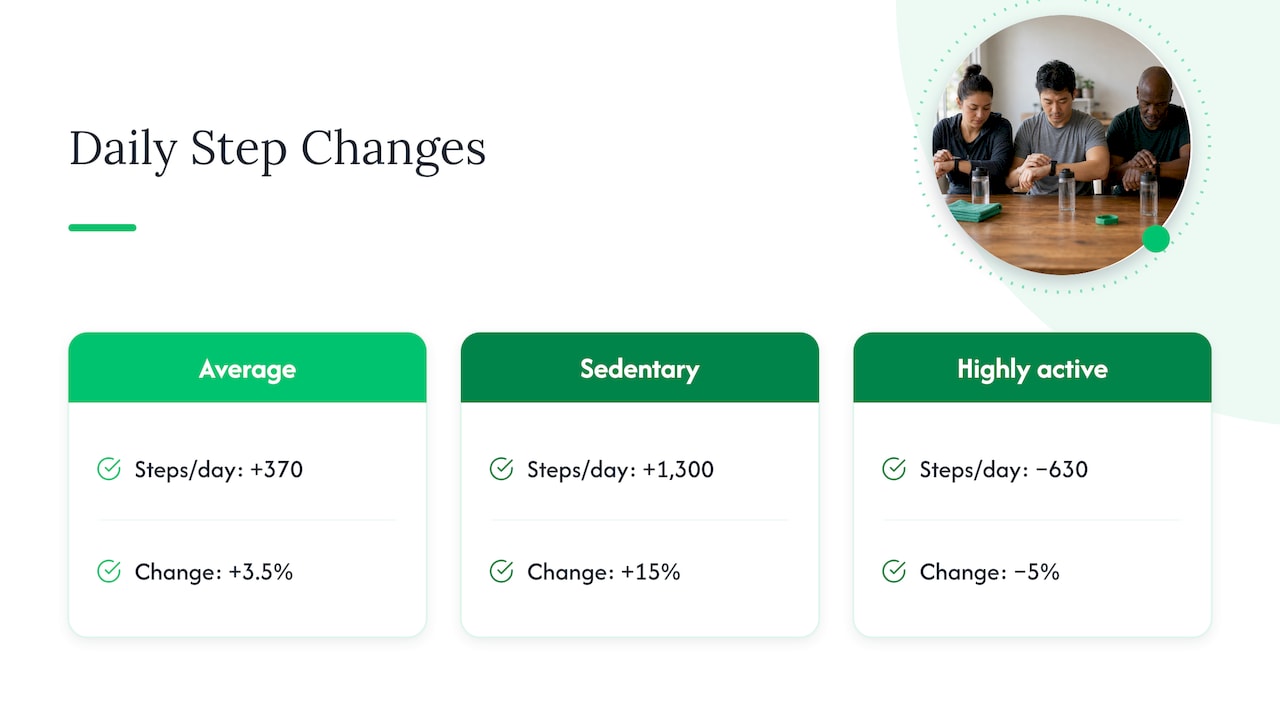
Leaderboards are not neutral. A study of US Fitbit users found that leaderboards raised average daily steps by 370, about 3.5%. The average hid a split: previously sedentary users walked about 1,300 more steps a day (a 15% increase), while previously highly active users walked about 630 fewer (a 5% decrease). The researchers suggest that rising expectations of exercise help people who were inactive and discourage those who were already active unless they rank near the top of a large board.
That is both a fairness point and an anti-cheating point. A board that only the fittest can win invites desperation tactics from people who feel they cannot win honestly. A board that rewards consistency, improvement or team totals gives everyone a reason to stay honest.
Cap what any one person can contribute
A daily cap on counted activity makes an inflated day worth the same as a strong, honest day. A cap also keeps the challenge welcoming: the person walking at lunch every day can keep pace with the marathon runner. Pick the cap by looking at what an ordinary, committed participant would do in a day and setting it somewhat above that.
Tie results to a cause, not a prize
Cheating thrives when the reward is a personal trophy. When the result is money for a charity, the incentive changes: inflating your own count means inflating a donation you did not earn, and most people will not do that in front of colleagues. This is the logic behind a charity step challenge, and it is why we think the purpose belongs at the center of the design. Our complete guide to organizing a step challenge for charity walks through the setup.
If you are funding donations, a total sponsorship cap also limits your exposure. With our program, a company chooses the rate per mile, the total sponsorship cap and whether donations go to each employee’s chosen charity or a company-selected cause. You know the maximum before the challenge starts.
Count more than steps
Steps are the easiest metric to fake because a shaking sensor looks like walking. Counting walking, running and biking distance by GPS and pedometer, and welcoming any movement, widens participation and takes the pressure off one fragile number. It also helps the colleague who uses a wheelchair, cycles to work or cannot wear a wrist tracker. For formats that move away from step counts altogether, see wellness challenges without steps.
Rules to publish before day one
Fair rules are short, specific and shared in advance. Here is a set you can adapt.
| Rule | What to write | Why it helps |
|---|---|---|
| What counts | Walking, running and biking you did yourself, tracked by the challenge app or device | Removes arguments about vehicles, machinery and pets |
| One device, one person | Each participant uses one tracker or app for the whole challenge | Prevents mixing devices with different algorithms |
| Daily cap | A maximum of counted activity per day | Makes inflation pointless |
| Manual entries | Not allowed, or limited and marked as manual | Closes the easiest loophole |
| Review trigger | Totals far outside the group’s range are checked by the organizer | Sets expectations without accusing anyone |
| Appeals | A named person hears disputes within a set time | Keeps trust when a count is wrong |
| Alternatives | Any participant can ask for a different way to take part | Keeps the challenge inclusive |
Two additions are worth making. First, ask everyone to confirm they have read the rules when they join. A one-click agreement beats a policy buried in an email. Second, name the spirit in one sentence, such as “count the movement you did on your own, and let the team’s total be honest.” Most people respond to that kind of norm.
How to handle a suspected cheat
A fair process protects the participant and the challenge.
- Check for honest explanations first. A new device, a bike ride logged with an ankle tracker, a phone left on a gym machine or a sync error that dumped several days at once can all produce a spike.
- Talk privately. Ask the participant to walk you through the day. Do not post anything on a shared channel.
- Apply the published rule. If the count broke the rules, adjust the total to what can be supported and let the person stay in the challenge. Reserve removal for repeated, deliberate manipulation.
- Offer an appeal. Guidance for employer wellness programs recommends a well-defined appeals and dispute process, and for larger programs suggests considering independent review of appeals.
- Record the outcome in aggregate only. Report results to leadership as team totals, not as individual health or performance data.
Keep it private and inclusive
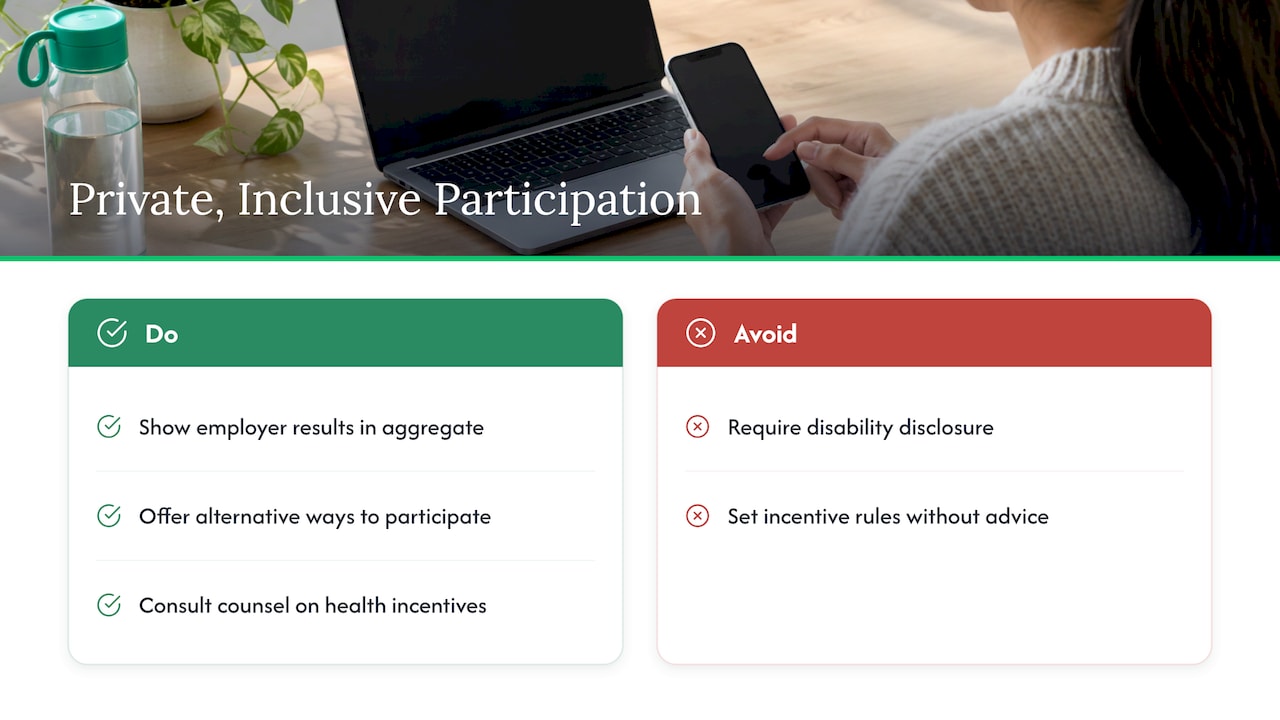
If your challenge touches health information, the same guidance notes that individually identifiable medical information is protected health information under HIPAA (the US federal health privacy law), and that employers should see results in aggregate form. It also says an employer may ask for verification, such as a physician’s note, when someone needs an alternative way to take part, but the process must comply with HIPAA and state rules, and employees cannot be required to disclose a disability protected by the Americans with Disabilities Act. If you run a program with incentives tied to health outcomes, talk to your employment counsel or benefits adviser before you set the rules.
The simplest safe approach is a participation-based challenge where anyone can join through whatever movement suits them, and no one has to explain why.
What this looks like in a company challenge
A workplace example shows the design at work. HARMAN launched its Charity Miles team in 2021 and saw an 11x increase in employee participation, with more than 1,200 employees generating over $120,000 for charity. Those results came from a challenge where the point was the shared contribution, not a podium. You can read more in our piece on workplace walking safety and the $120,000 raised.
When participation is that broad, rankings matter less and teamwork matters more. For a deeper look at running a challenge on the company side, see our corporate step challenge guide.
A simple launch checklist
Before you open registration, confirm these items:
- The three-part definition (honest variance, gray area, manipulation) is in your rules.
- Teams, not only individuals, appear on the board.
- A daily cap is set and explained.
- Everyone uses one tracking method for the whole challenge.
- An appeals contact is named and has agreed to respond promptly.
- An alternative way to participate is offered to anyone who needs it.
- Results shared with leadership are aggregated.
- If you are sponsoring miles, the rate and total cap are fixed in writing.
Then check in at the one-week mark. Look at the spread of totals, read any questions from participants and adjust the rules only if a real problem shows up, announcing the change to everyone.
Our approach to fair play
Cheating is usually a sign that a challenge is asking people to prove something about themselves. We would rather ask them to contribute something.
That is why Charity Miles is built around the mile, not the ranking. Members walk, run or bike, the app tracks distance by GPS and pedometer, and money goes to a charity they choose. Any movement counts, so a lunchtime walk matters as much as a long run. When the outcome is a donation, there is little to gain from inflating a number and a lot to gain from showing up.
For companies, we give you the controls that keep a program fair and predictable: private teams for your employees, friendly challenges inside the company, and sponsorship terms you set yourself, including the rate per mile, the total cap and where the donations go. Our program is designed to make participation easy and inclusive, so the whole team feels part of it.
Gene
Put it into practice
If you want a challenge your employees will trust, start with a program built around shared giving. With the Charity Miles Employee Empowerment Program, you create private teams for your people, run friendly challenges inside your company and choose how you sponsor their miles. It is a step challenge with a purpose, and it is designed to be easy for every fitness level.
Individuals can join free by downloading the app, and companies that want to sponsor can explore our corporate sponsorship options. Charities can also use the platform to engage grassroots supporters through Grow Your Movement.
FAQ
Is walking around my living room to hit a goal cheating?
No. It is real walking. The point of most challenges is movement, and indoor steps count as movement. If your organizer prefers to exclude something, such as logging steps from non-walking activity, it should say so in the rules before the challenge starts.
How do I know if a step total is suspicious?
Compare it with the rest of the group and with the person’s own history. A sudden jump, a total far above everyone else or steps recorded at times the person could not be walking deserve a private conversation. Remember that devices can differ by 15% or more from true counts, so a modest gap is rarely a sign of cheating.
Should we ban manual entries?
For most workplace and charity challenges, yes, or limit them and label them clearly. Manual entries are the easiest way to inflate a total and the hardest to verify. If you allow them, set a cap so one entry cannot swing the result.
How do we keep a challenge fair for people who are less active or use different devices?
Score teams, reward consistency or improvement as well as totals, and let people join with whatever movement suits them. Research on leaderboards shows that rankings motivate sedentary users more than highly active ones, so a mix of goals keeps both groups engaged.
What should we do when someone disputes their total?
Have a named person review it privately within a set time, apply the published rules and explain the outcome in writing. If health information is involved, keep it confidential and report results to leadership only in aggregate.
Sources
- Are currently available wearable devices for activity tracking and heart rate monitoring accurate, precise, and medically beneficial? (PMC)
- Why it’s easy to fool your activity tracker
- Evil Week: the easiest ways to cheat at a step-counting challenge
- Fitness app testing: beating step counter algorithms
- Making activity recognition robust against deceptive behavior (PLOS ONE)
- Health wearables, gamification, and healthful activity (PMC)
- Guidance for a reasonably designed, employer-sponsored wellness program (JOEM)