
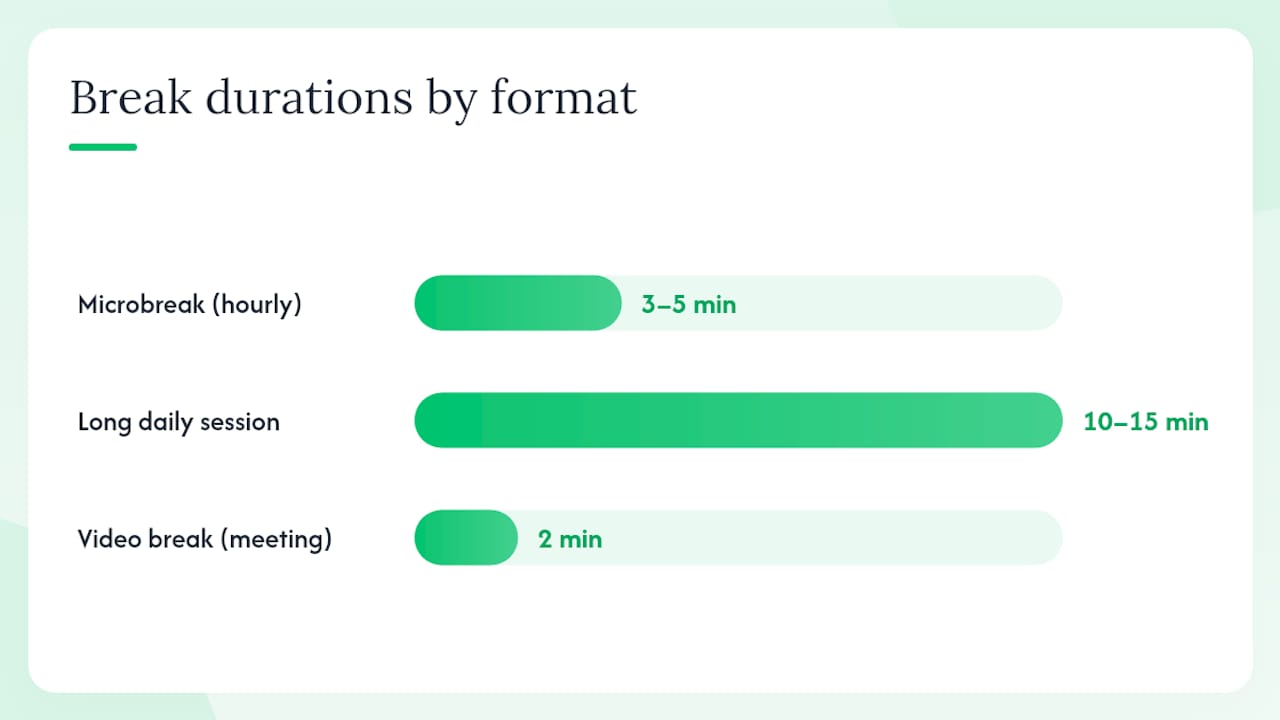
Active breaks at work reduce fatigue, improve energy, and in some trials lower fasting glucose and blood pressure. The evidence points to a clear starting cadence: a 3 to 5 minute movement break every 30 to 60 minutes, alongside a longer 10 to 15 minute break at least once a day. Schedule the first one this week, at the top of an hour, and build from there.
TL;DR:
- Microbreaks of 3 to 5 minutes every 30 to 60 minutes can significantly reduce fatigue and boost energy levels during the workday.
- A 12-week trial showed that hourly 3-minute micro-exercise breaks lowered fasting glucose, systolic blood pressure, and waist circumference.
- Longer, structured 10 to 15-minute breaks after cognitively demanding tasks have clearer benefits for performance and musculoskeletal relief.
- Adherence is crucial; participation rates above 80% are linked to meaningful reductions in discomfort and increased energy.
- Incorporating purpose-driven initiatives like charity-motivated movement can improve ongoing engagement and program sustainability.
Table of Contents
- What Active Breaks at Work Actually Do
- What Does the Research Say About Active Breaks?
- Types of Active Breaks You Can Try Today
- How Do You Design an Active-Break Program for Your Team?
- Sample Schedules and Scripts You Can Copy
- Making Active Breaks Work for Every Employee
- How Charity Miles Turns Movement Into Motivation
- Launch Checklist: What to Do This Week
- What Leadership Gets Wrong About Breaks
- Give Your Active-Break Program a Reason to Stick
- Sources
- FAQ
What Active Breaks at Work Actually Do
Active breaks at work are short, intentional pauses from sitting or repetitive tasks, built around movement instead of scrolling or coffee. Most fall into two buckets: microbreaks (roughly 30 seconds to 10 minutes) and longer structured breaks (10 to 15 minutes), each producing different outcomes depending on what employees do during them.
A 2022 meta-analysis covering 22 study samples and 2,335 participants found that microbreaks lift vigor by a moderate effect size (d = .36) and cut fatigue by a similar margin (d = .35), according to research published in a meta-analysis on microbreak effects. That is a real, measurable shift in how people feel by mid-afternoon, not a placebo effect from stepping away from a screen.
- Vigor increases in the 20 to 40 minutes following a movement break, even a short one.
- Fatigue drops more reliably than performance improves, especially for microbreaks under five minutes.
- Musculoskeletal discomfort eases with regular stretching or standing breaks, particularly in the neck, shoulders, and lower back.
- Metabolic markers can shift with sustained practice: one randomized trial found hourly 3-minute micro-exercise breaks over 12 weeks reduced fasting glucose and systolic blood pressure.
By the numbers: A 12-week trial of hourly 3-minute micro-exercise breaks reduced fasting glucose and systolic blood pressure, alongside a reduction in waist circumference. That is a meaningful cardiometabolic signal from a habit that costs nothing and requires no equipment.
Performance gains are the trickiest part of this picture. Short breaks reliably restore energy, but task performance only improves under certain conditions, longer breaks after cognitively demanding work tend to produce clearer performance benefits than a 90 second stretch during routine tasks. If your goal is well-being and sustained energy, microbreaks deliver consistently. If your goal is a measurable productivity bump on a specific deliverable, you may need a longer break or a shift in when you schedule it.
What Does the Research Say About Active Breaks?
The strongest case for active breaks at work rests on three types of evidence: randomized trials, pooled meta-analyses, and public health guidance built from workplace studies. None of these are marketing claims. They are peer-reviewed findings and a federal resource guide, and together they give HR teams something defensible to bring into a budget conversation.
The randomized trial on hourly micro-exercise breaks is the most concrete data point available. Over 12 weeks, participants who took a 3-minute movement break every hour saw measurable improvements in fasting glucose, systolic blood pressure, and self-reported energy and productivity. The dose was small. The consistency was what mattered, hourly, not sporadic.
The meta-analysis on microbreak effects adds the well-being layer. Pooling 22 samples, it found microbreaks of 10 minutes or less produce a small but statistically significant lift in vigor and reduction in fatigue. Performance effects showed up, but they were conditional. Longer breaks after mentally demanding work produced clearer performance gains than short breaks during routine tasks, a distinction worth building into how you schedule breaks around your team’s actual workload.
Public health guidance rounds out the evidence with implementation detail. The CDC’s workplace physical activity resource guide recommends short activity breaks of 5 to 10 minutes and lays out low-cost categories: active meeting announcements, seated or standing stretches, brief energizers, and walking discussions. It also emphasizes starting conservatively and communicating clearly with employees before rolling anything out broadly.
A narrative review proposing structured 15-minute active-break programs found that regular sessions, combining warm-up, light calisthenics, and breathing work, reduced stress and musculoskeletal complaints across the studies it synthesized. That supports a two-tier model: frequent microbreaks throughout the day, plus one longer structured session.
A few caveats matter for anyone building an internal case:
- Sample sizes in individual trials are often modest (dozens to a few hundred participants), so treat effect sizes as directional, not universal guarantees.
- Adherence drives outcomes. An 8-week video-call intervention found that office workers with at least 80% adherence saw significant reductions in neck and low-back discomfort, according to a study on active breaks and musculoskeletal discomfort, while lower-adherence participants saw smaller effects.
- University of Queensland research suggests pairing microbreak movement with a few seconds of “active strategizing,” a quick goal check or task update, produces higher energy and motivation than movement alone, per research on microbreaks and motivation.
The conservative approach: start with one scheduled break per hour, measure participation and self-reported energy for four weeks, then decide whether to add a longer midday session.
Types of Active Breaks You Can Try Today
Active breaks fall into four practical categories, and none require a gym, special equipment, or a change of clothes. The goal is friction-free movement that fits inside a normal workday.
Desk micro-mobility (2 to 3 minutes). Seated marches, ankle circles, wrist and neck rolls, and shoulder blade squeezes done right at the desk. These work well between video calls when leaving the room isn’t practical.
Standing mobility and bodyweight sequences (5 minutes). Calf raises, standing hip circles, gentle torso twists, and a few wall push-ups. The CDC’s guide lists these among its low-disruption categories suitable for any office layout.
Walking breaks and walking meetings. A short loop around the floor or building, or converting a one-on-one into a walking conversation. For remote teams, this translates into a phone-only meeting where both people walk during the call instead of sitting at a screen.
Breathing and gaze breaks for cognitive recovery. Box breathing (inhale four counts, hold four, exhale four, hold four) for 60 to 90 seconds, or a 40-second gaze at greenery or a window view. Leadership research from IMD’s guide on microbreaks recommends taking these proactively, before fatigue sets in, rather than waiting until focus has already collapsed.
Three ready-to-use routines cover most workday scenarios:
- 3-minute reset: 30 seconds of seated marches, 30 seconds of shoulder rolls, 60 seconds of box breathing, 60 seconds of standing calf raises.
- 5-minute standing sequence: Stand up, do 10 bodyweight squats, 10 wall push-ups, 30 seconds of torso twists, then a 40-second gaze break at a window before sitting back down.
- 15-minute structured session: Five minutes of light walking, five minutes of standing mobility (hips, shoulders, spine), and five minutes of guided breathing or stretching, modeled on the structured programs described in a review of active-break programs.
Pro Tip: Pair the movement with a task, not just a timer. Use the last 30 seconds of a microbreak to jot down your next task or check off a to-do. Research on active strategizing found this combination boosts energy and motivation more than movement alone.
How Do You Design an Active-Break Program for Your Team?
Building an active-break program starts with matching cadence to your actual goal, not copying whatever schedule another company uses. If the priority is reducing afternoon fatigue and burnout risk, hourly 3 to 5 minute microbreaks are the better lever. If the priority is cutting musculoskeletal complaints tied to long stretches of sitting, a longer daily session (10 to 15 minutes) tends to show clearer results in the research.
Set the cadence first. Hourly microbreaks work well for desk-based teams doing routine tasks. Teams doing deep, cognitively demanding work may benefit more from fewer, longer breaks scheduled after intense focus blocks rather than on a rigid hourly clock, consistent with the meta-analysis finding that performance gains depend on break length and task type.
Assign a champion, not a committee. One person per team or floor who sends the reminder, demonstrates the routine on video for remote staff, and tracks who’s showing up. This role rotates well and doesn’t require a fitness background, just consistency. For remote teams, a champion can run a two-minute video break at the start of a recurring meeting instead of a separate calendar event.
Build in safety and accessibility from day one. The guiding principle across CDC guidance and workplace studies is straightforward: start low, go slow. That means:
- Offer seated or standing versions of every movement, never a single mandatory format.
- Include a note that employees with existing injuries, recent surgery, or chronic conditions should check with a healthcare provider before starting a new movement routine.
- Make participation voluntary and camera-optional for remote sessions.
- Avoid high-impact moves (jumping, deep lunges) in a general workplace program; keep the default library low-impact.
Drive adherence with more than a calendar reminder. Adherence is the variable that determines whether any of this evidence translates into your office. The video-call intervention study found that participants with 80% or higher adherence saw significant reductions in neck and low-back discomfort, while lower-adherence groups saw much smaller effects, from research on video-call active breaks. Three levers help:
- Nudges: calendar blocks, Slack reminders, or a chime tied to the hour.
- Gamification: light team challenges tracking who completed the day’s breaks, similar to the formats described in fitness challenge ideas for employees.
- Purpose tie-ins: linking movement to a cause employees care about tends to outperform a plain reminder, a pattern covered later in this guide.
Measure before you scale. Track three things during a pilot: participation rate (percentage of invited employees who join at least three times a week), a two-question well-being pulse (energy and stress, rated 1 to 5), and any qualitative feedback on scheduling friction. Run this for four weeks, review the numbers, adjust the cadence or format, then decide whether to expand. This plan, do, check, adjust loop is more useful than trying to design the perfect program before you have any data. Teams looking for broader tactics to sustain participation beyond the pilot phase can pull from ideas for boosting engagement once the basic cadence is working.
Sample Schedules and Scripts You Can Copy
A pilot succeeds or fails on friction. The fewer decisions employees have to make in the moment, the more likely they are to actually take the break.
Hourly microbreak calendar template: Block 10:00, 11:00, 1:00, 2:00, and 3:00 as recurring 5-minute calendar holds labeled “Movement Break.” Set the calendar event description to one of the three routines above so nobody has to think about what to do.
Meeting break announcement script: “We’re two minutes into this meeting and it’s a good moment for a 90-second stand-and-stretch. Cameras optional, sitting is fine if that’s what works for you.” This framing, borrowed from the CDC’s guidance on active meeting announcements, keeps it low-pressure and inclusive.
Energizer script for a longer session: “Let’s do five minutes: two minutes of walking in place or around your space, two minutes of shoulder and hip mobility, one minute of quiet breathing. Go at your own pace.”
A 4-week pilot plan keeps the rollout simple and measurable:
- Week 1: Announce the program, share the “why” (cite the meta-analysis and CDC guidance), and launch hourly 3-minute breaks with a champion demonstrating each one.
- Week 2: Add one 15-minute structured session on a fixed day, and start tracking participation via a simple sign-in or reaction emoji.
- Week 3: Send the two-question well-being pulse survey and collect informal feedback on timing and format.
- Week 4: Review participation and survey data, adjust cadence or format based on what employees actually used, and decide on next steps.
| Week | Focus | What to Measure |
|---|---|---|
| 1 | Launch hourly microbreaks | Participation sign-ups |
| 2 | Add weekly 15-minute session | Attendance at longer session |
| 3 | Collect feedback | Well-being pulse (energy, stress) |
| 4 | Review and adjust | Completion rate, qualitative notes |
Making Active Breaks Work for Every Employee
An active-break program that only works for able-bodied employees at a desk isn’t finished. Inclusion has to be built into the design, not bolted on after complaints arrive.
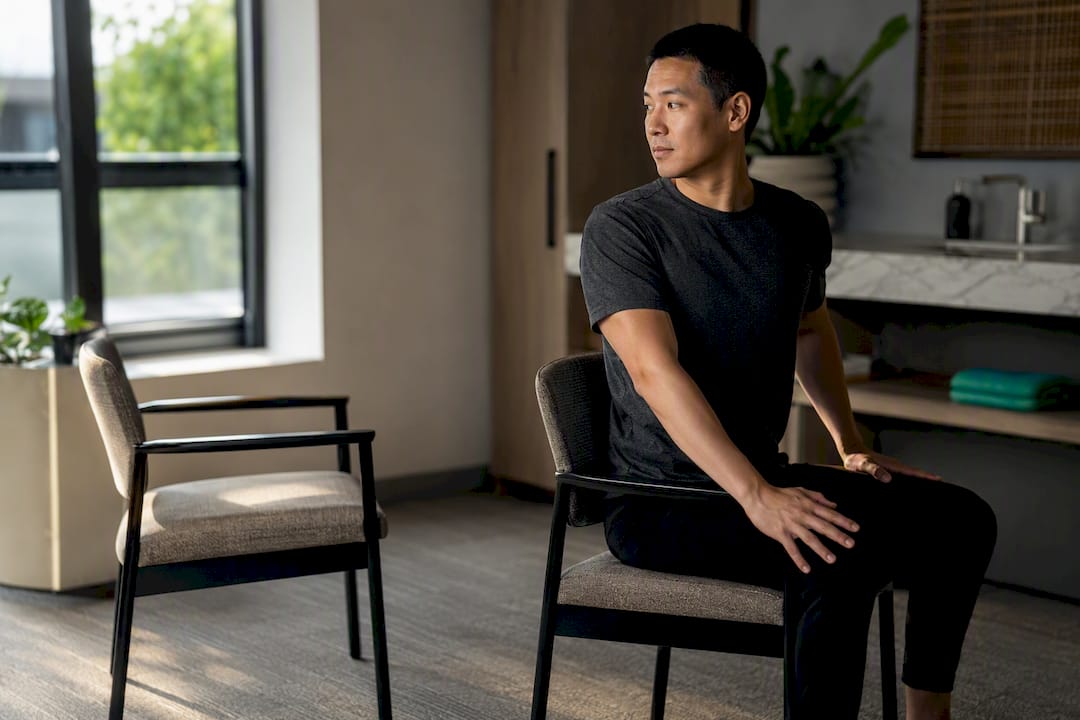
Chair-based options should exist for every single movement in your library. Seated marches, seated torso twists, and seated shoulder rolls deliver similar circulation and mobility benefits to their standing counterparts, and offering both from the start signals that the program is for everyone, not just people who can stand comfortably for five minutes.
Remote employees need a different delivery model, not a scaled-down one. A short video-led break at the start of a recurring meeting works better than expecting remote staff to self-initiate on their own schedule. One study of remote administrative workers found that after a structured active-break routine, sedentary time dropped sharply, from 31% of workers sitting more than 10 hours a day down to 14%, with uptake reaching 64% of participants by the end of the intervention, according to research on active breaks and sedentary behavior. Asynchronous prompts (a Slack message with a 90-second stretch video) work well for teams spread across time zones.
Messaging matters as much as the exercises themselves:
- State clearly that participation is voluntary and cameras are optional.
- Offer an opt-out that doesn’t require an explanation.
- Include a standing note that anyone with a current injury, recent surgery, or a chronic condition should check with a healthcare provider before starting a new routine, and document that guidance in the program’s launch communication.
- Avoid competitive framing that could exclude employees with mobility limitations, frame challenges around consistency and participation, not speed or intensity.
How Charity Miles Turns Movement Into Motivation
Purpose changes adherence. A plain reminder to stretch competes with email and deadlines; a reminder tied to a cause someone cares about tends to win more often, and that is the gap Charity Miles is built to close.
Charity Miles is a free app that converts walking, running, and biking miles into charitable donations, tracked by GPS with money going to a charity the member selects. Companies can use the app to create private team challenges and run internal competitions, optionally sponsoring employee miles on their own terms and deciding how donations are allocated.
- A company launched a Charity Miles team and saw a significant increase in employee participation, with many employees generating donations for charity.
- The model works by combining the intrinsic reward of movement with the extrinsic reward of a donation for a cause the employee supports.
- Movement of any kind counts: a lunchtime walk, a bike commute, a short walking break, all fit naturally alongside the hourly microbreak cadence covered earlier in this guide.
Organizations piloting timed active breaks can layer Charity Miles on top rather than choosing between them: run the 4-week microbreak pilot as scheduled, and invite employees to log those same walking breaks in the app so the movement they’re already doing generates a donation. The corporate step challenge format is a straightforward way to structure that overlap during the pilot’s later weeks.
Launch Checklist: What to Do This Week
Getting an active-break program off the ground doesn’t require a committee or a big budget. It requires five decisions and a champion willing to send the first reminder.
- Decide the objective and cadence: fatigue reduction (hourly microbreaks) or musculoskeletal relief (add a longer daily session).
- Assign a champion for each team or floor, someone who sends reminders and models the routine on video for remote staff.
- Schedule the breaks as recurring calendar holds, not verbal reminders that get forgotten by Wednesday.
- Prepare scripts for meeting announcements and energizer sessions so nobody has to improvise.
- Pick two or three metrics, participation rate, a short well-being pulse, and any early qualitative feedback.
Watch for two early warning signs. Low participation after week one usually means the timing conflicts with real work rhythms, adjust the schedule before assuming the program failed. Any safety complaint, discomfort during a stretch, dizziness while standing, should pause that specific movement immediately and prompt a check of the exercise’s difficulty and instructions.
Pro Tip: Combine the break program with a CSR incentive from week one instead of adding it later. Teams that tie movement to a visible cause, even informally, tend to see stronger week-three participation than teams running a plain reminder-only pilot.
What Leadership Gets Wrong About Breaks
Most leadership advice treats breaks as a productivity tax, something you tolerate because employees need a moment away from the screen. The research doesn’t support that framing. A 3-minute break taken proactively, before fatigue sets in, functions more like preventive maintenance than downtime. The trial data on hourly micro-exercise breaks and the meta-analysis on vigor and fatigue both point the same direction: consistency beats intensity, and small, frequent doses of movement outperform occasional long ones for sustained energy.
The mistake I see most often is treating a break program as a one-time announcement instead of a measured pilot. Four weeks, a simple pulse survey, and an honest look at participation numbers will tell you more than any amount of planning upfront. Start smaller than feels necessary, track what actually happens, and adjust based on real behavior rather than assumptions about what employees want.
[Gene’s professional background or credentials to establish expertise]
— Gene
Give Your Active-Break Program a Reason to Stick
A scheduled reminder gets people moving for a week. A reason they care about keeps them moving for a year. That’s the gap most active-break pilots run into: the routine is sound, but nothing sustains it once the novelty wears off.
Charity Miles closes that gap by turning the same walking breaks, standing stretches, and short movement sessions you’re already piloting into visible charitable impact. Through the Employee Empowerment Program, your company builds a private team, sets the sponsorship terms, and lets employees log the movement they’re doing anyway, converting hourly microbreaks into donations for causes they choose. If you’re already running a break pilot, explore the corporate wellness program page to see how to layer a CSR incentive on top before your four-week pilot ends.
Sources
- Randomized trial: hourly micro-exercise breaks — PubMed record
- Meta-analysis on microbreak effects — PMC (2022)
- Physical Activity Breaks for the Workplace, Resource Guide — CDC (2024)
FAQ
What Are Active Breaks?
Active breaks are short, scheduled pauses from sitting or repetitive work that involve movement, ranging from a 30-second stretch to a 15-minute structured session, aimed at restoring energy and reducing fatigue.
What Are Common Types of Breaks at Work?
Common types include desk micro-mobility (seated stretches), standing mobility sequences, walking breaks or walking meetings, and breathing or gaze breaks for cognitive recovery.
What Does “Poor Working Conditions” Mean in the Context of Breaks?
Poor working conditions in this context generally refers to prolonged sitting without movement opportunities, lack of scheduled rest, or environments that discourage stepping away from a desk, all of which contribute to fatigue and musculoskeletal discomfort.
How Long Should an Active Break Last?
Microbreaks of 3 to 10 minutes taken hourly show measurable benefits for energy and fatigue, while a longer 10 to 15 minute session once a day supports musculoskeletal relief and stress reduction.
Can Active Breaks Improve Productivity, Not Just Well-Being?
Active breaks reliably reduce fatigue and boost vigor; performance gains are smaller and depend on break length and task type, with longer breaks after demanding tasks showing clearer productivity effects than short breaks during routine work.
How Can Employers Increase Participation in Active-Break Programs?
Pairing movement with a purpose employees care about, such as tying steps to charitable donations through a program like Charity Miles, tends to drive stronger participation than reminders alone.