

The best CSR participation ideas share one trait: they are easy to join. A program that asks for personal leave, a rigid schedule or a trip across town draws a small crowd, however good the cause. Movement challenges, flexible volunteering and simple giving options draw far more. For a company that wants broad participation, a walking, running and biking challenge tied to charitable giving is one of the lowest-effort ways to get everyone involved. That is what the Charity Miles Employee Empowerment Program is built for: private company teams, friendly challenges and miles that turn into donations.
Below are the formats that work, the participation data behind them, and a way to pick and launch the right mix.
TL;DR
- Participation follows convenience. Flexible-scheduling volunteer opportunities had the highest participation rate, 43%, in CECP’s 2024 data.
- Mix formats: days of service, skills-based volunteering, virtual options, matching gifts and movement challenges, so every employee has a way in.
- Any-fitness-level activity challenges let people give through a lunchtime walk, a bike commute or a run.
- Start with one or two focused initiatives, ask employees which causes matter, and track participation from day one.
Table of Contents
- Why participation, not just programs, is the real CSR question
- Volunteering ideas that fit real schedules
- Giving ideas: matching, grants and fundraisers
- Movement challenges: the inclusive way to participate
- How to choose ideas your people will join
- A quick comparison of formats
- Measure participation from the start
- Our perspective
- Launch a movement-based CSR challenge
- FAQ
- Sources
Why participation, not just programs, is the real CSR question
Most companies have a CSR statement. Fewer have employees who take part. CECP’s Giving in Numbers report found that in 2024 the average employee volunteer participation rate was 25%. Companies with under 10,000 employees reached 31%, while those with over 100,000 reached 16%. Size makes participation harder, which is why the design of the program matters more than its budget.
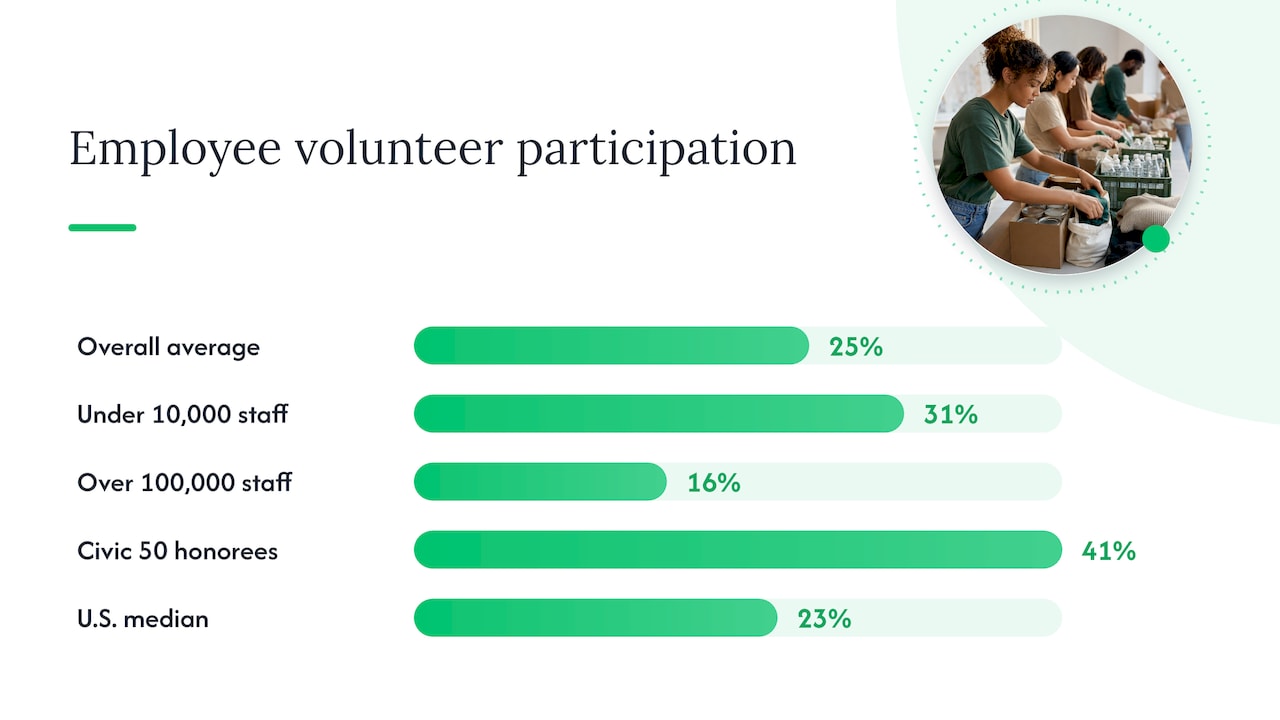
The top performers show what is possible. Points of Light’s Civic 50 report found that its honorees engaged 41% of employees on average in external volunteering, nearly double the 23% U.S. median, and that 86% offered volunteer time off.
So the goal of every idea below is the same: lower the effort to say yes.
Volunteering ideas that fit real schedules
The American Bankers Association describes five volunteering formats that work as a menu:
- Strategic partnerships, such as adopting a school or hosting a quarterly food bank event.
- Company-wide days of service, such as housing builds, veterans fairs or beach cleanups.
- Skills-based volunteering, such as teaching personal finance or helping with tax preparation.
- Hands-on service, such as packing and delivering meals.
- Virtual volunteering, such as care packages, letter-writing campaigns and online mentoring.
Offering several at once matters. America’s Charities notes that employees are less likely to participate when volunteering requires personal leave, complicated approvals, travel or one rigidly scheduled event. It recommends paid volunteer time off with a clear annual allotment, defined eligible organizations and simple manager approval.
For remote and hybrid teams, our guide to virtual volunteering covers formats that need no travel, and corporate volunteering ideas goes deeper on in-person options.
Giving ideas: matching, grants and fundraisers
Not everyone has hours to give, but many will give a few dollars when the company makes it simple.
- Donation matching. Pella’s diversity campaign offered a 2-for-1 match on employee donations and raised and donated over $90,000 in 2021.
- Team volunteer grants. America’s Charities suggests giving a nonprofit a grant after a department completes a qualifying volunteer project, which links hours to dollars.
- Department-versus-department fundraisers. Fundraising.com lists office-wide drives, matching challenges and team competitions among its CSR activity ideas.
- Hours-to-dollars conversion. At Northern Trust, a program called Donations for Doers converts logged volunteer hours into donations employees can direct.
If you are deciding how to balance these with hands-on service, see workplace giving vs. volunteering.
Movement challenges: the inclusive way to participate
A fitness challenge with a charitable twist works because it asks for something employees may already do. A walk at lunch becomes a gift. No sign-up for a Saturday shift, no skills required, and people of every fitness level can contribute.
The results are strong when the format is simple:
- Thermo Fisher ran a two-week challenge where over 500 employees logged more than 13,500 miles, and new donors increased 65%.
- A global health organization’s three-week movement challenge saw 60% of over 1,800 eligible employees register, double its 30% target, and 84% of participants said it increased their movement.
- A small team at Groov-Pin set a goal of walking 125 miles a week for a local charity’s anniversary, and exceeded 500 miles weekly.
The Freedom250 toolkit also suggests a walking or step challenge with a public tracker tied to a giving milestone as a practical company idea.
Charity Miles is a free iOS and Android app that tracks walking, running and biking by GPS and pedometer, and money is donated to the member’s chosen charity for every mile logged. In our Employee Empowerment Program, companies create private teams, run intra-company challenges, and can sponsor employee miles on their own terms: they choose the rate per mile, the total cap, and whether donations go to each employee’s charity or a company-selected cause. HARMAN, which launched its Charity Miles team in 2021, saw an 11x increase in employee participation, with 1,200+ employees generating over $120,000 for charity. For more on that story, read about 11x participation and employer brand.
How to choose ideas your people will join
- Ask what employees care about. The Manufacturing Institute’s Pella case study advises understanding which causes employees are passionate about and aligning them with company values.
- Form a cross-functional committee. Pella’s volunteer steering committee vetted nonprofit partners on reputation, results and leadership.
- Start small. One or two vetted partnerships or initiatives are easier to run well than ten.
- Build on what exists. Collette’s first Week of Service centered on food insecurity and built on its program of four paid volunteer hours per month per employee, giving the week a shared sense of urgency.
- Keep a dialogue with nonprofit partners. America’s Charities’ Workplace Volunteer Programs Guide stresses ongoing communication before and after each opportunity.
- Make it accessible. Offer individual, team, in-person and virtual options, so nobody is shut out by location, schedule or ability.
For a longer list of formats, see our workplace CSR ideas and CSR activities for teams.
A quick comparison of formats
| Idea | Effort for employees | Best for | Example |
|---|---|---|---|
| Flexible volunteering | Low | Busy or hybrid teams | Self-scheduled shifts |
| Day of service | Medium | Team building | Beach cleanup, meal packing |
| Skills-based volunteering | Medium | Professionals | Tax prep, mentoring |
| Matching gifts | Very low | Everyone | 2-for-1 match |
| Movement challenge | Very low | All fitness levels | Walk, run or bike miles for charity |
Measure participation from the start
What gets tracked gets improved. In CECP’s data, 80% of companies collected both outputs and outcomes data in 2024, yet only 30% used HR data to compare volunteers and non-volunteers on retention and performance in 2023. Civic 50 honorees show the gap too: fewer than two-thirds measure societal outcomes for grants, volunteering and in-kind giving.
A practical starting set:
- Participation rate (percent of eligible employees who take part)
- Hours, miles or dollars contributed
- New participants versus repeat participants
- Employee survey feedback on the experience
With the Employee Empowerment Program, enterprise clients get reporting on team activity, so these numbers come from one place rather than a spreadsheet.
Our perspective
Participation is a design problem. When we look at what makes people join a CSR initiative, the answer is rarely the cause alone. It is how little stands between the employee and the first step.
That is why we built Charity Miles around movement that already happens. A lunchtime walk, a bike commute or a weekend run counts, so the program is open to every fitness level and not only athletes. Each mile has a purpose, which makes ordinary activity feel meaningful, and team challenges add friendly competition and camaraderie.
Companies keep control. They choose the rate per mile, the cap, and where the donations go. The result is a program woven into company culture, not a one-off event that fades by Monday.
Gene
Launch a movement-based CSR challenge
If you want an idea that includes everyone from day one, our Employee Empowerment Program lets you set up a private team, run challenges and sponsor miles on your terms. Companies that want to go further can explore corporate sponsorship opportunities.
Individuals can start right away with the free Charity Miles app, and charities can use the platform to engage grassroots supporters at no cost.
FAQ
What are good CSR participation ideas for a small company?
Start with one or two focused initiatives, such as a quarterly volunteer event with a vetted local nonprofit and a simple giving option like a match. CECP’s data shows smaller companies reach higher participation rates, 31% for those under 10,000 employees, so a tight, personal program has an advantage.
How do I get remote employees to take part in CSR?
Use formats that need no travel: virtual volunteering, online mentoring, care-package drives and activity challenges that employees complete wherever they are. A step or mileage challenge with a shared team total gives distributed teams a common goal.
What is the easiest CSR activity to start this quarter?
A two- to three-week walking, running and biking challenge is among the simplest. Employees log activity they already do, and the company decides how miles convert to donations. Thermo Fisher’s two-week challenge drew over 500 employees.
How do I know if my CSR program is working?
Track participation rate, hours or miles contributed, and employee feedback. Compare the numbers each time you run an initiative, and share results with employees so they see what their effort achieved.
Sources
- Giving in Numbers, CECP (2025)
- The Civic 50 2025 Honoree Insights and Benchmarking Report, Points of Light
- Reimagine Your Volunteerism Program, American Bankers Association
- Corporate Volunteering: The Business Case, America’s Charities
- Workplace Volunteer Programs Guide, America’s Charities
- Diversity + Inclusion Best Practices Case Study, The Manufacturing Institute
- CSR Activities Made Clear and Actionable, Fundraising.com
- Start Strong, Scale Smart, Boston College Center for Corporate Citizenship
- Thermo Fisher Scientific Goes the Distance, Blackbaud
- Global Health & Care Organization case study, CoreHealth
- Groov-Pin Walking Challenge
- Business & Industry ToolKit, Freedom250