

The best charity partner is the one whose mission matches your goals, whose finances you can verify, and whom your people will want to support all year. Get those three right and the partnership holds up. Skip one and it fades after the first campaign. Below is the full process, from defining your goals to agreeing on terms, written for companies, teams, charities and individuals alike.
If you are a company, there is a fourth test: can your employees take part in the partnership in a way that fits their day? That is where we focus our work at Charity Miles. Our Employee Empowerment Program lets a company set up a private team, run challenges, and choose whether miles go to each employee’s chosen charity or to a company-selected cause.
TL;DR
- Decide your cause, who you want to help and where before you look at a single organization.
- Build a shortlist with targeted searches and a nonprofit database, then read each candidate’s programs and public filings.
- Verify the basics: tax-exempt status, a public Form 990 where one is required, and state registration.
- Involve your team in the choice, and start with a small pilot before a long commitment.
- Put donations, responsibilities, privacy and reporting in writing before launch.
Table of Contents
- Start with your goal, not with a charity
- Match the cause to the people who will carry it
- Build a shortlist
- Verify before you commit
- Decide the type and length of the partnership
- Agree on terms before launch
- Make the partnership easy to join
- Our perspective
- Bring it to your team
- FAQ
- Sources
Start with your goal, not with a charity
Most weak partnerships start with a good-looking organization and no clear reason for choosing it. Reverse that order. The University of Pennsylvania’s Center for High Impact Philanthropy says the first step is identifying the issue or cause area and the population or geographic focus your giving will serve. Until you make those choices, it is not feasible to run a good needs assessment across all the needs a society has.
Write your answers down in a short brief. Four questions are enough:
- What is your reason? A long-term strategic partnership, a corporate social responsibility (CSR) program, or raising money for a personal goal such as a marathon are different jobs. MindTools notes that your choice depends on knowing your rationale.
- What can you give? Support does not have to be money. Time, people and expertise count too.
- How wide is your scope? Local, national or international, and one organization or several.
- How long and how visible? A one-time gift, an ongoing relationship or a formal partnership, and whether you plan to promote your involvement.
Those last two points come from the same MindTools list of criteria, and they shape everything that follows. A company that wants to put its name on a campaign needs a different partner than a private donor who wants to give quietly.
Keep the people you serve in view
The Penn center adds a caution worth remembering: the more tightly directed your approach, the easier it is to lose the perspective of the people you want to help. It recommends deliberately identifying people to counter that risk. In practice, that means asking a candidate charity how it hears from the people it serves, and building a similar check into your own plan.
Match the cause to the people who will carry it
A cause with a meaningful connection to you motivates you and the people around you, which is the point MindTools makes for personal fundraisers and corporate programs alike. For a company, the people around you are employees, and their buy-in decides whether the partnership is a poster on the wall or a habit.
The Nashville Chamber of Commerce’s business engagement guide argues that involving your team in the choice is what makes giving stick. When the team owns the decision, they are more likely to support it passionately, give time and talent freely, and promote the company’s involvement proudly. MindTools suggests multi-voting as a fair way to reach a team decision.
A simple way to run this:
- Collect three to five causes from your goals brief.
- Let each employee vote for several, not just one.
- Take the top two or three into your research.
If you want idea starters for what a partnership can look like once you have a cause, our list of charity partnership ideas that deliver real results shows formats from fundraisers to activity challenges.
Build a shortlist
Stanford’s Center on Philanthropy and Civil Society recommends two main moves: ask your networks for recommendations, and research online with queries that combine your issue area, the people you want to help and the place you care about. Then read each candidate’s “About Us” and “Programs and Services” pages.
A nonprofit database speeds this up. Candid lets you search by keywords such as location and issue area and compare mission, programs and population served side by side. Giving Compass offers a search that matches meaning as well as exact words, so “helping kids” also surfaces “children” and “youth” groups, with filters for location, size, cause area and rating.
When you have a longer list, a table keeps the comparison honest:
| Criterion | What to look for | Where to check |
|---|---|---|
| Mission fit | Mission matches your cause, population and geography | Charity’s About and Programs pages |
| Outcomes | Annual reports with results, not only activity counts | Annual report, impact page |
| Financial openness | Public Form 990 where required, clear use of funds | IRS filing, database profile |
| Values | Stated openly and consistent with yours | Website, materials, a first call |
| Reporting | Can supply the data you need for your CSR goals | Ask directly |
| Sustainability | Your gift or time commitment can continue | Your own budget and calendar |
The last three rows reflect the six questions in the Nashville guide, which also asks whether the organization values equity and whether your team will get behind it.
Verify before you commit
Vetting is not optional, and it is not complicated. Do these checks in order.
Confirm tax-exempt status and read the filing
Most organizations exempt under section 501(a) of the tax code file Form 990, an annual information return. According to the IRS’s 2025 instructions, the form must be filed if gross receipts are at least $200,000 or total assets at least $500,000, and the completed form, except contributor details on Schedule B, must be available to the public from the IRS and from the organization. Smaller charities may not file the full form, so for them lean on other evidence: a track record, references and clear reporting.
In a 990, look at how much goes to programs compared with administration and fundraising, who sits on the board, and whether the numbers are stable year to year. Watch trends, not a single percentage.
Check state registration
Charity oversight in the United States is split between the IRS and the states. A 2025 academic article notes that 42 states require registration and some form of annual reporting for charities and solicitors, and that the IRS alone can revoke charitable tax-exempt status. So check the registry in the state where the charity operates and the state where you will be soliciting donations.
If you donate through an online platform in California, there is an extra layer. Under AB 488, effective March 26, 2024, platforms must verify that charities are in good standing with the state attorney general’s registry, the Franchise Tax Board and the IRS before they solicit or distribute donations.
Test the relationship in a small way
Board.org’s guidance for companies sourcing nonprofit partners recommends aligning the partner’s mission and vision with company values, using your enterprise and community relationships, being clear about expectations and using vetting tools. It also quotes a foundation executive who says you tend to see real alignment only after a grant has been issued, so an application alone cannot show fit.
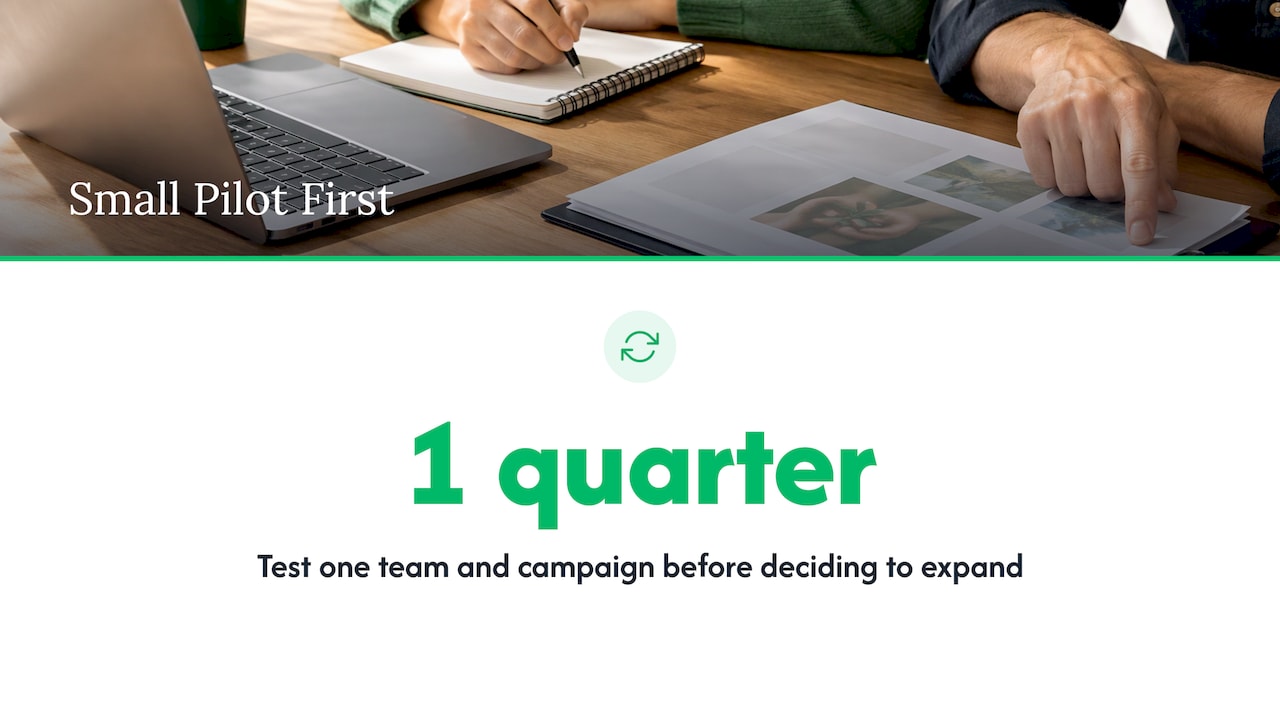
That is the case for a pilot. MindTools recommends a low-risk trial run: lend support in a small way first and watch the organization’s accountability, transparency and trustworthiness. Run one quarter, one team and one campaign, then decide whether to expand. Our pilot-first playbook for charity partner engagement walks HR and CSR teams through that approach.
Decide the type and length of the partnership
Not every partnership should be a multi-year commitment. A useful way to choose is by what you are asking the charity and your own people to do:
- Event-based: one challenge, one drive, one day of service. Easy to start, easy to forget.
- Campaign-based: a defined season, such as a month-long challenge with a fundraising target.
- Ongoing: a standing relationship with regular activity, shared reporting and a named contact on each side.
Whichever you pick, partnerships work best when you collaborate with the communities involved and bring in the people closest to the issue rather than deciding for them. For a charity, the same logic applies in reverse: look for partners who want to engage your supporters, not just sponsor your logo.
Agree on terms before launch
This is the step teams most often skip, and it is where partnerships quietly go wrong. Whatever the size of the partnership, write down five things in plain language and have both sides sign off:
- Donation terms. How much, how often, per what trigger (for example, per mile, per hour volunteered or per participant), and whether there is a cap.
- Responsibilities. Who recruits participants, who communicates, who handles receipts and thank-you notes.
- Use of names and logos. What each side may say publicly and who approves it.
- Privacy. What participant data the charity and the company can see, and what each may do with it.
- Results. The measures you will report, how often, and in what format. Match them to the data your CSR or ESG goals require, as the Nashville guide suggests.
Two pages are better than twenty. The point is that nobody has to guess in month four.
Make the partnership easy to join
A cause people care about still fails if joining is a chore. That is why activity-based giving works well for companies: any movement counts, so a lunchtime walk, a bike commute or a run all contribute, and employees of every fitness level can take part.
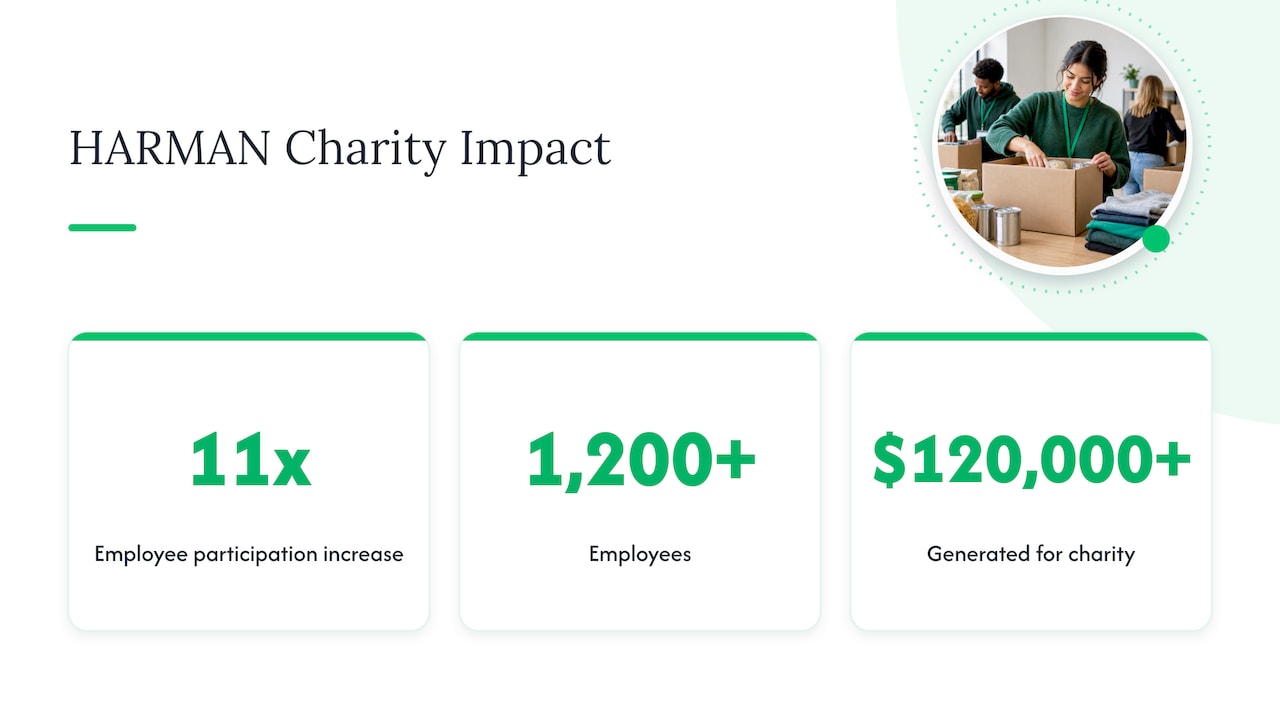
With our Employee Empowerment Program, a company creates private teams, runs friendly challenges between them, and can sponsor employees’ miles on its own terms: the rate per mile, the total sponsorship cap, and whether donations go to each employee’s chosen charity or a company-selected cause. HARMAN launched its Charity Miles team in 2021 and saw an 11x increase in employee participation, with 1,200+ employees generating over $120,000 for charity.
That structure answers the term questions from the previous section directly: the trigger is the mile, the cap is set by the company and the beneficiary is chosen up front. For more on how giving fits daily work life, see our piece on charity in corporate culture.
Our perspective
We have seen the same pattern in how companies approach this question: they spend weeks comparing charities and almost no time asking how employees will actually take part. The charity is only half of the partnership. The other half is the habit.
That is why we built Charity Miles around movement people already do. The app is free for members and free for charities, tracks walking, running and biking, and sends money to the charity the member picks for every mile. Companies layer a private team and optional sponsorship on top, and they decide the rate, the cap and where the donations go.
Our advice is to let employees choose causes they believe in, keep the terms simple, and make participation as easy as a walk. When the cause is personal and the action is small, the partnership has a chance to last.
Gene
Bring it to your team
If you are ready to turn your shortlist into participation, our Employee Empowerment Program gives HR, CSR and wellness leaders private team challenges and sponsorship settings the company controls. Companies that want to fund the miles can look at our corporate sponsorship opportunities. Individuals can start with the free Charity Miles app and pick a charity for their first mile.
Charities that want to engage grassroots supporters can start from our home page and see how a movement of walkers, runners and cyclists can work for a cause.
FAQ
How do I know if a charity is good?
Check that it is tax-exempt, read its public Form 990 if it files one, and look at its annual report for outcomes rather than activity alone. Confirm it is registered in the states where it solicits. Then ask how it hears from the people it serves.
How many charity partners should a company choose?
One is enough to start. A single partner makes it easier to build a clear story and measure results. Many companies add more later, or let employees direct donations to different charities within one program, once the first partnership is running well.
Should employees be involved in choosing the partner?
Yes. The Nashville Chamber of Commerce guide argues that team ownership of the decision leads to stronger, more passionate support. A short vote on a pre-screened list gives people a voice without turning the choice into a long debate.
Does a charity partnership have to be financial?
No. Time, people and expertise can be as valuable as money, according to MindTools. Many strong partnerships combine volunteering, in-kind help and a fundraising element that employees can join through everyday activity.
Sources
- Deciding on Your Initial Goals and Approach for Philanthropy, University of Pennsylvania Center for High Impact Philanthropy
- How to Choose a Nonprofit or Charity to Support, MindTools
- Corporate Giving, the Nashville Way, Nashville Chamber of Commerce
- Finding and Vetting Organizations, Stanford PACS Center
- Find nonprofits to support, Candid
- Giving Compass Nonprofit Search
- 2025 Instructions for Form 990, IRS
- Toward the Ideal of Uniformity, Transparency and Efficiency, Nonprofit Policy Forum
- Charity Verification for California AB 488 Compliance
- Sourcing impactful nonprofit partners for your corporate philanthropy program, Board.org