

An ADA-inclusive wellness program does two things. It stays clear of disability-related questions and medical exams unless you can handle them lawfully, and it gives every employee, whatever their ability, a real way to take part and earn any reward. The simplest route is an activity-based program where any movement counts, participation is optional, and no one has to disclose a health condition to join. That is the approach we build around at Charity Miles.
This guide is for HR, CSR and wellness leaders, and for the charities and individuals who work with them. It explains when the ADA applies, what “voluntary” means in practice, and how to design a program people with disabilities can use without being singled out.
TL;DR
- The ADA applies to a wellness program when it asks disability-related questions or requires a medical exam, such as a health risk assessment or biometric screening. Activity challenges that collect no health data sit outside that trigger.
- Even then, nondiscrimination and reasonable accommodation still matter, so every program needs more than one way to take part.
- Participation must be truly voluntary: no penalties, no pressure, and clear notice of what information is collected and who sees it.
- Design for varied abilities: choose activities where any movement counts, offer non-fitness options, and give people multiple ways to earn a reward.
- A charity-giving challenge in which each mile logged triggers a donation lets employees join at their own pace and for a cause they care about.
Table of Contents
- When the ADA applies to a wellness program
- What changed, and what is still unsettled
- What “voluntary” means in practice
- Reasonable accommodation and alternative paths
- Six design choices that make a program inclusive
- A worked example: a team challenge without health data
- Why charity-linked activity suits inclusive programs
- Our perspective
- How Charity Miles fits an inclusive program
- FAQ
- Sources
When the ADA applies to a wellness program
The Americans with Disabilities Act (ADA) is the federal law that bars employment discrimination based on disability. Title I of the ADA also limits when an employer can ask employees medical questions or require medical exams, and says such inquiries must generally be voluntary when they are part of a wellness program, according to Troutman’s wellness design guide.
The practical test comes down to what the program collects. SHRM explains that the ADA applies if a program asks disability-related questions or involves a medical examination. In that case it brings confidentiality requirements, limits on the information gathered, and access to reasonable accommodations.
Here is how common program elements line up:
| Program element | Triggers ADA rules on inquiries and exams? | What to plan for |
|---|---|---|
| Health risk assessment with medical history questions | Yes | Voluntary participation, written notice, confidentiality, accommodations |
| Biometric screening (blood pressure, cholesterol, glucose) | Yes | Same, plus an alternative way to earn the reward if a test is unsafe for someone |
| Wearable device that sends health data to the employer | May trigger ADA requirements, per EEOC’s December 2024 fact sheet as summarized by Groom Law Group | Review what data is collected before launch |
| General health education, lunch-and-learns | Generally no inquiry or exam, per the Viscardi Center and NDRN guide | Still design for access |
| Team activity challenge that logs distance only | No health questions or exams involved | Still design for access and offer alternatives |
Two cautions apply to that last row. First, whether a program triggers the inquiry-and-exam rules is separate from whether it is accessible. The same Viscardi Center and NDRN guide notes that employers keep their other nondiscrimination obligations either way. Second, rules differ if your program is tied to a group health plan, where HIPAA also applies. Our HIPAA wellness programs guide covers that side. For legal questions about your own plan, speak with employment counsel.
What changed, and what is still unsettled
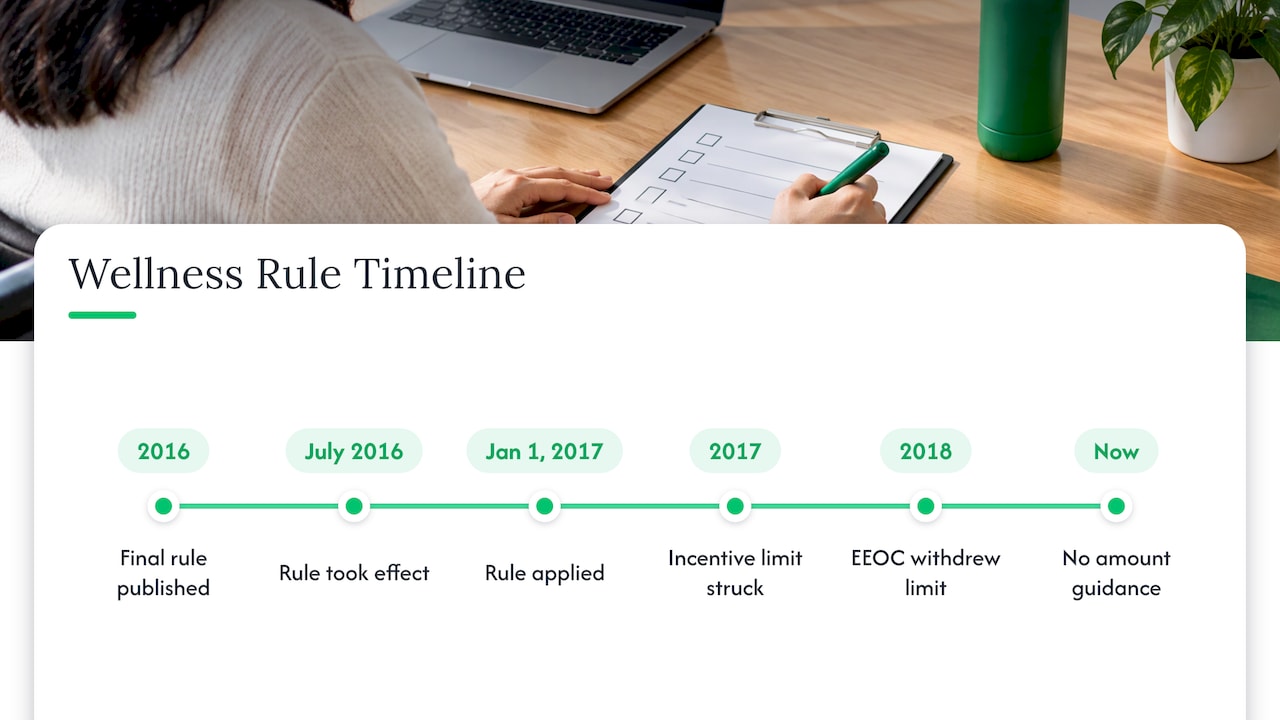
The EEOC’s 2016 final rule on wellness programs, published in the Federal Register, covered all wellness programs that include disability-related inquiries or medical exams, whether offered to everyone or only to people on the group health plan. It took effect in July 2016 and applied from January 1, 2017.
The incentive limit in that rule did not last. According to Groom Law Group’s analysis, a court struck down the incentive portion in 2017 and the EEOC withdrew it in 2018. There is currently no EEOC guidance on what incentive amount satisfies the voluntary requirement, which leaves a gray area for programs that attach large financial rewards or penalties to medical inquiries.
The takeaway for HR: when a program does not ask for health information, this uncertainty has little to attach to. That is one reason many teams lean on activity-based participation and modest, non-medical rewards. Our wellness incentives guide goes deeper on reward design.
What “voluntary” means in practice
Voluntary does not just mean “optional on paper.” The EEOC’s Q&A on its wellness rulemaking describes voluntary participation as an employer not requiring participation, not denying or limiting health coverage, and not taking adverse action against, retaliating against, coercing, intimidating or threatening employees who decline or miss a target.
In day-to-day terms:
- No penalties for opting out. Declining a screening or a challenge should never affect a performance review, a schedule or a benefit.
- Notice before data. If you do collect medical information, the NCHPAD worksite wellness guide says employees must be told what is collected, how it will be used, who receives it and how it is protected from improper disclosure.
- Aggregate reporting only. Employers should see results in a form that does not identify individuals, per the Viscardi Center and NDRN guide.
- No data, no problem. The simplest way to protect confidential health information is not to collect it. A challenge that logs miles needs no diagnosis, no weight and no medical history.
Our participation guide explains why access has to come before rewards, and how to avoid designing a program that quietly pressures people to disclose.
Reasonable accommodation and alternative paths
Reasonable accommodation means adjusting how a person takes part so a disability does not keep them from the same opportunity. Troutman’s guide notes that reasonable accommodation is required even for participation-only wellness programs, which HIPAA does not require to offer a reasonable alternative standard.
The examples in the ADA wellness regulations, as cited by Troutman, make the idea concrete:
- A sign language interpreter for a deaf employee attending a nutrition class, so they can earn the same incentive, unless it would cause undue hardship.
- Written materials in large print or another alternate format for an employee with a vision impairment.
- An alternative test or certification so an employee for whom a blood draw is dangerous can still finish a biometric screening and earn the reward.
NCHPAD, the National Center on Health, Physical Activity and Disability, adds practical options in its worksite wellness guide: someone to read health education materials aloud to an employee with vision loss, a trained sighted guide for walks, help with manual tasks and longer breaks. It also suggests incentives such as adapted activity trackers, and checking the accessibility of any gym before offering memberships.
One point from the AMA Journal of Ethics is easy to miss. Alternate paths work best when personalized goals are open to everyone, because asking employees to request a special arrangement can make them feel singled out for having a disability. Build flexibility into the default design instead of treating it as an exception.
Six design choices that make a program inclusive
Here is a working checklist, drawing on NCHPAD, SHRM and American Employers Alliance guidance.
1. Count every kind of movement
The American Employers Alliance warns that a running challenge excludes employees with mobility impairments and that a weight-loss contest may be inappropriate for employees with eating disorders. Pick activities and goals that do not rank people by body type or athletic ability.
2. Offer more than one way to earn a reward
The same guidance recommends multiple pathways to earn wellness incentives. If one route is steps, another might be a class attended, a team goal contributed to, or a personal target the employee sets.
3. Add non-fitness options
SHRM’s inclusive wellness steps suggest activities like book clubs or gardening alongside physical ones, so people who cannot or prefer not to exercise still belong.
4. Fit different shifts and locations
SHRM also recommends scheduling sessions at different times for different shifts, recording sessions for on-demand viewing, using technology to reach remote employees and providing resources in multiple languages. A challenge that runs for weeks and lets people log activity whenever suits them handles much of this by design.
5. Make materials accessible
Any training video, kickoff recording or how-to clip needs captions and readable formats. A video captioning workflow is a useful reference when you prepare launch materials. For live events, NCHPAD’s meeting checklist covers step-free access, pathways at least 36 inches wide, distributed wheelchair seating, assistive listening devices, advance interpreter services and alternate-format handouts.
6. Keep health data out unless you truly need it
If your program has no medical component, you remove most of the ADA inquiry and confidentiality burden. If it does have one, give notice first, keep results aggregate and keep it separate from employment decisions.
For more activity ideas, see our guide to inclusive wellness activities, and our six-step HR playbook for inclusive wellness programs.
A worked example: a team challenge without health data
Imagine a 600-person company with office, warehouse and remote staff. HR launches a four-week team challenge.
- Open invitation. Everyone is invited. Nobody is asked about health, weight or fitness level, and the announcement says opting out has no consequence.
- Any movement counts. A lunchtime walk, a bike commute or a run each log as miles. Employees choose the pace and the route that works for them.
- A choice of how to contribute. Some employees log miles. Others join a team as supporters, take part in a non-fitness activity or help organize. The team goal is shared, so effort looks different for different people.
- A reward that is not medical. The company sponsors a donation per mile to charity. No one earns or loses a premium discount, and no one’s health status is reported.
- Aggregate results only. Leadership sees team totals and participation counts, not individual health information.
This kind of design keeps the program outside the inquiry-and-exam rules by not asking those questions. It does not replace your own legal review, and any accommodation request still deserves a prompt, respectful answer.
Why charity-linked activity suits inclusive programs
Personal fitness targets can make some employees feel measured against colleagues. Giving a mile a purpose beyond the individual changes the conversation. The goal becomes the team’s donation, which many people can contribute to in their own way. HARMAN is one example: after launching its Charity Miles team in 2021, the company saw an 11x increase in employee participation, with 1,200+ employees generating over $120,000 for charity.
It also helps with the engagement case. Gallup research shows companies with engaged employees are 21% more profitable, and a program that people actually feel included in is more likely to be used. Our guides on wellness challenges that give back and corporate wellness ideas that boost engagement show how to put this into practice.
Our perspective
We built Charity Miles on a simple belief: movement should count wherever it comes from. A lunchtime walk, a bike commute and a long run all log the same way, and every mile turns into a donation to a charity the member chooses.
That is why inclusive design is not a side feature for us. A program that works only for athletes is not a wellness program for the whole company. Because any movement counts, the program is open to every fitness level, and because the app tracks distance rather than health measurements, employees take part without handing over medical details.
Companies stay in control. They create private teams, run friendly challenges and can sponsor employees’ miles on their own terms: the rate per mile, the total cap, and whether donations go to each employee’s chosen charity or a company-selected cause.
Our advice to HR leaders is to start with access, add meaning, and let the rewards follow.
Gene
How Charity Miles fits an inclusive program
The Charity Miles app is free for members and for charities. Members walk, run or bike, the app tracks distance by GPS and pedometer, and money is donated to their chosen charity for every mile.
For companies, the Employee Empowerment Program adds private teams for employees, intra-company challenges and optional sponsorship where you set the rate per mile, the cap and the donation destination. It is built to be woven into company culture rather than run as a one-off event.
If you want a challenge that welcomes every fitness level and keeps health questions out of the picture, explore the Employee Empowerment Program and talk with us about a private team for your company.
FAQ
Does the ADA apply to every wellness program?
No. It applies when a program asks disability-related questions or requires a medical exam, according to SHRM. Programs that only offer general education or log activity without health questions fall outside those specific rules, though employers still must not discriminate and should offer reasonable accommodations.
Can we offer a reward for taking part?
Yes, but how you design it matters. If the program includes medical inquiries or exams, participation must be voluntary, and the EEOC currently has no guidance on what incentive size meets that standard, per Groom Law Group. Activity-based programs with modest, non-medical rewards avoid most of that uncertainty. Check your plan with employment counsel.
What should we do when an employee asks for an accommodation?
Respond promptly and work out an alternative that lets them earn the same reward, such as an interpreter, alternate-format materials or a different way to meet the goal. Unless it causes undue hardship, the employer is expected to provide it. Involve HR and, where needed, your legal adviser.
How do we avoid singling out employees with disabilities?
Build flexibility into the standard design. Offer several ways to participate and let anyone set a personal goal, so nobody needs to explain a diagnosis to join. The AMA Journal of Ethics highlights this risk of employees feeling singled out.
Is a step or mileage challenge inclusive on its own?
Only if it counts different kinds of movement and offers other ways to contribute. A format that rewards only running or only high step counts can exclude people with mobility impairments. Mixed activity types and team-based goals widen access.
Sources
- Workplace Wellness Programs: Health Care and Privacy Compliance, SHRM
- Wellness Program Design and Compliance, Troutman
- Technical Assistance Guide on Making Employee Wellness Programs Accessible, Viscardi Center and NDRN
- Wellness Programs Under Scrutiny in EEOC’s New Wearable Devices Guidance, Groom Law Group
- Federal Register, May 17, 2016, EEOC wellness final rule
- EEOC Questions and Answers on employer wellness programs
- Worksite Wellness Guide, NCHPAD
- Workplace Wellness Programs and Accessibility for All, AMA Journal of Ethics
- Designing a Workplace Wellness Program, American Employers Alliance
- 6 Steps to Make Wellness Programs More Inclusive, SHRM