

To sponsor employee miles, your company agrees to donate a set amount to charity for every mile employees walk, run, or bike. You choose the rate per mile, the total cap, and whether the money goes to each employee’s favorite charity or to one cause the company picks. It is not mileage reimbursement, which repays staff for driving a personal vehicle on company business. With Charity Miles, the app tracks the distance and you set the terms for the sponsorship in our Employee Empowerment program.
This guide covers what sponsoring miles means, how to set a rate and budget that holds up, how to run the challenge, and what to record for tax purposes.
TL;DR
- Sponsoring employee miles is a charitable giving and wellness program: you pay a donation per mile of walking, running, or biking. It has nothing to do with reimbursing business driving.
- You control three numbers: the rate per mile, the total cap, and where the money goes (each employee’s charity or a company-chosen cause).
- Divide your cap by the expected miles to find a rate. A hard cap means the cost can never exceed your budget.
- Count every kind of movement so a lunchtime walker earns the same as a marathoner.
- Keep payment records and written acknowledgments for the gift, and confirm deduction details with your tax adviser.
Table of Contents
- What it means to sponsor employee miles
- Why companies sponsor miles
- Step 1: Decide where the money goes
- Step 2: Set the rate per mile
- Step 3: Set a sponsorship cap
- Step 4: Choose the activities and the rules
- Step 5: Launch and keep momentum
- Step 6: Handle the tax and record-keeping side
- Common mistakes to avoid
- Our perspective
- Start a sponsored-mile program
- FAQ
- Sources
What it means to sponsor employee miles
The phrase causes confusion because “miles” and “employees” also describe an expense policy. They are two different programs.
Mileage reimbursement is a payment to an employee who uses a personal car, van, motorcycle, or bike for eligible business travel. The rate is meant to cover vehicle costs such as fuel, insurance, maintenance, and depreciation. It compensates a cost the employee incurred for you.
Sponsoring employee miles is the opposite kind of spending. Employees are not out of pocket. They move for their own health, and your company turns that movement into a donation. The payment goes to a charity, not to the employee.
In practice a sponsored-mile program has four parts:
- A way to measure distance. With Charity Miles, members walk, run, or bike, and the app tracks distance using GPS and pedometer.
- A private team for your employees, so people compete and cheer each other on inside the company.
- A sponsor, which is your company, that pays per mile.
- A destination, which is the charity.
The model is familiar from fundraising walks, where supporters pledge an amount per mile. The difference is that sponsorship is set by the company in advance, so employees do not have to chase pledges to make their effort count.
Why companies sponsor miles
A step challenge gives employees a score. A sponsored-mile challenge gives them a reason. Each mile has a visible effect on a cause they care about, and that tends to keep people moving after the novelty fades.
There is research behind the idea. A demonstration study by the CDC’s NIOSH tested a two-week workplace Move-A-Thon in which participants earned donations for meeting a daily step minimum. Eight participants averaged 9,330.8 steps per day and generated $202 in donations. The authors concluded that monetized charitable donations are an effective alternative incentive for worksite physical activity, and participants were receptive to longer future events. It was a small pilot, but it shows the mechanism at work.
A larger example comes from our own program. Since launching its Charity Miles team in 2021, HARMAN saw an 11x increase in employee participation, with 1,200+ employees generating over $120,000 for charity. You can read how that program was built in our workplace walking case study.
The benefits you can expect to talk about internally:
- Wellbeing. Regular movement raises energy and helps with stress and fatigue.
- Inclusion. Any movement counts, so people at every fitness level can contribute.
- CSR you can see. Employees choose or see the cause, so giving is part of the company culture and not a one-time announcement.
- Team connection. Friendly challenges between departments or offices give colleagues a reason to talk.
Step 1: Decide where the money goes
Your first decision is the destination, because it shapes how personal the program feels.
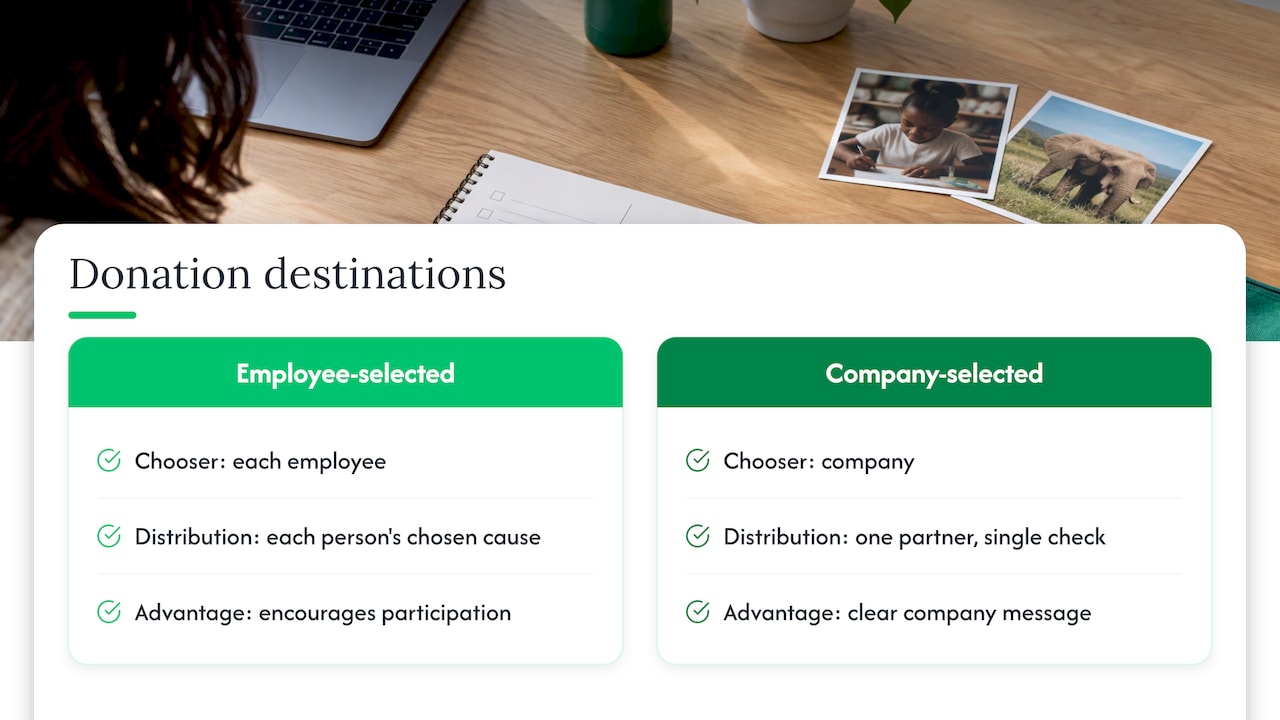
Each employee’s chosen charity. Every member picks a cause, so a mile run by one person supports an animal shelter and a mile walked by another supports a children’s hospital. This feels personal and makes people more likely to log miles. Charity Miles supports this option.
One company-selected cause. All miles support a single partner, such as a charity near your headquarters or the one your CSR committee already backs. This makes for a clean story and a single, larger check at the end.
Choose employee-selected charities when your priority is participation. Choose a single cause when your priority is a clear company message. Whichever you pick, tell employees before launch so no one is surprised.
Step 2: Set the rate per mile
There is no standard rate. The right number depends on how many people you expect to join and how far they will go. Work backwards from a budget:
Donation budget ÷ expected total miles = rate per mile
Here is a worked example with made-up numbers for a company of 500 employees:
- Assume 150 people join (30% participation).
- Assume each logs about 40 miles over a four-week challenge. That is roughly 10 miles a week, or a few short walks.
- Expected total: 150 × 40 = 6,000 miles.
- With a $6,000 budget, the rate is $1.00 per mile.
If participation doubles, you would have 12,000 miles and a $12,000 bill. That is why the next step matters.
Check your assumptions
Two things to keep in mind when you estimate:
- Participation grows when the program is easy. Our HARMAN result, an 11x increase, is a reminder that early estimates can be low when the experience is simple and meaningful.
- Rates should feel worth it, not just large. A visible, round number like $0.50 or $1.00 per mile is easy for employees to repeat to colleagues and to calculate for themselves.
Step 3: Set a sponsorship cap
The cap is the maximum your company will donate in total. It is the safeguard that lets you say yes to enthusiasm. If employees outperform every projection, the cap ensures you never pay more than the budget finance approved.
With Charity Miles you choose the total sponsorship cap yourself, along with the rate. Some practical ways to set it:
- Start with your CSR or wellness budget line. Use an amount already approved for giving or employee engagement.
- Set the cap above your expected total. If you expect $6,000 in donations, a $10,000 cap leaves room for success without risk.
- Decide what happens at the cap. Employees can keep logging miles after the sponsorship is used up, and many will, because the habit is the real goal. Tell them in advance so the milestone feels like a celebration, not a cutoff.
Other ways to structure the budget
Charities that run corporate challenges use a few common structures. Girls on the Run International’s employee challenge kit, for example, describes companies committing a specific amount per participant or a flat company donation. It also describes matching employee donations made at registration so the support doubles.
The table compares the three structures:
| Structure | How it works | Best for |
|---|---|---|
| Per-mile sponsorship | Donation grows with every mile logged | Rewarding effort and keeping people moving |
| Flat company donation | One fixed gift regardless of activity | Predictable budgets, less incentive to keep moving |
| Employee donation matching | Company matches what staff give | Companies that want staff to give personally too |
Per-mile sponsorship ties the money to the behavior you want, which is why we recommend it as the core of the program. You can also add a matching element later if employees start giving on their own.
Step 4: Choose the activities and the rules
Keep the rules short enough to fit on one slide.
Count all movement. A walk, a run, and a bike ride all count in Charity Miles. A lunchtime lap around the parking lot is worth the same to the cause as a weekend long run. This is what makes a program inclusive and not a contest for the already-fit. Our guide to fitness challenge ideas for employees has more formats to borrow.
Pick a duration. The Sunrise Association’s corporate challenge guide recommends a one-month challenge and the same metric for all activities, so miles stay comparable across walking, running, and cycling. A month is long enough to build a habit and short enough to keep energy high. If you want an ongoing program, run it in recurring monthly or quarterly cycles.
Define who can join. Full-time staff, part-time staff, remote employees, and contractors may all be eligible. Decide up front and say so clearly.
Keep participation voluntary. Movement is personal, and people have health and mobility needs you cannot see. Make it clear that joining is optional and that all forms of movement count. Remind employees to move at a level that is comfortable for them, and to talk with their doctor before starting anything strenuous if they have a health condition.
Step 5: Launch and keep momentum
A good launch follows a simple sequence. The Sunrise Association’s seven steps are a useful outline: determine participants, customize the challenge, set company-wide goals, select team captains, host a kickoff, spread the word, and recognize achievements.
Here is how that looks with a sponsored-mile program:
- Announce the sponsorship terms. Share the rate, the cap, and the cause in one message. Specifics make people believe it.
- Create private teams. In Charity Miles, you set up private teams for your employees, so colleagues see each other’s progress and not a stranger’s.
- Name team captains. One volunteer per department or office keeps the conversation going.
- Hold a kickoff. It can be a short call, a lunch, or a walking meeting. If you want to bring teams together in person, you could pair it with outdoor corporate team games on the same day.
- Share progress weekly. Post total miles and dollars raised so far. Seeing the number grow is the motivator.
- Close with recognition. Celebrate the total, thank the participants, and share where the money went.
The DaVita Bridge of Life corporate model follows a similar rhythm: companies form a team, take part in a virtual walking, running, and cycling challenge, and earn recognition for reaching milestones. Milestones and recognition are what turn a month of activity into a story people repeat.
If you want more ideas for sustaining participation, see our list of fitness fundraising ideas, or our guide to a corporate fitness challenge.
Invite employees’ networks
The Sunrise Association model also encourages participants to share the challenge by email, social media, and text, and to invite family and friends to join teams. For a charity, this is how a corporate challenge reaches grassroots supporters. For a company, it widens the effect of the program beyond the payroll.
Step 6: Handle the tax and record-keeping side
The rules depend on how your company is structured, so confirm them with your tax adviser or CPA before you launch. Here is what to raise with them.
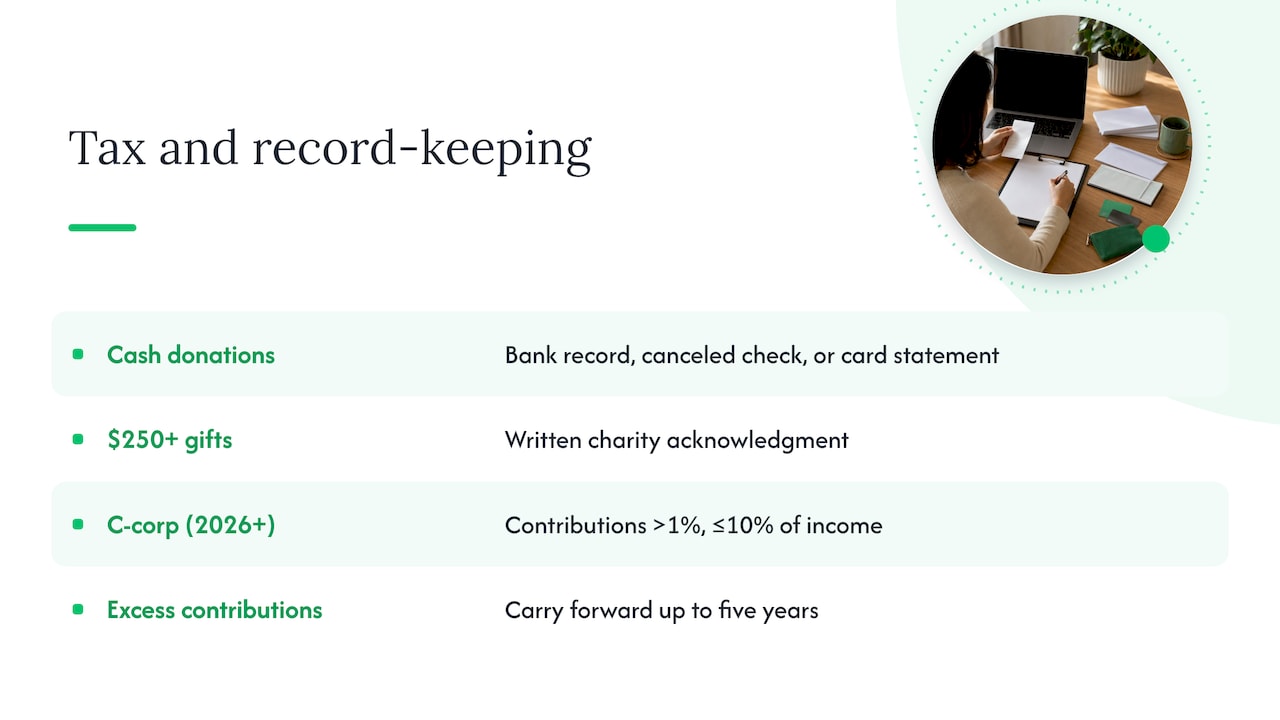
Keep payment records. For any cash donation, a business should keep a bank record, canceled check, or card statement, and for gifts of $250 or more it should obtain a written acknowledgment from the charity. Ask the charity for that letter when you send the final payment.
Understand the limit for C-corporations. For tax years beginning in 2026, a C-corporation can deduct charitable contributions only to the extent they exceed 1% of taxable income and do not exceed 10%. The 1% floor is new under the One Big Beautiful Bill Act, and excess amounts can be carried forward up to five years, per the same summary of the law. Other business types are treated differently, which is one more reason to ask your adviser.
Keep sponsorship a gift. Sponsorships that only acknowledge a name or logo are generally treated as charitable contributions, while those that include endorsements or pricing are treated as advertising expenses. If your company wants public recognition from the charity, ask your adviser how it affects the treatment.
Keep program records. Save your terms (rate, cap, destination), the final mile totals, and the donation amount. Charity Miles provides reporting for enterprise clients, which helps you document totals for finance and for your CSR report.
Common mistakes to avoid
- Skipping the cap. Enthusiasm is the goal, but an uncapped rate makes finance nervous.
- Setting a rate no one remembers. Use a round number employees can repeat.
- Making it a contest for athletes. If only the fastest runners matter, most of your team will opt out. Count all movement and celebrate team totals.
- Going quiet after launch. Weekly updates matter more than the kickoff.
- Not reporting back. Tell employees how much was donated and who received it. It is the reason they will join the next round.
Our perspective
We built Charity Miles on a simple idea: movement should mean more than a number on a screen. When a company sponsors employee miles, the person who takes a ten-minute walk after lunch and the person who trains for a half marathon both contribute to something bigger than themselves.
The companies that get the most from the program make three decisions early and keep them simple. They choose a per-mile rate employees can remember, a cap finance has approved, and a cause people feel proud of. They also treat the program as part of the culture and not a one-off event, and that is why we designed private teams, friendly challenges, and sponsorship controls to work together in one place.
The result we point to most often is HARMAN, where participation rose 11x and more than 1,200 employees generated over $120,000 for charity. We think the lesson is that people give their effort freely when the effort is easy, inclusive, and visibly useful.
Gene
Start a sponsored-mile program
Charity Miles is free for members and free for charities. Companies use the Employee Empowerment program to create private teams, run friendly challenges, and sponsor employee miles on their own terms: you choose the rate per mile, the total cap, and whether donations go to each employee’s chosen charity or a company-selected cause.
To see how it would work for your company, visit the Employee Empowerment program page. If you are a brand looking to activate a community, see our corporate sponsorship opportunities.
FAQ
Is sponsoring employee miles the same as mileage reimbursement?
No. Mileage reimbursement repays an employee for using a personal vehicle on company business. Sponsoring employee miles is a donation your company makes to charity for each mile employees walk, run, or bike for their own wellbeing.
How much should we donate per mile?
Start with your budget and divide it by the miles you expect. For example, $6,000 across 6,000 expected miles gives $1.00 per mile. Then set a cap so a strong turnout can never exceed the budget.
Can employees choose their own charity?
Yes. With Charity Miles, a company can let donations go to each employee’s chosen charity, or direct all of them to a cause the company selects. Pick the option that fits your goal, personal connection or a single company message.
Do we need to cover every type of exercise?
It helps. Walking, running, and biking all count in Charity Miles, so people of every fitness level can take part. Using the same distance metric for all of them keeps the challenge fair, as the Sunrise Association’s guide also recommends.
Are sponsored miles tax deductible?
Charitable gifts from a business may be deductible, but the rules depend on your company’s structure. Keep payment records and the charity’s written acknowledgment, and ask your tax adviser how the limits apply to you.
Sources
- Mileage reimbursement: a complete guide (Perk)
- A Move-a-thon Event: A Workplace Demonstration (CDC Stacks)
- HELIX: An Employee Engagement Challenge (Girls on the Run International)
- Evergreen Corporate Endurance Challenge (Sunrise Association)
- Move It With Purpose Sponsorship Brochure 2026 (Bridge of Life)
- How to Donate to Charity as a Business and Deduct It (LegalClarity)