

An asynchronous team challenge is a shared goal that every person completes on their own time, with no live session, no fixed start hour and no one waiting on anyone else. The format that holds up best for distributed teams is a movement challenge: everyone logs walks, runs or rides whenever they fit, and the team’s miles add up to a single total. When those miles also become donations, people have a reason to keep going. That is the idea behind the Charity Miles Employee Empowerment program, where companies create private teams, run friendly challenges and can sponsor employee miles on their own terms.
This guide covers what makes a challenge truly asynchronous, the formats that work for mixed schedules and abilities, the rules to write down before you launch, and how to measure whether it worked.
TL;DR
- A challenge is asynchronous when no one has to be online, in a meeting or in the same time zone to take part. Logging activity whenever it fits is the whole mechanic.
- Count all movement, not just athletic effort. Walks, bike commutes and lunchtime loops keep busy parents, shift workers and less active colleagues in the game.
- Write six things down before launch: who is eligible, how long it runs, how activity is tracked, how it is scored, when results close and how people are recognized.
- Tie the miles to a cause. Companies running Charity Miles teams have seen large participation gains, including 11x at HARMAN.
- Measure participation first, then activity, then impact, and report team totals rather than individual numbers.
Table of Contents
- What makes a team challenge asynchronous
- Why pairing movement with giving keeps people going
- Asynchronous challenge formats worth considering
- Design rules that keep it inclusive
- How to run an asynchronous team challenge, step by step
- Privacy basics
- How to measure whether it worked
- What this looks like in real companies
- Run your asynchronous challenge with Charity Miles
- Our perspective on asynchronous challenges
- FAQ
- Sources
What makes a team challenge asynchronous
Most advice ranking for this topic is about asynchronous communication: replies that take hours, notification overload, the loneliness of remote work. A team challenge is a different thing. It is a deliberate activity designed so that nothing depends on timing.
Three tests tell you whether a challenge is really asynchronous:
- No required live moment. A kickoff call can exist, but it should be optional and recorded. If a person in Singapore cannot join on equal terms with a person in Denver, the design has a live dependency.
- A flexible window. People can contribute at 6 a.m., at lunch or after the kids are asleep, and the contribution counts the same.
- A shared total that builds over time. Individual effort rolls into a team number, so no one needs to coordinate with anyone to make progress.
Movement is an unusually good fit because the activity itself is already independent. Nobody needs a teammate in the room to walk around the block. What a team lacks is the sense that those separate walks add up to something shared, and a simple team total supplies that.
Why pairing movement with giving keeps people going
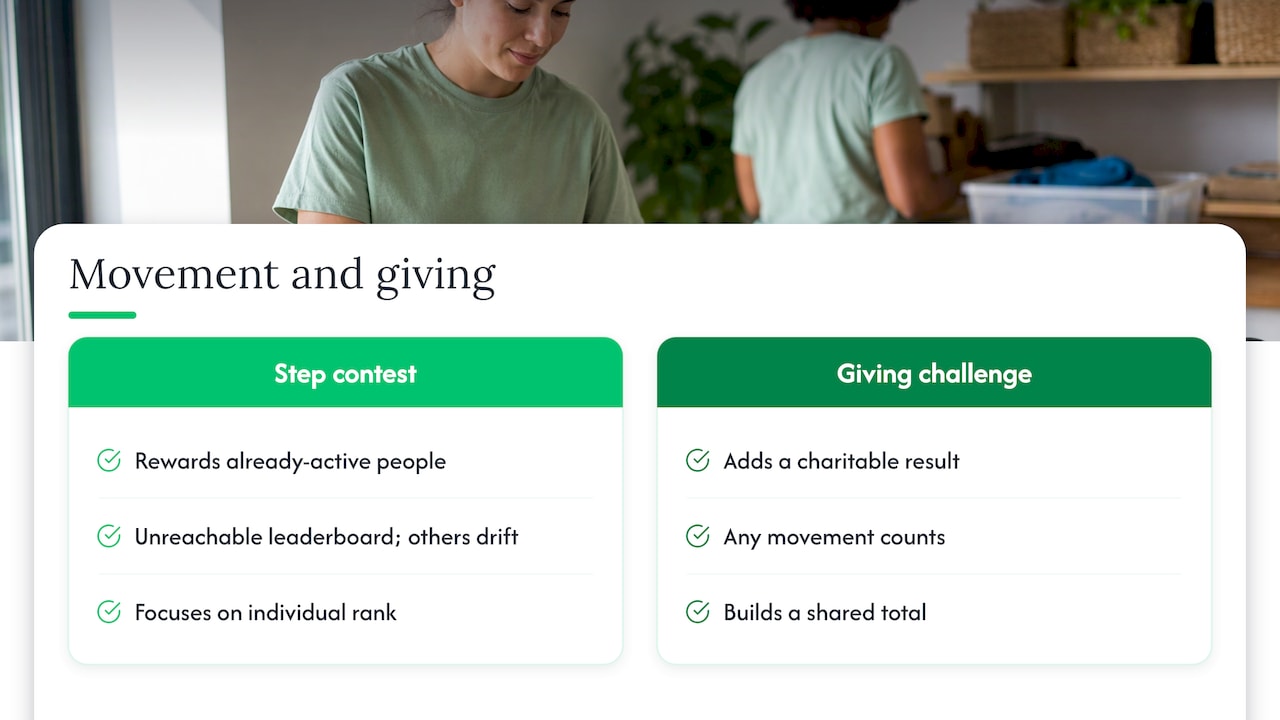
A plain step contest rewards the people who were already active. Once the leaderboard is out of reach, everyone else drifts away. Attaching a charitable result changes the question from “how do I rank?” to “how do we add up?” A short walk now has a purpose beyond a number on a screen.
This is how Charity Miles is built. The free app (iOS and Android) tracks distance by GPS and pedometer when members walk, run or bike, and money is donated to a charity of the member’s choice for every mile logged. It is free for members and free for charities. For companies, the program adds private teams, intra-company challenges and optional sponsorship, where the company sets the rate per mile, the total cap and whether donations go to each employee’s chosen charity or a cause the company selects.
Because any movement counts, the same challenge works for a marathoner and for someone who takes one lunchtime walk a day. That inclusiveness is what keeps an asynchronous challenge from becoming a contest of the already fit.
Asynchronous challenge formats worth considering
The format should match your team’s makeup. These are the ones that work without anyone being online at the same time.
The team mileage total
Everyone logs their own miles, and the team works toward one shared goal over two to six weeks. It is the simplest format and the easiest to explain in a single message. Pick a goal that is ambitious but reachable, then raise it if the team gets there early.
The relay
Each person owns a segment, such as a day or a week, and the team’s effort passes from one person to the next. The best assignments follow people’s calendars rather than their fitness levels, and a relay needs room for swaps and make-up days so one missed day does not sink the group.
Department or office missions
Split the company into teams by function, location or a mix of both. Cross-department teams build more new connections, while department teams build existing bonds. Either way, keep team sizes close enough that the comparison feels fair, or compare teams by average per person instead of raw totals.
The weekly minutes target
A low-bar format asks everyone to reach a weekly activity target in any form they like. The World Health Organization recommends that adults do at least 150 minutes of moderate-intensity activity per week, which makes that figure a sensible, familiar anchor for a weekly goal.
The cause-led sprint
A short, focused push around a single cause or awareness month. Hansei Solutions ran this style with its Miles for Mental Health challenge: each May, every mile logged in Charity Miles contributes to a collective goal and triggers a donation to the Change Your Brain Foundation. A fixed month and a clear cause give people a reason to start now rather than later.
Design rules that keep it inclusive
The usual reason a remote challenge fizzles is not the format. It is a design that quietly assumes a certain kind of person: one who can run at 6 a.m., has no caregiving duties and keeps a regular schedule. A few rules prevent that.
- Count more than one kind of activity. Walking, running, cycling and similar movement should all earn credit. If someone can only manage a short walk, that walk is a full contribution.
- Never require a live event. Make any kickoff or wrap-up optional and recorded, and set deadlines in a way that does not penalize people in other time zones. A rolling window, such as a full 24 hours for each reporting cut-off, is kinder than a single global cut-off time.
- Reward consistency over peaks. A leaderboard that tracks the single biggest day favors athletes. Recognizing the team that logs on the most days, or the most improved team, favors habit.
- Make participation voluntary. No one should feel professional pressure to join. Opt-in sharing and a clear way to leave keep trust high.
- Compare people with themselves where you can. If you do rank individuals, measure progress against each person’s own starting point so job roles with very different activity levels can compete fairly.
These rules cost nothing to adopt, and they are the difference between a challenge 20 percent of people join and one most of the team does.
How to run an asynchronous team challenge, step by step
1. Set one clear purpose
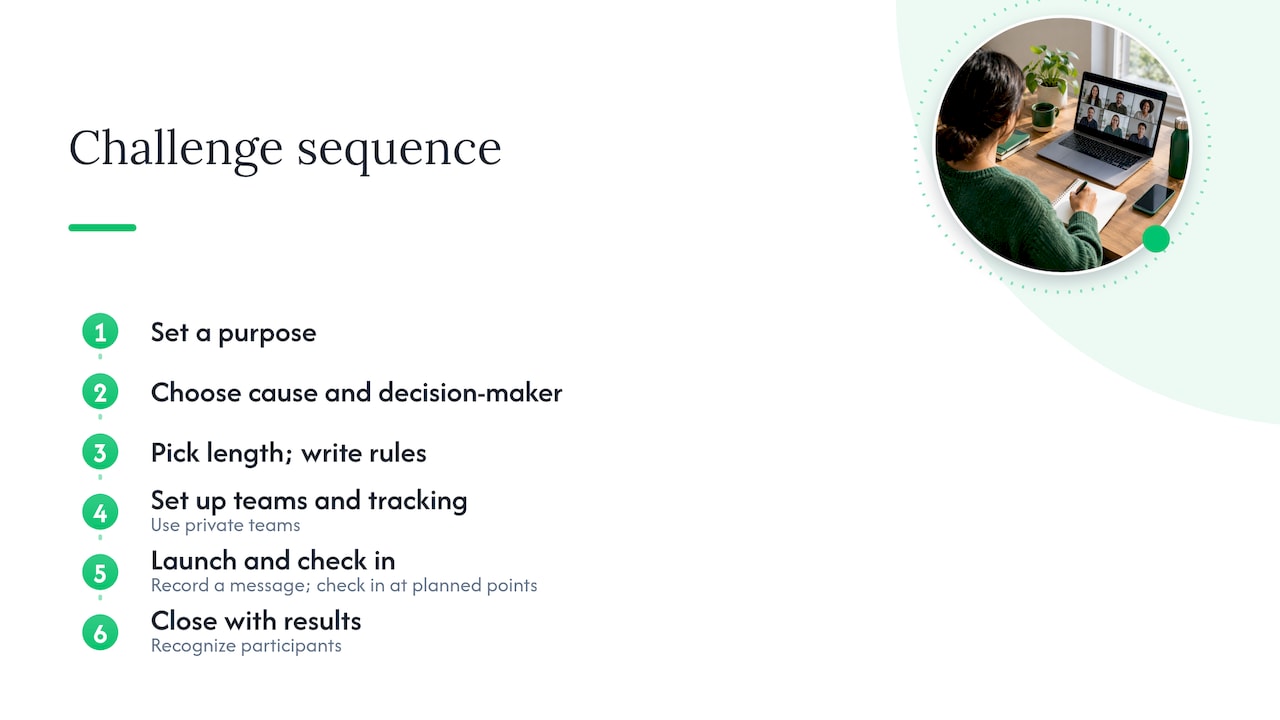
Decide what the challenge is for: connection across a remote team, a wellness push, a CSR commitment, or all three. A single sentence is enough, such as “Move 10,000 miles together in four weeks and fund a cause our team picked.” Everything else flows from that sentence. Teams that combine wellness and giving in one program tend to find the two reinforce each other, because the cause gives the movement a meaning.
2. Choose the cause and who decides
You have two choices. People can direct their own miles to the charity they care about, or the company can name a single cause for everyone. With Charity Miles, a company that sponsors miles decides which: donations can go to each employee’s chosen charity or to a company-selected cause. Individual choice raises personal buy-in. A single cause makes a stronger shared story and a simpler final number. Many teams pick a single cause for the headline goal and let people keep their own charity for everything beyond it.
3. Pick the length
Two to six weeks is the practical range. Shorter than two weeks and people barely form a habit. Longer than six and attention fades unless you add milestones. If you want a longer program, run it as a series of short challenges with a break between them. Our guide to running a credible virtual charity challenge in 2 to 6 weeks lays out that timeline in more detail.
4. Write the rules down
A one-page rule set prevents nearly every dispute. Cover six categories: eligibility, challenge length, tracking method, scoring, verification and deadlines, and recognition. Our wellness challenge rules template gives you a starting point you can adapt. Keep it short enough that someone will read it on a phone.
5. Set up private teams and tracking
This is the step where the manual approach gets heavy. Someone has to collect numbers, reconcile them and post updates. In Charity Miles, the company creates private teams for its employees, and the app tracks each person’s distance automatically by GPS and pedometer, so there is no weekly form to chase. The team sees a running total without an organizer assembling it by hand.
6. Launch with a short, recorded message
Explain the goal, the dates, how to join and what counts. Keep it under three minutes and put it where people already look. Make clear that it is optional and that any movement counts. Post the same message in writing so no one needs to watch the video.
7. Check in at planned points
Schedule four light checkpoints: right after launch to confirm everyone can log, at the midpoint to spot drop-off, in the final week to resolve any questions about totals, and after the end for a review. At each, share the team total and one human detail, such as a photo of a favorite route. These updates do the job the live meeting would have done.
8. Close with results and recognition
Announce the final total, the amount donated and the cause it reached. Recognize things that reward effort and participation, such as most days active or best team spirit, instead of only the top mileage. Then say what the next challenge will be, while momentum is high.
Privacy basics
Any program that tracks activity should handle data with care. Three habits cover most of the risk:
- Keep participation voluntary, with no professional consequence for opting out.
- Report aggregate team totals to managers and HR rather than raw individual numbers.
- Collect only what the challenge needs. Distance and team are enough; detailed body metrics are not.
In the Charity Miles program, teams are private to the company, which keeps the conversation inside the group you intend.
How to measure whether it worked
A challenge you cannot measure is a challenge you cannot improve or defend at budget time. Track three layers, in this order.
Participation. What share of invited employees joined, and what share were still active in the final week? Participation is the first thing that moves, and it is the most honest signal of whether the design was inclusive. Compare it with your last voluntary program or event.
Activity. Total miles, average miles per active person and the number of active days. Averages matter more than totals, since a few very active people can hide a team where most have stopped.
Impact. The total donated, the number of charities reached and, if you ran a pulse survey, how people felt about the company and about each other before and after. Give the survey two or three questions, not twenty.
For a fundraising-oriented challenge, charities often add measures of who is asking for donations and how much each participant raises, because those show whether people are bringing in their own networks. A walking challenge where the company covers the donation will focus more on the first two layers.
What this looks like in real companies
The strongest evidence comes from teams that have run it at scale.
- HARMAN. Since launching its Charity Miles team in 2021, HARMAN saw an 11x increase in employee participation, with more than 1,200 employees generating over $120,000 for charity. The HARMAN pilot playbook walks through how a six-week pilot was structured.
- Principal. Over 5,000 Principal employees took part in the V Foundation for Cancer Research 2025 Charity Miles challenge. The goal was to move at least 1 million miles to raise $1 million, and employees doubled the mileage target to 2 million miles over the year.
- Hansei Solutions. A single-month mental health challenge each May shows how a focused cause can anchor an annual tradition.
Charities use the same pattern outside the workplace. Feeding America’s Team Feed toolkit describes a virtual activity fundraiser where participants cover 53 miles, enter activity manually or sync a fitness device, and share progress with their community. Another nonprofit’s team step count competition idea has groups log the most steps in a week or month, post team totals and invite friends to sponsor miles. Both are asynchronous by nature: the activity happens whenever each person chooses, and the total builds in public.
For more formats, see our list of virtual fundraising ideas and our roundup of CSR activities for teams.
Run your asynchronous challenge with Charity Miles
If you want the tracking, the teams and the giving in one place, the Employee Empowerment program is built for this. Companies create private teams, run intra-company challenges and choose how to sponsor miles: the rate per mile, the total cap, and whether donations go to each employee’s chosen charity or a cause the company selects. Because any movement counts, it works for every fitness level and every time zone. If you are weighing sponsorship options, our corporate sponsorship page explains how companies set their terms.
Prefer to see the app first? Walk through how Charity Miles works or download the app.
Our perspective on asynchronous challenges
Most team challenges fail for a quiet reason: they were designed for the people who were going to be active anyway. A leaderboard of miles tells a busy parent, a night-shift nurse or a new hire in a faraway office that this is not for them.
We built Charity Miles around the opposite assumption. Any movement counts, so a lunchtime walk is as valid as a long run. The miles turn into a donation, so the question shifts from “where do I rank?” to “what did we do together?” That shift is what keeps people logging in week three, when novelty has worn off.
We also think companies should control the terms. Some want to fund each employee’s favorite charity, and others want the whole company behind one cause. Either is a good answer, and the choice of rate per mile and total cap belongs to the company.
Asynchronous is not a compromise for remote teams. Done well, it is the more inclusive way to run any challenge, because it asks people to show up for a goal, not for a time slot.
Gene
FAQ
What is an asynchronous team challenge?
It is a team activity that members complete on their own schedules, with no live session or fixed time. Progress is shared through a running total or leaderboard, so a person in any time zone contributes equally. Movement challenges are a natural fit because the activity itself is independent.
How long should an asynchronous challenge run?
Two to six weeks suits most teams. That is long enough to form a habit and short enough to hold attention. For a longer program, run a series of shorter challenges with a pause between them and a fresh goal each time.
How do you keep a challenge fair for different fitness levels?
Count all kinds of movement, set team goals rather than only individual ones, and reward consistency alongside distance. Charity Miles counts any walking, running or biking, so someone who walks at lunch contributes as meaningfully as a marathoner. Recognition for participation and most active days keeps the focus on effort.
Can a company fund the donations?
Yes. In the Charity Miles Employee Empowerment program, a company can sponsor its employees’ miles and choose the rate per mile, the total sponsorship cap and whether donations go to each employee’s chosen charity or a company-selected cause.
How do you protect participants’ privacy?
Make joining voluntary, share team totals instead of individual numbers with managers, and collect only distance and team. Charity Miles teams are private to the company, so results stay among colleagues.
Sources
- Raising funds one mile at a time (Principal)
- Miles for Mental Health 2026 (Hansei Solutions)
- Team Feed: Meals for Miles Athletic Fundraiser Toolkit (Feeding America)
- Legs for Luke ideas (Live Like Luke)
- Physical activity fact sheet (World Health Organization)