

You can run a strong wellness challenge without counting a single step. Swap steps for minutes of any activity, a points system, a bingo card, or miles logged by walking, running or biking. Each of these lets people who use wheelchairs, have joint pain, work on their feet all day or simply prefer yoga over walking take part on equal terms. This guide covers the formats that work, how to track them fairly, how to add charitable giving, and the planning mistakes that sink participation.
TL;DR
- Replace steps with minutes of any movement, a points system or a bingo card, so every ability level can take part.
- Real programs at universities, school districts and county governments already run this way, and their rules are easy to copy.
- Normalizing activity with a points formula keeps a 60-minute yoga class and a 60-minute run comparable.
- Adding a donation, such as a per-hour company match, gives people a reason to keep going that a leaderboard alone does not.
- Keep it short, make the goal reachable, and offer more than one way to log activity.
Table of Contents
- Why steps are not the only way to measure movement
- Five no-step challenge formats that work
- How to track participation without a step counter
- Make it inclusive from the start
- Add giving to your challenge
- Planning mistakes to avoid
- Perspective: why movement with meaning keeps people going
- Run your no-step challenge with Charity Miles
- A simple four-week plan you can copy
- FAQ
- Sources
Why steps are not the only way to measure movement
A step counter is easy to understand, but it quietly defines “exercise” as walking. Someone who swims, rolls a wheelchair, lifts weights or cycles to work has to translate their effort into a number that does not fit. People who wear no tracker, or whose job keeps them on their feet, are in the same spot.
The need for movement of all kinds is real. According to the CDC, as cited in NASA’s Deskfit Booklet, one in four adults sits more than eight hours a day, and half of Americans do not meet weekly physical activity guidelines. The same booklet cites the U.S. Department of Health and Human Services guidelines: adults need at least 150 to 300 minutes of moderate-intensity aerobic activity a week plus muscle-strengthening on at least two days. Notice that these guidelines are written in minutes and activity types, not steps.
That is the quickest argument for a no-step challenge. Your measurement should match the guidance people are actually trying to meet, and it should not exclude anyone from the starting line.
Five no-step challenge formats that work
1. Minutes-based challenges
Participants log the minutes they move, whatever the activity. This is the simplest swap and the one most employers start with.
The American Heart Association’s Move More Activity Challenge gives participants 30 days to log minutes of any activity, from walking and dancing to vacuuming, toward a goal of 150 minutes per week. Over the 30 days, that equals 300 points. The goal is tied to the national guideline, so the target feels meaningful and not arbitrary.
Duke University’s Get Moving Challenge is a 10-week competition where individuals and coworker teams compete in steps and/or minutes of exercise. People enter weekly stats and play Exercise Bingo for drawing prizes, and weight management can be tracked separately as a non-competitive option. The “and/or” is the useful part: people choose the measure that suits them.
2. Points systems that level the field
Minutes alone can favor people who have more free time or do gentler activities for longer. A points system fixes that by weighting intensity.
The AHA challenge tracks activity in the Heart Walk app, which calculates points from the activity and workout type. Points are normalized using METs (Metabolic Equivalent of Task): walking 60 minutes equals 30 points and running 60 minutes equals 90 points. A simpler version works well for smaller companies. Harnett County’s Fall Into Fitness virtual challenge awards 1 point for every 10 minutes of exercise and requires at least 30 points for prize eligibility. That means five hours of movement over the four-week run, a threshold nearly anyone can reach. The county also offers an optional Bingocize® workshop with inclusive exercises.
3. Bingo cards
Bingo is the friendliest no-step format because it rewards variety and removes the pressure to out-perform a coworker.
The University of Rochester’s Well-U program provides a bingo board that runs all year. Employees check off completed wellness activities and earn Bingo by filling five spaces in any direction, or the whole card. Because the squares can mix physical, mental and social activities, nobody is locked out by a fitness level.
A sample card for your own team might include:
- A 20-minute walk or roll outside
- A stretching or yoga session
- A strength workout at home or the gym
- A bike ride or commute
- A walking meeting
- A healthy lunch with a coworker
- Five minutes of breathing or mindfulness
- A short note thanking a colleague
4. Pick-your-own-activity challenges
The National Center on Health, Physical Activity and Disability (NCHPAD) runs a Wellness Activity Challenge in which participants choose 12 activities from a list, do one each month, and share wins on social media. It is a low-pressure, year-long model that suits teams who find weekly leaderboards stressful.
5. Distance challenges that count every kind of movement
If you like the clarity of a distance goal but not the step counter, track miles. Walking, running and biking all count, and the person doing a lunchtime walk and the person on a bike commute log on the same scale. This is the model Charity Miles is built on, and we cover it in more detail below. For theme ideas that keep a distance challenge fresh, see our guide to walking challenge themes.
How to track participation without a step counter
Tracking is where no-step challenges succeed or stall. The trick is to make logging take under a minute and to accept more than one method.
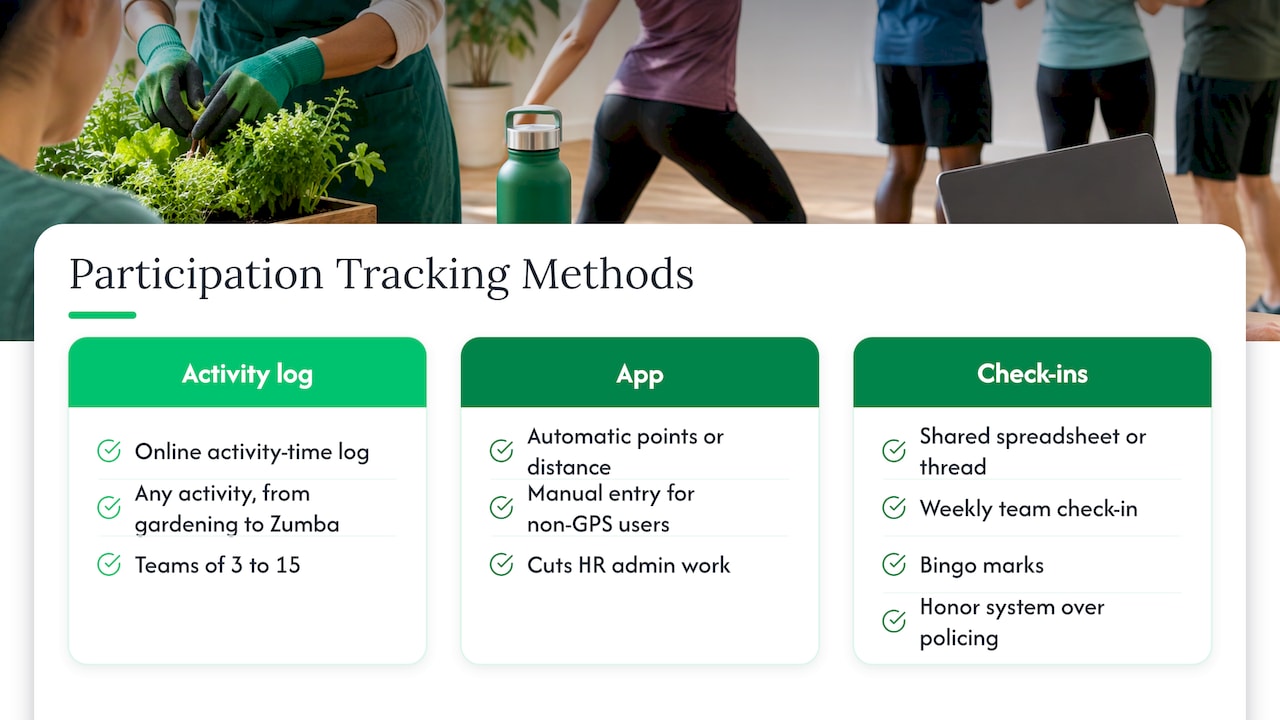
Self-reporting in a log. Montgomery County Public Schools’ Just 10 Challenge is a 10-week program where all staff, from elementary and secondary schools to transportation and central services, log activity time in an online fitness log. Teams of 3 to 15 compete for grand prize grants, and people can log anything from gardening and housework to yoga and Zumba. The program is older, but the design still holds: broad activity definitions, small teams, and a prize that benefits the group.
App-based tracking. Apps can calculate points or distance automatically, which cuts admin work for HR. Choose one that lets people enter manual activity as well, so those who prefer not to use GPS are still included.
Check-ins and bingo marks. For small teams, a shared spreadsheet or a weekly check-in thread is enough. The key is that the honor system works better than policing.
Whatever you choose, set the rule in one sentence: “Log any movement you do on purpose, and 10 minutes equals 1 point.” If employees need a paragraph to understand it, they will not use it.
Make it inclusive from the start
Dropping steps is a good first move, but inclusion needs a few more decisions. NCHPAD’s Inclusive Worksite Wellness Guide advises organizations to check whether employees of all abilities can participate through a variety of activities, such as activity breaks at their desk, walking or wheeling, or tracking activity. It also recommends the AIMFREE tool to assess the accessibility of fitness facilities.
The same guide recommends offering program information in alternate formats, including large print (16 to 18 point font or higher), Braille, documents with little text and more photos, and accessible online formats. It also advises using person-first or identity-first language when referring to people with disabilities in program materials.
A practical checklist:
- List at least five ways to earn credit, including seated, low-impact and indoor options.
- Send the rules in an accessible digital format and offer a large-print copy.
- Let people set their own weekly goal, with the national 150-minute guideline as a reference point and not a requirement.
- Offer a non-competitive track, like Duke’s weight management option, for people who want participation without ranking.
- Ask a few employees with different abilities to read the rules before launch.
If your workforce is remote or hybrid, add one more: let people log from anywhere and share a photo or a one-line update in a team channel. Shared stories do more for virtual engagement than a leaderboard.
Add giving to your challenge
A challenge with a purpose beyond a prize holds attention longer. Two real examples show how donations can be built in.
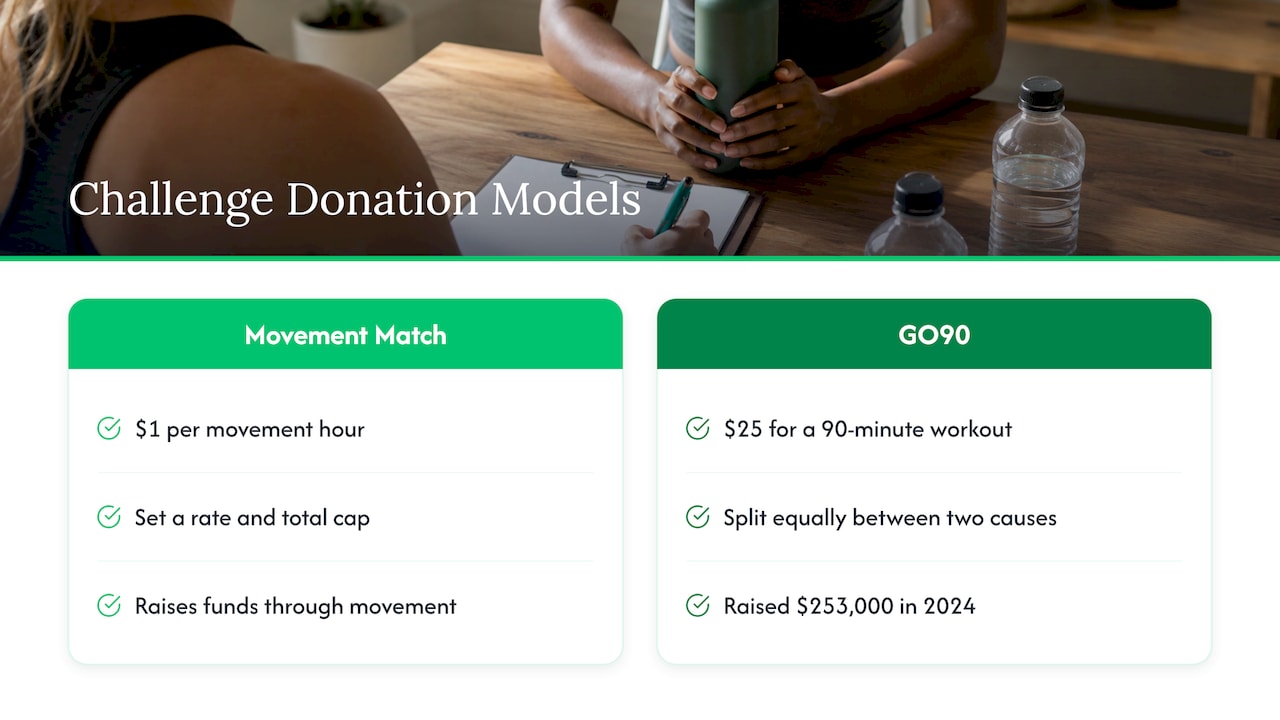
The AHA toolkit recommends a company Movement Match, for example $1 for every hour of movement, to raise funds while encouraging participation. It is easy to budget: set a per-hour rate and a total cap before you launch.
On the community side, Life Time’s GO90: Move with Meaning workout required a $25 donation for a 90-minute workout challenge, with funds split equally between Augie’s Quest to Cure ALS and the Life Time Foundation. Its 2024 debut raised $253,000. The lesson for employers is that a defined, time-boxed movement goal paired with a clear cause can generate real money.
For more ways to connect movement and fundraising, our list of fitness fundraising ideas and the corporate charity challenge playbook walk through formats and budgets.
Planning mistakes to avoid
Most no-step challenges fail for ordinary reasons, not because of the format. These are the ones we see most often.
- Setting the bar too high. A goal that only already-active people can reach turns everyone else into spectators. Pick a threshold most employees can hit in the first week.
- Running too long. Ten weeks works for a structured program with prizes, but a first challenge is easier to finish at two to four weeks. Run a second round if it goes well.
- Offering one way to participate. If the only route to points is a gym workout, you have rebuilt the step challenge problem with a different label.
- Complicated logging. If logging takes more than a minute, participation drops after week one.
- Prizes that reward the already-fit. Use random drawings, team goals or milestone rewards, not only top-of-leaderboard prizes.
- No communication rhythm. A weekly note with a shout-out, a new bingo square or a progress update keeps momentum.
- Ignoring remote staff. Give distributed employees the same tools and the same chance to contribute to team totals.
Perspective: why movement with meaning keeps people going
We built Charity Miles on a simple observation: people move more when the movement matters to them. A step count is a number. A mile that raises money for a cause someone cares about is a reason.
That is why we do not ask employees to chase a step target. Our app tracks distance by GPS and pedometer for walking, running and biking, and any movement counts, whether it is a lunchtime walk, a bike commute or a run. That keeps the program open to every fitness level and not only to athletes.
For HR and CSR leaders, the useful part is control. Through our Employee Empowerment Program, you create private teams, run friendly challenges inside the company, and decide whether to sponsor miles at all. You choose the rate per mile, the total cap, and whether donations go to each employee’s chosen charity or a cause the company selects. It works like a step challenge, but easier to join and woven into company culture, not a one-off event.
The results we have seen point the same direction. Since launching its team in 2021, HARMAN saw an 11x increase in employee participation, with more than 1,200 employees generating over $120,000 for charity. We believe that when wellness, philanthropy and team building live in one place, participation becomes something people choose, not something HR has to chase.
Gene
Run your no-step challenge with Charity Miles
If you want a distance-based challenge that is free for your employees and lets you set the sponsorship terms, our Employee Empowerment Program was designed for this. Employees join private company teams, log walking, running or biking miles in the app, and the company can optionally sponsor those miles on its own terms.
The app is free for members and free for charities. If you want to see how it works before you talk to us, start with how the app works, or look at the options for corporate sponsorship. Teams planning their first event can also use our guide to launching an employee challenge.
A simple four-week plan you can copy
Here is a template that combines the best parts of the programs above.
Week 0, setup. Pick your measure (minutes, points or miles), write the one-sentence rule, and choose a cause or a match rate. Share the rules in an accessible format.
Week 1, easy win. Make the first goal small, such as 30 points or 150 minutes in the week. A quick first success matters more than ambition.
Weeks 2 and 3, variety. Introduce bingo squares or optional activity themes, like a walking meeting day or a stretch break week. Share a team total and one story.
Week 4, finish together. Celebrate the team result, announce the donation, and ask what to change next time. Keep prizes modest and drawn at random for everyone who hit the minimum.
For more structure, our guide to four-week fitness challenges and team challenge ideas include formats you can adapt.
FAQ
What can we use instead of steps in a wellness challenge?
Use minutes of any activity, a points system, a bingo card, or miles for walking, running and biking. Minutes and points are the easiest to explain, and bingo is the most inclusive. Many programs let people mix methods.
How do you keep a points system fair across different activities?
Weight points by intensity. The American Heart Association’s challenge uses METs, so 60 minutes of walking earns 30 points and 60 minutes of running earns 90. If that feels too complex, award 1 point per 10 minutes for everyone, as one county program does.
How long should a no-step challenge last?
For a first run, two to four weeks is a good range because it is long enough to build a habit and short enough to finish. Structured programs with prizes can run 10 weeks. Pick the length that fits your team’s energy and plan a follow-up round.
Can we add charitable giving to a challenge?
Yes. You can match activity with a donation, for example a set amount per hour of movement, or let employees direct donations to a charity they choose. Set the rate and total cap before launch so the budget is clear.
Sources
- Deskfit Booklet, NASA
- Move More Activity Challenge, American Heart Association
- Get Moving Challenge, Duke University Human Resources
- Fall Into Fitness 2026, Harnett County
- Well-U Wellness Challenges, University of Rochester
- The Wellness Activity Challenge, NCHPAD
- Just 10 Program Guide, Montgomery County Public Schools
- Inclusive Worksite Wellness Guide, NCHPAD
- Life Time hosts GO90 Workout, Augie’s Quest