

A hybrid wellness challenge lets people take part in the office, at home or on the road, and counts all of it toward one shared goal. The strongest versions add a cause, so every mile, step or workout also becomes a donation. Below, we walk through how to design one: the format, the rules, the inclusion details, the tracking and the reporting.
TL;DR
- A hybrid challenge has one goal, one scoreboard and several ways to join, so remote and on-site people compete on equal terms.
- Pick a single measure everyone can contribute to (miles are the simplest), then pick the cause, the duration and the fundraising goal before you announce anything.
- Write donation and pledge rules before registration opens, and send participants a simple results summary at the end.
- Make every kind of movement count, so a lunchtime walk matters as much as a long run.
- Charity Miles gives companies private teams, sponsor-controlled donation terms and GPS-tracked miles in one place.
Table of Contents
- What a hybrid wellness challenge actually is
- Why add a cause to the challenge
- Step 1: Choose the cause, the activity and the goal
- Step 2: Choose a format and duration
- Step 3: Make it inclusive from the start
- Step 4: Launch, engage and keep people moving
- Step 5: Track activity and donations
- Step 6: Set donation rules and report the results
- Our perspective: why miles make hybrid challenges work
- Run your hybrid challenge on Charity Miles
- A simple four-week plan you can copy
- Frequently asked questions
- Sources
What a hybrid wellness challenge actually is
The word “hybrid” describes how people take part, not what they do. Some join a group walk in a park or a parking lot. Others log the same activity from their own neighborhood. Everyone’s effort lands on the same leaderboard and counts toward the same goal.
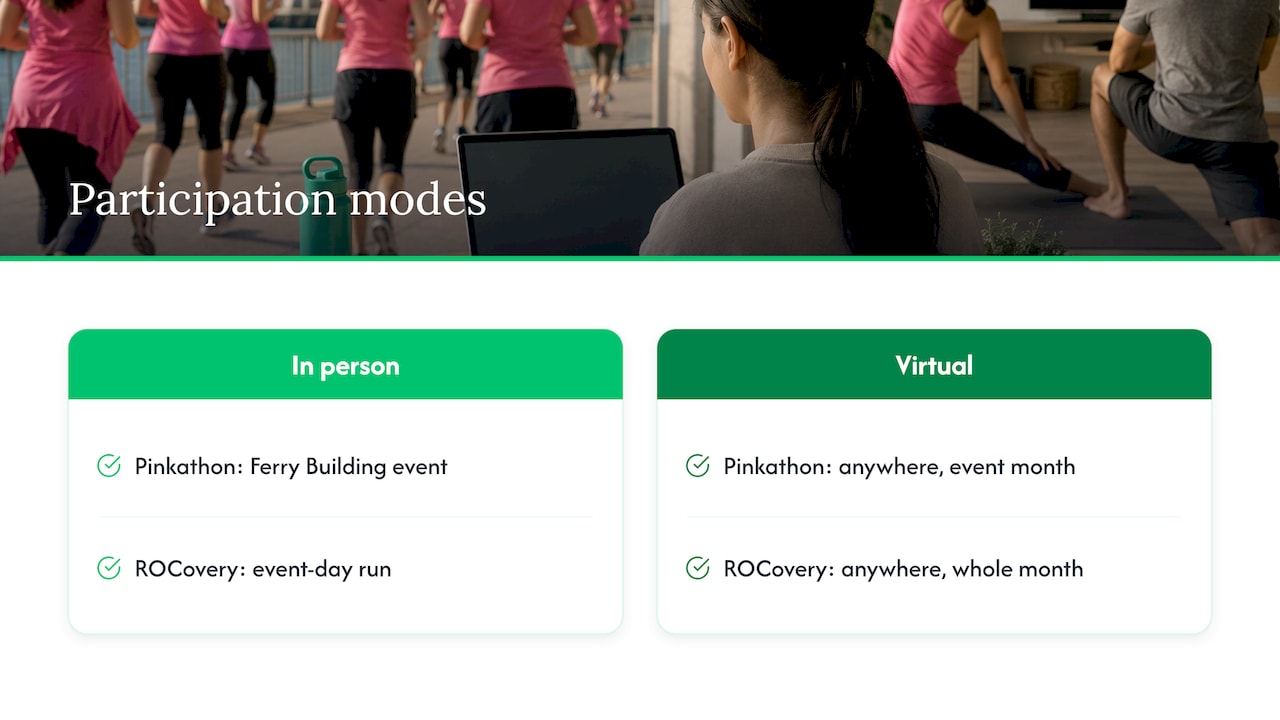
Public fundraising events show the pattern clearly. The Pinkathon offers an in-person event at the San Francisco Ferry Building and a virtual challenge that can be completed anywhere during the event month. It raises money for the Breast Cancer Research Foundation, with a $25 registration and an expectation of voluntary donations. Another example, the ROCovery Run/Walk and X-Challenge in Henrietta, New York, lets people run on the day or enter results from anywhere for the whole month, with a virtual 5K registration of $38.10 including a $3.10 fee.
For a company, the same idea fits a workforce split between headquarters, satellite offices and home desks. You are not running two events. You are running one challenge with two or three doors into it.
Why add a cause to the challenge
A step count on its own is easy to forget. A step count that moves money to a charity the participant picked is harder to ignore. People have a reason to log the walk they would otherwise skip, and a reason to tell a colleague about it.
There is a practical benefit for hybrid teams too. Remote employees often miss the casual moments that build team spirit. A shared cause gives them something to talk about in a chat channel, and gives office-based colleagues the same topic over coffee. We cover the wider case for CSR that employees take part in in a separate guide.
Step 1: Choose the cause, the activity and the goal
Decide these three things first, because every later choice depends on them.
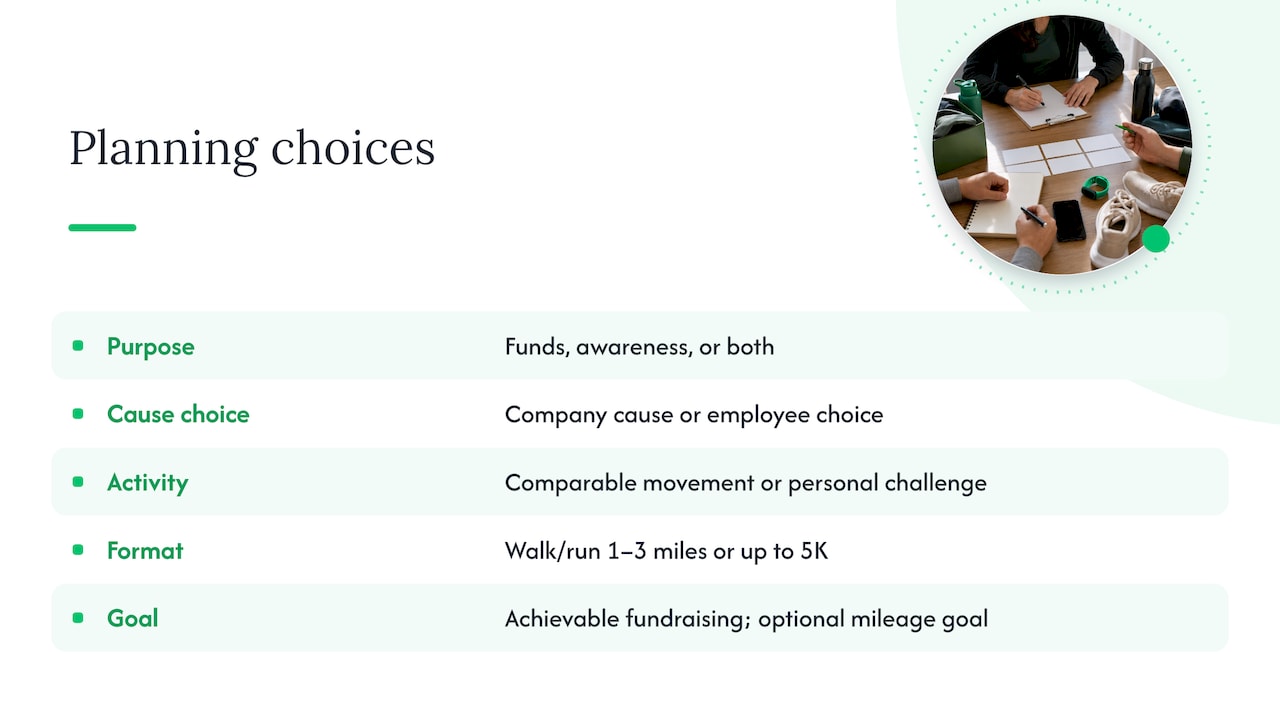
The cause. The SUDC Foundation’s guide to virtual challenge events recommends deciding early whether the event raises funds, awareness or both. For a company, a second choice follows: does each employee pick their own charity, or does the company name one cause? Both work. A single cause gives a clear story. Individual choice gives people personal ownership.
The activity. Walking, running and biking are the easiest to compare across locations, because distance means the same thing in Denver and in Dayton. Memorial Sloan Kettering’s athletic event toolkit suggests formats such as walks or runs of 1 to 3 miles or up to 5K. For virtual events it also describes letting participants choose individual challenges they feel comfortable completing, with a donation set per challenge, for example $10 per push-up completed within an hour.
The goal. The SUDC guide advises a fundraising goal that is achievable but large enough to motivate people. For a company, you can also set a collective mileage goal, such as the distance across the country or around the world, and let the sponsorship cap follow from it.
Step 2: Choose a format and duration
Most hybrid challenges fall into one of four shapes. Pick the one that fits your culture and your calendar.
| Format | How it works | Best for |
|---|---|---|
| Month-long mileage challenge | Everyone logs miles at their own pace; teams compete on total distance | Mixed offices and remote staff |
| Four-week themed sprints | A different focus each week (walking, biking, a team day, a stretch goal) | Keeping interest from fading |
| Kickoff event plus tracking | One in-person or video kickoff, then individual logging | Companies with a main hub |
| Collective destination | The whole company “travels” a set distance together | Large, spread-out organizations |
The collective destination is a good fit for hybrid groups because no one’s contribution looks too small. Mind, a UK mental health charity, suggests workplace ideas such as a collective walk covering the distance between colleagues’ homes, the length of the UK or even the distance to the moon, with steps linked to fundraising. A US company could use the width of the country, or the distance between its offices.
On duration, four weeks is a sensible default. It is long enough to build a habit and short enough to keep a deadline feeling real. Our guide to four-week fitness challenges for community engagement goes into the weekly rhythm in more detail.
Step 3: Make it inclusive from the start
Inclusion is where hybrid challenges usually succeed or fail. A challenge built around a 5K excludes the colleague who uses a wheelchair, the one recovering from surgery and the one who works two jobs and has no free evening. A few design choices fix most of this.
- Count any movement. Walking, rolling, cycling, running and similar activity should all convert to the same unit. If a person can log a slow walk and see it count the same as anyone else’s, they stay in.
- Offer more than one way to contribute. Some teams add points for activities such as volunteering time, so people who cannot be active still add to the total. The NHIF Wellness Challenge, for instance, lets participants log points for self-care activities or donating time to a charity as well as steps and mileage.
- Let people choose their own pace. The BCRF 40-Mile Challenge is built so participants complete miles at their own pace throughout the month. That removes the pressure of a single race day and suits shift workers.
- Avoid body-focused goals. Rank teams on participation and total distance, not on weight or personal performance.
- Share leaderboards by team, not by person. Team totals reward the group, and a newcomer is less exposed than on an individual ranking.
- Time activities across the day. A challenge that runs over a lunch break, a commute and a weekend fits more schedules than one fixed event.
If an employee has a medical condition or a disability, point them to their own clinician for advice on what level of activity is right for them, and keep participation voluntary.
Step 4: Launch, engage and keep people moving
A challenge lives or dies in its first week and its third. Launch with a short message from a visible leader, a clear link to join and a description of the cause in two sentences. Then give people a reason to return.
Teams help. University College London’s step challenge toolkit notes that team members can motivate each other, and captains can encourage them and submit weekly numbers. A captain in each location, including one for remote staff, keeps everyone connected.
Some rhythms that keep interest up:
- Week one: announce the goal and a first small milestone to hit quickly.
- Week two: share a team spotlight, such as the most miles walked on a lunch break.
- Week three: add a fresh twist, such as a bike commute day or a walking meeting day.
- Week four: show the total raised so far and how close the group is to the goal.
For rewards, small and symbolic usually beat large and expensive. Recognition in a company meeting, a donation made in the winning team’s name or an extra volunteering hour all keep the focus on the cause. For more on this, see our overview of corporate wellness ideas that boost engagement.
Step 5: Track activity and donations
Tracking is the part hybrid teams most often get wrong, because a spreadsheet works for 20 people and breaks at 200. You need one system that accepts activity from everywhere.
The NHIF challenge is a useful model. Participants sync data from devices and apps such as Fitbit, Apple Health, Android Health, Garmin and Strava, and join preset teams. The point is that people do not have to re-enter their data by hand, which is the main reason participation drops.
The SUDC guide also lists the committee jobs that sit behind a smooth event: managing timelines, recruiting participants and sponsors, tracking donations and registrations, and keeping everyone informed. Assign these to named people before launch, even if the “committee” is two employees.
At the end, measure what matters to your goals: how many people joined, how many logged activity in the last week, total miles and total dollars donated. Our guide on corporate wellness benefits and ROI lays out how HR teams frame these numbers for leadership.
Step 6: Set donation rules and report the results
Money questions cause more confusion than any other part of a challenge. Settle them early.
The organizer guide from Bike to the Beach advises that you write pledge rules before registration opens, reconcile fundraising records regularly and provide a simple final summary. For a corporate challenge, that translates into a short list of decisions:
- Who pays: the company, individual employees or both?
- What is the rate per mile, and is there a total cap?
- Does each employee choose a charity, or does the company pick one?
- When will the donation be made, and how will employees be told?
Publish the answers in the launch message. Then close the loop. Send one clear summary with the total distance, the total donated, the charity or charities that received it and a thank-you. Participants who see the result are far more likely to join the next challenge.
Our perspective: why miles make hybrid challenges work
Over the years, we have watched many wellness programs struggle with the same problem. They work for the people already at the gym and quietly lose everyone else. A hybrid workforce makes that worse, because the people in the office and the people at home end up in different programs.
We built Charity Miles around one idea: any movement counts. A lunchtime walk, a bike commute and a run all convert to miles, and miles convert to donations for a charity the member chooses. That gives a hybrid team a shared unit that does not depend on where, when or how fast someone moves.
For companies, we add private teams, friendly challenges between groups and optional sponsorship on the company’s own terms. Employers choose the rate per mile, the total cap and whether donations go to each employee’s charity or a cause the company selects. We think that control matters, because the challenge then reflects the company’s values and not a template.
One example is HARMAN. Since launching its Charity Miles team in 2021, it has seen an 11x increase in employee participation, with more than 1,200 employees generating over $120,000 for charity. A hybrid challenge works best when it feels like part of company culture rather than a one-off event, and that is what we aim to help companies build.
Gene
Run your hybrid challenge on Charity Miles
If you want a ready-made way to run this, our Employee Empowerment program lets you create private teams for your employees, run challenges between them and, if you wish, sponsor their miles. Employees track distance with the free app on iOS or Android, and you stay in control of the donation terms.
If you are comparing options, our page on the corporate step challenge shows how a company-wide format works. To see how sponsoring employees’ miles fits a budget, visit our corporate sponsorship opportunities. Individuals who want to try the app first can start with how Charity Miles works.
A simple four-week plan you can copy
Here is a workable template for a mid-size company with employees in an office and at home.
Before launch (two weeks out)
- Choose the cause and the donation rules.
- Name a captain at each location and for remote staff.
- Decide the goal: a total mileage target and, if you sponsor, a cap.
Week one: start
- Send the announcement and the join link.
- Hold a 15-minute kickoff, in person and on video, with a group walk if schedules allow.
- Post the first leaderboard by team.
Weeks two and three: build momentum
- Share one team story per week.
- Add a themed day, such as a walking meeting day.
- Remind people that any movement counts, including slow walks.
Week four: finish
- Show progress toward the goal on day one of the week.
- Close logging on a stated day.
- Send the results summary within a few days.
Nothing here needs a large budget. It needs clear rules, a single tracking tool and someone who sends the weekly updates.
Frequently asked questions
How long should a hybrid wellness challenge run?
Four weeks suits most companies. It is long enough to form a routine and short enough to hold attention. Public events often run a full month for virtual participants, as the BCRF and ROCovery examples above do, and shorter formats such as a single event day suit a kickoff.
How do I keep remote employees as engaged as on-site staff?
Use one scoreboard and one unit of measure, so location does not change how someone’s effort counts. Name a captain for remote staff, and share team stories in the channels people already use. Team totals rather than individual rankings help everyone feel part of the group.
Do we have to sponsor employees’ miles?
No. A challenge can run with employees simply logging miles for a charity of their choice. Sponsorship is an option that raises the stakes, and with Charity Miles you set the rate per mile, the total cap and where the money goes.
What should we measure at the end?
Track participation (how many joined and how many were still active in the final week), total miles and total dollars donated. Add a short employee survey if you want feedback. Sharing a simple summary with participants after the challenge closes keeps goodwill high for the next one.
Sources
- Pinkathon Challenge for Breast Cancer
- ROCovery Run/Walk and X-Challenge on BikeSignup
- SUDC Foundation: Hosting a Successful Virtual Challenge Event
- MSK Athletic Event Tool Kit
- Mind: Hybrid fundraising
- NHIF Wellness Challenge
- BCRF virtual fitness challenge
- UCL steps challenge toolkit
- Bike to the Beach: Bike-a-Thon organizer guide