

The most effective sedentary workplace solutions combine three things: short movement breaks through the day, a workstation that lets people change position, and a team culture that makes moving normal. One fix alone rarely holds. A reminder app fades, a sit-stand desk gets used for a week, and a wellness email gets skimmed. Together, they change how a workday feels.
This guide is for HR, CSR and wellness leaders, and for anyone who sits most of the day and wants a realistic plan. We cover what the research says, what to do hour by hour, how to equip a desk, and how to build a program people join because they want to.
TL;DR
- Interrupt sitting often: research reviewed by Cochrane found that one to two minutes every half hour cut sitting at work by about 40 minutes a day.
- Sit-stand desks help, but they work best with encouragement and a team habit rather than as a standalone purchase.
- Start low and go slow: the CDC advises building activity gradually, especially after years of sitting.
- Keep participation voluntary and inclusive, so every fitness level can take part.
- Charity-linked team challenges give movement a purpose beyond the step count, and that purpose is what keeps people going.
Table of Contents
- What counts as sedentary work, and why it matters
- Solution 1: Build movement breaks into the day
- Solution 2: Change the workstation
- Solution 3: Make movement a team habit
- A 90-day plan for HR and wellness leaders
- Turn desk-bound days into donations
- Easing in after years of sitting
- Common obstacles and how to solve them
- FAQ
- Sources
What counts as sedentary work, and why it matters
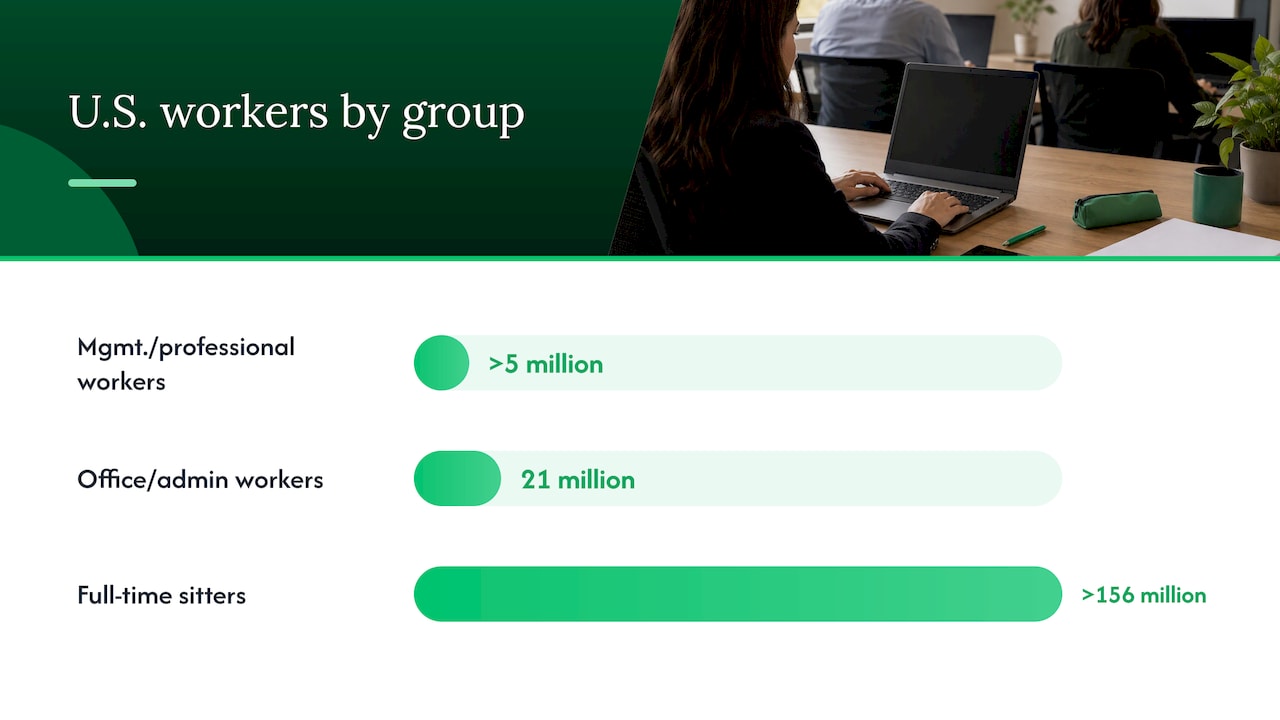
NIOSH defines a sedentary job as one that involves mainly sitting, with occasional walking, standing and lifting of no more than 10 pounds. In the same publication, it notes that more than 5 million U.S. workers hold management and professional positions and 21 million work in office and administrative support, all roles with long stretches at a desk (NIOSH, Total Worker Health). The CDC’s workplace guide puts the number of full-time U.S. workers who spend significant time sitting at more than 156 million (CDC Physical Activity Breaks guide).
The health concern is well documented. NIOSH links prolonged sitting with back and shoulder pain, diabetes, metabolic syndrome, obesity and premature mortality, and notes that these risks may persist even when a worker exercises in their free time. Mayo Clinic describes a cluster of effects tied to extended sitting: higher blood pressure, high blood sugar, extra waist fat and unhealthy cholesterol. It also reports an analysis of 13 studies covering more than 1 million people. Those who sat more than eight hours a day with no physical activity had a mortality risk comparable to that of obesity and smoking. Roughly 60 to 75 minutes of moderate aerobic activity a day offset the effects of too much sitting (Mayo Clinic).
Two takeaways shape everything below. First, a gym session after work is good, but it does not fully cancel a day in the chair, so the workday itself has to change. Second, you do not need to fix this with intense exercise. Frequent, small interruptions are the foundation.
Solution 1: Build movement breaks into the day
Breaks are the cheapest, fastest change, and the evidence on timing is practical.
How often to move
The Cochrane review of workplace interventions found that short breaks, one to two minutes every half hour, reduced sitting time at work by an average of 40 minutes per day compared with two longer 15-minute breaks (Shrestha et al., 2018). Frequency beats duration.
Other health organizations land in a similar place:
- The Society of Behavioral Medicine suggests a computer reminder at least once every 30 minutes, plus a fitness tracker with inactivity alerts (SBM).
- UCLA Health recommends an automatic timer to get you up at least once an hour (UCLA Health).
- Mayo Clinic describes movement “snacks”: two or three minutes of stairs or pushups after an hour of sitting, with a goal of sitting less than three or four hours a day for those who are able (Mayo Clinic News Network).
If you want one rule, use this: move for a minute or two every 30 minutes, and take a slightly longer walk once an hour.
What to do in a break
The CDC’s guide is built around short activity breaks of five to ten minutes for employers of any size or industry. For micro-breaks at the desk, MU Health lists heel raises, glute squeezes, shoulder blade squeezes, sit-to-stands, triceps dips and chin tucks (MU Health). UCLA Health adds easy swaps: take the stairs, and walk over to a coworker instead of sending a message or calling.
A sample day for an office or hybrid worker:
| Time | Movement | Length |
|---|---|---|
| Start of day | Walk part of the commute, or a lap around the block before logging in | 5 to 10 minutes |
| Every 30 minutes | Stand, stretch chest and shoulders, refill water | 1 to 2 minutes |
| Mid-morning | Walking one-on-one or stairs between meetings | 5 minutes |
| Lunch | Outdoor walk, ideally with a colleague | 15 to 20 minutes |
| Mid-afternoon | Desk strength moves such as sit-to-stands | 3 minutes |
| End of day | Walk or bike home, or a short walk before dinner | 10+ minutes |
None of this requires special clothing, a shower or a gym membership, which is why it is inclusive.
Solution 2: Change the workstation
Breaks are about behavior. The workstation makes the behavior easier.
Sit-stand desks
The Cochrane review found that sit-stand desks, alone or with information and counseling, reduced sitting at work by an average of 100 minutes per workday in the short term (up to three months) compared with standard desks. The reviewers rated the evidence low-quality. At 3 to 12 months, the reduction was an average of 57 minutes per day, and total daily sitting, including time outside work, fell by 82 minutes in two studies (Cochrane review).
A network meta-analysis of 23 randomized trials found that a sit-stand workstation with promotion, a treadmill workstation with promotion, a sit-stand workstation alone and multicomponent programs all reduced occupational sedentary time. The multicomponent approach showed the largest effect (Zhou et al., 2023). The pattern is clear: the desk helps, and the desk plus encouragement helps more.
Standing is not the goal, variety is
NIOSH stresses that mobility counteracts the harms of both prolonged sitting and prolonged standing. Its bulletin on standing concluded that dynamic movement appeared to be the best solution, such as walking around or easily shifting between sitting, standing and leaning (NIOSH Science Bulletin). A workplace that lets people sit or stand as they wish is, in NIOSH’s words quoting Grandjean, highly recommended from a physiological point of view.
So when you budget for equipment, think flexibility:
- Adjustable-height desks or desktop risers where possible.
- A comfortable, neutral posture when seated.
- Layouts that put printers, water and meeting rooms a short walk away.
- Walking-friendly meeting norms, such as walking one-on-ones and phone calls taken on foot.
Solution 3: Make movement a team habit
Individual willpower runs out. Culture does not. NIOSH recommends visible senior management support, worker participation in designing the solutions, more control over schedules and workloads, privacy, and voluntary participation without coercive incentives or penalties (NIOSH).
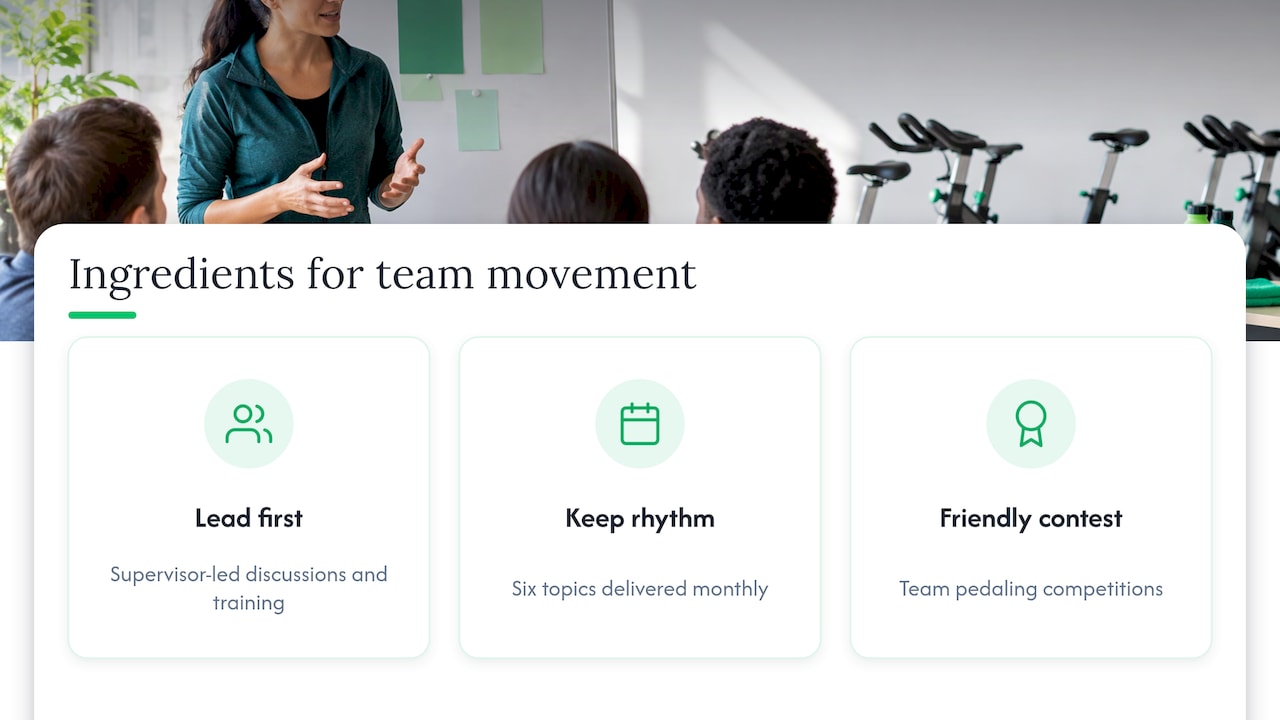
There are good models for the structure. The OHSU Active Workplace toolkit was designed for sedentary occupations and includes 15-minute trainings on six topics, delivered monthly: sedentary behavior, ergonomics and injury, stress management, physical activity, sleep and nutrition (OHSU). A six-month intervention built on the Total Worker Health approach combined supervisor-led discussions and training with team pedaling competitions, goal setting and self-monitoring (Wipfli et al., 2024).
Three ingredients show up repeatedly: leaders who go first, a rhythm of recurring activity rather than a one-off event, and friendly team competition. That is the same logic behind a well-run corporate step challenge, and our guide to fitness challenge ideas for workplace wellness compares formats so you can match one to your workforce.
Give the movement a reason
A step count is abstract. A mile that generates a donation is concrete. When people connect personal movement with a cause they chose, a lunchtime walk stops being a chore and becomes a small act of giving. This is the idea behind our work, and the reason we think charitable challenges suit sedentary teams so well: any movement counts, so the person who walks at lunch contributes as much as the weekend runner.
Our perspective on sedentary work
We have seen the same pattern across the companies we work with: people do not stay active because a policy says so. They stay active when movement is easy, shared and meaningful. A reminder to stand up competes with a full calendar. A teammate asking whether you are joining the lunch walk, so the team can hit its mileage goal for a cause you all picked, is much harder to ignore.
That is why we built our Employee Empowerment Program around private company teams, friendly challenges and optional sponsorship. Companies choose the rate per mile, the total cap, and whether donations go to each employee’s chosen charity or a company-selected cause. Because walking, running and biking all count, the program includes people at every fitness level, including those who have spent years at a desk and are just starting.
Our own example: since launching a Charity Miles team in 2021, HARMAN saw an 11x increase in employee participation, with 1,200+ employees generating over $120,000 for charity. Results differ by company, but the lesson holds. Pair a healthy habit with a purpose, and participation follows.
Gene
A 90-day plan for HR and wellness leaders
You do not need a large budget to begin. Here is a sequence that follows the research above.
- Weeks 1 to 2: Listen and set the baseline. Involve employees and their representatives in designing the plan, as NIOSH recommends. Ask what gets in the way: back-to-back meetings, no safe place to walk, or no sense that breaks are allowed.
- Weeks 3 to 4: Make breaks official. Have leaders announce that short breaks are expected, and model them. Schedule meetings to end five minutes early so people can stand and walk.
- Weeks 5 to 8: Launch a team challenge. Keep it voluntary, welcome every kind of movement and let people join on their own terms. Pick a shared cause so the effort has meaning.
- Weeks 9 to 12: Improve the environment. Use what you learned to add adjustable desks, walking routes or standing meeting areas where the need is clearest.
- Ongoing: Keep a monthly rhythm. Like the OHSU toolkit, rotate short topics (stress, sleep, ergonomics, movement) so the program stays fresh.
For remote and hybrid teams, the same plan works if movement is tracked individually and shared at team level. See how we approach CSR initiatives for remote employees for more.
What to measure
Pick a few simple indicators and review them monthly:
- Participation rate: the share of eligible employees who log movement at least once.
- Active teams: how many teams have members logging movement each week.
- Miles or minutes moved, in total and per participant.
- Qualitative feedback: energy, mood and whether breaks feel allowed.
- Charitable impact, if you sponsor miles.
Our engagement reporting playbook explains how to turn these into updates for HR and CSR stakeholders.
Turn desk-bound days into donations
If you want a ready-made way to put solution three into practice, our Employee Empowerment Program lets you create private teams, run intra-company challenges and optionally sponsor employees’ miles on your own terms. The Charity Miles app is free for members and uses GPS and a pedometer to track walking, running and biking, with money going to a charity each member picks.
Learn how the Employee Empowerment Program works, explore corporate sponsorship opportunities, or see how the app works for individual members.
Easing in after years of sitting
For employees who have been inactive for a long time, the message needs care. The CDC tells employers to communicate “start low and go slow”: raise activity gradually, begin with lower-intensity activities, and build how often and how long you do them. If anything hurts, stop. And if you have a chronic condition or symptoms, speak with a health care professional or physical activity specialist about appropriate activity levels (CDC).
MU Health’s Rousseau adds a useful point: when circulation slows, energy drops and less blood reaches the brain, and habits stick more easily when you pair movement with work tasks than when you try to add a full workout. A few practical ways to do that:
- Stand for every phone call.
- Walk to a colleague’s desk instead of messaging.
- Take the stairs for one or two floors, then build up.
- Fill your water bottle at the far end of the floor.
- Walk for the first five minutes of a one-on-one.
These are small, but they stack. Over weeks, a two-minute walk becomes a ten-minute one, and the lunchtime stroll becomes the part of the day people look forward to.
Common obstacles and how to solve them
“I’m too busy.” Anchor movement to something you already do. Take calls on foot, or stand during the first minutes of every meeting. Leaders can help by building buffer time into the calendar.
“Our building doesn’t have a good place to walk.” Map a short loop outside or use a hallway or stairwell. For remote teams, the neighborhood works. Any movement counts, so no special space is needed.
“Only the already-fit people join.” Choose challenges that reward participation and team totals rather than individual speed. Keep sign-up voluntary and avoid penalties, in line with NIOSH guidance.
“It fades after a few weeks.” Use a recurring schedule, rotate themes and keep the cause visible. The monthly rhythm in the OHSU and Wipfli programs is designed for exactly this.
For more ideas on keeping programs fresh, see our collection of corporate wellness ideas that boost engagement.
FAQ
What is sedentary work?
Sedentary work involves mainly sitting, with occasional walking, standing and light lifting of up to 10 pounds, according to the NIOSH definition. Typical examples are office, administrative, management and professional roles. Many call-center, software and finance jobs fit this description.
How long should you sit a day?
There is no single magic number, but Mayo Clinic suggests sitting less than three or four hours a day is a good goal for those who are able. Breaking up sitting matters too: short interruptions every 30 to 60 minutes are linked with less time spent sitting at work.
How do you not be sedentary at work?
Stand and move for a minute or two every half hour, take a longer walk at lunch, and use stairs or walking conversations where you can. If your employer offers adjustable desks or team challenges, use them. A workplace challenge adds social support that makes the habit last.
How do you reverse years of sitting?
Build up gradually. The CDC advises starting with lower-intensity activity and slowly increasing how often and how long you move. Stop if something hurts, and talk to a health care professional first if you have a chronic condition or symptoms.
Are sit-stand desks enough on their own?
They help: a Cochrane review found reductions of about 100 minutes of sitting per workday in the short term. A network meta-analysis found that adding promotion to the desk was more effective than the desk alone, so pair equipment with breaks and team encouragement.
Sources
- NIOSH: Workplace Solutions, Total Worker Health concepts
- Mayo Clinic: Sitting risks
- Mayo Clinic News Network: Active work stations
- CDC: Physical Activity Breaks for the Workplace
- Cochrane review: Workplace interventions for reducing sitting at work
- Society of Behavioral Medicine: Move More and Sit Less
- UCLA Health: How to stay active with a desk job
- MU Health: 5 Ways to Stay Active at Work
- NIOSH Science Bulletin: Prolonged Standing at Work
- Zhou et al., 2023: Effects of active workstations
- OHSU Active Workplace User Guide
- Wipfli et al., 2024: Workplace sedentary behavior intervention