

Integrating wellness with corporate social responsibility means running one program that improves how employees feel and also does good for a cause. Instead of a gym discount in one budget and a charity drive in another, you connect them. Employees move, a donation follows, and both the HR team and the CSR team report on the same activity. This guide covers what that looks like, what the evidence says, how to design it, and how to measure it.
TL;DR
- Wellness and CSR integration joins physical, social and emotional health goals with giving, so one activity serves both.
- Research on workplace health promotion and employee giving supports the link, and the best programs let employees choose the cause.
- Start with movement that anyone can do, such as walking, set a donation rule, and give the program a clear owner.
- Track participation, activity and funds raised from day one, and handle employee health data with care.
- We built the Employee Empowerment program for exactly this: private team challenges with company-controlled sponsorship.
Table of Contents
- What wellness and CSR integration actually means
- Why the two work better together
- Activities that connect wellness and social impact
- How to design an integrated program in six steps
- Measuring what matters
- Privacy and trust
- Where grassroots supporters and charities fit
- Bring wellness and giving together with Charity Miles
- FAQ
- Sources
What wellness and CSR integration actually means
Most companies already run both programs. Wellness lives with HR and benefits. CSR lives with communications, sustainability or a foundation. They often serve the same employees, yet they rarely share goals, data or a calendar.
Integration closes that gap. Academic work on this topic points to the overlap: a systematic review of CSR and workplace health promotion finds that the two meet in areas such as safe working environments, nutrition, and lifestyle support like sport and fitness. In other words, CSR has always included how a company treats its own people, and health is part of that.
The idea is not new at the policy level either. BSR’s report A New CSR Frontier: Business and Population Health argues that companies should treat health and wellness as a wider stakeholder and value chain issue. It recommends measurable KPIs with transparent reporting and a cross-functional health network, so that wellness and prevention sit inside the broader CSR agenda.
In practice, an integrated program has three parts:
- A health-supporting activity. Something employees do for their own wellbeing, such as walking, running, biking or volunteering.
- A giving mechanism. The activity triggers or unlocks a donation, a volunteer opportunity or a contribution to a cause.
- Shared measurement. One set of numbers answers both the HR question (who took part?) and the CSR question (what did we give?).
Why the two work better together
Giving connects to wellbeing
Wellness is usually described in four parts: physical, financial, social and emotional. Benefits Canada notes that philanthropy connects directly with social and emotional wellness, and that creating connections and giving back are good for people. A program that asks employees to move and to help others touches all of those at once.
Wellness programs can pay off in the workplace
The evidence on corporate wellness is encouraging when programs are well run. A study by Lamar Pierce at an industrial laundry company, Doing Well by Making Well, found that average worker productivity rose by nearly 5% after a wellness program was introduced. Employees who were already healthy and whose health did not change still showed a 7.5% productivity increase. That suggests part of the effect comes from how people feel about their employer, not only from health changes.
Employees give more of themselves when the cause matters
Research on skills-based volunteering from James Cook University found that the motive of helping others mattered more than self-interest in encouraging employees to take part, and that organizational support reduced worries about committing time. The same logic applies to movement-based giving. When a mile has a purpose beyond the step count, people have a reason to keep going after the first week.
The UK’s Royal Voluntary Service reports that 46% of businesses agree corporate volunteering is an effective wellness benefit, and 44% say it has improved wellbeing across their organisation. That is a UK survey, but it matches what many US HR teams report anecdotally.
Leading companies already link community and employee engagement
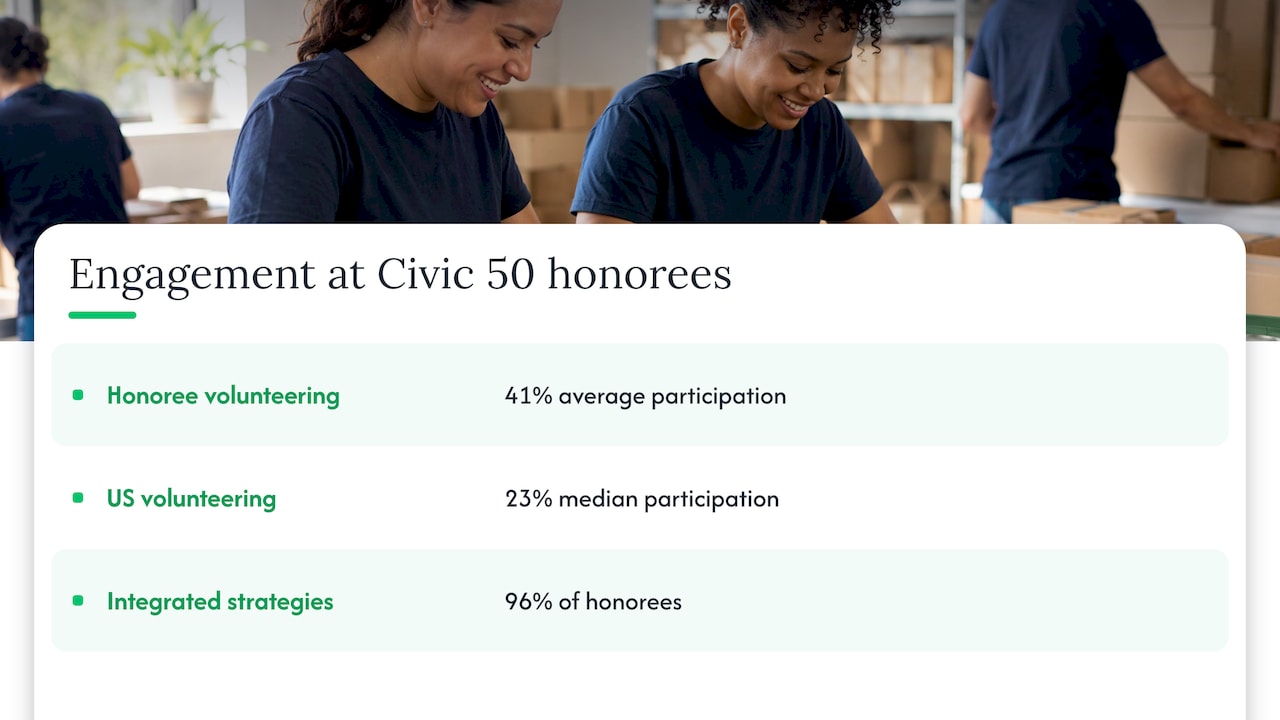
The Civic 50 2025 report from Points of Light shows how this looks among US community-minded employers. Honorees engaged 41% of employees on average in external volunteering, against a US median of 23%, and 96% of them integrated community engagement with their employee engagement strategies. The companies that give the most are, in large part, the ones that treat giving as part of how they engage their workforce.
Activities that connect wellness and social impact
Not every activity fits every workforce. Here are the formats we see most often, and what each one asks of your team.
| Activity | Wellness benefit | Giving link | Best for |
|---|---|---|---|
| Walking, running and biking challenges | Physical activity, stress relief | Donation per mile | Mixed fitness levels, hybrid teams |
| Team volunteering days | Social connection, purpose | Hours given to a cause | Co-located teams |
| Skills-based volunteering | Meaning, new skills | Professional help for nonprofits | Specialist teams |
| Wellness points converted to donations | Any healthy habit | Employee-chosen charity | Large, varied workforces |
| Matching programs | Financial and emotional wellness | Company matches personal gifts | Employees who already give |
Benefits Canada suggests that wellness programs could offer a donation to a charity of the employee’s choice as a reward for completing challenges or showing certain behaviors. It also recommends broadening matching programs to cover charities employees choose, not only ones the organization picks.
If you want ideas for the challenge format, our guide to fitness challenge ideas for workplace wellness compares options by effort, inclusiveness and fit. If skills are a better match for your culture, see what HR needs to know about skills-based volunteering.
How to design an integrated program in six steps
SHRM’s research on employee volunteering and giving programs names six drivers of effectiveness: cause-effective configuration, strategic business positioning, sufficient investment, a culture of engagement, strong participation and actionable evaluation. Its report, Mapping Success in Employee Volunteering, is a useful checklist. Here is how we translate it into steps for a wellness-led program.
- Name one owner and one shared goal. Put HR and CSR in the same room. Agree on one sentence, for example: more employees moving each week, and more money reaching causes they care about.
- Start with inclusive activity. If the entry bar is a marathon, you will reach the same 10% who were already active. Walking, a lunchtime loop or a bike commute lets everyone count.
- Let employees choose the cause, or offer both options. Choice builds ownership. Some companies prefer to direct donations to one company cause, and that works too when the story is clear. You can also combine the two.
- Set the sponsorship rule before launch. Decide the rate, the cap and the period. A defined budget removes the fear of runaway costs and makes the finance conversation simple.
- Make it social. Team challenges, friendly competition and visible progress turn individual effort into shared culture. For remote staff, see our notes on CSR initiatives for remote employees.
- Plan the reporting up front. Know what you will report, to whom and how often, before the first mile is logged.
Make it easy to join
The SHRM drivers include a culture of engagement and strong participation, and both depend on friction. If joining takes more than a couple of minutes, participation drops. Pick a tool that works on the phones employees already have, and let them join without a long form or a new login to a system they will never use again.
Keep it voluntary
Participation in wellness and giving should be a choice. A 2024 systematic review in Management Review Quarterly found that understanding the different effects of CSR on employees helps organizations design policies that foster positive attitudes and behaviors and reduce negative effects. For a wellness-led program, that means no leaderboard that shames low performers, no pressure to disclose fitness levels, and recognition for effort, not only for the highest totals.
Measuring what matters
Integration only pays off if you can show it. The Civic 50 report notes that fewer than two-thirds of honorees measure societal outcomes for each major component of their community engagement, and fewer than two-thirds measure how community programs affect business functions such as health and wellness or employee engagement. Many leading companies, in other words, still have room to measure better. BSR’s recommendation of measurable KPIs with transparent reporting points the same way.
A simple scorecard covers both audiences:
| Question | Metric | Who cares |
|---|---|---|
| Are people joining? | Enrollment rate and weekly active participants | HR, leadership |
| Is it inclusive? | Participation by location, department and activity level | HR, DEI |
| Are people moving? | Miles or minutes logged per participant | Wellness |
| Is it doing good? | Funds donated, causes supported | CSR, communications |
| Does it last? | Participation after 30, 90 and 180 days | Everyone |
| Is the culture shifting? | Pulse survey on connection and purpose | HR |
For a deeper look at methods, read how to measure the impact of a corporate wellness program and our lifecycle guide to engagement reporting for HR and CSR.
One caution on interpretation: participation and donations are outputs. Wellbeing and engagement change more slowly, so use a survey baseline before launch and compare at set intervals instead of promising outcomes in the first month.
Privacy and trust
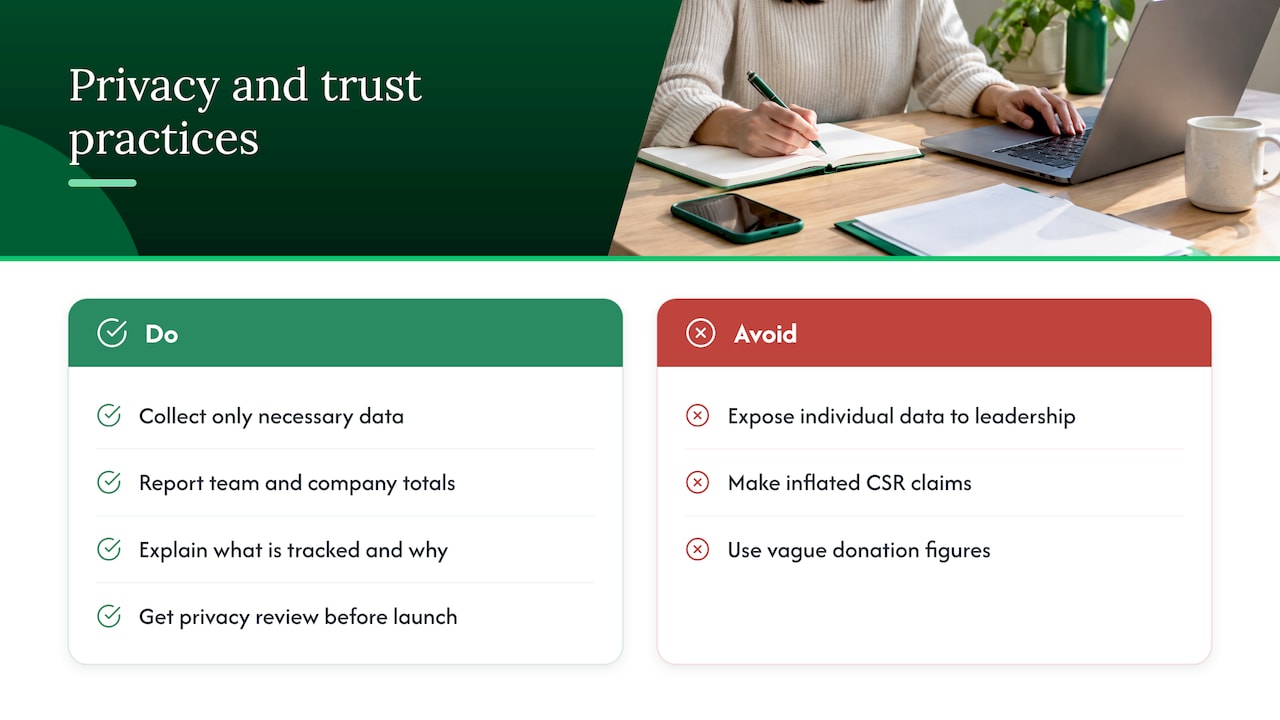
Wellness data is personal. Even step counts and mileage can reveal habits, so the program should collect only what it needs. Good practice is to report team and company totals to leadership, keep individual data visible only to the employee, and tell people plainly what is tracked and why. Your legal and privacy teams should review the design before launch, particularly if the program touches health information or operates across states or countries. Platforms for privacy and compliance management can help organizations document data processing and assign responsibility for it.
On the CSR side, avoid inflated claims. Report what was donated and to whom, and describe the outcome in plain terms. A small, accurate number builds more trust than a large vague one.
Where grassroots supporters and charities fit
Integration is not only an employer story. Movement-based giving also lets individuals and charities take part. People log a walk, run or bike ride, and a donation goes to a charity they pick. Charities benefit when supporters carry their cause into daily routines instead of waiting for an annual event. When a company joins, those supporters become a team, and the charity gains a wider audience. The same app that employees use at work is free for individuals to use on their own, so a workplace program can grow into a habit that continues outside it.
Our perspective
We have spent years watching what keeps people moving, and the answer is rarely a prize. It is purpose. When a lunchtime walk also sends money to a cause an employee picked, the walk stops being a task and becomes something they want to tell a coworker about.
That is why we believe wellness and CSR belong in one program. Companies that run them separately ask employees to care twice, once for a step goal and once for a giving campaign. Combining them asks once, and it counts all movement, not only athletic activity, so people at every fitness level can contribute.
We also believe companies should be in control. In our Employee Empowerment program, the company chooses the rate per mile, the total sponsorship cap, and whether donations go to each employee’s chosen charity or to a company-selected cause. That control is what lets HR and CSR leaders commit with confidence.
The results we have seen support the approach. Since launching its Charity Miles team in 2021, HARMAN saw an 11x increase in employee participation, with more than 1,200 employees generating over $120,000 for charity. Read the full story in our guide to activity-based giving at work.
Gene
Bring wellness and giving together with Charity Miles
Charity Miles is a free app for iOS and Android that tracks walking, running and biking by GPS and pedometer, and donates to the charity each member chooses for every mile logged. For companies, our Employee Empowerment program adds private teams, intra-company challenges and optional sponsorship on terms you set: the rate per mile, the total cap and where the money goes.
If you want to see how sponsorship works, explore corporate sponsorship opportunities. If you would rather pilot first, our pilot playbook for HR leaders walks through a small launch. You can also see how the app works before you involve your team.
FAQ
What is the difference between a wellness program and a CSR program?
A wellness program focuses on the health of your own employees. A CSR program focuses on your company’s impact on society. Integration connects them, so an activity that supports employee health, such as a walking challenge, also generates a donation or community benefit.
Do wellness and CSR programs improve employee engagement?
The evidence is encouraging but depends on design. The Pierce study found a productivity gain of nearly 5% after a wellness program, and Civic 50 honorees nearly all link community work with employee engagement. Results vary by company, so set a baseline and track change over time.
How much should a company sponsor per mile?
There is no single right rate. The best approach is to set a per-mile rate and a total cap that fit your budget, and to decide ahead of time whether donations go to employee-chosen or company-chosen causes. With Charity Miles, the company sets those terms.
Can remote and hybrid employees take part?
Yes. Movement-based programs work anywhere because employees log activity wherever they are, and private teams let colleagues compete or cheer each other on across locations. Our guide to CSR initiatives for remote employees covers the details.
How do we handle employee privacy?
Collect only what you need, share team-level totals with leadership, and explain the data use in plain language before launch. Involve your legal or privacy team in the design, especially if health information is involved.
Sources
- Corporate social responsibility and workplace health promotion (systematic review, PMC)
- A New CSR Frontier: Business and Population Health (BSR)
- Doing Well by Making Well: The Impact of Corporate Wellness Programs on Employee Productivity
- Achieving triple win with skills-based volunteering (James Cook University)
- About Corporate Volunteering (Royal Voluntary Service)
- The Civic 50 2025 Honoree Insights and Benchmarking Report (Points of Light)
- How to tie workplace philanthropy into employee engagement and wellness (Benefits Canada)
- Mapping Success in Employee Volunteering (SHRM)
- CSR and employee outcomes: a systematic literature review (Management Review Quarterly)