

The best way to allocate a wellness budget is to start with a business goal, assess what your people need, split the money across a few categories instead of one big bet, and measure results before the next cycle. Spend where participation is likely and where you can track an outcome. Cut what nobody uses.
That approach works whether you manage a six-figure HR budget or a few thousand dollars at a nonprofit. Below we walk through how to set priorities, how to divide the money, what the tax rules mean for your choices, and how to stretch a small budget.
TL;DR
- Tie the budget to one or two business goals, such as lower turnover or fewer absences, then let a short needs assessment decide the details.
- Split spending across three layers: foundational (screenings, education), interactive (coaching, challenges, classes) and cultural (policies, environment).
- Check tax treatment before you pick a reward: cash and non-medical perks are generally taxable to the employee.
- On a small budget, compare options by cost per participant and favor programs that cost little to run and are easy to join.
- Review participation, satisfaction and cost data every cycle, then move money from what is idle to what works.
Table of Contents
- Start with the goal, not the line items
- Assess what your people actually want
- A three-layer way to split the budget
- Check the tax treatment before you choose rewards
- Making a small budget go further
- Connecting movement and giving without a big spend
- Perspective: why we put access ahead of rewards
- How to measure whether the money worked
- A simple allocation plan you can adapt
- Put a challenge in your budget
- FAQ
- Sources
Start with the goal, not the line items
Most wellness budgets go wrong at the first step. Someone lists vendors and perks, adds up the quotes and calls it a plan. A stronger method runs in the other direction.
The Chapman Institute advises that wellness budgets should follow the organization’s business strategy, for example reducing absenteeism or turnover, rather than the reverse. That framing helps in two ways. It tells you what to leave out, and it gives leadership a reason to treat the budget as a strategic item instead of a perk that gets trimmed first when money gets tight.
Pick one or two goals. Examples:
- Keep experienced people longer.
- Reduce stress-related fatigue on a high-pressure team.
- Raise participation in company giving and volunteering.
- Give a remote or hybrid workforce a shared activity.
Write each goal as a sentence you could check a year from now. “Raise the share of employees who take part in at least one wellness activity each quarter” is checkable. “Improve wellbeing” is not.
Assess what your people actually want
A goal tells you why you are spending. A needs assessment tells you where. The CDC advises employers to run a health needs assessment using surveys, interviews or biometric data, so the program matches employee interests and not just what the planning committee likes.
Older CDC guidance in its Steps to Wellness guide suggests measuring baseline data on health conditions, productivity costs and environmental obstacles before you commit resources. You do not need a consultant for this. A short anonymous survey can ask:
- Which of these would you actually use in the next three months?
- What gets in the way of being active or taking breaks during the workday?
- Which times and formats work for you: lunchtime, after hours, self-paced?
- Would you rather support a cause as part of a wellness activity?
The last question matters more than it looks. Many employees who skip a gym stipend will walk for a cause they care about. The answers give you a ranked list, and the ranking becomes your allocation.
A three-layer way to split the budget
The Transamerica Institute’s employer guide groups workplace wellness into three components: foundational elements such as screenings, interactive components such as coaching or fitness classes, and cultural supports such as policies that promote health or access to nutritious food. It also suggests that a mix of the three delivers better value than an isolated intervention.
That gives you a practical skeleton for dividing dollars:
| Layer | Typical items | Cost behavior |
|---|---|---|
| Foundational | Health screenings, education sessions, mental health resources, benefits communication | Often per-person or per-event; predictable |
| Interactive | Coaching, fitness classes, team challenges, workshops | Scales with participation; can be capped |
| Cultural | Walking-meeting norms, flexible schedules, healthy food at events, quiet spaces | Often low cash cost, high leadership time |
| Measurement | Surveys, reporting, analysis | Small, but protect it |
Notice the last row. A common mistake is spending the full budget on activities and leaving nothing to find out whether they worked. Hold back a modest share for measurement from day one.
What the numbers can tell you
Benchmarks help you sanity-check a plan, as long as you treat them as ranges. The Transamerica report says informal discussions with wellness experts indicated that robust programs combining awareness campaigns, interactive programs and a supportive culture cost an average of $250 to $450 per participant per year. That is an expert estimate, not a survey, so use it as a rough planning band.
For older, hard data, a CDC-published study of a 172-employee organization found direct employer intervention costs of $136.27 per capita, in 2006 dollars. Prices have moved since, but the study shows that small employers can run a program with a modest outlay.
For context on the wider benefits picture, the Bureau of Labor Statistics reported that in June 2025 private industry employers spent an average of $3.23 per hour worked on health insurance benefits, with total insurance costs averaging $3.44 per hour. Wellness spending sits on top of that baseline, so it helps to know how it compares with what you already pay.
If you want a deeper look at what to expect by company size, our guide on why U.S. HR teams should start small with program costs walks through the same logic.
Check the tax treatment before you choose rewards
How you deliver a wellness benefit changes what it costs you and what it costs your employees. This is where a lot of allocation plans quietly break.
The IRS draws a line in Publication 502: medical care expenses must be primarily to alleviate or prevent a physical or mental disability or illness, while expenses that are merely beneficial to general health, such as vitamins or a vacation, are not medical expenses. That distinction is the reason an HSA or FSA will reimburse some purchases and not others.
For employer-provided benefits, the general rule in Publication 15-B is that fringe benefits are taxable and included in pay unless the law specifically excludes them. An IRS memorandum adds that cash rewards or non-medical benefits such as gym memberships provided through a wellness program are generally included in an employee’s gross income and subject to employment taxes. The same memo notes that employer-provided health care as defined in section 213(d) is generally excluded from gross income.
What this means for your split:
- A gift card, cash incentive or stipend for general fitness will usually be taxable, so budget for the payroll taxes or accept that employees will see less than the face value.
- Medical-type benefits can be treated differently, which is a reason to talk to your benefits counsel or tax adviser before launching a stipend.
- Rewards that do not put money in an employee’s pocket, such as a company donation made per mile walked, avoid the cash-reward question altogether. Confirm the treatment with your own adviser for your plan design.
We cover this in more depth in are wellness incentives taxable.
Making a small budget go further
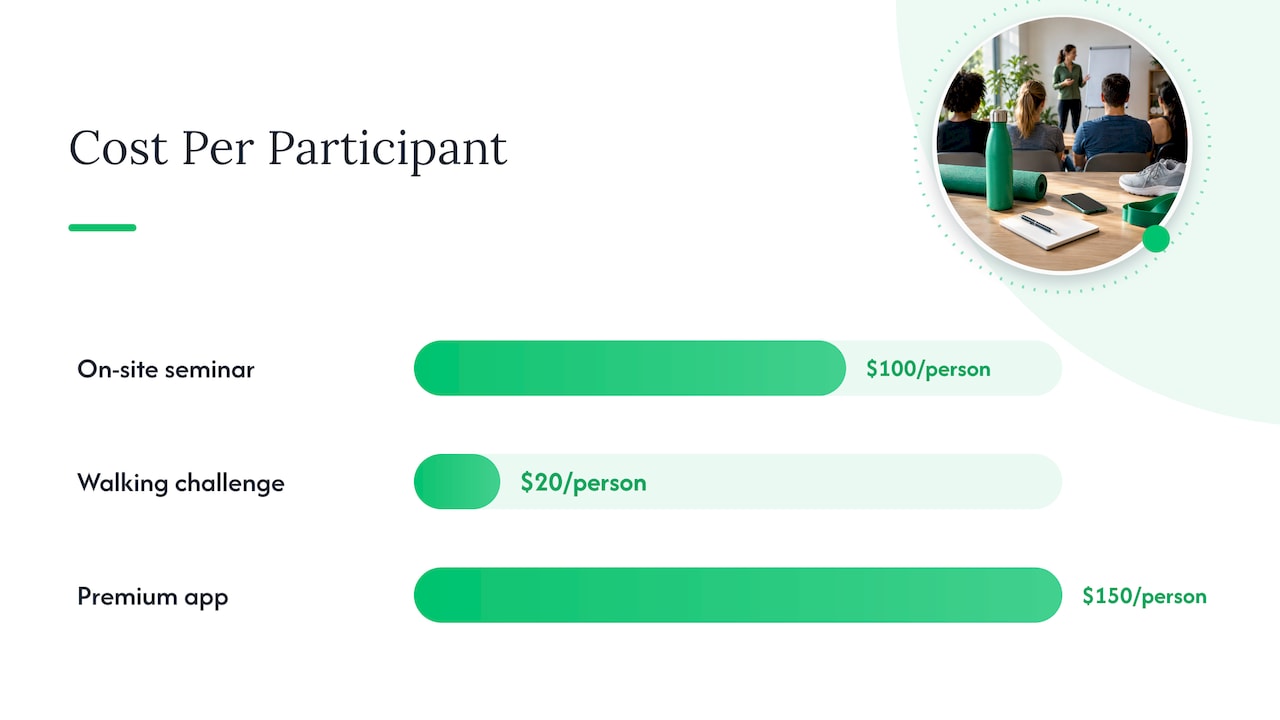
Limited funds do not mean a weak program. They mean choosing carefully. The SHRM Foundation’s guide explains that organizations with limited budgets can use cost-effectiveness analysis to compare wellness interventions when programming options are constrained. In plain terms: divide what each option costs by the number of people it actually reaches, then rank them.
A quick worked example, using made-up round numbers for illustration:
- Option A: an on-site seminar costs $3,000 and 30 people attend. That is $100 per participant.
- Option B: a company-wide walking challenge costs $4,000 and 200 people join. That is $20 per participant.
- Option C: a premium app subscription costs $6,000 and 40 people activate it. That is $150 per participant.
The cheapest line item is not always the cheapest per person, and the most impressive one rarely is. Whatever you pick, favor formats that have low barriers to joining, because unused benefits are the most expensive ones you can buy.
A few low-cost moves that tend to stretch dollars:
- Use challenges instead of one-off events. They run for weeks, so one setup cost covers months of activity. For ideas on formats, a roundup of fitness challenge ideas can help you design stages and goals that keep people involved.
- Fund culture changes first. Walking meetings, protected lunch breaks and flexible start times cost little cash.
- Let employees choose. A single mandatory program wastes money on the people it does not fit.
- Cap the variable parts. Anything that scales with participation should have a ceiling you set in advance.
Nonprofits face the same math with even less room. Volunteers and staff are often motivated by the mission already, so activities that tie movement to the cause cost little and reinforce why people joined.
Connecting movement and giving without a big spend
One of the cheapest interactive layers you can add is an activity that doubles as giving. Employees walk, run or bike, and a donation follows each mile. The cost to the company can be a set rate per mile with a hard cap, so the maximum is known before the first step is logged.

That is how the Charity Miles Employee Empowerment program works. Companies create private teams, run challenges inside the company and, if they choose, sponsor employee miles on their own terms: the rate per mile, the total sponsorship cap, and whether donations go to each employee’s chosen charity or a company-selected cause. Because any movement counts, including a lunchtime walk or a bike commute, it reaches people who would never join a gym program. Our guide to how HR can budget sponsor-funded wellness challenges shows how to set the rate and cap.
Perspective: why we put access ahead of rewards
We built Charity Miles around a simple observation: people keep moving when the movement means something to them. A step count alone is easy to ignore. A mile that sends money to a cause you picked is harder to skip.
When we talk with HR and CSR leaders about allocation, we suggest funding access before rewards. If an employee cannot join in two minutes, on any fitness level, no incentive budget will fix participation. Any walk, run or ride counts in our program, so the people who need movement most are not shut out by an athletic bar.
We also think the sponsor should hold the controls. Companies choose the rate per mile, the cap and the destination of the donations, so finance knows the ceiling and the team sees the cause. One platform covers wellness, giving and team building, which means one line in the budget does three jobs.
At HARMAN, since launching a Charity Miles team in 2021, employee participation rose 11x, with 1,200+ employees generating over $120,000 for charity. Results vary by company, but the pattern we see is consistent: low barriers and shared purpose beat one-off events.
Gene
How to measure whether the money worked
Allocation is a loop, not a one-time decision. The SHRM and HERO measurement guide says organizations can evaluate wellness spending using health risk, participation, satisfaction and financial measures, including cost-trend comparisons between participants and nonparticipants.
A workable scorecard for a first year:
- Participation: share of eligible employees who joined, and share still active at month three.
- Satisfaction: a two-question pulse survey after each activity.
- Cost per participant: total spend divided by active participants, by program.
- Business goal: the turnover, absence or engagement figure you chose at the start.
The CDC says that data from screenings, assessments and engagement and satisfaction surveys can create a feedback loop for continuous improvement and for spotting gaps in what you offer. The Nebraska DHHS toolkit inside the CDC’s Steps to Wellness guide recommends using whole numbers rather than percentages in objectives, which makes progress easier to track over time. “Add 50 active participants” is clearer than “grow participation 25%.”
Two cautions on return on investment:
- The SHRM Foundation’s guide explains that break-even analysis can show if and when benefits will offset costs, which is a more honest question in year one than a headline ratio.
- A CDC-hosted review found that the highest reported ROI often came from low-cost cognitive programs in large corporations, while ROI calculations can emphasize short-term labor effects and discount longer-term chronic disease prevention. Read any ratio with that bias in mind.
For a fuller walkthrough, see when a program ROI figure is real and how to prove it and our page on measuring corporate wellness impact.
A simple allocation plan you can adapt
Here is a starting template. Adjust the shares to your needs assessment, and treat the percentages as a planning aid, not a benchmark from any study.
| Category | Starting share | Why |
|---|---|---|
| Foundational (screenings, education, mental health resources) | 25% | Gives a baseline and meets the needs the survey uncovered |
| Interactive (challenges, coaching, classes) | 40% | Where participation and engagement are built |
| Cultural (environment, policy, communication) | 15% | Low cash, makes the rest stick |
| Measurement and reporting | 10% | Lets you reallocate next cycle |
| Reserve for what employees ask for | 10% | Keeps the plan responsive |
Then follow this sequence:
- Write your one or two business goals.
- Run a short employee survey and rank the results.
- Assign money by layer, with caps on anything that scales with headcount.
- Check the tax treatment of each reward with your adviser.
- Launch, collect data monthly and hold a review each quarter.
- At renewal, move money from the weakest line to the strongest.
For more activity ideas that keep people involved, see these corporate wellness ideas that boost engagement.
Put a challenge in your budget
If your survey shows interest in movement and giving, a private team challenge is one of the easier lines to add. Charity Miles is free for employees and free for charities. Companies that want to run a private team can choose their own sponsorship terms, from the rate per mile to the cap and the destination of donations. See how it works on the Employee Empowerment program page.
If you want to see what employees would use first, you can explore the Charity Miles app and try a few miles yourself. Companies interested in sponsoring can start with our corporate sponsorship opportunities.
FAQ
How much should an employer budget for wellness?
There is no single right number. A Transamerica Institute report cites expert estimates of $250 to $450 per participant per year for robust, multi-part programs. Start from your goals and survey results, then use cost per participant to compare options. Many employers begin smaller and expand what proves popular.
What can I buy with a wellness stipend?
It depends on your employer’s policy. Stipends commonly cover items such as fitness memberships, trackers and mindfulness apps. Check your plan’s list of exclusions. For tax purposes, the IRS says expenses merely beneficial to general health are not medical expenses, so they generally cannot be paid from an HSA or FSA.
Are wellness rewards taxable?
Often, yes. An IRS memorandum states that cash rewards and non-medical benefits such as gym memberships provided through a wellness program are generally included in an employee’s gross income and subject to employment taxes. Ask your tax adviser or benefits counsel how your specific design is treated.
How do I prove a wellness budget is working?
Track participation, satisfaction, cost per participant and the business metric you chose at the start. Compare participants with nonparticipants where you can, and use break-even analysis in the first year. Then move money from low-use programs to high-use ones.
Sources
- Chapman Institute: Crafting an Annual Wellness Budget That Delivers ROI
- CDC: Employers’ Guide to Heart Disease and Stroke Prevention
- CDC: Steps to Wellness guide
- Transamerica Institute: Value on Investment employer guide
- Preventing Chronic Disease: Cost-effectiveness of health promotion
- U.S. Bureau of Labor Statistics: Employee benefits cost, June 2025
- IRS Publication 502: Medical and Dental Expenses
- IRS Publication 15-B: Fringe Benefits
- IRS memorandum on wellness program rewards
- SHRM Foundation: Evaluating Worksite Wellness
- SHRM and HERO: Program Measurement and Evaluation Guide
- CDC: Integrated Health Programs, Health Outcomes, and Return on Investment
- FitDesk: Fitness challenge ideas