

A charity wellness program links healthy activity to charitable giving: people walk, run, bike or join a class, and each unit of effort triggers a donation to a cause. A company, a nonprofit or a group of friends can run one. The best versions are easy to join, open to every fitness level, and clear about who pays for the donations and where the money goes.
We built Charity Miles around this idea, and this guide covers what the research says, which formats work, and how to plan a program that people keep using after the first week.
TL;DR
- A charity wellness program connects physical activity to donations, and the donations can be funded by an employer, a sponsor or the participants themselves.
- U.S. public health agencies already point employers to charity walks, runs and rides as ways to promote activity at work.
- Plan it like any workplace initiative: get leadership support, set measurable goals, pick a cause, track results, and review them.
- Make it inclusive. Any movement should count, not only workouts by people who are already fit.
- Keep expectations honest: the strongest evidence supports well-designed, sustained programs, not one-off events.
Table of Contents
- What a charity wellness program actually is
- Why employers and nonprofits pair the two
- Formats you can run
- How the donations work
- What the research says, and how to use it
- How to plan and launch your program
- Choosing a cause people will care about
- Make it inclusive from day one
- Measuring what matters
- Perspective
- Run your program with Charity Miles
- FAQ
- Sources
What a charity wellness program actually is
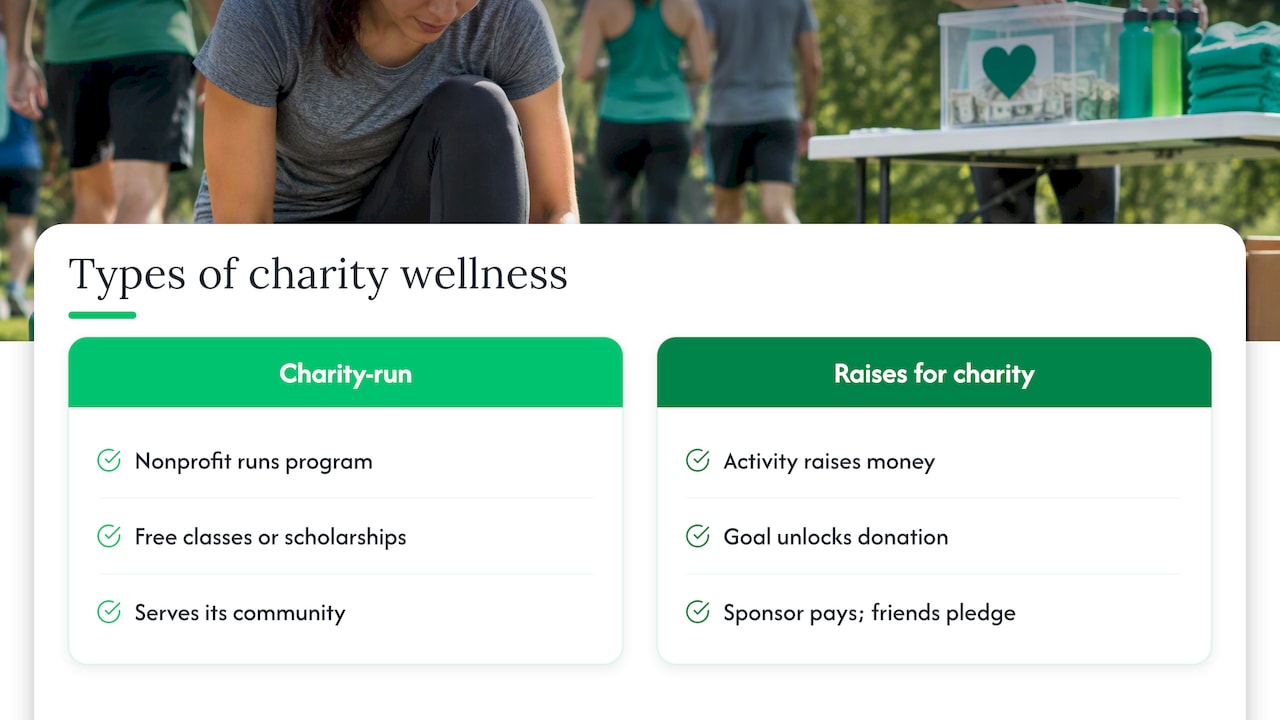
The label covers two different things, and search results mix them together. The first is a wellness program run by a charity, such as a nonprofit offering free classes, scholarships or sliding-scale fees to people in its community. The second is a wellness program that raises money for charity, where the activity itself produces the gift. This article is about the second kind, although the first is a useful reminder that wellness and community support often go hand in hand.
The second kind has a simple mechanic. Someone sets a goal, such as steps per day, miles per week or sessions per month. Meeting the goal releases a donation. A sponsor, usually an employer or a brand, pays for it, or participants gather pledges from friends and family.
A small U.S. government demonstration shows how this can look in practice. A CDC-hosted report on a workplace Move-A-Thon tracked workers’ steps over two weeks and used donations to charity as the incentive. It is a modest example, but it captures the pattern: movement in, giving out.
Why employers and nonprofits pair the two
Physical activity has a strong public health case. The HHS Physical Activity Guidelines executive summary says activity can help people feel, function and sleep better and reduce the risk of many chronic diseases. The same document calls for action at the workplace and community levels, which is where charity-linked programs fit.
Giving adds a second motivation. Many people find it hard to stick with exercise for its own sake. Tying each mile to a cause they care about gives the effort a purpose beyond the workout. This is the intrinsic-motivation idea in practical form: people keep going when the activity means something to them.
A workplace volunteer guide from America’s Charities says employee volunteering can support satisfaction, morale, health, leadership development, community relationships and retention. A charity wellness program sits close to that: it asks for a smaller time commitment than a volunteer day, so more people can take part.
Formats you can run
You do not need a large budget to start. These are the most common formats, from lightest to most structured.
Charity walks, runs and rides
The CDC’s workplace guide, Steps to Wellness, recommends encouraging employees to team up with coworkers for charity runs or walks, combining fundraising with training and team-building. The HHS Move Your Way worksite playbook lists company-sponsored charity runs, walks and bike rides among the channels employers already use to promote activity.
The weakness of a single event is that it happens once. People train for a few weeks, the day passes, and the habit fades. If you use an event, treat it as a launch point for something longer.
Always-on activity challenges
Here, people log everyday movement over weeks or months and every mile earns a donation. The format suits busy teams because a lunchtime walk, a bike commute or a weekend run all count. Our guide to fitness challenge ideas for workplace wellness compares several versions, from team step contests to distance goals.
Sponsored miles
In this version a company or brand covers the donation. The sponsor chooses a rate per mile and an overall cap, so the budget is known before launch. Employees get the motivation of giving without having to pay or fundraise. We cover how the sponsor side works on our corporate sponsorship page.
Pledge-based fundraising
Participants ask friends and family to pledge per mile or per goal. It can raise more per person, but it asks more of participants, and some will feel awkward about asking. Offering a sponsor-funded option alongside it keeps the program open to everyone.
Blended wellness and volunteering
The Jump IN guide on community engagement recommends aligning employee wellness, volunteer opportunities, community events and giving priorities so they reinforce one another. In practice, a walking challenge that benefits a local food bank can be followed by a volunteer day at that same food bank.

How the donations work
The main design question is who funds the gift. There are three common answers, and each changes how the program feels.
| Funding model | Who pays | Best for | Watch for |
|---|---|---|---|
| Employer or brand sponsorship | The company, at a set rate with a cap | Companies that want a predictable budget and wide participation | Choose a cap that matches the number of people you expect |
| Participant pledges | Friends and family of participants | Charity-led events and community fundraisers | Can feel like a burden on participants |
| Matching | Sponsor matches what participants raise | Programs that want both personal and company investment | Needs clear communication of the match rules |
The CDC demonstration gives concrete numbers for a small incentive. Participants could earn up to US$20 for meeting a 3,000-step daily goal for two weeks, with up to US$2 more per exercise buddy, and the eight people who finished generated US$202 for charity, according to the CDC-hosted report. Your rates will depend on your budget, but the structure of a goal, a time window, a small bonus for social participation and a cap is easy to borrow.
With Charity Miles, a company can set the rate per mile, the total sponsorship cap, and whether donations go to each employee’s chosen charity or to a cause the company selects. That control is the reason many teams prefer sponsored miles to flat, one-time donations.
What the research says, and how to use it
The evidence is encouraging, and it is also specific about what works. Reading it closely makes your program stronger.
Workplace activity programs can help well-being. A 2025 systematic review of 15 workplace physical-activity studies reported improvements in employee mental health, stress and well-being. The studies varied in type, length, delivery and evaluation, so the practical lesson is to define your own approach and measure it.
Donation incentives are being tested seriously. The TRIPPA trial design randomized 800 full-time desk-based employees across 15 worksites to compare pedometer-based activity goals with cash incentives or donations to charity, as described in its published study design. The authors note that wearable technology paired with financial incentives may be a scalable, affordable way to promote health.
Reach and duration matter. The HHS scientific report chapter on promoting regular physical activity says community-wide programs can raise activity when they stay in intensive contact with most of the target group over time. It also names the considerations that decide success: reach, audience fit, convenience, stakeholder cooperation, cost, sustainability and inclusion of people who would not normally use the venue.
In plain terms, build for broad participation and a long run. A program everyone can join and that runs all year will serve you better than a two-week sprint for the already active.
How to plan and launch your program
The CDC’s integrated approach guide describes a sequence that works for nearly any workplace initiative: build leadership support and employee participation, set a clear goal with measurable objectives, gather and analyze worksite information, create an action plan with resources, implement, then monitor and evaluate. Here is how that looks for a charity wellness program.
- Win leadership support. Ask a senior leader to take part, not just approve the budget. A visible executive logging miles does more than any announcement.
- Pick your partners. The HHS playbook suggests involving managers, wellness leaders, HR, wellness committees, union representatives, volunteers and employees who are passionate about activity. Those people become your first team captains.
- Learn what your people want. A short survey about preferred activities, schedules and causes tells you whether to build around walking, cycling or mixed activity.
- Set measurable goals and a timeline. HHS recommends agreeing on measurable goals and a shared timeline before launch. Examples: percentage of employees who join, average active days per week, dollars donated.
- Choose the cause and the funding model. See the section below.
- Design the details. America’s Charities highlights type, frequency, duration, incentives, technology, communications and tracking as the elements that make or break a program. Decide each one in advance.
- Launch with a story. Explain why you chose the cause and what the donations will do.
- Review and improve. Use surveys or focus groups to see what people thought, then adjust.
Our article on workplace wellness program participation explains why access should come before rewards, which is worth reading before you finalize the design.
Choosing a cause people will care about
Participation tends to rise when people feel ownership of the cause. There are two reasonable approaches.
- Employee choice. Each person picks a charity from a list or from any registered nonprofit. It honors personal values and avoids the awkwardness of a cause some staff do not share.
- Company-selected cause. The company picks one cause for the whole program. This builds a shared story and a single, larger total, and it works well when the cause relates to the company’s mission or community.
Many teams combine the two: employees choose during the year, and the company directs a pooled bonus at the end to a shared cause. If you are weighing individual giving against company-funded giving, our comparison of employee giving vs corporate sponsorship explains how each affects impact.
Make it inclusive from day one
The fastest way to shrink a program is to design it around people who already exercise. A few choices keep the door open:
- Count walking, running and biking equally, and let people log movement they already do.
- Use team totals as much as individual rankings, so a slower pace still contributes.
- Offer goals in miles or minutes rather than a single step target that suits only some bodies and jobs.
- Avoid tying rewards to health outcomes. In the U.S., wellness incentives are subject to legal rules, so have HR or counsel review the design before launch.
- Make sure remote, hybrid and shift workers can all join on equal terms.
For safety, remind participants to choose routes with sidewalks or trails, to be visible at dusk and to follow local traffic rules. We wrote up how one company handled this in a workplace walking safety case study. Anyone with a medical condition or who is returning from injury should talk with their own doctor before taking on new exercise goals.
Measuring what matters
Pick a few numbers and track them from the first week. We suggest four:
- Participation rate: the share of eligible employees who join, and the share still active after a month.
- Activity: total miles, active days per person and average miles per active day.
- Giving: total dollars donated, by cause.
- Sentiment: a short pulse survey on morale, energy and connection to the company.
HHS recommends using surveys or focus groups to assess accomplishments and reviewing results to find improvements. Be careful with conclusions: a short challenge in one group is not proof of a broad health change, and the HHS evidence review says as much about narrow programs. Report what you saw, compare it with your own baseline, and keep improving. For ideas on tracking progress in a way that goes beyond raw numbers, this piece on measuring wellness progress offers a useful angle on setting personal markers.
Perspective
We have watched a lot of wellness programs begin with energy and end with a quiet inbox. The ones that last share one trait: people can see what their effort does. When a lunchtime walk becomes a donation to a cause you picked, the walk has a reason.
That is why we built Charity Miles to count all movement, not only workouts. A coworker who walks the dog for twenty minutes should feel as much a part of the team as the one training for a half marathon. Companies keep control of the terms: the rate per mile, the cap, and whether donations follow each employee’s choice or a company cause.
Our results from teams have been encouraging. Since launching its Charity Miles team in 2021, HARMAN saw an 11x increase in employee participation, with 1,200+ employees generating over $120,000 for charity. We see that as a sign that inclusive, ongoing programs can bring people in who would never sign up for a one-day race.
Our advice to HR and CSR leaders is simple: start small, make joining effortless, and keep the program running long enough for habits to form.
Gene
Run your program with Charity Miles
If you want to launch without building tracking, team tools and donation logistics yourself, our Employee Empowerment program gives companies private teams, friendly challenges and optional sponsorship on terms they set. The app is free for members and for charities, and it tracks walking, running and biking by GPS and pedometer.
Individuals can start today with the Charity Miles app. Companies that want a broader overview can read about our corporate wellness programs before talking with us.
FAQ
What is the difference between a charity wellness program and a corporate wellness program?
A corporate wellness program focuses on employee health and may or may not involve giving. A charity wellness program adds a donation to each unit of activity, so the effort benefits a cause as well as the participant. Many companies run the two together so the same program serves both well-being and corporate social responsibility goals.
Who pays for the donations?
The funder depends on the design. A company or brand can sponsor miles at a set rate with a cap, participants can collect pledges, or a sponsor can match what participants raise. In the CDC Move-A-Thon demonstration, the incentive was a small, capped donation tied to a daily step goal.
Do you need a big budget to start?
No. A cap lets you decide your maximum spend in advance, and a small per-mile rate can still add up across a team. The larger investment is planning and communication: clear goals, visible leadership and regular updates matter more than a big prize pool.
How long should a charity wellness challenge run?
Longer programs tend to serve people better than short sprints. HHS’s evidence review points to sustained, intensive contact with a broad audience as what moves activity. A good pattern is a launch challenge of several weeks inside an ongoing program, with seasonal themes to keep interest up.
Sources
- A Move-a-thon Event: A Workplace Demonstration (CDC Stacks)
- Steps to Wellness: A Guide to Implementing the 2008 Physical Activity Guidelines (CDC)
- Move Your Way Community Playbook: Partnering with Worksites (HHS)
- Physical Activity Guidelines Executive Summary (HHS)
- Promoting Regular Physical Activity, Scientific Report Part F Chapter 11 (HHS)
- Implementing an Integrated Approach (CDC Stacks)
- Design and baseline characteristics of participants in the TRIPPA study (PubMed)
- Sustainable Workplaces and Employee Well-Being: A Systematic Review (PMC)
- Workplace Volunteer Programs Guide (America’s Charities)
- Community Engagement (Jump IN for Healthy Kids)
- How to Measure Wellness Progress in Mind-Body Practice