

A walking streak challenge is a commitment to walk every day for a set stretch, such as 7, 30 or 100 days, and to count the days in a row. The idea is simple. The hard part is deciding what counts as a day, picking a goal you can hit on your worst day, and knowing what to do when life interrupts. This guide covers all three, plus ways to make a streak more meaningful by walking with a team or for a cause.
TL;DR
- Define a “streak day” before you start: a minimum number of minutes or steps, and a cutoff time such as midnight.
- Set the minimum from your own baseline, not from a viral number. Log a week, then build from there.
- Start low and go slow, and talk to a health care provider first if you have a chronic condition or symptoms.
- Plan for a missed day with a written rule: reset, grace day, or “never miss twice.”
- Streaks last longer with other people and a purpose. Teams, charity miles and shared challenges all help.
Table of Contents
- What a walking streak challenge is
- Set a daily goal you can actually keep
- Start safely
- What to do when you miss a day
- Track your streak without making it a chore
- Why streaks work better with other people
- Add a purpose: walk for a cause
- Run a walking streak challenge at work
- Our perspective: movement works best when it means something
- Bring a streak to your team with Charity Miles
- A 30-day starter plan
- FAQ
- Sources
What a walking streak challenge is
In its strictest form, a streak challenge means you walk every day for the length of the challenge, and missing a day resets the count to zero. That is the version most people picture, and it is the one that gives streaks their pull: the longer the number, the more you have to lose.
The details vary a lot, and those details decide whether the challenge works for you. Three choices matter most.
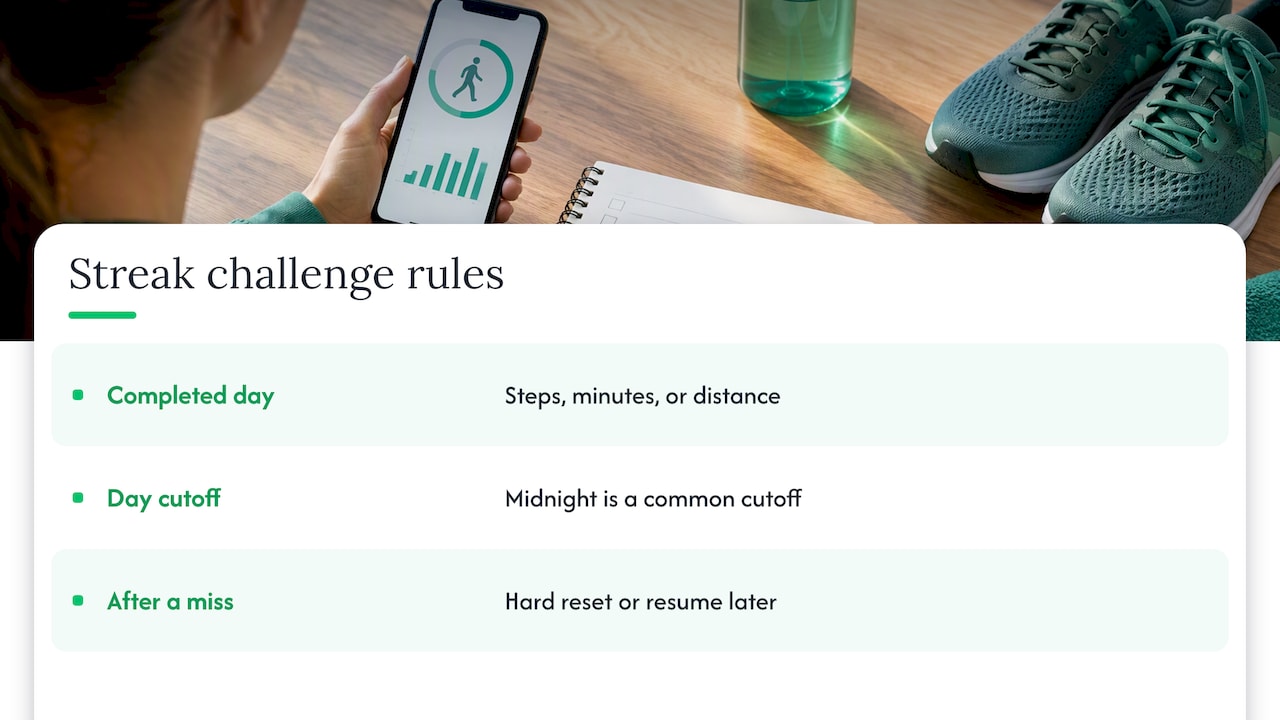
1. What counts as a completed day. Some people use a step count, some use minutes, some use distance. A step target is easy to check on a phone. A minutes target is fairer if you use a wheelchair, a walker, a treadmill or a stroller, or if you walk with a short stride. Distance works well with GPS apps and is the easiest to turn into a donation or a team total.
2. When the day ends. Pick a cutoff and stick to it. Midnight is the common rule, and some streak features reset the count if your activity is not recorded before then. Late-night laps around the living room are a real thing, so decide whether you are okay with that or whether you want the walk done before dinner.
3. What happens after a miss. A hard reset is one option. A softer model lets participants pick up where they left off after a missed day. We come back to this below, because the choice has a real effect on whether people finish.
Set a daily goal you can actually keep
Most streaks die in the first two weeks, and usually because the daily bar was set for the person you hope to be, not the person who just got home from a long shift. A reliable fix is to measure first.
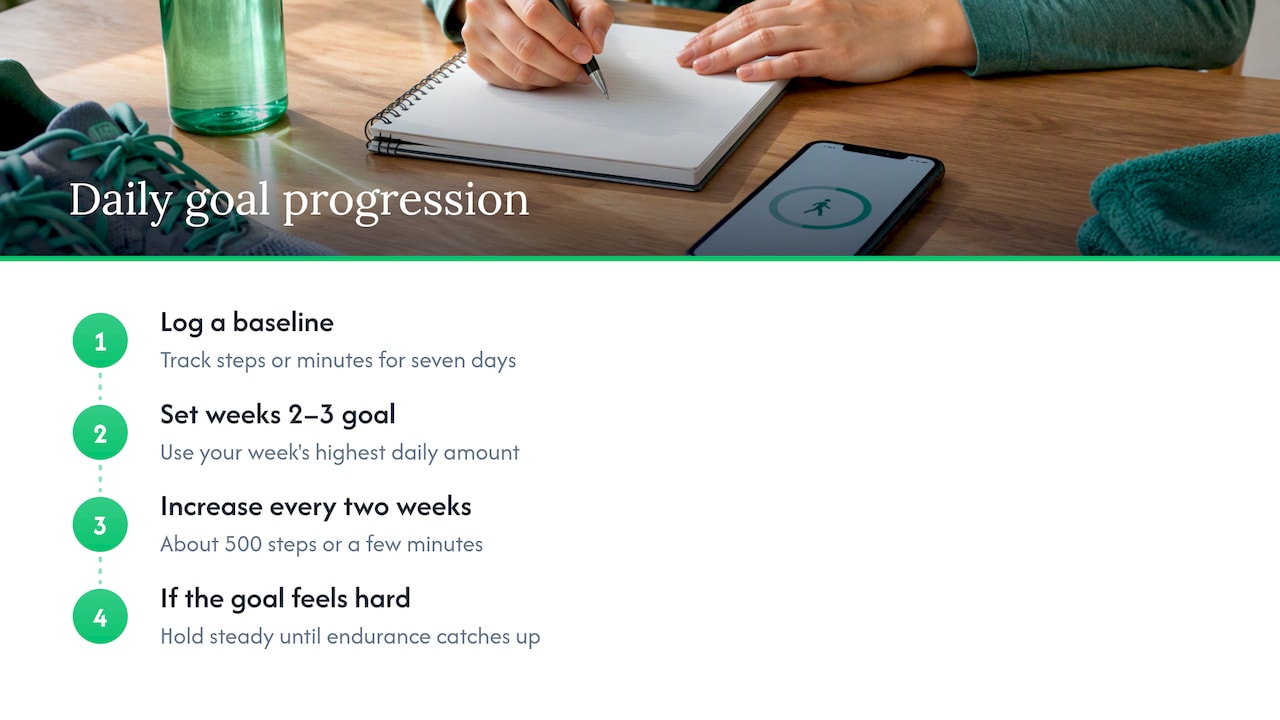
The WalkingWorks program from Blue Cross Blue Shield suggests logging your steps or minutes for seven days to find a baseline. You then use your highest daily amount from that week as the goal for weeks two and three. After that, raise the goal by about 500 steps, or a few minutes, every two weeks. If a goal feels hard, hold it steady until your endurance catches up.
That approach has a useful side effect for streaks. Your goal is something you have already done at least once, so day one feels doable.
A worked example
Say you log a week and your daily totals run between 2,800 and 4,600 steps, with the best day at 4,600.
| Weeks | Daily minimum | Reasoning |
|---|---|---|
| Week 1 | Log only | Establish a baseline, no streak pressure |
| Weeks 2 and 3 | 4,600 steps | Your best day from week 1 |
| Weeks 4 and 5 | 5,100 steps | Add 500 steps |
| Weeks 6 and 7 | 5,600 steps | Add another 500 |
| Weeks 8 and 9 | 6,100 steps | Hold steady here if week 8 felt hard |
If you prefer minutes, the same pattern works: find your best day, hold it, then add a few minutes every two weeks.
How much is enough
Your streak minimum does not have to match a national guideline, but it helps to know the target you are building toward. The Physical Activity Guidelines for Americans say adults should aim for 150 to 300 minutes of moderate-intensity aerobic activity each week for substantial health benefits. Spread across seven days, that is roughly 20 to 45 minutes of brisk walking a day.
Moderate intensity has a simple practical test. According to the U.S. Department of Health and Human Services, you are breathing hard but can still easily hold a conversation. If you can sing, you can go a little faster. If you cannot talk, slow down.
The same guidelines say that inactive people should start low and go slow, beginning with lower-intensity activities and gradually increasing how often and how long they are active. A 10-minute daily streak that you keep for three months beats a 10,000-step streak that ends on day six.
Start safely
Walking is among the most accessible forms of activity, and the Surgeon General’s Call to Action to Promote Walking points to exactly that: it fits into busy lives without special equipment or skills. A daily streak still puts steady load on your feet, knees and hips, so a few precautions are worth taking.
- See a professional if you have a condition. The federal guidelines say adults with chronic conditions or symptoms should be under a health care provider’s care, and can ask a health professional or physical activity specialist about the types and amounts of activity that suit them. If you have heart disease, diabetes, joint problems or unexplained symptoms, ask your doctor before choosing a daily minimum.
- Listen to your body. The National Institute of Diabetes and Digestive and Kidney Diseases advises you to stay hydrated and stop if you feel out of breath, dizzy, faint or nauseated, or have chest or other pain. A streak is never a reason to walk through those signs.
- Choose shoes, routes and light carefully. The guidelines advise appropriate gear and safe environments. In practice that means supportive shoes, well-lit sidewalks or paths, and reflective clothing if you walk before sunrise or after dark.
- Build gradually. Big jumps in daily time are a common reason new walkers get sore and quit.
If balance or fall risk is a worry, the best streak is the one that includes safe practice. Resources such as balance training for seniors explain exercises that support steadier walking, which makes a daily habit easier to sustain at any age.
What to do when you miss a day
This is the question that makes or breaks a streak. You will miss a day eventually: a flight, a fever, a double shift, a storm. What matters is the rule you wrote beforehand.
Here are the four most common models.
| Model | How it works | Best for |
|---|---|---|
| Hard reset | Miss a day, count returns to zero | Short sprints of 7 to 14 days with high motivation |
| Grace day | One or two “free” misses per month | Month-long and workplace challenges |
| Never miss twice | A miss is fine, a second in a row is not | Building a lasting habit |
| Consistency count | Count total active days, not consecutive ones | Beginners, people with health conditions, long programs |
There is a real argument for each. Streaks work because they feel concrete. Scientific American reports that streaks are perceptual, that streak-holders largely credit their own resolve for completing them, and that streaks can motivate behavior. That is the upside of a hard reset: the count itself becomes the reward.
The downside is the “what the heck” effect. When a long streak breaks, some people feel the whole effort was wasted and stop altogether. Consistency-based challenges avoid this by letting participants carry on after a missed day instead of starting from zero. For a first streak, or for a group with mixed fitness levels, a grace day or a consistency count is often the smarter design.
A simple rule many walkers like: pick a hard reset for the first 7 days to build momentum, then switch to “never miss twice” for the long haul.
Track your streak without making it a chore
The tracking method matters less than whether you will actually use it. The NIDDK notes that you can track activity on paper, online or with an app, and that pedometers and fitness trackers can count steps and other activity. Tracking progress may help you stay motivated and set new goals.
A few practical choices:
- Paper calendar. Mark an X on each completed day. It is visible, free and satisfying, and works well on a fridge or office wall.
- Phone step counter. Good for step-based goals. Check that your phone is on you, or you will under-count.
- GPS app. Best when distance matters, for example when miles turn into donations. If you want to try one that does, the Charity Miles app tracks walking, running and biking distance with GPS and pedometer.
- Shared log. For a team, a shared spreadsheet or app team page adds visibility, which leads to the next point.
Why streaks work better with other people
Solo streaks depend on willpower alone. Adding people changes the odds.
A 2018 study of Walk Georgia users, published through the CDC, found that people using the program in groups logged more activity than individual users and had a larger share of weeks with at least 150 minutes logged. The authors pointed to social support, accountability and the ability to choose your own activities as key factors in engagement and motivation.
You can build all three into a streak with very little effort:
- Find a streak partner. Text each other a thumbs-up after each walk. The message is the proof.
- Walk together once a week. Even one shared walk makes the daily solo ones easier to protect.
- Let people choose how they move. A lunchtime loop, an evening stroll with a dog, a bike commute, a lap around a parking lot between meetings. Choice keeps the challenge from excluding anyone.
- Post the total, not just the individuals. A team number makes a missed day feel like it matters to someone besides you.
Add a purpose: walk for a cause
A number on a screen only motivates for so long. A reason tends to last longer. One simple option is a charity walk or fundraising challenge. The British Heart Foundation, for example, describes an October challenge to walk 31 miles in a month to support life-saving research. That is a UK campaign, but the format works anywhere: a distance goal, a month, a cause.
You can also make every daily walk count automatically. With Charity Miles, you walk, run or bike, the app tracks your distance, and money is donated to a charity of your choice for every mile you log. The app is free for members and free for charities. That turns each streak day into a small, visible contribution, so a missed day has a cost beyond a broken number: some miles that would have gone to a cause you picked.
Run a walking streak challenge at work
Workplace streaks have a few extra requirements. Participants have different schedules, abilities and comfort levels. Some work remotely, some on shop floors, some from home with children. A design that works for an office of marathoners will lose most of everyone else.
Here is a structure that works for most teams.
- Pick a length. Two to four weeks is long enough to build a habit and short enough to finish. Run it again next quarter rather than stretching it to 100 days.
- Set an inclusive minimum. Count any movement: walking, rolling, running, biking. Use minutes or miles rather than a high step count.
- Use a grace rule. Give each person one or two grace days. Nobody should be out of a team challenge on day nine because of a sick child.
- Make it team-based. Private teams, friendly competition between departments, and a shared leaderboard create the accountability the Walk Georgia research points to.
- Attach a cause. Let employees pick their charity, or have the company choose one. A purpose gives people something to talk about besides steps.
- Celebrate often. Weekly shout-outs and small milestones matter more than a prize at the end.
- Repeat with a new theme. Themes keep interest up. We cover some in our guide to walking challenge themes that drove 11x participation and in 15 walking challenge ideas you can launch this week.
If your team is spread across offices or time zones, a virtual walking challenge lets everyone take part from wherever they are.
One small caution on design. A hard-reset streak is fine for individuals who opt in, but in a workplace, public pressure can feel punishing. Keep streak data visible to the team only as totals, and let people join at their own level.
Our perspective: movement works best when it means something
We have spent years watching what keeps people moving, and the pattern is consistent. Streaks catch attention, but meaning keeps them going. When a mile is only a mile, it is easy to skip. When a mile also funds a charity you chose, or lifts your team’s total, skipping costs something you care about.
That is why we built Charity Miles around any movement, not athletic performance. A lunchtime walk, a bike commute and a run all count, so a streak is open to every fitness level instead of just the people who already train. For companies, our Employee Empowerment Program puts that idea into practice. Companies create private teams, run intra-company challenges, and can sponsor employees’ miles on their own terms, choosing the rate per mile, the total cap and whether donations go to each employee’s chosen charity or to a company-selected cause.
It works because it feels like part of company culture rather than a one-off event. Since launching its Charity Miles team in 2021, HARMAN saw an 11x increase in employee participation, with 1,200+ employees generating over $120,000 for charity.
Our advice for any streak, personal or corporate: keep the daily bar low, keep the reason high, and write down your miss rule before day one.
— Gene
Bring a streak to your team with Charity Miles
If you lead HR, wellness or CSR at your company and want a walking challenge people stick with, our Employee Empowerment Program gives you private teams, friendly challenges and configurable sponsorship in one place. If you want to see how the app works before you decide, start with how Charity Miles works.

Individuals can simply download the app and start logging miles for the charity of their choice.
A 30-day starter plan
If you want to begin tomorrow, use this simple outline. Adjust the numbers to your own baseline.
- Days 1 to 7: Walk as you normally do and log it. No streak yet. Note your best day.
- Days 8 to 14: Streak begins. Daily minimum equals your best day from week one. Walk at a pace where you can talk but feel your breathing.
- Days 15 to 21: Hold the same minimum, or add a few minutes if the last week felt easy.
- Days 22 to 30: Add about 500 steps or a few minutes. Invite one person to join you and pick a charity for your miles.
- Day 31: Review. Did you miss a day? What got in the way? Adjust the minimum or the cutoff time and start a second round.
Tie each walk to something you already do, such as the first coffee, the end of your last meeting or after dinner. Anchoring a new habit to an existing routine means you do not have to decide each day whether to go.
FAQ
How long should a walking streak challenge be?
For a first streak, 7 to 30 days works well. A week proves you can do it, and a month is long enough to start feeling like a habit. For teams, two to four weeks with a repeat later is easier to sustain than one very long challenge.
Do I have to walk every single day?
Not for health. The federal guidelines focus on weekly totals of 150 to 300 minutes of moderate activity, not on daily perfection. A streak is a motivation tool, so if a strict daily rule makes you quit after a missed day, switch to a grace day or a consistency count.
How many steps or minutes should count as a streak day?
Use your own baseline. Log a week, take your best day as the minimum, and add about 500 steps or a few minutes every two weeks. If you are inactive or have a chronic condition, start lower and check with a health care provider first.
Can a walking streak raise money for charity?
Yes. You can join a charity walk or a distance challenge, or log your daily miles in an app that donates per mile. With Charity Miles, money goes to the charity you choose for each mile you walk, run or bike, and companies can sponsor those miles for their teams.
What if I get sick or injured during my streak?
Stop and rest. Pushing through dizziness, chest pain or other pain is not worth a number. Talk to a health care provider, and when you are ready, restart with a lower minimum.
Sources
- WalkingWorks: Starting the WalkingWorks Program
- Physical Activity Guidelines for Americans, 2nd edition
- Move Your Way: Community Playbook Campaign Talking Points
- Status Report for Step It Up! The Surgeon General’s Call to Action
- Tips to Keep Moving, NIDDK
- Why Keeping a Streak Boosts Your Motivation, Scientific American
- Individual and Group-Based Engagement in an Online Physical Activity Program, CDC
- 7 easy ways to increase your steps count, British Heart Foundation