

A good CSR survey asks employees four things: whether they know what your company does for society, whether they believe it, whether they take part, and what gets in the way. Below you will find 40 questions grouped by those goals, along with the response scales, wording rules and follow-up steps that make the answers usable. The same questions also work as social impact survey questions if you swap in your own programs and charity partners.
TL;DR
- Cover five areas: awareness, trust, participation, personal impact and community outcomes. Ask 15 to 25 questions in total, not 60.
- Use rating scales for awareness and sentiment, multiple choice for participation, and two or three open-ended questions for barriers and ideas.
- Keep wording neutral, say whether answers are anonymous, and pilot the survey with a small group first.
- Decide before you launch who will act on the results and by when. A survey with no follow-up lowers trust in the program it measures.
- Pair the survey with a participation baseline, such as miles, hours or sign-ups, so opinions can be checked against behavior.
Table of Contents
- What a CSR survey should measure
- Awareness questions
- Trust and values questions
- Participation questions
- Personal impact and well-being questions
- Social impact and community outcome questions
- Two closing questions worth keeping
- How to build the survey so the answers are honest
- A sample 15-question short form
- From results to action
- Our perspective: survey the behavior, not just the opinion
- Turn survey answers into a program people join
- FAQ
- Sources
What a CSR survey should measure
Start with the decision the survey will inform. Are you choosing causes for next year? Deciding whether to fund a volunteering day? Checking that employees see the company’s values in action? The answer sets the length and the audience.
Gallup groups workplace-facing corporate responsibility into five areas: ethics and compliance, diversity, equity and inclusion, employee development, well-being, and environment. The same Gallup paper argues that employee input on ethics, compliance and culture is a leading indicator of performance, because it can surface problems before they escalate. That makes employees, not just executives or customers, the right primary respondents.
For most HR and CSR teams, a practical employee survey covers these five blocks:
- Awareness: do people know what the company supports?
- Trust and credibility: do they think the effort is genuine?
- Participation: who takes part, how often and how?
- Personal impact: does taking part change how people feel about their work?
- Community outcomes: do employees believe the work helps the people it targets?
Supplier questionnaires and investor-facing ESG assessments are a different tool. They ask companies about policies and audits. This article is about asking your own people.
Awareness questions
People cannot value a program they have never heard of. These questions find out whether your communication is reaching them. Research on internal CSR communication examined six dimensions, including informativeness, transparency and personal relevance, and found that communication can foster positive attitudes toward participating. So it is worth testing each of those qualities.
Use a 1 to 5 agreement scale (strongly disagree to strongly agree) unless noted.
- I can describe, in a sentence or two, what our company does to support society and the environment.
- I know which charities or causes our company currently supports.
- I know how to get involved in company-sponsored giving or volunteering.
- Information about our social responsibility work is easy to find.
- Our company is open about what its community programs achieve.
- Communication about these programs feels relevant to my role and interests.
- (Multiple choice) Where do you usually hear about these programs? Email, intranet, manager, team meeting, company chat, colleagues, I don’t hear about them.
- (Open-ended) What would you like to know about our community work that you don’t know today?
Trust and values questions
Employees notice quickly when CSR is marketing instead of practice. These questions test credibility. Keep them on the same agreement scale.
- Our company’s actions match its stated values.
- Leaders at our company visibly take part in social responsibility efforts.
- I trust that donations made in our company’s name reach the intended cause.
- Our company treats the communities where it operates fairly.
- I would feel comfortable raising an ethical concern at work.
- I believe my manager supports taking part in community programs during the workday.
- Our company’s social responsibility work is a priority, not an afterthought.
- (Open-ended) Is there anything our company says about its values that doesn’t match your experience?
Question 13 comes straight from the ethics and compliance area above. It is sensitive, so anonymity matters most here. Survey designers consistently advise telling respondents, in the first lines of the survey, whether answers are anonymous and who will see them. Without that, expect polite, inflated scores.
Participation questions
Opinions are easy to give. Behavior is more useful, and multiple choice is the cleanest format for it. In the academic study of employee CSR engagement noted earlier, researchers asked about participation frequency and the perceived facilitators and barriers, including employer support and encouragement. Borrow that structure.
- (Multiple choice) In the past 12 months, how many company-sponsored giving or volunteering activities did you take part in? None, 1, 2 to 3, 4 or more.
- (Multiple choice) Which kinds have you joined? Volunteer day, donation drive, matching gift, team challenge, skills-based volunteering, fundraising event, none.
- (Multiple choice) What is the main reason you joined? A cause I care about, colleagues, manager encouragement, wellness benefits, company incentive, curiosity.
- (Multiple choice, select all) What keeps you from taking part more? Not enough time, don’t know about it, not interested in the causes, schedule or location, remote work, health or mobility, feels like extra work.
- I feel encouraged by my employer to take part.
- I could take part in a way that suits my own fitness level and abilities.
- Remote and hybrid employees have the same chance to take part as office-based staff.
- (Open-ended) What one change would make you more likely to take part?
Questions 22 and 23 matter more than they look. Programs built around a single format, such as a Saturday volunteer day, quietly exclude caregivers, remote staff and people with limited mobility. If you run an activity-based program, any movement format that counts equally, such as a lunchtime walk or a bike commute, tends to show up in these answers as a lower barrier.
Personal impact and well-being questions
This block links giving to the way people feel at work. Data compiled in a 2025 corporate social impact toolkit from ACCP reports that employees who participate in volunteer programs report higher satisfaction with their jobs, company culture and leadership than nonparticipants. You can test whether that holds in your own company by comparing participants and non-participants on these items.
- Taking part in company community programs makes me feel more connected to my colleagues.
- Taking part makes me feel more proud to work here.
- Taking part gives my work more meaning.
- I feel more energized after taking part in a company-sponsored activity.
- I can sustain my workload over time. (Reverse-code this one when you score it, as UNC-Chapel Hill did in its staff well-being survey, so that agreement signals risk rather than health.)
- I would recommend this company as a place to work.
- (1 to 10 scale) Overall, how would you rate your well-being at work right now?
The UNC-Chapel Hill report is a useful model for scales: a 1 to 5 agreement scale for its first seven questions and a 1 to 10 scale for overall well-being. It also used pre- and post-surveys across an eight-month period, which is the right shape if you want to show change rather than a one-time snapshot. For broader engagement items, Gallup’s Q12 survey offers 12 validated questions. Our own take on how to ask the right engagement questions goes deeper on that side.
Social impact and community outcome questions
Employees rarely see beneficiaries directly, so these questions measure perceived impact. Treat them as a complement to real outcome data from your charity partners, not a replacement.
- I believe the causes our company supports are addressing real needs.
- I can see the results of our giving or volunteering.
- The charities we work with are a good fit for our company’s values.
- Our company’s programs help the communities where our employees live and work.
- (Multiple choice) Which cause areas should we prioritize next year? Health, hunger, education, environment, veterans, animals, local community, other.
- Employees have a say in which causes we support.
- (Open-ended) Describe one moment when you felt our company made a difference.
For the harder question of measuring real outcomes, the Civic 50 survey workbook from Points of Light defines successful volunteerism through efficiency, effectiveness and reach. Reach is the number of people served, effectiveness is something like improved success rates for beneficiaries, and efficiency is helping systems run on fewer resources. The same workbook asks companies to say whether they measure quantified outcomes, qualitative outcomes, quantitative outputs or only anecdotes. That four-way split is a handy self-check before you write your results summary.
Two closing questions worth keeping
- (0 to 10) How likely are you to encourage a colleague to join our next community program?
- (Open-ended) Anything else you’d like leadership to hear about our social responsibility work?
How to build the survey so the answers are honest
Match the question type to the job
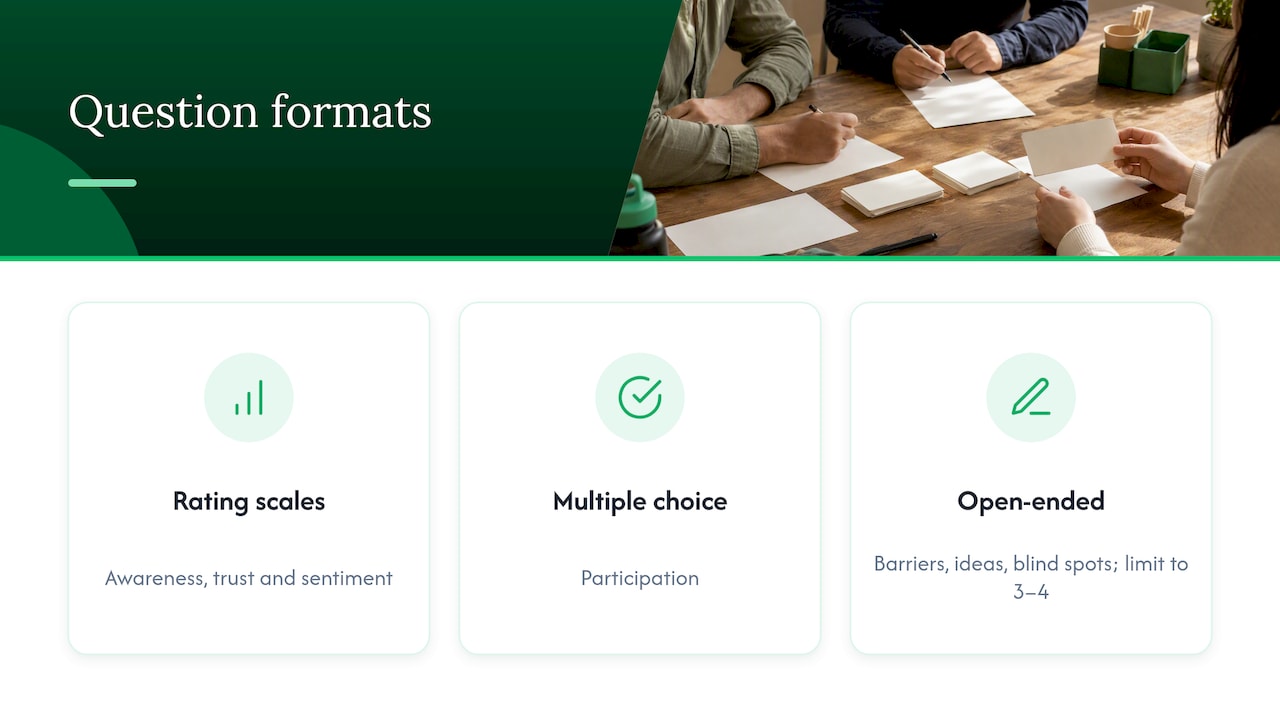
Rating scales suit awareness, trust and sentiment. Multiple choice suits participation. Open-ended questions suit barriers, ideas and blind spots. Keep open-ended questions to three or four, or completion rates drop and the comments you get get shorter.
Keep the wording neutral
Compare these two versions:
- Leading: “How much do you value our company’s outstanding commitment to giving back?”
- Neutral: “To what extent do you agree that our company’s actions match its stated values?”
The first tells people what to say. The second lets them disagree. Avoid double-barreled items too, such as “Our company is ethical and environmentally responsible,” because respondents may feel differently about each half.
Anchor on validated questions, then customize
Gallup advises that customized engagement surveys can keep their validity and benchmark comparability when anchored by a core set of validated questions. In practice: keep your engagement or well-being core stable from year to year, and rotate the CSR-specific modules around it.
Pilot before you launch
The Leeds Beckett organizational values toolkit recommends piloting questions and methodology to confirm that people understand them and that the data supports the analysis you intend. It also says the sample should be large enough to represent the population. Try the draft on 10 to 15 people from different departments and shifts, and fix any item that makes them ask what you mean.
The same toolkit offers a useful rule for deciding how much more data you need: if responses are very similar, there may be no need to keep surveying, while a large variance may justify surveying more of the population for statistical significance.
Borrow from government survey design for volunteering items
If you want to compare your volunteering numbers with national figures, mirror the way the U.S. Bureau of Labor Statistics asks. The American Time Use Survey uses standardized volunteering questions to identify whether a person volunteered for or through an organization. Using similar phrasing makes your results easier to explain to leadership.
A sample 15-question short form
If you have one chance and little goodwill, send this version. It takes under five minutes.
| Area | Questions to use | Format |
|---|---|---|
| Awareness | 1, 3 | 1 to 5 agreement |
| Trust | 9, 11, 15 | 1 to 5 agreement |
| Participation | 17, 20, 21, 22 | Multiple choice and agreement |
| Personal impact | 26, 28, 31 | Agreement and 1 to 10 |
| Community outcomes | 33, 36 | Agreement and multiple choice |
| Open feedback | 24 | Open-ended |
Add question 39 as the sixteenth if you want a single headline number to track year over year.
From results to action
A survey only counts if people see something change. Gallup notes that engagement surveys work best when they give managers actionable data, turning results into coaching and better team performance. The same applies here. Use this sequence:
- Share the headline results within a few weeks. Silence after a survey reads as indifference.
- Pick two or three priorities, not ten. For example, “people don’t know how to get involved” and “remote staff feel left out.”
- Name an owner and a date for each priority.
- Compare participants with non-participants on the personal impact block. The gap tells you what the program is doing for engagement.
- Resurvey the same core items in six to twelve months.
When you report back, tell employees what you heard, what you will change and what you will not, with reasons. If you also update your charity partners, email tools for nonprofits can help you share volunteer program results with them and with supporters.
Where a company has also pledged outcomes to outside raters, remember how they judge claims. S&P Global’s sustainability assessment guidance says many questions earn maximum points only when adequate supporting material is provided, and it looks at validation or external audits of stated results. Internal survey data alone is rarely enough for that audience, so keep your raw participation records.
Our perspective: survey the behavior, not just the opinion
We see the same pattern in many CSR programs. The survey says employees love giving back, yet only a small share ever take part. Opinion questions are cheap to answer and flattering to read. Behavior is the better test.
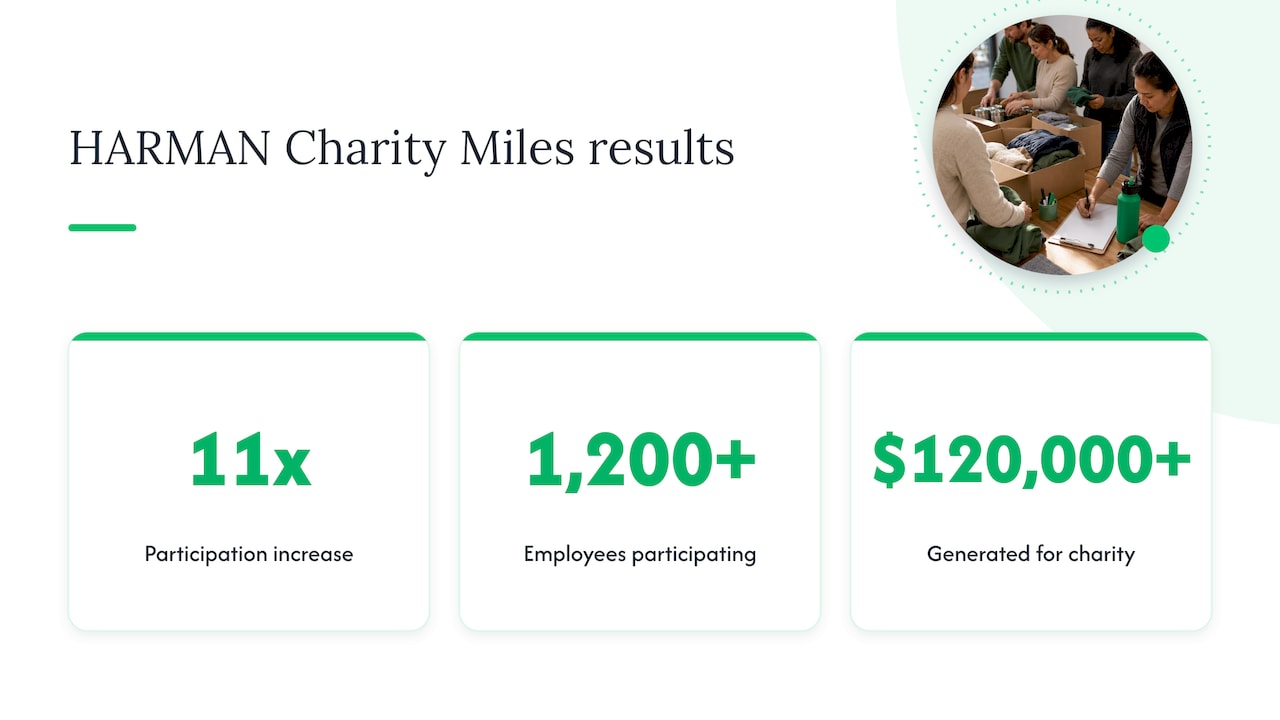
That is why we suggest pairing every survey with a participation baseline. When our Employee Empowerment Program runs at a company, the activity data is already there: who joined a team, how many miles were logged, which challenges drew people in. A survey then explains the numbers instead of guessing at them. HARMAN, for example, launched a Charity Miles team in 2021 and saw an 11x increase in employee participation, with more than 1,200 employees generating over $120,000 for charity. You can read how that pilot played out.
Two more things we have learned. First, barriers are usually practical, not moral. People rarely say they don’t care. They say they don’t have time or don’t know how. Programs where any movement counts, such as a lunchtime walk, a bike commute or a run, remove the biggest practical barrier, which is the idea that you need to be an athlete. Second, ask about inclusion explicitly. Questions 22 and 23 above often reveal more than any satisfaction score.
— Gene
Turn survey answers into a program people join
Once your survey tells you what employees want, you need a format that fits. Our Employee Empowerment Program lets you create private teams, run friendly company challenges and, if you choose, sponsor employee miles at a rate and cap you set. Donations can go to each employee’s chosen charity or a cause the company selects. The Charity Miles app is free for members and for charities.
If your survey shows that awareness is low and participation is uneven, a private team challenge is a simple first step. For more ideas on formats, see our guide to CSR initiatives for employers.
FAQ
How many questions should a CSR survey have?
Aim for 15 to 25 questions, which takes five to ten minutes. Shorter surveys get higher completion, and you can cover the five areas (awareness, trust, participation, personal impact and community outcomes) with two to five questions each. Add a longer module only for a specific decision.
Should a CSR survey be anonymous?
Usually yes, especially for questions about leadership credibility, ethics and workplace habits. Say clearly at the start whether responses are anonymous and who will see them. If you need to compare departments, report only groups large enough that no one can be identified.
What is the difference between a CSR survey and a social impact survey?
A CSR survey asks about the company’s responsibility practices and how employees see them. A social impact survey focuses on outcomes for communities and beneficiaries. Many employee surveys blend both, as the community outcomes block above does, but the strongest impact evidence comes from your charity partners’ data.
How often should we run it?
Once a year for the full survey is a common rhythm, with a short pulse of three to five questions after major programs. Keep a stable core of items so you can compare year to year.
Sources
- Gallup’s Perspective on ESG and the Will of the Workplace
- Gallup’s Q12 Employee Engagement Survey
- How to Engage Employees in Corporate Social Responsibility? (SAGE)
- Making the Case for Corporate Social Impact (ACCP)
- Burnout to Balance, staff well-being report (UNC-Chapel Hill)
- The Civic 50: 2026 Survey Workbook (Points of Light)
- Organisational Values Self-Assessment Tool (Leeds Beckett University)
- American Time Use Survey Questionnaire (U.S. Bureau of Labor Statistics)
- Measuring Sustainability Performance (S&P Global)
- Email marketing platforms for nonprofits comparison