

Good wellness challenge rules do five things. They name the start and end dates, define exactly which activities count, explain how points or miles are scored, protect participants’ health and privacy, and say what happens if something goes wrong. Write those down before anyone signs up and most disputes never happen. This guide walks through each rule, shows how real organizations word theirs, and ends with a template you can adapt for a fitness or walking challenge.
TL;DR
- Publish dates, goals, eligible activities and point values before launch, so nobody argues about scoring halfway through.
- Define activity precisely and cap or normalize scoring so a marathoner and a first-time walker can both feel the challenge is fair.
- Keep participation voluntary, keep health data private, and point people to a doctor before they start a new activity program.
- If miles raise money for charity, state who pays, any per-mile rate, and any cap in the rules themselves.
- Report progress often and publish final results the same way you promised in the rules.
Table of Contents
- Start with the rules every challenge needs
- Define what counts, precisely
- Set goals, duration and participation expectations
- Walking challenge rules: distance, steps, tracking, teams
- Make the challenge fair for every fitness level
- Safety rules: protect the people who take part
- Privacy and legal rules for employer challenges
- Rules for challenges that raise money for charity
- Keep people engaged and report results
- Our perspective: rules should make people want to join
- Run your challenge with Charity Miles
- A sample rules template
- FAQ
- Sources
Start with the rules every challenge needs
Whether you call it a wellness challenge, a fitness challenge or a step challenge, the skeleton of the rules is the same. BambooHR’s guidance on running a wellness challenge recommends publishing a specific start and end date, clear goals, a focused timeframe, transparent progress tracking, and explicit definitions of eligible activities and point values before it begins. That list is a good test of any draft: if a participant cannot find an answer to one of those items in your rules, add it.
Here is a checklist we use as a starting point.
| Rule | What to write | Example wording |
|---|---|---|
| Dates | Exact start, end and logging deadline | “The challenge runs four weeks. Log activity by Monday at 5 p.m.” |
| Who can join | Eligibility and team formation | “Open to all employees. Teams of 3 to 5.” |
| What counts | Activities, devices, units | “Walking, running and biking, tracked by app or fitness tracker.” |
| Scoring | Points, miles or steps, caps, tie-breaks | “One mile equals one point. Daily cap applies.” |
| Tracking | How and when to log | “Auto-sync or manual entry, weekly.” |
| Prizes or giving | What is awarded, who funds it | “Company donates per mile up to a total cap.” |
| Health and safety | Voluntary participation, accommodations | “Consult your doctor first. Contact HR for accommodations.” |
| Privacy | What is collected and who sees it | “Team totals are shared. Individual health data is not.” |
| Disputes | Who decides and how to appeal | “The organizing committee’s decision is final.” |
Keep the rules to one page if you can. People read a short rules page. They skim a long one and then ask questions in the team chat.
Define what counts, precisely
Vague activity rules cause the most arguments. “Be active” invites debate about whether gardening counts. “Walking steps only” does not.
The official 2026 Walk & Ride Challenge rules are a good model of precision. They count walking steps only, and state that steps from aerobics, running, rollerblading, cycling, swimming and yoga do not count. You may not want to be that strict. A mixed challenge that counts walking, running and biking is friendlier and suits a wider range of employees. The point is to choose on purpose and write it down.
When you allow several activities, you need a common unit. The American Heart Association’s Move More toolkit normalizes activity points using METs (a measure of how hard an activity is) and recommends 150 minutes of activity per week, which equals 300 points in its 30-day challenge. Miles are simpler. Distance is easy to explain, easy to verify with GPS, and works across walking, running and biking, which is why we build around it.
Decide these details in advance:
- Which activities count. List them. Say what does not count, too.
- Which tools are accepted. Smartphone app, wearable, manual entry? Say whether manual entries need a screenshot or just an honor-system log.
- Indoor activity. Treadmill miles are fair to people in cold climates or with safety concerns. Say whether they count.
- Duplicate tracking. If someone wears a watch and runs an app, say only one source counts.
Set goals, duration and participation expectations
A challenge needs a goal that participants can picture. That can be an individual target (for example, a weekly activity minimum), a team target, or a shared target such as total miles walked by the company.
On duration, short and focused beats long and vague. The AHA toolkit above uses a 30-day format, and many workplace challenges run between two and six weeks. Pick a length that matches the habit you want to build. Two weeks is a sprint that can fit a busy quarter. Four to six weeks gives people time to form a routine, but expect some drop-off in the final stretch.
Participation rules are where you decide whether the challenge is inclusive. Consider:
- Individual and team categories. New York City’s official 2025 Let’s Move NYC rules define separate individual and team categories, and include a consistency category that requires a specified adherence threshold. A consistency award rewards the person who shows up every day, not only the person with the most steps.
- Team size. The Walk & Ride Challenge requires 3 to 5 members for prize eligibility and ranks winning teams by average steps per member. Ranking by average rather than total stops a large department from winning just by being large.
- Opt-in only. Say plainly that joining is voluntary and that not joining has no consequence.
If you want ready-made scoring formulas, see our two scoring templates for fair workplace fitness challenges.
Walking challenge rules: distance, steps, tracking, teams
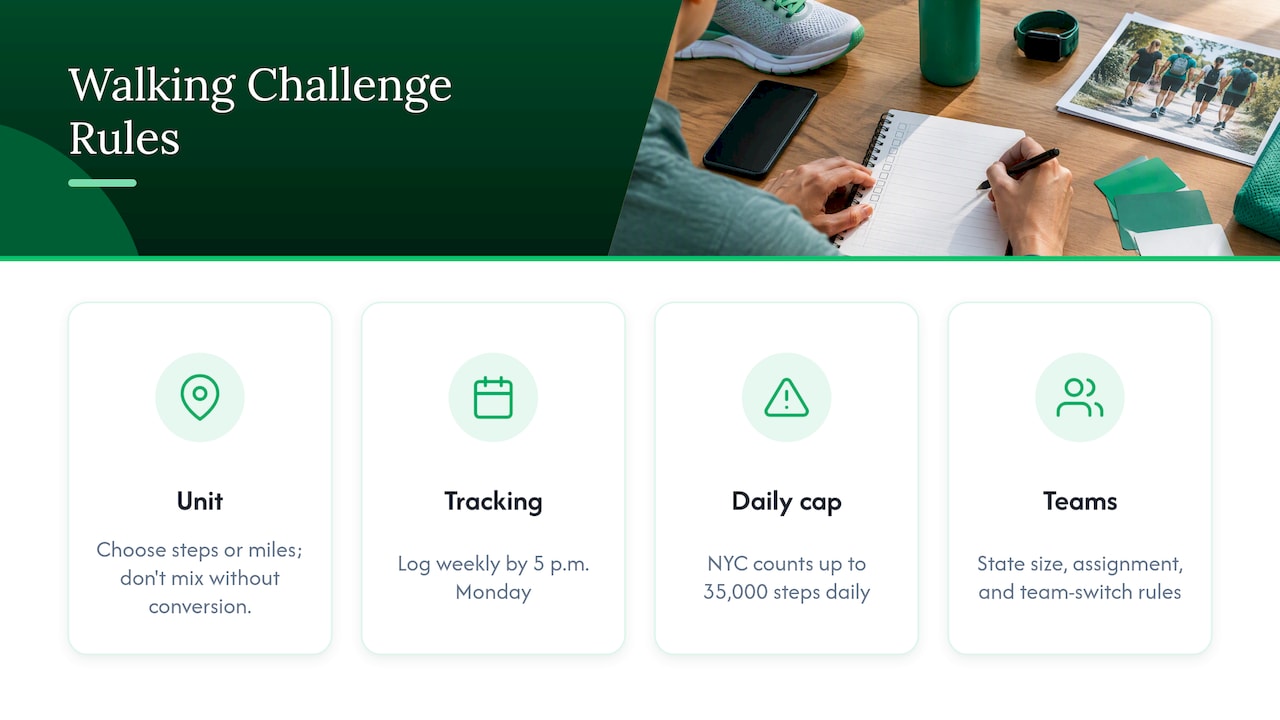
Walking challenges are the most popular format because almost everyone can take part. The rules should cover four things.
Unit. Choose steps or miles. Steps suit pedometer and wearable users. Miles are easier for GPS apps and let walkers, runners and cyclists compete together. Do not mix the two without a conversion rule.
Tracking and deadlines. The Walk & Ride rules let participants use smartphones or fitness trackers and require steps to be logged weekly by 5 p.m. on Monday. A fixed weekly deadline keeps the leaderboard honest and gives your team a predictable moment to post updates.
Daily caps. Caps stop one extreme day from deciding the outcome. The NYC rules cap daily counted steps at 35,000. Your cap should be high enough that ordinary active people never hit it, and low enough to discourage overexertion and gaming.
Teams. State minimum and maximum team size, how people are assigned, and whether someone can switch teams midway. Our step challenge guide covers team formation in more depth.
Make the challenge fair for every fitness level
Fairness is the difference between a challenge people join and a challenge that the same five athletes win every time. A few rules help.
- Reward progress as well as volume. Add a personal-improvement or consistency award alongside the top-total award.
- Use averages for teams. As above, averages level out team size.
- Count all movement. A lunchtime walk should matter as much as a long run. This is why our platform counts walking, running and biking, not only athletic activity.
- Offer a reasonable-accommodation contact. The NYC rules provide a reasonable-accommodation contact. Name a person and an email address in your rules, and say that alternative ways to take part, such as wheelchair pushing or seated activity, can be arranged.
- Avoid body-based goals. Weight loss targets can be harmful and may raise legal questions. Activity goals are safer.
For more on building scoring that feels even, our fitness challenge ideas for team building show formats that work for mixed abilities.
Safety rules: protect the people who take part
Put safety language where participants will act on it: next to the sign-up button and in the welcome message.
The CDC’s Road to Health Toolkit encourages participants to consult a doctor or other health care professional before starting any physical activity program. Add one line to your rules saying this, and tell people with a heart condition, diabetes, joint problems, or who are pregnant that their own clinician is the right person to ask.
The same toolkit lists practical walking safety steps: wear appropriate clothing and shoes, hydrate before and after activity, listen to your body to avoid overexertion, and warm up and cool down for 5 to 10 minutes each. Turn those into a short “before you start” box in your challenge handout.
Safe conditions matter just as much as safe habits. Older participants and anyone concerned about falls should be encouraged to choose flat, well-lit routes and to include balance work in their week. This guide to balance training for seniors explains exercises that help prevent falls, which can be a helpful resource to share with participants who want to walk more confidently.
Also write in the rules that no one should exercise through pain, heat illness symptoms or dizziness, and that stopping is always acceptable. Daily caps on counted activity, as described above, support that message.
Privacy and legal rules for employer challenges
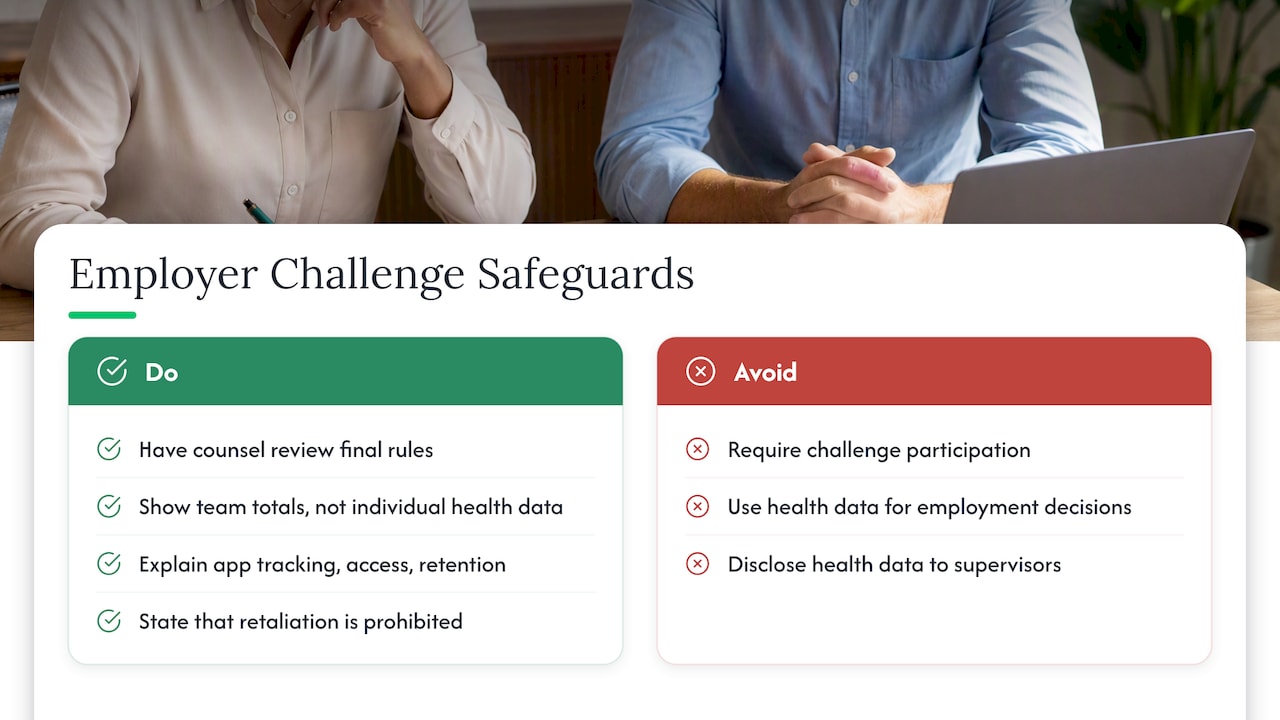
If you run the challenge at work, privacy and voluntariness are not optional. We are not lawyers, so have your HR counsel or employment attorney review your final rules. These are the points to raise with them.
Voluntary participation. The EEOC explains that the ADA and GINA generally prohibit employers from obtaining and using health information, but allow health-related questions and medical examinations as part of a voluntary wellness program. A distance-based activity challenge that does not ask for medical information is a simpler case than a biometric screening, but the principle holds: do not require participation.
Incentive limits. Under the EEOC’s 2016 final rules, employer-sponsored wellness programs tied to a group health plan may offer incentives for providing health information, such as biometric screenings, up to 30% of the total cost of self-only coverage. If your challenge only tracks miles and does not collect health information, check with counsel whether that limit applies to your prizes.
Confidentiality. The EEOC’s sample notice says employers must maintain the privacy of participant health information, keep it separate from personnel records, and ensure it is not used to make employment decisions or disclosed to supervisors. In practice, show team totals and leaderboards, not individual health data.
No retaliation. Participants cannot be discriminated against for not participating or for the medical information they provide, and must be protected against retaliation. Say so in one sentence.
Also tell participants what the tracking app collects (location during activity, distance, time), who in your company can see it, and how long it is kept. Plain language beats legal language here.
Rules for challenges that raise money for charity
When miles turn into donations, participants and sponsors need to know the money terms up front. Include:
- The rate. How much is donated per mile or step?
- The cap. What is the maximum total sponsorship?
- The source. Does the company pay, an outside sponsor, or participants?
- The recipient. Does each person choose a charity, or is there one company-selected cause?
- The timing. When will the donation be made, and how will you report the total?
On our platform, a company that sponsors miles chooses the rate per mile, the total cap, and whether donations go to each employee’s chosen charity or a single company cause. Whatever platform you use, put those same four terms in writing.
A tax note for anyone who donates personally: the IRS says a donor claiming a deduction of $250 or more must obtain and keep a contemporaneous written acknowledgment of the contribution. The IRS also says that a charity that gives goods or services in exchange for a contribution above $75 must provide a written disclosure statement estimating the value of what it gave. If your prizes or perks are tied to donations, speak to a tax professional about how these rules apply. A company paying per mile out of its own budget is a different situation from employees donating personally, so do not assume the same treatment.
For formats and examples, see our overview of charity fitness challenge formats and the guide to organizing a step challenge for charity.
Keep people engaged and report results
Rules do not keep a challenge alive. Rhythm does. Build these habits into the plan and mention them in the rules so people know what to expect.
- Launch with a kickoff message that restates the dates, the scoring and the goal in three sentences.
- Post a weekly update on the same day each week. Match it to your logging deadline.
- Highlight different people. Celebrate the most improved, the most consistent, and the team that rallied late, not only the leader.
- Share a collective number. “Together we walked 3,000 miles” motivates people who will never top a leaderboard.
- Close with a results post that follows the format promised in the rules: final standings, awards, and, for a charity challenge, the total donated and where it went.
- Ask for feedback with two or three questions so the next round improves.
Themes also help. Our walking challenge themes show how teams keep interest over several weeks. A real example: since launching its Charity Miles team in 2021, HARMAN saw an 11x increase in employee participation, with 1,200+ employees generating over $120,000 for charity. Read the team spotlight for how teams stay motivated.
Our perspective: rules should make people want to join
We have watched many companies run challenges, and the pattern is consistent. The rules that work are short, generous and specific. They count every kind of movement, so the person who walks at lunch feels as welcome as the person who runs marathons. They put the company’s commitment in writing, whether that is a per-mile donation or a cap. And they treat participation as an invitation, never an obligation.
We also believe the best challenge is not a one-off event. A step challenge ends and habits fade. When movement is tied to a cause people care about, and woven into company culture through private teams and friendly competition, people keep going because the miles mean something. That is why we built our Employee Empowerment Program around company control: you choose the rate, the cap and the destination, and employees choose how to move.
If you remember one thing, make it this: fairness is a design decision you make in the rules, before anyone logs a single mile.
— Gene
Run your challenge with Charity Miles
If you want a challenge where rules, tracking and donations work together, our Employee Empowerment Program lets you create private teams, run intra-company challenges, and optionally sponsor miles at the rate and cap you choose. The app is free for employees and tracks walking, running and biking by GPS and pedometer. You can see how it works on the Charity Miles app page.
A sample rules template
Copy and adapt this, then have HR or counsel review it.
- Dates. The challenge begins on [start date] and ends on [end date]. Log activity by [day and time] each week.
- Eligibility. Open to all employees. Participation is voluntary and has no effect on employment.
- Teams. Teams have 3 to 5 members. Team scores are the average of members’ miles.
- What counts. Walking, running and biking tracked in [app] or a fitness tracker. Indoor treadmill miles count. Only one tracking source per activity.
- Scoring. One mile equals one point. A maximum of [number] miles counts per person per day.
- Awards. Top team, most improved, most consistent. [Describe prizes.]
- Giving. [Company] will donate [rate] per mile up to [cap] to [charity or each participant’s chosen charity].
- Health. Talk with your doctor before starting a new activity program. Stop if you feel pain, dizziness or illness.
- Accommodations. Contact [name, email] for alternative ways to take part.
- Privacy. We share team and company totals. We do not share individual health information with supervisors.
- Disputes. Contact [name]. The organizing committee decides.
FAQ
How long should wellness challenge rules be?
One page is ideal. Cover dates, eligibility, what counts, scoring, awards, health and privacy, and how to ask questions. Link to a longer FAQ if you need more detail.
Should a daily cap be part of fitness challenge rules?
Yes, in most cases. A cap keeps one extreme day from deciding the outcome and discourages overexertion. New York City’s official rules, for example, cap counted steps at 35,000 per day.
Can employees be required to join a workplace wellness challenge?
The EEOC says wellness programs that ask health questions or involve medical exams must be voluntary. Make every challenge opt-in and state that nonparticipation has no consequences. Have your employment counsel review the details for your situation.
What should walking challenge rules say about tracking?
Name the accepted tools, such as smartphones or fitness trackers, and set a regular logging deadline. Say whether manual entries are allowed and that only one tracking source counts for each activity.
Sources
- 5 Tips for Running a Successful Wellness Challenge (BambooHR)
- Move More Activity Challenge (American Heart Association)
- 2026 Walk & Ride Challenge rules
- Let’s Move NYC 2025 official rules (NYC.gov)
- Road to Health Toolkit: Activities Guide (CDC)
- EEOC Issues Final Rules on Employer Wellness Programs
- Sample Notice for Employer-Sponsored Wellness Programs (EEOC)
- Substantiating charitable contributions (IRS)