

Wellness is the active pursuit of health: the daily choices about movement, food, sleep and stress that you make. Well-being is the broader result: how satisfied, connected and purposeful your life feels overall. The two overlap and feed each other, which is why people mix them up. But if you run a workplace program, the difference changes what you build.
Below, we explain both terms using definitions from U.S. health agencies, settle the spelling question, and show why employers who treat the words as synonyms often miss the point. We also cover newsletter topics for HR teams.
TL;DR
- Wellness is an active process: the choices and habits that support health. Well-being is the broader state: quality of life, purpose and satisfaction.
- A handy shorthand: wellness is the process, well-being is the result.
- In American English, the standard spelling is hyphenated: well-being. The one-word “wellbeing” is the common British form.
- At work, a wellness program alone does not guarantee better well-being. Conditions, leadership and participation matter just as much.
- Any movement counts. Inclusive, low-barrier activity is one of the easiest ways to link the two.
Table of Contents
- What wellness means
- What well-being means
- Wellness vs. well-being at a glance
- Is it wellbeing or well-being?
- Why the difference matters at work
- How to connect wellness activity to well-being
- Our perspective
- Putting it into practice: a simple approach for HR teams
- Employee well-being newsletter ideas and wellness newsletter topics
- Where Charity Miles fits
- FAQ
- Sources
What wellness means
Wellness is something you do. The Global Wellness Institute describes it as the active pursuit of activities, choices and lifestyles that lead to holistic health, and it contrasts wellness with a passive state of being. You don’t wake up with wellness. You practice it.
U.S. public health agencies use similar language. The CDC’s workplace health program description defines wellness as a dynamic process of learning life skills, becoming aware of choices and choosing a more balanced, healthy lifestyle. It spans social, physical, emotional, career, intellectual, environmental and spiritual dimensions.
SAMHSA goes further and names eight interconnected dimensions: emotional, environmental, financial, intellectual, occupational, physical, social and spiritual. Its guide also stresses that wellness is culturally shaped, so different communities may define each dimension differently.
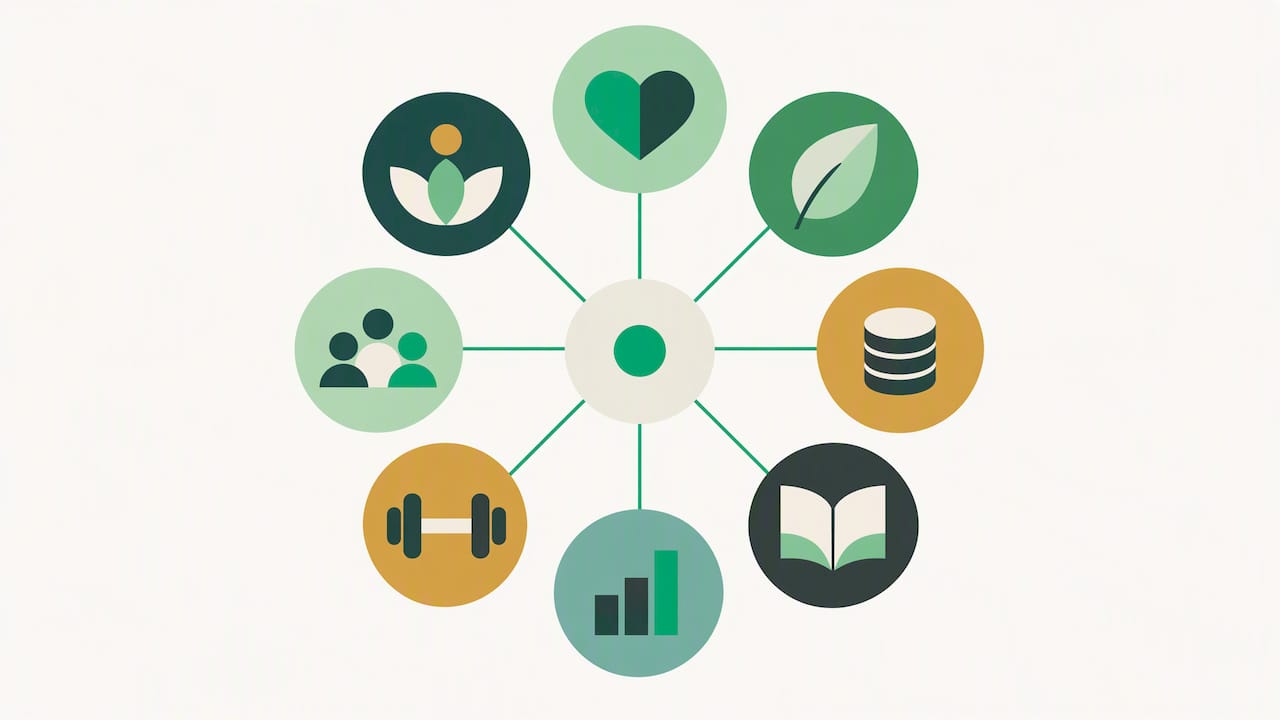
In everyday use, though, “wellness” often narrows to the physical side. Gallup’s explainer on the two terms describes wellness as physical health supported by eating, activity and sleep habits. That narrower sense is how most companies use it when they say “wellness program.”
What well-being means
Well-being is the bigger picture. The University of Illinois summarizes the World Health Organization’s definition as a positive state experienced by individuals and societies, covering quality of life and the ability to contribute with meaning and purpose.
Gallup frames well-being as five dimensions of a well-lived life: career, social, financial, physical and community. Notice what that adds. Someone can exercise every morning and still have low well-being if they dread their job, worry about money or feel isolated.
Washington State’s Employee Assistance Program draws the line this way: wellness is about intentional daily choices that promote health and prevention, while well-being is about fulfillment and satisfaction across emotional, psychological, social and spiritual areas.
Wellness vs. well-being at a glance
| Wellness | Well-being | |
|---|---|---|
| Nature | Active, ongoing process | State or outcome |
| Focus | Habits, choices, prevention | Fulfillment, satisfaction, quality of life |
| Typical scope | Often physical, sometimes multi-dimensional | Always broad: work, relationships, money, community, purpose |
| Who controls it | Largely the individual | Individual plus environment, employer and community |
| Example | A lunchtime walk, a sleep routine | Feeling secure, connected and valued at work |
The University of New Hampshire Extension uses the same process versus result framing: wellness as a continuous, lifelong, active process, and well-being as a state that lets people reach their potential.
The agencies are not perfectly consistent, and that is worth knowing. The NIH’s National Center for Complementary and Integrative Health says both terms are used in efforts to promote general health, and its dimensions of wellness include emotional well-being and physical well-being. In other words, “well-being” shows up inside the definition of “wellness.” The words nest and overlap. The practical distinction is about emphasis, not a strict dictionary border.
Is it wellbeing or well-being?
For a U.S. audience, write well-being with a hyphen. Merriam-Webster, the standard reference for American English, lists only the hyphenated spelling, while British dictionaries such as Collins give the closed form “wellbeing.” Most U.S. government sources, including the CDC, NIH and HHS pages cited in this article, use the hyphen.
The real rule is consistency. Choose one form for your audience and use it everywhere: your intranet, your policy documents and your newsletter. If your company has employees in the UK, you may see both forms in internal materials. That’s fine, as long as each version is consistent for its readers.
One more point of usage: “wellness” is a noun and not a hyphenated term, but it often modifies other nouns (wellness program, wellness challenge). “Well-being” is always the noun for the state.
Why the difference matters at work
Here is where the vocabulary stops being academic. If you think of employee health as “wellness,” you build programs: a gym stipend, a step challenge, a meditation app. If you think in terms of well-being, you also ask about workload, autonomy, manager support and belonging.
The evidence supports the second view.
- The U.S. Surgeon General’s workplace well-being framework centers worker voice and equity and calls for action across five essentials. It treats well-being as an organizational responsibility, not just an individual fitness issue.
- NIOSH identifies job stressors that can damage workers’ health and well-being: interpersonal conflict, insufficient supervisor support, low job control, overload and work-family imbalance.
- The American Psychological Association reports that evidence-based workplace approaches include mental-health coverage, manager training, flexible work options, equity, listening to workers and limiting communications outside work hours.
- A CDC-published study of hospital food-service workers found that clear, two-way communication, community and purpose, paid sick leave and health insurance supported worker well-being.
None of that is a yoga class. That doesn’t make wellness programs pointless. It means they work best as one piece of a wider effort. Gallup cautions that simply offering a wellness program does not improve well-being: employees must know it exists and be persuaded to use it.
That last part, participation, is the weak point of many programs. If you want a deeper look at it, our piece on access before rewards in wellness program participation walks through how to remove barriers first.
How to connect wellness activity to well-being
A good rule: choose wellness activities that also touch the other well-being dimensions. Three questions help.
- Does it include everyone? A program built for athletes leaves out the people who most need a reason to move. Activities where any movement counts, such as a walk, a bike commute or a run, meet people where they are.
- Does it build connection? Team formats address the social dimension. A solo tracker doesn’t.
- Does it add purpose? When movement supports something people care about, it touches the purpose and community pieces that definitions of well-being emphasize.
The last point is where charitable giving fits. People are more likely to keep moving when the activity means something beyond their own step count. We cover practical formats in how to engage employees with wellness challenges that give back and in our roundup of corporate wellness ideas that boost engagement.
Community involvement matters outside the company too. Looking at local wellness events in your area is one way to see how community organizations support holistic health, and it can inspire volunteer or team activities.
Our perspective
We built Charity Miles on a simple belief: movement is more motivating when it matters to someone. Our free app tracks walking, running and biking by GPS and pedometer, and money is donated to a charity the member chooses for every mile logged.
Here is how we think about the wellness versus well-being question, drawn from working with companies.
- Wellness is the doorway. Physical activity is the easiest thing to start. A lunchtime walk is a low-effort, low-risk first step for almost anyone.
- Well-being is what makes people stay. Participation lasts when people feel connected to teammates and to a mission. That is why we pair individual movement with private company teams, friendly challenges and giving.
- Employers set the conditions. A challenge cannot fix an overloaded team. We would never claim it does. But it can add connection, energy and shared purpose to a culture that is also working on the basics the Surgeon General and NIOSH describe.
- Inclusion is non-negotiable. Because every kind of movement counts, a person with a desk job and a bad knee can walk alongside a marathoner on the same team.
One example: since launching its Charity Miles team in 2021, HARMAN saw an 11x increase in employee participation, with more than 1,200 employees generating over $120,000 for charity. We read that as a participation story. People joined because the activity was easy and meaningful, not because they were told to get healthier.
— Gene
Putting it into practice: a simple approach for HR teams
If you’re deciding where to start, this sequence keeps the two ideas in balance.
- Assess before you launch. NIOSH recommends that employers assess worker well-being before introducing a wellness program, make information easy to understand and reachable by mobile or web, and provide employee-assistance resources.
- Fix conditions you can control. Workload, scheduling flexibility and manager training do more for well-being than any single perk.
- Offer low-barrier wellness options. Choose activities that need no equipment, no fitness level and no gym.
- Make it social and purposeful. Teams, shared goals and a cause give people a reason to return.
- Communicate often. Participation depends on awareness, which is where newsletters come in.
For policy language, our employee well-being policy template with a 10-item checklist gives HR a starting point. If you are new to the vocabulary, what a wellness program is is a good primer, and our guide to the best employee wellness programs helps you compare approaches by type.
Employee well-being newsletter ideas and wellness newsletter topics
The distinction helps here too. A newsletter that only says “drink water, take the stairs” covers wellness. A stronger one covers both the habits and the conditions around them.
According to SAMHSA’s guide, a workplace newsletter can feature wellness-related articles and case studies, and a learning community can share ideas and announce activities. The CDC and NIOSH’s Impact Wellbeing Guide recommends email announcements and regular staff newsletters for sharing well-being updates.
Topics that cover wellness habits
A NIOSH workplace newsletter recommends content on sleep, hydration, physical activity, balanced eating, chronic-condition care, medication effects, social isolation, stress and seeking mental-health help. That is a ready-made editorial calendar. Pair each with something actionable:
- A sleep tip with a reminder about flexible start times
- A hydration and movement prompt before a team challenge starts
- A short guide to the employee assistance program and how to reach it
- A stress note that names the team’s busiest period and what leadership is doing about it
Topics that cover broader well-being
Mayo Clinic Press notes that wellness coaching can span relationships, occupation, education and learning, movement, stress management, spirituality and financial stability. Use that breadth for a monthly theme:
- Career: growth opportunities, mentoring, internal mobility
- Social: team spotlights, new-hire welcomes, volunteer days
- Financial: benefits explainers, open-enrollment reminders
- Community: charity partners, results from team challenges, local events
- Physical: walking routes, bike-commute tips, challenge leaderboards
Keep it useful and inclusive
The coach featured in the NIOSH newsletter says effective programs meet employees where they are, avoid shame or alienation, and cover topics employees say they want. So ask them. A two-question survey in your next issue tells you more than guessing.
SAMHSA’s perspective on inclusion is also practical: let communities define what each dimension means for them. A shared newsletter can invite staff to contribute their own stories and routines.
Finally, mix channels. The CDC-published study mentioned above found workers relied on team huddles, manager check-ins, bulletin-board notices, texts and email, and that clear communication was associated with better reported mental health. A newsletter is one channel, not the whole plan.
Where Charity Miles fits
If you want to turn wellness activity into something that builds well-being, our Employee Empowerment program gives you a place to start. Companies create private teams, run friendly challenges, and can optionally sponsor employee miles: you choose the rate per mile, the total cap, and whether donations go to each employee’s chosen charity or a company-selected cause. The app is free for members, and any movement counts.
It works best as part of a bigger plan, alongside the conditions and communication practices above. If you want to see how it works for individuals first, you can explore the Charity Miles app.
FAQ
Is it wellbeing or wellness?
They are two different words, not two spellings of one. “Wellness” is the active pursuit of health through daily choices. “Well-being” is the broader state of quality of life and satisfaction. “Wellbeing” without the hyphen is just a variant spelling of well-being, common in British English.
What is the difference between wellness and well-being in one sentence?
Wellness is the process of making healthy choices, and well-being is the overall state of a good life that those choices help produce. Several university and state sources describe it as process versus result. In practice the two overlap, and each influences the other.
What are the dimensions of wellness?
SAMHSA lists eight: emotional, environmental, financial, intellectual, occupational, physical, social and spiritual. The CDC’s description of wellness names a similar set, adding career. Different organizations group them slightly differently, so pick one framework and use it consistently.
Does a wellness program improve employee well-being?
Not by itself. Gallup cautions that offering a program does not improve well-being unless employees know about it and are persuaded to use it. Federal guidance from the Surgeon General and NIOSH also points to workload, leadership and job control, so the strongest efforts combine programs with changes to working conditions.
What should an employee well-being newsletter include?
Mix habit topics, such as sleep, movement, hydration and stress, with broader well-being topics like career growth, financial benefits, community and connection. Add clear pointers to employee-assistance resources and ask staff what they want to read. Keep the language plain and make it easy to open on a phone.
Sources
- Global Wellness Institute: What is Wellness?
- CDC: Workplace Health Program Definition and Description
- SAMHSA: Promoting Wellness Guide
- Gallup: Wellness vs. Wellbeing: What’s the Difference?
- University of Illinois: Health vs. Wellness vs. Wellbeing
- Washington State EAP: Wellness & Well-being
- University of New Hampshire Extension: Wellness Wheel Assessment
- NCCIH: Wellness and Well-Being
- The Write Practice: Is Well-being Hyphenated?
- HHS Surgeon General: Workplace Mental Health & Well-Being
- NIOSH: Supportive Leaders Drive Organizational Improvements
- APA: Why mental health needs to be a top priority in the workplace
- CDC study: The Psychosocial, Organizational, and Environmental factors for food-service workers
- NIOSH: Behind the Wheel at Work, Vol 8 No 2
- CDC/NIOSH: Impact Wellbeing Guide
- Mayo Clinic Press: What is wellness coaching?