

The best way to allocate a CSR budget is to decide what you want the money to do, then divide it across a few clear buckets: strategic nonprofit partnerships, employee-driven programs, measurement, and a small reserve. Most companies get into trouble not because the total is too small, but because the money is scattered across too many one-off gifts that nobody can explain a year later.
This guide walks through how we think about the split, what the tax rules mean for your ceiling, what current benchmarks say about where peers are moving, and how to protect the budget when finance starts trimming.
TL;DR
- Start with outcomes and the audience you want to reach, then size each bucket. Do not start with last year’s line items.
- Peers are shifting toward fewer, larger partnerships and toward employee engagement, which is where budgets grew most in recent surveys.
- For U.S. corporations, the deductible amount of charitable giving is capped at 10% of taxable income, and a 1% floor now applies for tax years beginning after 2025.
- Keep a flexible reserve and a measurement line (we suggest the ranges below) so you can prove impact.
- Low-barrier, team-based programs such as walking challenges let a modest budget reach every employee, not only the already-active.
Table of Contents
- Start with the ceiling: what the tax rules allow
- What peers are doing with their budgets
- A framework for splitting the budget
- Prioritize projects with a simple scoring pass
- Why movement-based programs stretch a small budget
- Perspective: how we’d budget a movement-based giving program
- Where Charity Miles fits in your allocation
- Protecting the budget when finance trims
- A 90-day plan to set your allocation
- FAQ
- Sources
Start with the ceiling: what the tax rules allow
Before you divide anything, know the outer limit for deductible giving. For U.S. corporations, the IRS says charitable contributions are generally deductible up to 10% of taxable income, figured before certain deductions. Amounts above the limit can be carried forward for up to five later tax years.
There is a newer wrinkle. Under the One Big Beautiful Bill Act, for tax years beginning on or after Dec. 31, 2025, only the portion of a corporation’s giving that exceeds 1% of taxable income and stays within 10% is deductible. In practice, the first 1% of taxable income you give may not produce a deduction. That does not mean you should skip it. It means your finance team should model the effect before you commit to a number.
Timing also helps. Accrual-method corporations can generally deduct contributions authorized by the board during the tax year and paid by the return due date, excluding extensions, as explained in Publication 542. That lets you fine-tune year-end giving once profit is clearer.
This is general information, not tax advice. Your CFO or outside tax adviser should confirm how these limits apply to your entity, especially if you give through a foundation or have a net operating loss.
What peers are doing with their budgets
It helps to know whether you are an outlier. The 2025 CSR Insights Report from ACCP found that employee engagement budgets increased the most, while operations and grantmaking mostly stayed flat. Foundation budgets saw a slight increase. The same report points to companies moving away from many small grants and toward larger, strategic partnerships.
Two things follow for your allocation:
- Spreading $200,000 across 80 small checks is getting harder to defend. Fewer, deeper relationships are easier to measure and easier to talk about.
- Engagement is where the energy is. Programs that let employees take part, and choose where the money goes, are gaining ground over passive check-writing.
Separate research on corporate plans backs up the direction of travel: a 2025 study summary reports that many executives plan to boost their CSR investment.
A framework for splitting the budget
There is no universal percentage, and we would be wary of anyone who gives you one. What we can offer is a structure that works across company sizes. The ranges below are our starting suggestions, not industry benchmarks. Adjust them to your goals.
| Bucket | What it funds | Suggested share |
|---|---|---|
| Strategic partnerships | Multi-year commitments with a small number of nonprofits tied to your mission | 35% to 45% |
| Employee-driven giving and engagement | Matching, volunteering, challenges, employee-chosen charities | 25% to 35% |
| Community and disaster response reserve | Flexible funds for local needs and unplanned events | 10% to 15% |
| Measurement and communications | Reporting, surveys, storytelling, program tools | 5% to 10% |
| Administration | Staff time, vendor fees, compliance | 5% to 10% |
A company with a CSR budget of $100,000 would then put roughly $35,000 to $45,000 into two or three partnerships, $25,000 to $35,000 into employee programs, and so on. If your budget is smaller, collapse the partnership bucket into one anchor nonprofit and keep the rest of the structure.
Bucket 1: strategic partnerships
Choose partners where your business has something to offer beyond money: expertise, volunteers, product, or reach. Commit for at least two to three years so the nonprofit can plan. Write down two or three outcomes you will track together before the first payment goes out.
Bucket 2: employee-driven programs
This is the bucket most likely to grow, and the one where design matters most. Letting staff pick the cause matters, too. Our guide on why employees want to choose charities covers the data behind that. The ACCP report makes the same point: giving staff a say in grantees helps show tangible impact and supports talent retention.
Bucket 3: the reserve
Every year something unplanned comes up: a flood near a facility, a team member’s cause, a partner in crisis. A reserve of 10% to 15% keeps you from raiding other buckets. If the reserve goes unspent, roll it into a partnership at year end. If you are an accrual-basis taxpayer, the board-authorization timing described above can help here.
Bucket 4: measurement
Many programs lose funding because they cannot show what happened. Set aside a modest share for surveys, participation reporting and a short annual impact summary. It is cheap insurance.
Prioritize projects with a simple scoring pass
When requests exceed funds, score each one from 1 to 5 on five criteria:
- Mission fit: does it connect to what your company does or where your people live?
- Employee relevance: will staff care, and can they take part?
- Measurability: can you name the number that will change?
- Cost to deliver: include staff time, not only the grant.
- Durability: does the benefit last beyond the check?
Fund the highest scores until each bucket is full. Keep the scoring sheet. It becomes your audit trail and answers the question “why this and not that?” without a meeting.
Why movement-based programs stretch a small budget
If your employee engagement bucket is modest, the design of the program decides whether it reaches 5% of staff or 50%. High-cost wellness facilities tend to serve people who already exercise. Activity challenges where any movement counts reach more people at lower cost.

The CDC’s guide on physical activity in the workplace argues that a good culture of health depends on policies and supports that make it possible to be active, plus visible leaders who take part themselves. It also notes that programs work best when they reflect individual, group and environmental factors, and are woven into daily culture rather than handed down from the top.
There is a business case as well. The same CDC document cites studies linking regular activity to fewer missed workdays and reports wellness program returns above $1.50 per dollar in some cases. Treat these as indicators, not guarantees, since results vary by program and workforce.
How does that translate into a CSR line item? Think of one program doing two jobs. The same dollar funds a charity donation and supports employee wellbeing, so you are not forced to pick between a giving budget and a wellness budget. If you are building the wellness side more deeply, a wellbeing strategy for HR is worth designing alongside it, so that movement challenges fit a wider plan rather than standing alone.
Perspective: how we’d budget a movement-based giving program
We built Charity Miles around a simple idea: people will move more when each mile does some good, and companies get more from giving when employees are part of it. In our work with employers, the budgeting question usually comes down to control.
In our Employee Empowerment Program, the company sets the rules. You choose the rate per mile, the total sponsorship cap, and whether donations go to each employee’s chosen charity or to a company-selected cause. That cap is the useful part for a budget owner. You know the maximum exposure on day one, and you can size it to the engagement bucket instead of hoping participation lands somewhere reasonable.
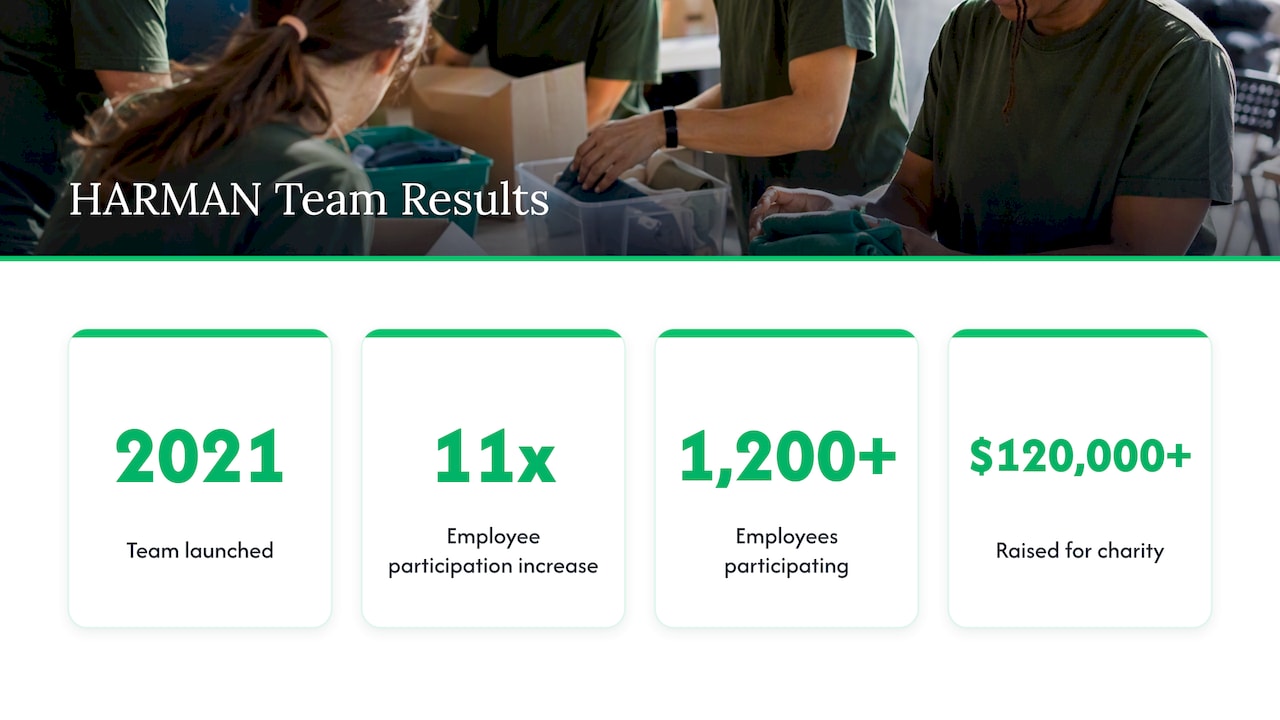
We also encourage teams to resist the urge to fund the biggest possible launch. Start with a defined challenge period, a cap you are comfortable with, and a plan to report participation. HARMAN, for example, launched its team in 2021 and saw an 11x increase in employee participation, with 1,200+ employees generating over $120,000 for charity. A result like that comes from participation, not from the size of the first check.
Our advice: treat employee-driven giving as a program you tune each quarter, not a donation you make once.
— Gene
Where Charity Miles fits in your allocation
If your plan includes an employee engagement bucket, our Employee Empowerment program lets you run private team challenges and sponsor miles on your own terms, with the rate and cap you choose. Brands and companies that want a wider community activation can look at corporate sponsorship opportunities. Individual employees can use the app for free.
Protecting the budget when finance trims
Budget pressure is the real test of an allocation. A few habits make cuts less likely:
- Tie every bucket to a number. Participation rate, hours volunteered, dollars raised, retention in participating teams.
- Show the double return. A program that supports charities and employee wellbeing is easier to defend than one that does only one.
- Offer a scaled-down version, not a yes or no. Show what 75% and 50% funding would look like before anyone asks.
- Report early. A one-page quarterly update beats a long annual deck.
For ideas on structuring the engagement side, see our pieces on the corporate step challenge and CSR and employee engagement.
A 90-day plan to set your allocation
- Days 1 to 30: Confirm the tax picture with finance. Gather last year’s giving, sort it into the five buckets, and see where the money really went.
- Days 31 to 60: Interview leaders and survey employees about causes. Score open requests with the five criteria above.
- Days 61 to 90: Set bucket sizes, name two or three outcomes per bucket, pick a launch date for the employee program and get board authorization.
Then review at six months. Move money between buckets only when the data tells you to.
FAQ
How is a CSR budget calculated?
Most U.S. companies start from a percentage of pre-tax profit or from last year’s spend, then adjust for goals. The tax code caps deductible corporate giving at 10% of taxable income, so many finance teams use that as the upper bound. Your own number should reflect strategy, not only a formula.
What percentage of the budget should go to employee programs?
There is no official figure. We suggest 25% to 35% as a starting range, and the ACCP survey shows employee engagement budgets rising faster than other areas. Start lower if you have no program in place and scale as participation proves out.
Is unspent CSR budget lost?
In the U.S., there is no federal rule that forces a company to spend a set amount, so unspent funds usually roll into the next year or into a reserve. Check with your tax adviser if you give through a foundation, since separate rules can apply. Carryforwards apply to deductions above the 10% limit, not to unspent budget.
Can a small business do CSR on a tight budget?
Yes. Pick one cause, one employee activity, and one measure. A capped, team-based challenge can reach everyone in the company without a large outlay.
Sources
- Instructions for Form 1120 (IRS)
- Publication 542, Corporations (IRS)
- Deducting corporate charitable contributions (The Tax Adviser)
- 2025 6th Annual CSR Insights Report (ACCP)
- Physical Activity in the Workplace (CDC)
- Businesses planning to increase investments in CSR