
The EEOC’s wellness rules come from two laws, the Americans with Disabilities Act (ADA) and the Genetic Information Nondiscrimination Act (GINA). They apply when a program asks employees disability-related questions, requires medical exams, or collects genetic information. A simple movement challenge that only records miles usually sits outside the heaviest parts of those rules. The incentive limit many people still quote, 30% of self-only coverage, is no longer a safe number to rely on. Here is how the pieces fit together, and how to design a walking, running, or biking program that stays on the right side of them.
This is general information for HR and CSR leaders, not legal advice. Have employment or benefits counsel review the final design of any program that touches health data or rewards.
TL;DR
- The EEOC’s wellness rules are triggered by what a program does (medical questions, exams, genetic information), not by what it is called.
- Under the ADA, a program that asks health questions or requires exams must be voluntary, reasonably designed to promote health, and backed by a clear notice and strict confidentiality.
- The EEOC’s 2016 incentive limit of 30% of self-only coverage is no longer in force, and the agency has not issued a replacement. Do not cite it as a current allowance.
- A challenge that tracks miles, asks no health questions, and rewards participation is far simpler to run. Separate rules from the Department of Labor can still apply if rewards are tied to a health factor.
- The usual failure point is data handling. Keep individual health information away from managers and ask your vendor for aggregate reporting.
Table of Contents
- Which laws sit behind the EEOC’s wellness rules
- What happened to the 30% incentive limit
- Does a walking challenge trigger the rules?
- The Department of Labor layer
- Accommodation: any movement counts, and that is a compliance feature
- The data pathway: where programs actually go wrong
- A compliance checklist for a movement challenge
- Our perspective
- Run a compliant challenge with Charity Miles
- FAQ
- Sources
Which laws sit behind the EEOC’s wellness rules
The EEOC does not have a single “wellness law.” It enforces two statutes that touch wellness programs.
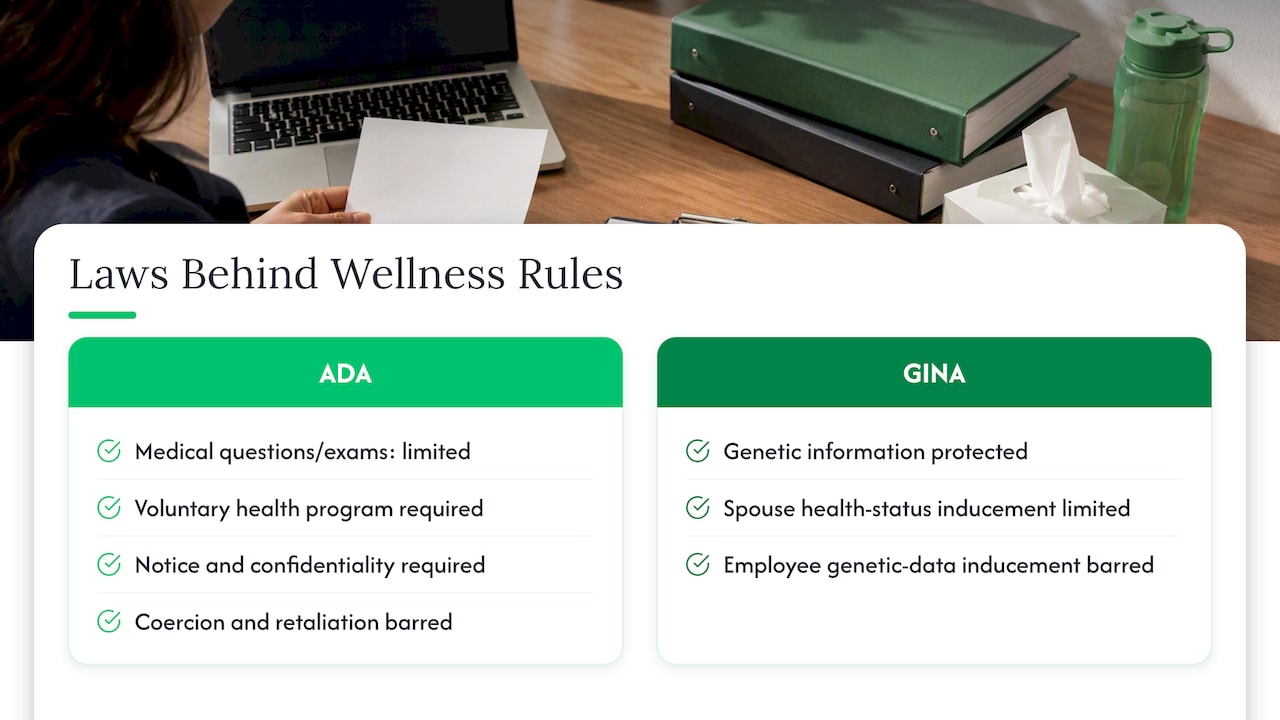
The ADA limits when an employer may ask disability-related questions or require medical examinations. The regulation at 29 C.F.R. § 1630.14(d) permits them as part of a voluntary employee health program. Such a program must be reasonably designed to promote health or prevent disease, and it must give employees an understandable notice of what information is collected, why, who sees it, and how it is protected. Employers also may not require participation, deny group health coverage for not participating, or retaliate, coerce, intimidate, threaten, or interfere with employees.
GINA protects genetic information, which includes family medical history. Under the EEOC’s GINA wellness rule, an employer may offer a limited inducement for a spouse to share current or past health status through a wellness service. It may not offer an inducement for an employee’s own genetic information, a child’s current or past health status, or family medical history gathered from a spouse or child.
The EEOC’s stated rationale, set out in its announcement of the 2016 rules, is that wellness programs can support health, but incentives must not become pressure to disclose protected health information. That is why the rules focus on voluntariness, notice, confidentiality, and anti-retaliation rather than simply approving or banning programs.
What happened to the 30% incentive limit
In May 2016 the EEOC finalized rules that allowed incentives, whether rewards or penalties, of up to 30% of the total cost of self-only coverage for voluntary programs involving disability-related inquiries or medical exams. The Federal Register notice shows the rule took effect July 18, 2016 and applied from January 1, 2017. The EEOC’s own example: with $6,000 self-only coverage, the maximum inducement is $1,800.
That is no longer the full story. The EEOC later removed the incentive-limit provisions, effective January 1, 2019, as reflected in coverage of the revised rules. A replacement proposed in January 2021 was withdrawn weeks later, leaving employers with little agency guidance on what incentives are permissible. As of October 2026, we are not aware of a new EEOC incentive rule, so check the EEOC site and ask counsel before relying on any number.
Two practical consequences follow:
- The ADA requirement that a program be “voluntary” still applies. Without a safe-harbor percentage, a large reward or penalty tied to health questions or exams invites a challenge that participation was not really voluntary.
- Never present 30% as a universal wellness allowance. It was an EEOC number for programs with medical inquiries or exams. Department of Labor rules for health-contingent programs are a separate system.
Does a walking challenge trigger the rules?
The test is functional. Calling a program “wellness,” “fitness,” or “CSR” does not decide anything. Ask three questions:
- Does the employer ask disability-related questions or require a medical exam (a health-risk assessment with medical questions, a biometric screening, a physical)?
- Is participation genuinely voluntary?
- Is any reward tied to a health factor?
A challenge that records distance and asks no disability-related questions, requires no medical exam, and collects no health-status information generally does not trigger the EEOC incentive rules aimed at medical inquiries. Once you add a health-risk assessment, biometric screening, or exam, ADA and GINA analysis becomes central.
| Program feature | ADA/GINA exposure | What to do |
|---|---|---|
| Team challenge that logs miles, no health questions | Low | Keep it voluntary, offer alternative ways to take part, limit data collected |
| Challenge plus health-risk questionnaire | Higher | Give the required notice, keep responses confidential, avoid tying large rewards to answering |
| Biometric screening or exam | Higher | Same as above, and review reward design with counsel |
| Spouse participation with health information | Specific GINA rules | Obtain prior, knowing, written, voluntary authorization |
| Reward for hitting a health result (weight, blood pressure) | Also DOL health-contingent rules | Add reasonable alternative standards, get benefits counsel involved |
The Department of Labor layer
A separate set of rules governs wellness programs connected to a group health plan. The Department of Labor explains in its guidance on the Affordable Care Act wellness rules that walking, diet, and exercise programs are “activity-only” health-contingent programs when a reward depends on completing an activity related to a health factor. The general reward limit there is 30% of employee-only coverage, or 50% for programs designed to prevent or reduce tobacco use. Dependent participation changes the calculation.
For activity-only programs, the DOL expects:
- An opportunity to qualify at least once a year.
- A reward within the applicable limit.
- A program reasonably designed to promote health or prevent disease.
- A reasonable alternative standard, disclosed in program materials.
The DOL’s employer advisor adds detail on alternatives: when a medical condition makes the standard unreasonably difficult or medically inadvisable, the employer should offer another way to earn the reward. Time commitments must be reasonable, an educational alternative cannot require the person to pay for it, and a personal physician’s recommendation must be accommodated when medically appropriate.
The DOL also explains why inclusive movement programs are easier to administer than outcome-based ones. An activity-only program rewards doing the activity. An outcome-based program requires a health result, so it needs broader alternative-standard protections for people who do not reach it.
Most corporate movement challenges, including ours, are not tied to a group health plan at all. They reward participation with recognition, team standings, or a charitable donation. That is the simplest design, but it still deserves a counsel check if you plan to link anything to premiums or benefits.
Accommodation: any movement counts, and that is a compliance feature
The ADA defines disability as a physical or mental impairment that substantially limits one or more major life activities, a record of such an impairment, or being regarded as having one. The EEOC’s ADA questions and answers list walking among the major life activities. A challenge built only around steps can therefore exclude some employees by design.
The EEOC’s guidance stresses individualization. A standard that works for most employees may not work for someone with a disability, and the answer is to modify the program rather than assume identical conditions are fair. In practice:
- Count wheeling, cycling, swimming, or other movement alongside walking and running.
- Let employees log distance by hand if they cannot use a particular device.
- Name a contact person for accommodation requests, and say so in the launch announcement.
- Never make a team’s ranking depend on every member hitting the same number of miles.
These choices also help participation. Employees who feel the program was built for them join, and stay.
The data pathway: where programs actually go wrong
The activity is rarely the problem. The trouble starts with where information goes. The EEOC’s small business fact sheet on the GINA rule is a useful checklist. In practice:
- Keep medical information in separate confidential files, not in personnel records.
- Give managers only what they need, such as a work restriction or an accommodation, never a diagnosis.
- Receive aggregate wellness data rather than individually identifiable data unless an exception applies.
- For spouses, get written authorization before they complete a health-risk assessment. The rule requires it to be prior, knowing, written, and voluntary.
Before you sign with any wellness or challenge vendor, put these in the contract: data minimization, access controls, permitted uses, retention and deletion, and reporting at the aggregate level. Ask what the app collects beyond distance and who at your company can see it.
A compliance checklist for a movement challenge
- Define what you collect. Distance, date, and team. No medical questions, no diagnoses.
- Keep it voluntary. No penalty for opting out, no effect on coverage, no pressure from managers.
- Reward participation, not health results. Team recognition or donations to charity avoid most of the issues above.
- Offer inclusive ways to take part. Any movement counts, with an alternative for those who cannot walk or run.
- Publish a short notice. Say what is tracked, who sees it, and that reporting is aggregate.
- Restrict reporting. HR sees team totals, not individual health information.
- Review with counsel if you add screenings, questionnaires, spouse participation, or any link to health plan costs.
For ideas on structuring events, see our guide to evaluating fitness challenge ideas for workplace wellness and our four-week challenge format.
Our perspective
We built Charity Miles around a simple idea: movement should be easy to join and meaningful to do. Members walk, run, or bike, the app tracks distance with GPS and pedometer, and a donation goes to a charity they pick. It is free for members and free for charities. That shape happens to fit the regulatory logic well. The app counts distance, not health status, and any movement counts, so the program is not a fitness test.
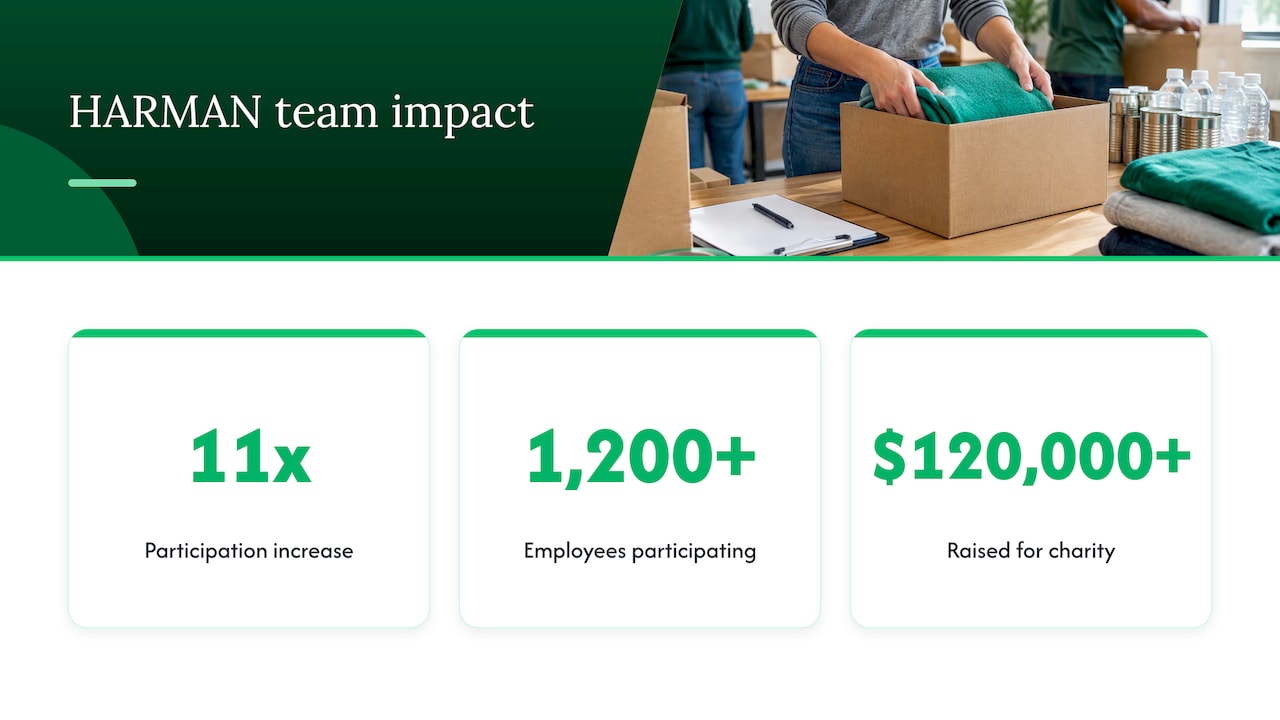
On the corporate side, companies create private teams, run friendly challenges, and can choose whether to sponsor miles, at what rate per mile, with what cap, and whether donations go to each employee’s chosen charity or a company-selected cause. The reward is a donation to charity rather than a payment tied to a health result. We have seen the approach work: since launching its team in 2021, HARMAN saw an 11x increase in employee participation, with more than 1,200 employees generating over $120,000 for charity. We describe the workplace walking approach in more detail on our site.
Our advice to HR leaders is to keep wellness simple and let purpose do the motivating. The more a program depends on medical questions and large personal payouts, the more legal weight it carries. A program built on shared purpose needs far less of both. We are not your lawyers, so involve yours when anything beyond mileage enters the picture.
— Gene
Run a compliant challenge with Charity Miles
If you want a private, company-wide movement challenge without the medical-data complexity, our Employee Empowerment program lets you set up teams, control sponsorship terms, and keep the focus on participation and giving. Looking to fund miles as a brand? See our corporate sponsorship options.
FAQ
Do the EEOC’s wellness rules apply to a walking challenge?
Not in the same way they apply to programs with medical questions or exams. A challenge that only records distance, asks no disability-related questions, and collects no health-status information generally does not trigger the EEOC’s incentive rules. Adding a health-risk assessment or screening brings the ADA and GINA into play, so involve counsel at that point.
Is there still a 30% EEOC incentive limit?
No. The EEOC removed its incentive-limit provisions effective January 1, 2019, and a 2021 proposed replacement was withdrawn. The 30% figure still appears in Department of Labor rules for health-contingent programs tied to a group health plan, which are a separate system.
Does an employer have to offer alternatives?
For health-contingent programs under Department of Labor rules, yes: a reasonable alternative standard must be available and disclosed in program materials. Even where it is not strictly required, offering alternatives is the best way to meet the ADA’s accommodation expectations and to include every employee.
Can managers see who participated and how much they moved?
They should not see individual health information. Best practice is to provide aggregate reporting such as team totals, and to keep any medical information in separate confidential files. Spell this out in your vendor contract.
What counts as a disability under the EEOC’s rules?
A physical or mental impairment that substantially limits one or more major life activities, a record of such an impairment, or being regarded as having one. Walking, breathing, and caring for oneself are among the listed major life activities.
Sources
- 29 C.F.R. § 1630.14, medical examinations and inquiries
- Federal Register: Regulations Under the Americans with Disabilities Act (2016)
- EEOC: Final rule on employer wellness programs and GINA
- EEOC: Final rules on employer wellness programs (newsroom)
- K&L Gates: EEOC withdraws proposed wellness incentive rules
- Department of Labor: Affordable Care Act wellness program guidance
- Department of Labor elaws: Health Benefits Advisor for Employers
- EEOC: The ADA, Questions and Answers
- EEOC: Small business fact sheet on the GINA wellness rule