
A wellness communication plan is the written answer to one question: how will every employee hear about your wellness program, trust it and act on it, all year? A good plan names your audiences, picks channels they already use, assigns the messengers, sets a calendar and defines how you will know it worked. This guide walks through each piece, with a template you can adapt this week.
TL;DR
- Listen first. Survey or hold focus groups to learn which channels your people prefer before you build anything.
- Treat the program like a product: define the benefit, the effort, the access point and the promotion.
- Use peer champions, not only corporate announcements. Trust is the hardest part of wellness communication.
- Fit messages into moments employees already have, such as team meetings and lunch hours, instead of asking for extra time.
- Run the plan year-round and review it against goals, not just at open enrollment.
Table of Contents
- Why the communication plan matters as much as the program
- Step 1: Set goals and name your audiences
- Step 2: Listen before you choose channels
- Step 3: Build trust before you promote
- Step 4: Frame the message around what people value
- Step 5: Choose channels and messengers
- Step 6: Build a 12-month calendar
- Step 7: Measure and adjust
- Our perspective: movement that means something is easier to communicate
- A ready-made engine for your plan
- A starter checklist
- FAQ
- Sources
Why the communication plan matters as much as the program
Most wellness programs do not fail because the offering is weak. They fail because people do not know about them, do not understand them or do not believe they are for them. A focus group study of a university worksite wellness program found exactly this pattern: participation was a bright spot, but limited understanding of the program’s benefits and services was a recurring barrier.
The workplace is also an unusually good place to communicate about health. The same literature notes that employed Americans spend an average of 43 hours a week at work, which means your channels, your managers and your peers are already reaching people daily.
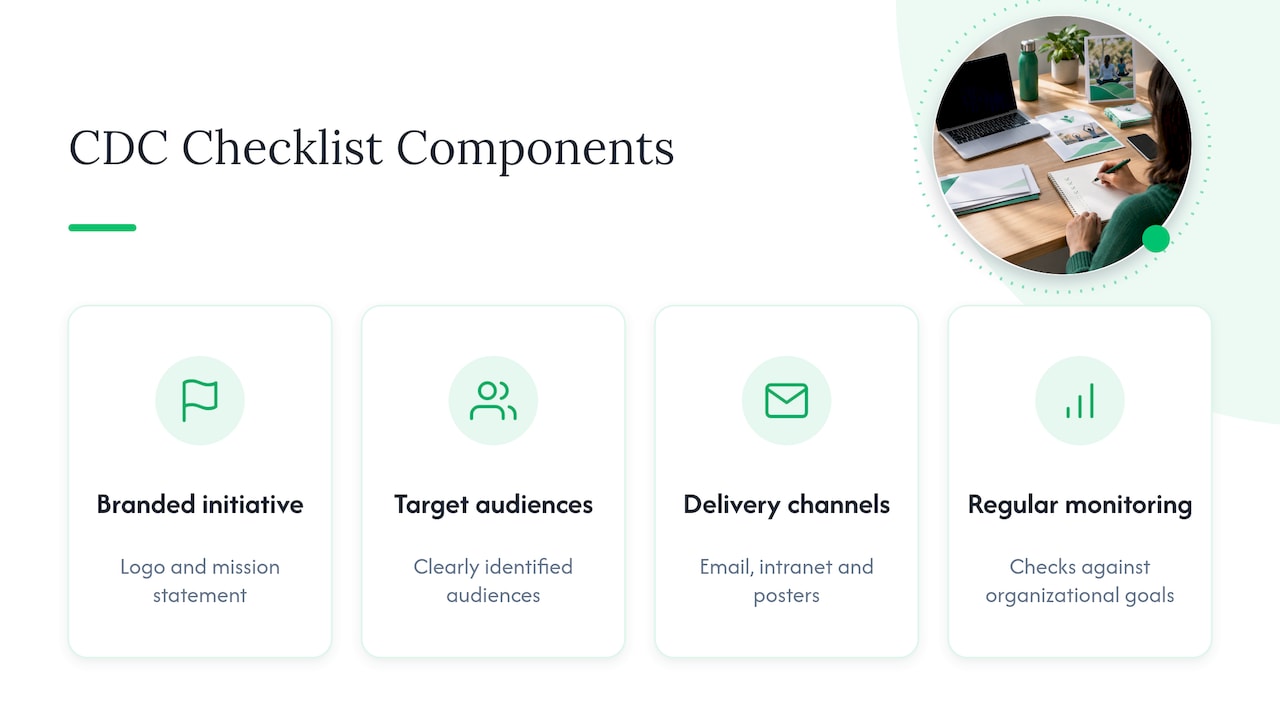
The CDC’s workplace health checklist describes what a sound plan looks like: a branded initiative with a logo and mission statement, clearly identified target audiences, several delivery channels such as email, intranet and posters, and regular monitoring against organizational goals. Structured, integrated and sustained beats a one-time launch blast every time.
Step 1: Set goals and name your audiences
Start with what you want communication to change. Vague goals (“raise awareness”) produce vague plans. Pick two or three measurable ones:
- Percent of eligible employees who have heard of the program
- Registration or enrollment rate by month three
- Active participation rate (people who take part at least once a month)
- Repeat participation after the first challenge or event
Then split your workforce into audiences, because one message will not fit everyone. A typical mid-size employer has at least these groups:
| Audience | What they need to hear | Best messenger |
|---|---|---|
| Executives and senior leaders | Business case, budget, what role modeling looks like | HR or CSR lead |
| People managers | How to support participation without pressure | HR partner, peer managers |
| Office-based staff | Easy ways to move or unwind during the workday | Team champions |
| Remote and hybrid staff | How to join without being in the building | Virtual champions, team leads |
| Frontline and shift workers | Access that works without a desk or company email | Supervisors, pre-shift briefings |
| New hires | What exists and how to start | Onboarding buddy, HR |
The CDC’s guidance on building a workplace health program recommends involving employees early and assigning a coordinator, council or committee to oversee the effort. Name that owner in your plan. A communication plan without a single accountable person tends to stall in week six.
Step 2: Listen before you choose channels
Best practice, as laid out in the AMA’s well-being communication strategy tool, is to ask the workforce first. Short surveys and a few small focus groups tell you whether people prefer email, app notifications, team meetings or face-to-face conversations. Your assumptions about this will probably be wrong for at least one group.
Keep the listening phase light:
- Send a five-question pulse survey. Ask where people currently get company news, what they have ignored, what they would actually read and what would make a wellness program feel worth joining.
- Hold two or three 30-minute conversations with a mix of roles, including at least one frontline group.
- Ask what would make them skeptical. This one question surfaces most of your trust issues up front.
- Write down the answers and let them decide the channel mix. If you are weighing email tooling, a comparison of email platforms for nonprofits shows the kinds of features worth checking, though your survey results should drive the choice more than any feature list.
This step also doubles as communication. Asking people what they want is the first signal that the program is built with them rather than at them.
Step 3: Build trust before you promote
Experts in workplace health identify trust as the largest hurdle. According to a CDC-hosted case study collection, wellness programs can be met with skepticism, so communication should be transparent, show organizational support and come from trusted peers. Messages that fit existing company culture are more likely to be accepted.
In practice, that means answering the questions employees quietly have:
- What do you see about me? State plainly what data, if any, is collected and who sees it. For an activity program, say that individual data is not used in performance or benefits decisions, but only if that is true in your company.
- Is this required? Say clearly that participation is voluntary.
- Is this for people like me? Show examples across ages, abilities and job types.
- Why is the company doing this? Be honest. “We want people to feel better at work and to do some good together” lands better than polished corporate language.
We cover the access side of this in more depth in our piece on workplace wellness program participation, where making the program easy to join matters more than the size of any reward.
Step 4: Frame the message around what people value
Health-first messaging can feel clinical or like a lecture. A piece in the AMA Journal of Ethics on communicating risk and benefit is a useful reminder that people can read every word and still take nothing from it. Plain, concrete framing matters.
A behavioral approach we like is anchoring: tie the behavior you want to something employees already care about. Practitioners suggest anchoring wellness behaviors to values like family, social connection or friendly competition, which builds intrinsic motivation. Compare two versions of the same announcement:
- Metrics framing: “Join our wellness challenge to lower your health risk.”
- Value framing: “Take a lunchtime walk with your team and turn every mile into a donation to a cause you pick.”
The second gives people a reason that has nothing to do with a biometric number.
Another lens from social marketing is the four P’s, described in a state worksite wellness webinar on communication strategy. Treat the program as a consumer product and answer four questions for each audience:
| P | Question to answer | Example |
|---|---|---|
| Product | What is the benefit of the behavior? | More energy at 3 p.m., time with coworkers, money for a charity |
| Price | What does it cost in time, effort or exposure? | Zero cost, no equipment, any pace, any movement counts |
| Place | When and where can people access it? | On a phone, on a break, at home or on site |
| Promotion | How will they hear about it? | Champion stories, manager mentions, short reminders |
If you do not promote it effectively, employees will not engage, however good the program is. Most plans over-invest in the product and under-invest in price and place.
Step 5: Choose channels and messengers
Use more than one channel, and match each to an audience. A workable mix for most employers:
- Email: the official announcement, key dates, a monthly digest. Keep it short and put one action in each message.
- Team chat: a dedicated, private wellness channel for day-to-day updates, photos and resources. Several of the top-ranking guides suggest this, and it works because people share in the tool they already have open.
- Intranet or a single hub page: the source of truth for details, eligibility and FAQs.
- Team meetings and pre-shift briefings: a 60-second mention from a manager reaches people email never will.
- Posters and screens: useful for sites without desks. Use a QR code that leads to the signup, not a wall of text.
- Mobile app: for activity-based programs, the app itself is a channel through team feeds and notifications.
Recruit peer champions
Practitioners report that messages from enthusiastic non-leadership peers are seen as more relatable and trustworthy than official corporate communications. Champions can share personal stories and testimonials, and they help bridge cultural and language gaps in diverse workforces.
How to set up a champion network without creating a burden:
- Aim for one champion per team or site, volunteers only.
- Give them a one-page kit: three sample messages, the signup link and the answers to the five most common questions.
- Ask for one small act a month, such as a photo of a team walk or a quick note in chat.
- Recognize them publicly, and let them adapt the wording to their own voice.
Do not add to the workload
Wellness communication that asks for extra time backfires. The AMA’s reporting on healthcare communication programs describes successful efforts that fit into existing micro-moments and workflows, such as team meetings, lunch hours or pre-shift briefings, rather than requiring separate training sessions. Apply the same rule to your plan: if a message needs a new meeting, rewrite it.
Step 6: Build a 12-month calendar
The best-performing structure is year-round, not a January burst. A simple rhythm:
| Phase | Timing | Goal | Sample communications |
|---|---|---|---|
| Listen | Month 0 | Learn preferences and doubts | Pulse survey, focus groups |
| Tease | 2 to 3 weeks before launch | Build curiosity | Champion previews, manager heads-up |
| Launch | Month 1 | Registration | Leader kickoff note, hub page, QR posters, team chat |
| Sustain | Months 2 to 4 | Habit formation | Weekly one-line updates, team leaderboards, stories |
| Refresh | Months 5 to 8 | Re-engage drop-offs | New challenge theme, new-hire welcome, seasonal angles |
| Celebrate | Months 9 to 11 | Show progress | Results recap, champion thank-yous |
| Review | Month 12 | Learn and adjust | Survey again, update next year’s plan |
Keep cadence predictable. One weekly touch in chat and one monthly email beats five messages in launch week followed by silence.
Step 7: Measure and adjust
The CDC checklist calls for regularly monitoring progress against organizational goals. For communication specifically, track:
- Reach: email open and click rates, hub page visits, QR scans
- Conversion: registrations as a share of eligible employees, by site and role
- Retention: how many participants are still active at 30, 60 and 90 days
- Sentiment: a short repeat of the original survey, especially the trust questions
- Qualitative: what champions are hearing in the hallway
Compare groups. If office staff register at triple the rate of frontline staff, the problem is channel and access, not motivation. Fix the channel, then look again next month.
Our perspective: movement that means something is easier to communicate
We build the Charity Miles app and the Employee Empowerment program, so we see the same communication problem from the inside. The programs that struggle ask employees to care about a metric. The ones that work give employees something to say yes to.
With Charity Miles, a lunchtime walk, a bike commute or a run becomes a donation to a charity the employee picks. Companies can choose to sponsor those miles, set the rate per mile and the total cap, and decide whether donations go to each person’s chosen charity or a company-selected cause. That gives a communication plan a simple, positive message with a purpose beyond personal health, and it welcomes every fitness level because any movement counts.
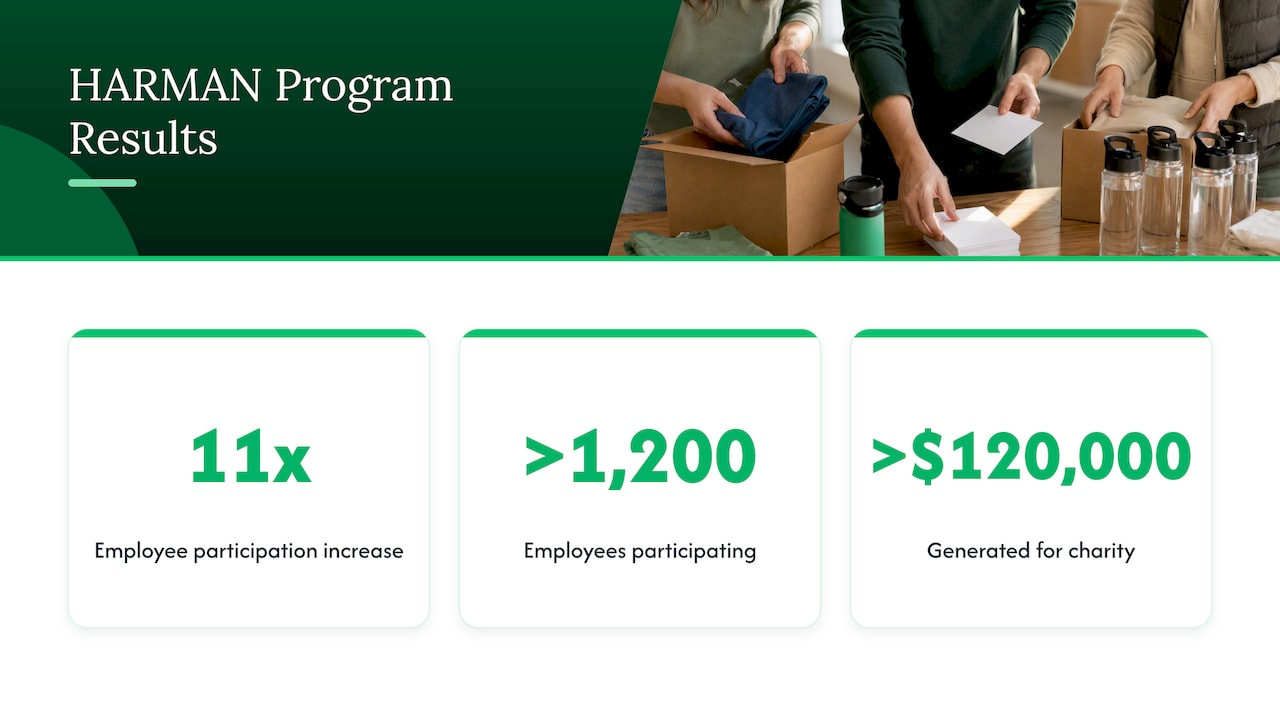
The result we point to is HARMAN: since launching a Charity Miles team in 2021, the company saw an 11x increase in employee participation, with more than 1,200 employees generating over $120,000 for charity. We would not claim communication alone did that. But a clear, values-first message, easy access and friendly team competition gave communicators plenty to work with.
Our advice is to start with the message employees would repeat to a coworker, then build the plan around it.
— Gene
A ready-made engine for your plan
If your plan includes an activity-based element, our Employee Empowerment program gives you private company teams, intra-company challenges and optional sponsorship on your terms, so you can spend your effort on communication rather than building a platform. You can also see how wellness challenges that give back work in practice, or ask us about corporate sponsorship.
A starter checklist
Copy this into your planning document:
- Owner named, with a committee or champion network
- Two or three measurable goals
- Audience list, including remote and frontline staff
- Survey and focus groups completed, results recorded
- Brand: name, short mission line, simple visual identity
- Trust statements drafted: voluntary, privacy, purpose
- Value-based key messages for each audience
- Channel map with one owner per channel
- Champion kit and recruitment list
- 12-month calendar with weekly and monthly rhythms
- Metrics dashboard and review dates
- A plan for what to change if the numbers lag
For program design ideas to pair with the plan, see our guide to corporate wellness ideas that boost engagement and the walking challenge themes that drove participation. For physical activity programs specifically, the CDC’s employer guide to physical activity in the workplace stresses building a culture of health, and notes there is no one-size-fits-all approach.
FAQ
What should be included in a wellness communication plan?
Include goals, target audiences, key messages, channels, messengers, a calendar and measurement. The CDC also recommends branding the initiative with a name and mission statement. Add a section on trust: what is voluntary, what is private and why the company is doing it.
How often should we communicate about wellness?
Aim for a steady rhythm rather than bursts: a short weekly touch in a team channel or meeting and a monthly email is a good starting point. Use your survey results to adjust. If people say they feel flooded, cut frequency and keep the content more useful.
How do we reach employees who do not sit at a computer?
Use the places they already gather: pre-shift briefings, supervisor mentions, posters with QR codes and mobile-friendly signup. Recruit champions from those teams so the message comes from someone they know. Ask these groups directly what works, since their preferences often differ from office staff.
How do we get employees to trust a wellness program?
Be open about what is collected and who sees it, make participation voluntary and let peers share their own stories. Messages that match your culture land better than polished corporate copy. Following through on what you said you would do is the strongest trust signal.
Sources
- Focus group assessment of a university-based worksite wellness program (PMC)
- CDC Workplace Health Checklist
- CDC: Strategies for Building a Workplace Health Program
- AMA Steps Forward: well-being communication strategy tool
- CDC Stacks: workplace wellness case study on trust
- CDC Stacks: LifeWorks@TURCK case study on wellness champions
- AMA Journal of Ethics: Effective Ways to Communicate Risk and Benefit
- Arizona worksite wellness webinar on communications strategy
- AMA: Better communication boosts patient experience, physician well-being
- CDC: Physical Activity in the Workplace employer guide