
VTO refers either to unpaid Voluntary Time Off, a staffing tool, or to paid Volunteer Time Off, a philanthropy benefit. If you are solving a scheduling or overtime problem, skip to the staffing section below; if you are building a giving program, the policy sections that follow are built for you, and we’ll show how a platform like Charity Miles can support that rollout.
TL;DR:
- Paid volunteer policies commonly grant 8, 12, 16, or 24 hours annually; nonprofits, schools, community events, and approved mentoring may qualify.
- Set eligibility, paid hours, rollover, qualifying activities, and verification rules in writing, and require two weeks’ notice and manager approval to protect staffing consistency.
- Volunteer time remains outside compensable work only when participation is genuinely optional; assigning tasks or requiring attendance can trigger FLSA compensation obligations.
- For unpaid VTO, verify exempt status before approving partial week deductions, document that participation is voluntary, and code hours separately from paid leave.
- Pilot with deskless and hourly employees, then review adoption after three months and impact after twelve months; track participation, hours, and sentiment.
Table of Contents
- What is voluntary time off and when do employers use it?
- What is volunteer time off and how is it structured?
- How do the two VTO meanings compare in practice?
- Why volunteer time off matters for engagement and recruitment
- How to write a VTO policy: a step-by-step checklist
- Rolling out approvals, tracking, and legal guardrails
- Case study: an employee empowerment program as a VTO enabler
- A priority roadmap for the next 6 to 12 months
- Put your VTO program into motion with Charity Miles
- FAQ
- Sources
What is voluntary time off and when do employers use it?
Unpaid Voluntary Time Off is an employer-initiated option that lets staff step away from a shift during low-demand periods, often in exchange for keeping their job secure while trimming payroll costs. It shows up most in seasonal retail, warehouses, and call centers, where leadership needs to flex labor without layoffs. For exempt employees, unpaid time off raises wage-and-hour questions, since docking a salaried worker’s pay for a partial week can jeopardize their exempt status under federal rules.
Before offering unpaid VTO, walk through a short payroll checklist:
- Confirm whether the employee is exempt or non-exempt before approving any unpaid day.
- Document the voluntary nature of the time off in writing to avoid disputes later.
- Update timekeeping systems so unpaid VTO hours are coded separately from PTO or sick leave.
What is volunteer time off and how is it structured?
Paid Volunteer Time Off is a benefit that compensates employees at their standard rate while they serve a charitable cause, distinct from both PTO, which covers personal time, and unpaid VTO, which covers staffing gaps. Companies typically structure the benefit in set increments: 8, 12, 16, or 24 hours per year, often granted in full-day or half-day blocks with limited or no rollover.
Most policies define eligible activities narrowly enough to prevent misuse but broadly enough to invite participation:
- Service at a registered 501©(3) nonprofit or school counts in nearly every policy.
- Organized community events, like river cleanups or food bank shifts, typically qualify.
- Board service or mentoring through an approved community group often qualifies with manager sign-off.
How do the two VTO meanings compare in practice?
Mixing up these two policies is the fastest way to create payroll errors and employee confusion, so it helps to compare them directly.
- Pay status: unpaid Voluntary Time Off reduces an employee’s paycheck for the period taken, while paid Volunteer Time Off pays the standard rate.
- Use case: Voluntary Time Off addresses a staffing surplus, while Volunteer Time Off addresses employee engagement and community impact.
- Tracking needs: unpaid VTO is usually logged like any unpaid absence, while paid VTO often needs a separate HRIS field tied to charitable hours.
- HR outcome: unpaid VTO reduces labor cost during a slow stretch, while paid VTO builds retention and employer brand over time.
A warehouse offering unpaid VTO during a demand lull and a corporate office offering 16 paid hours for volunteering are solving entirely different problems with the same acronym. Naming the policy clearly in your handbook, “Volunteer Time Off (paid)” versus “Voluntary Time Off (unpaid)”, prevents most of the confusion before it starts.
Why volunteer time off matters for engagement and recruitment
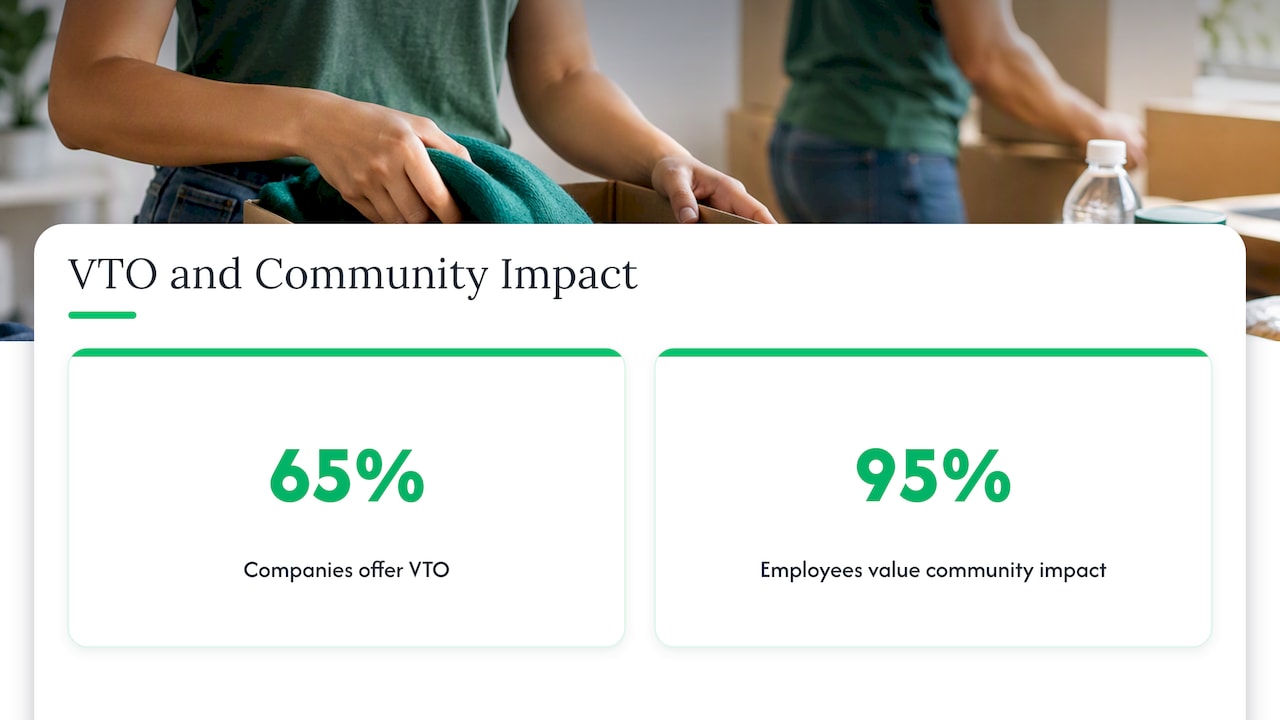
Building the business case for paid Volunteer Time Off starts with a gap worth pointing out: roughly 65% of companies offer VTO to their domestic workforce, yet the same research found that 95% of employees say making a positive community impact matters to them. That gap between what employees want and what most employers provide is exactly where a well-designed policy earns its budget.
95% of employees value community impact, but only about 65% of companies offer VTO, a gap HR can use to justify launching or expanding a program. Track participation rate, hours logged, and employee sentiment before and after launch to show measurable movement on engagement and retention.
How to write a VTO policy: a step-by-step checklist
A workable policy starts narrow and expands once you see how employees actually use it.
- Write a purpose statement and define scope: who is eligible, any tenure requirement, and how part-time staff participate.
- Set hours, increments, rollover rules, and blackout dates, and state plainly that the time is paid at the standard rate.
- Define qualifying organizations and activities, the approval workflow, and what verification you require.
- Build tracking into your HRIS with dedicated fields, decide whether a volunteer-platform integration makes sense, and pick your KPIs: participation rate, hours logged, and dollars or impact generated.
- Draft simple policy language and a short launch communications plan so managers and employees hear the same message.
A few practical notes make the checklist easier to execute:
- Borrow structure from existing guides rather than starting from a blank page; AIHR’s VTO overview lays out eligibility, hours, and recordkeeping in plain terms.
- Keep verification low-friction: a confirmation email from the nonprofit or a platform-generated report is usually enough.
- Revisit hour allotments annually against industry benchmarks so the policy stays competitive.
Rolling out approvals, tracking, and legal guardrails
Approval workflows work best as a short, published set of rules rather than open-ended manager discretion, since consistency protects both morale and compliance. A simple structure, two weeks’ notice plus manager sign-off, keeps staffing predictable while still feeling easy for employees to use.
For tracking, capture these fields at minimum:
- Employee name, date, hours, organization, and activity type.
- A separate code from PTO so reporting stays clean.
- A manager approval timestamp for audit purposes.
Many HR teams start with manual spreadsheets or basic HRIS fields, then layer in a volunteer-platform integration once participation grows past a pilot group.
On the legal side, DOL opinion letters make clear that volunteer time is not compensable hours worked as long as participation is genuinely optional and the employer does not direct or control the activity; once an employer starts assigning specific volunteer tasks or requiring attendance, that time can become compensable under the FLSA.
Pro Tip: Pilot your policy with a mixed group that includes deskless and hourly workers first, since scheduling friction tends to surface there before anywhere else.
Case study: an employee empowerment program as a VTO enabler
A platform built for team-based giving can turn a paper policy into daily participation. Our program gives companies private teams, sponsorable employee miles, and impact reporting that fits naturally into VTO tracking.
- Companies set their own sponsorship rate per mile and total cap, directing donations to a chosen charity or a company cause.
- Since launching a Charity Miles team in 2021, one company saw an 11x increase in employee participation, with many employees generating a substantial amount for charity.
- HR teams can export participation data directly for reporting without building a separate tracking system from scratch.
A priority roadmap for the next 6 to 12 months
Pilot with mixed-role teams, deskless workers included, so friction surfaces early rather than at full rollout. Keep tracking simple at launch, then check two windows: three months for adoption, twelve months for impact. Have senior leaders participate visibly; culture change follows behavior, not memos.
— Gene
Put your VTO program into motion with Charity Miles
Once your policy is written, the fastest way to make it real is to give employees a simple way to log activity and see the impact add up. Our Employee Empowerment program lets you set up a private company team, choose sponsorship terms, and pull participation data straight into your HR reporting without building anything from scratch.

- Schedule a pilot team and invite a representative mix of roles before a full launch.
- Define your sponsorship rate, cap, and charity options up front so the terms are clear to employees.
- Export participation and impact data to support your next budget conversation.
| Step | Action | Owner |
|---|---|---|
| 1 | Set up a private team | HR/CSR lead |
| 2 | Define sponsorship terms | Finance + HR |
| 3 | Launch pilot and track participation | HR |
| 4 | Export data for reporting | HR |
See how the Charity Miles app works for both individual members and corporate teams, and reach out to start a pilot that fits your VTO policy.
FAQ
What does VTO mean for time off?
VTO can mean either unpaid Voluntary Time Off, an employer-offered option to reduce hours during slow periods, or paid Volunteer Time Off, a benefit that compensates employees for time spent volunteering. The correct meaning depends on your company’s specific policy, so check how your handbook defines it.
Do you get paid for VTO?
It depends on which policy your employer means: unpaid Voluntary Time Off reduces your paycheck for the time taken, while paid Volunteer Time Off compensates you at your standard rate. Most employee handbooks specify which type applies, so confirm with your HR team.
What counts as volunteer time off?
Qualifying activities typically include service at a registered nonprofit, organized community events, or approved board or mentoring roles, as outlined in guidance from AIHR. Companies generally require the organization to be a recognized charitable or community group and may ask for simple verification.
What does “VTO” mean at large employers?
Large employers vary in how they define and structure VTO, with some using it as an unpaid staffing tool and others as a paid volunteering benefit. Checking your specific employer’s handbook or HR portal is the most reliable way to confirm which definition and hour allotment applies to you.
Sources
- WHD Opinion Letter FLSA (March 14, 2019) — U.S. Department of Labor
- Volunteer Time Off (VTO): All You Need To Know — AIHR