
Most common wellness incentives, cash, gift cards, prepaid cards, and general gym memberships, are taxable income to employees unless they meet a narrow medical-care or fringe benefit exclusion. The exceptions run through Section 213(d), Sections 105 and 106, or a tightly limited Section 132 de minimis rule. When an incentive is taxable, we treat it as wages for payroll tax and W-2 reporting purposes, not as a tax-free perk.
TL;DR:
- An incentive can qualify as medical care only when it pays for diagnosis, treatment, or prevention tied to a documented condition, such as prescribed exercise.
- Cash, gift cards, and prepaid cards remain taxable regardless of amount, requiring payroll withholding and wage reporting instead of a small benefit exclusion.
- Employer sponsorships tied to activity create no employee wages when funds go directly to charity; cash paid to employees remains taxable, even if later donated.
- Fixed indemnity payments without corresponding unreimbursed medical expenses can still become wages, so employers should review vendor designs and document eligibility before the first payout.
Table of Contents
- Which wellness incentives the IRS treats as taxable
- When incentives can be nontaxable under the medical-care rules
- Payroll tax, withholding, and W-2 reporting obligations
- Designing compliant wellness incentives: an employer checklist
- IRS memoranda and rulings that shape enforcement today
- A practical example: sponsoring movement instead of paying cash
- Tax implications for employee charitable giving through wellness programs
- Direct cash incentives versus charitable donation incentives
- Did COVID-19 relief change wellness incentive taxation?
- State-level tax considerations for wellness incentives
- Balancing engagement with compliance
- Encouraging movement without the payroll headache
- FAQ
- Sources
Which wellness incentives the IRS treats as taxable
Cash is always reportable income. That rule does not bend based on intent, occasion, or how small the amount is. The IRS has been explicit that cash and cash-equivalent items never qualify as de minimis fringe benefits, no matter how minor the payment seems, according to Publication 15-B. Gift cards and prepaid debit cards fall into this same bucket because they function as cash once issued, even when branded as a “wellness reward” or tied to a specific retailer.
HR teams run into this constantly with program designs that feel wholesome but create a W-2 problem:
- A wellness challenge that pays a cash amount to each employee who logs 10,000 steps a day for a month.
- A gift card awarded for completing a biometric screening.
- A flat cash bonus paid per pound lost or per workout attended, which is taxable unless narrowly excluded.
Each of these counts as wages unless a narrow exclusion applies, and none of them typically qualifies. Prizes and contest-style payouts get the same treatment as straight cash bonuses: the IRS does not care that the money was earned through a step count instead of a sales quota. Once value moves from employer to employee without meeting the medical-care or fringe benefit tests, it is income, and it belongs on the W-2.
When incentives can be nontaxable under the medical-care rules
The path to tax-free treatment is narrow, and it runs through a specific legal definition rather than a general sense of “this is good for employees.” Section 213(d) defines “medical care” as amounts paid for the diagnosis, cure, mitigation, treatment, or prevention of disease, or for treatments affecting any structure or function of the body. The IRS FAQ on nutrition, wellness, and general health expenses makes clear that expenses merely beneficial to general health do not meet this standard. A gym membership purchased to feel better or stay in shape is not medical care. The same membership purchased because a physician prescribed exercise to treat a diagnosed condition, such as hypertension, can meet the standard, but only with that documented link.
Coverage under Sections 105 and 106 works differently: it excludes employer-provided accident or health coverage and reimbursements for medical care under that coverage, which is why employer contributions to a qualifying health plan stay off the W-2 while a cash wellness bonus does not.
De minimis fringe rules under Section 132 carve out a small, specific category: items so minor and infrequent that accounting for them would be unreasonable, think an occasional snack or a small holiday gift. Cash and gift cards are excluded from this carve-out entirely.
A blood pressure screening paid directly by an employer can qualify as medical care, while a general gym membership reimbursement typically does not, based on the narrow standard set out in IRS guidance on medical expenses. The difference comes down to diagnosis and prescription, not good intentions.
Common examples that illustrate the line:
- A diagnosed diabetic’s nutrition counseling, prescribed by a doctor, can qualify as medical care.
- A general “eat healthier” wellness stipend available to all employees typically does not.
- A smoking-cessation program tied to a documented health risk has a stronger case than an undocumented one.
Payroll tax, withholding, and W-2 reporting obligations
When a wellness incentive fails the medical-care or fringe benefit test, it becomes wages, and that triggers a full set of payroll obligations. Wages for this purpose are defined under the same code sections that govern ordinary compensation, meaning Social Security and Medicare (FICA), federal unemployment (FUTA), and federal income tax withholding (FITW) all apply.
Here is what that means in practice for payroll and benefits teams:
- Classify the payment correctly at the time it is issued. Treat cash, gift cards, and nonqualifying reimbursements as supplemental wages, not as a tax-free benefit, from day one.
- Withhold and remit taxes in the same pay period. Taxable wellness payments need FICA, FUTA, and FITW applied the same way a cash bonus would be.
- Report the full amount on Form W-2. The payment belongs in taxable wages, not in a separate “benefits” line that implies exclusion.
- Coordinate with insurance and benefits vendors. IRS memoranda analyzing fixed-indemnity wellness payments found that many plans marketed as tax-free actually produce wage income when distributed on a fixed schedule with no corresponding unreimbursed medical expense, a conclusion detailed in CCA 202323006.
- Correct past errors proactively. If prior wellness payouts were excluded from W-2 reporting without meeting the medical-care test, correcting the record now limits exposure before an audit forces the issue.
Designing compliant wellness incentives: an employer checklist
Building an incentive program that either qualifies for exclusion or is taxed correctly from the start saves HR teams from the far more painful work of unwinding mistakes later. A few design choices make the biggest difference.
When the goal is genuine tax-free treatment, tie the benefit to a documented medical diagnosis and keep that link on file. Employer contributions to HSAs, HRAs, or FSAs tend to hold up better than direct cash payments, provided they are structured consistently with nondiscrimination requirements. Avoid cash or gift cards entirely when tax-free treatment is the goal, since neither one has a path to exclusion regardless of how the program is framed.
Documentation is what separates a defensible program from a risky one:
- Physician prescriptions or treatment plans tying the benefit to a diagnosed condition.
- Written program rules describing eligibility and how benefits are calculated.
- Proof of expenses for any reimbursement-based benefit.
- Payroll records showing how taxable incentives were coded and reported.
- Nondiscrimination testing results where the plan design requires them.
Pro Tip: Loop in payroll, benefits, and tax counsel before launching a new incentive, not after the first payout goes out the door.
Programs that rely on creative insurance structures or indemnity payments deserve particular scrutiny. The IRS has flagged this territory directly, warning that some companies misrepresent general wellness expenses as medical care for HSA, FSA, HRA, and MSA purposes. When a vendor’s pitch sounds like it is solving a tax problem too neatly, that is the moment to get a written opinion rather than take the pitch at face value.
IRS memoranda and rulings that shape enforcement today
Two pieces of IRS guidance do more to explain current enforcement posture than any general rule of thumb. In CCA 202323006, the IRS concluded that fixed-indemnity wellness payments are includible in gross income and treated as wages for employment-tax purposes when employees receive them without any corresponding unreimbursed medical expense. A predictable monthly payout dressed up as an insurance benefit does not escape wage treatment just because it runs through a policy.
IRS memo 201622031 reaches a similar conclusion for cash rewards and premium reimbursements: they are includible in gross income except in narrow circumstances that satisfy Sections 105 or 106. Related guidance in Revenue Ruling 2002-3 reinforces this by addressing premium reimbursements funded through salary reduction, finding that merely returning previously excluded salary does not create a fresh exclusion.
The throughline across both authorities is the same:
- Payments tied to an actual unreimbursed medical expense have a real path to exclusion.
- Payments that function as regular income, regardless of the insurance or wellness label attached, create payroll tax exposure.
- Employers who assume a vendor’s plan design has already solved this problem often learn otherwise during an audit.
A practical example: sponsoring movement instead of paying cash
One way employers sidestep this entire exposure is by never transferring value to the employee at all. With our Employee Empowerment Program, a company sponsors a charitable donation based on employee miles logged through walking, running, or biking, rather than paying employees directly. Because the payment goes from employer to charity, not to the employee’s pocket, the wage question described above does not arise the same way a cash bonus would. Teams can see exactly how the sponsorship mechanics work before setting a rate per mile or a total budget cap.
Tax implications for employee charitable giving through wellness programs
When a wellness program routes donations to charity based on employee activity, the tax picture depends heavily on who is writing the check. If the employer sponsors the donation directly, based on miles walked or challenges completed, the employee has not received anything of value personally, so there is no wage income to report for that employee. The company may separately evaluate its own charitable deduction for the sponsorship payment under the ordinary rules for corporate charitable contributions.
The analysis changes if an employer instead gives employees cash and asks them to donate it themselves. In that scenario, the cash is wages the moment it is paid, regardless of what the employee later does with it. An employee’s personal charitable deduction for that donation is a separate, unrelated question on their individual return, and it does not undo the wage character of the original payment. This distinction matters for program design: a sponsorship model that never puts cash in an employee’s hands avoids creating a W-2 item in the first place, while a “here’s money, now donate it” model creates taxable wages regardless of good intentions.
Direct cash incentives versus charitable donation incentives
The tax treatment of these two approaches diverges sharply, even though both are often pitched internally as “wellness incentives.”
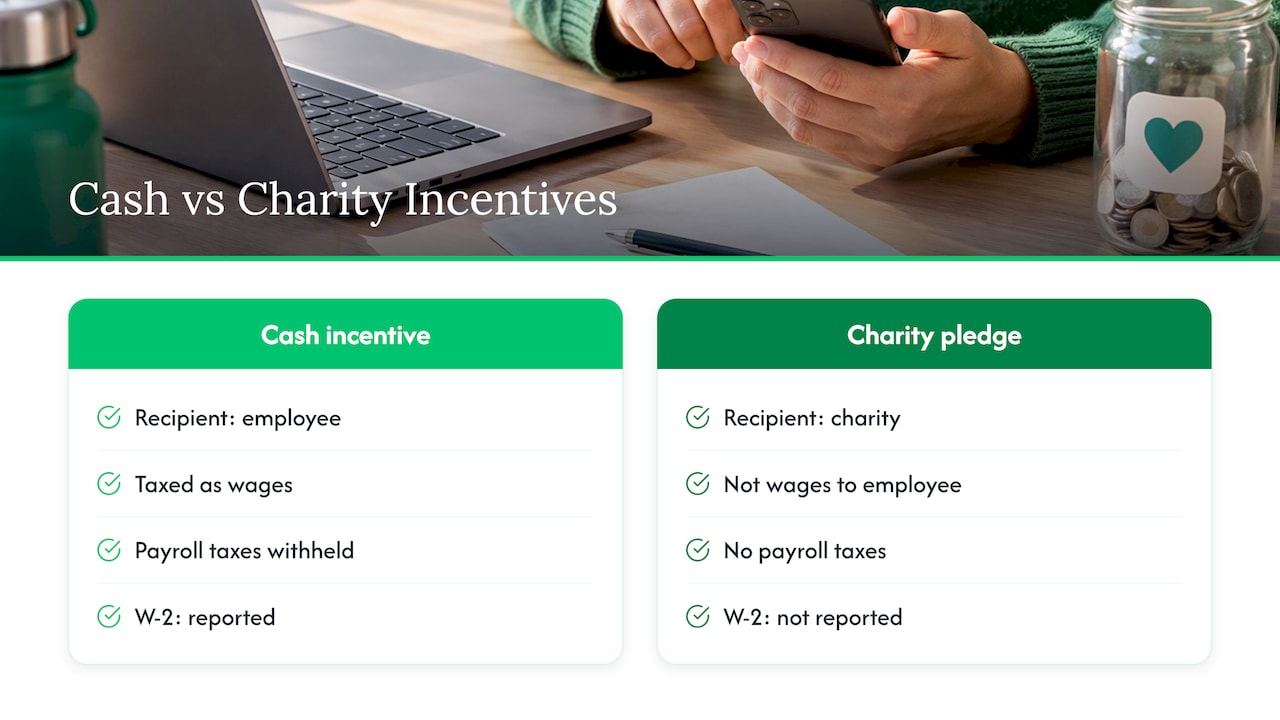
A direct cash incentive, whether paid as a bonus, a gift card, or a prepaid card, is wages from the moment it is issued. It gets FICA, FUTA, and FITW applied, and it lands on the employee’s W-2 as ordinary income, exactly as described under Publication 15-B. There is no participation threshold or dollar amount small enough to escape this treatment once the payment is cash or a cash equivalent.
A charitable donation incentive structured as an employer sponsorship, where the company pledges a donation per mile or per milestone reached, works differently because the employee never receives the money. Nothing moves into the employee’s bank account, so there is no wage to withhold against and no W-2 entry to make for that employee. The company’s own accounting for the donation follows standard corporate charitable-contribution rules rather than payroll rules. For employers trying to reward participation without creating payroll complexity, this structural difference, who actually receives the payment, is the deciding factor, not the generosity of the gesture or the size of the budget behind it.
Did COVID-19 relief change wellness incentive taxation?
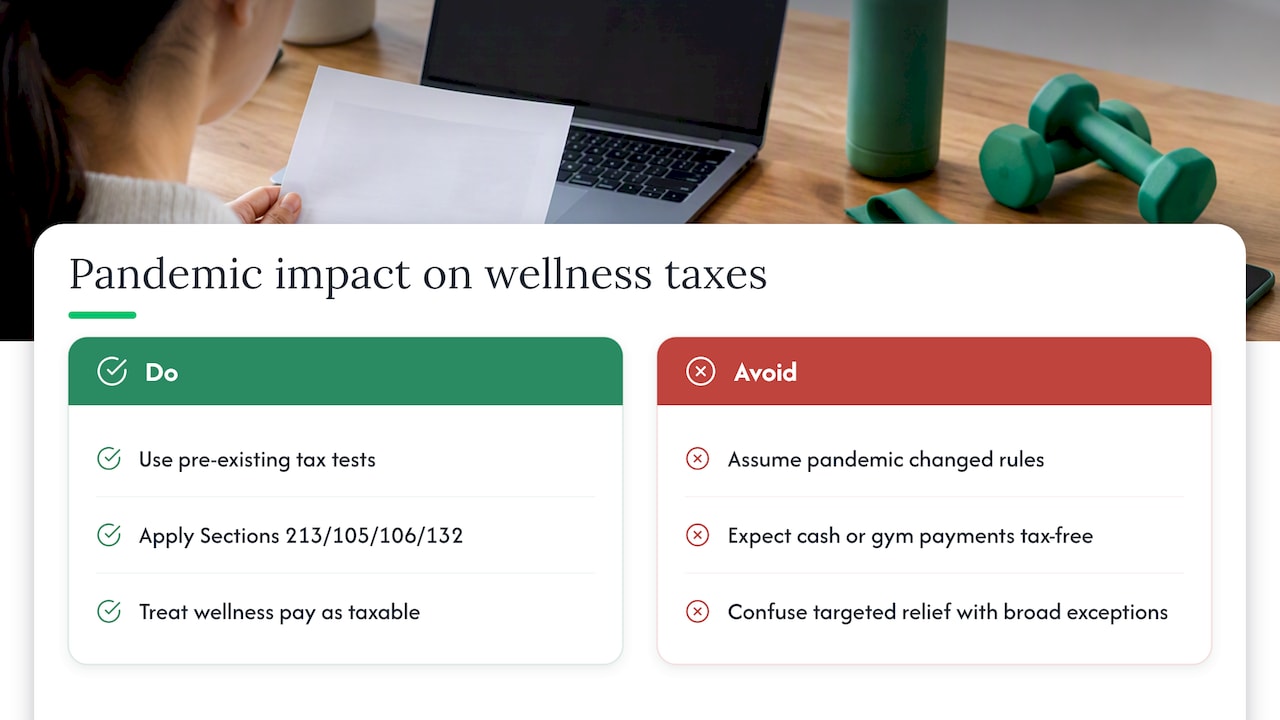
Pandemic-era relief legislation expanded several specific benefits, including temporary rules around dependent care flexible spending accounts and certain health plan grace periods, but it did not rewrite the underlying framework that governs wellness incentive taxation. Section 213(d)’s medical-care definition, the Section 105/106 exclusions for accident and health coverage, and the de minimis fringe limits under Section 132 all remained the operative tests before, during, and after the relief period.
Employers sometimes assume that pandemic flexibility extended to wellness cash payments or gym reimbursements, but no broad exclusion for general wellness incentives emerged from that relief. A cash payment for completing a home workout challenge in 2026 is taxed under the same rules that applied before any pandemic-era legislation existed. Where confusion persists, it usually traces back to temporary, narrowly targeted provisions aimed at specific benefits like telehealth or dependent care, not a general loosening of what counts as tax-free wellness compensation. The safest assumption for any program still running today is that the pre-existing medical-care and fringe benefit tests apply in full, without pandemic-era exceptions carrying forward.
State-level tax considerations for wellness incentives
Federal rules set the floor, but state income tax treatment does not always mirror federal treatment exactly, and employers operating across multiple states need to check both. Most states that impose an income tax start from federal adjusted gross income or federal taxable wages, which means a payment taxable at the federal level typically flows through as taxable at the state level too. States with no personal income tax, including Texas and Florida, remove the state income tax question entirely for employees there, though federal payroll tax obligations still apply regardless of state.
Where state treatment can diverge is in employer-side payroll tax administration: state unemployment insurance wage bases, reporting formats, and specific state fringe benefit statutes vary by jurisdiction. An employer running a multi-state wellness program should confirm state withholding and reporting requirements with payroll counsel or a state revenue department rather than assuming federal treatment automatically resolves every state-level question. This is one area where the federal analysis in this guide is necessary but not sufficient on its own.
Balancing engagement with compliance
Wellness programs genuinely improve how people feel at work, but good intentions do not override tax law. Build every incentive plan with payroll, benefits, and tax counsel in the room from the start, not after a mistake surfaces.
— Gene
Encouraging movement without the payroll headache
We offer a program that lets companies reward movement through sponsorship, not direct cash payouts, which keeps the design simple for HR and payroll alike. Companies set their own rate per mile, total budget, and whether donations go to employee-chosen charities or a company cause.

- Visit our Employee Empowerment Program page to see how private team challenges work.
- Review how the platform tracks miles and sponsorships before setting program terms.
- Pilot the program with a single department before rolling it out company-wide.
Ready to see it in action? Explore corporate sponsorship opportunities and set up a pilot team this quarter.
This article is general information, not a substitute for advice from a qualified financial advisor. Consult a qualified financial professional about your own circumstances before acting on anything here.
FAQ
Do you have to pay tax on incentives?
Yes, most wellness incentives such as cash, gift cards, and prepaid cards are taxable wages unless they meet the narrow medical-care exclusion under Section 213(d) or qualify under Sections 105 or 106. The default assumption for any cash-based reward should be that it is taxable until proven otherwise.
What are the IRS rules on wellness programs?
Wellness program payments are evaluated under the medical-care definition in Section 213(d), the health coverage exclusions in Sections 105 and 106, and the de minimis fringe benefit limits in Section 132. Publication 15-B confirms that cash and cash-equivalent rewards never qualify as de minimis, regardless of amount.
Is wellbeing reimbursement taxable?
A wellbeing reimbursement is taxable unless it covers a documented medical expense tied to diagnosis, treatment, or prevention of a specific condition. General wellness reimbursements, like an unrestricted gym membership stipend, typically fail this test according to IRS guidance and are includible in income.
What is the $75 rule in the IRS?
There is no federal threshold that makes a wellness incentive tax-free under current IRS guidance. De minimis fringe benefits are judged by infrequency and administrative impracticality of accounting for them, not a specific dollar cutoff, and cash or cash-equivalent items are excluded from that category entirely regardless of amount, per Publication 15-B.