
Per mile donation programs turn tracked walking, running, and biking miles into verified charitable dollars, paid out through an activity-tracking app instead of a one-time pledge drive. Employers sponsor the miles at a set rate, employees log activity through a phone, and the platform routes funds to charity. For HR and CSR leaders, it works as an engagement tool wrapped around a wellbeing habit, and programs like Charity Miles package it for enterprise use.
TL;DR:
- Per-mile donation programs are flexible with rates and caps, allowing companies to select a modest per-mile rate to maximize participation without overspending.
- Verification relies on smartphone sensors and optional third-party integrations, with privacy controls sharing only aggregated mileage data to protect employee confidentiality.
- Successful campaigns start with clear communication, leadership pledges, simple registration, layered recognition, and a fixed end date to maintain engagement.
- Metrics to track include participation rates, wellbeing improvements, and total dollars raised, providing a comprehensive view of program effectiveness.
- Enterprise programs have achieved significant participation growth and fundraising outcomes, with some surpassing initial goals by large margins, indicating long-term viability.
Table of Contents
- What Is a Per Mile Donation, and How Does It Work?
- What Does a Per Mile Sponsorship Actually Cost?
- How Do Employers Verify Miles and Protect Employee Privacy?
- How Do You Design a Campaign People Actually Join?
- What Metrics Prove the Program Is Working?
- What Results Have Enterprise Programs Actually Delivered?
- Why Daily Micro-Donations Change Workplace Culture
- Ready to Launch a Per Mile Donation Program?
- Sources
What Is a Per Mile Donation, and How Does It Work?
A per mile donation ties a specific dollar amount to each mile an employee logs, with the company or a sponsor paying that amount to a charity rather than the employee’s pocket. The mechanics are simpler than most HR leaders expect. A sponsor, usually the employer, sets the rate per mile and the total sponsorship cap. Employees walk, run, or bike, and their phone tracks the distance automatically through the app.
The platform verifies the activity, tallies it, and routes the resulting donation to charity. Some programs run live counters that show the fundraising total climbing in real time, which tends to build momentum mid-campaign. Others hold funds until a scheduled payout at the end of a challenge window, then remit in a single batch.
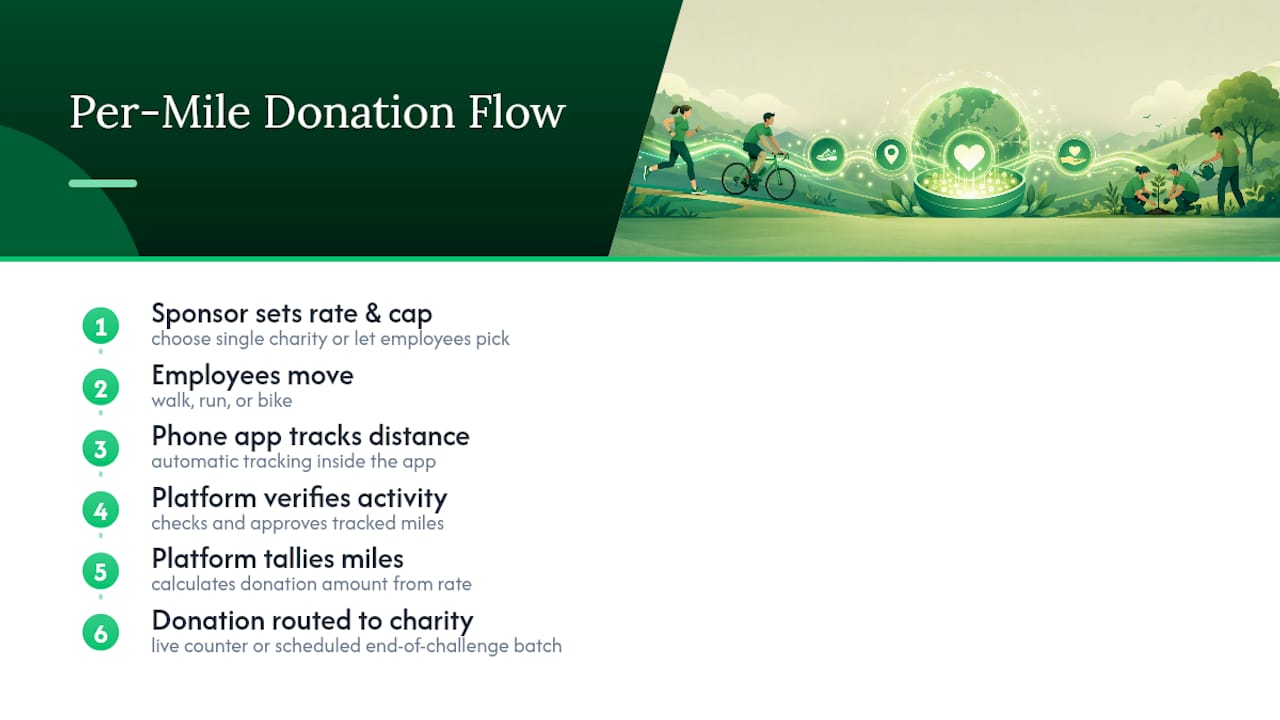
Employers also choose who benefits. Some direct every dollar to one company-selected cause, which suits a CSR strategy built around a signature partner. Others let each employee pick their own charity, which tends to feel more personal and often extends participation. Charity Miles supports both structures inside private employee participation teams, so the choice doesn’t have to be locked in before launch.
What Does a Per Mile Sponsorship Actually Cost?
Per-mile rates vary widely, and the right number depends more on your goals than on any industry standard. A lower rate, something in the cents-per-mile range, lets you sponsor a larger, more inclusive campaign without capping participation early. A higher rate signals a bigger CSR commitment but forces tighter caps to keep the budget predictable.
Setting the cap is where most of the planning happens. Conservative participation estimates paired with a clear ceiling protect the budget from a surprise overshoot if the campaign takes off. A modest leadership pledge at the start, an executive publicly committing the first chunk of miles, can jumpstart momentum without exposing the company to runaway cost.
A rough budgeting formula looks like this:
- Estimate your active workforce size and multiply by an expected participation rate for a first-time campaign.
- Multiply participants by an average expected mileage over the campaign window.
- Multiply that total mileage by your chosen per-mile rate to get a baseline budget, then set your cap slightly above that figure for headroom.
How Do Employers Verify Miles and Protect Employee Privacy?
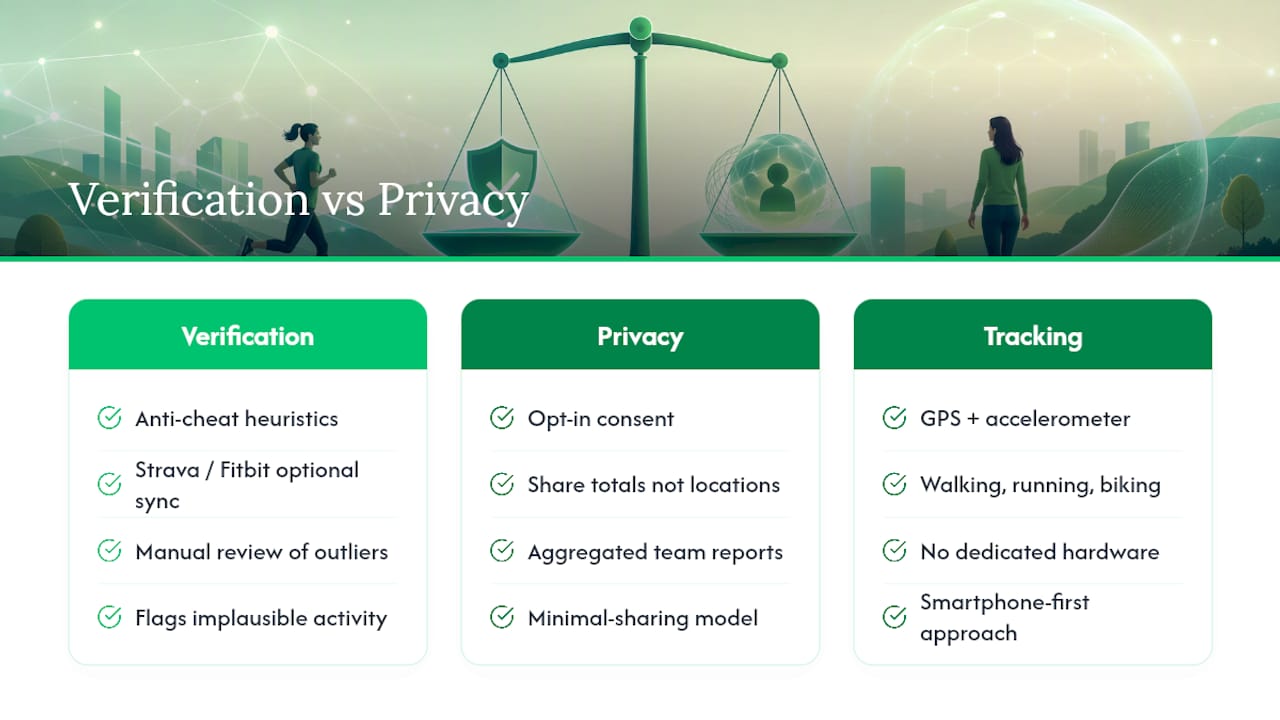
Most per-mile donation platforms run entirely on the sensors already in an employee’s pocket. GPS and accelerometer data from a smartphone track distance for walking, running, and biking, which means there’s no dedicated hardware to distribute, configure, or replace. Charity Miles builds its corporate charity challenges around this smartphone-first approach specifically to keep participation friction low.
Verification typically combines a few layers: anti-cheat heuristics that flag physically implausible activity, optional integration with services like Strava or Fitbit for employees who already track workouts there, and manual review for flagged outliers. None of this requires broad access to an employee’s personal data.
Privacy controls generally follow a minimal-sharing model. Employees opt in, the app shares mileage totals rather than granular location history, and employers receive aggregated team reporting instead of individual activity logs. That distinction matters to legal and procurement teams evaluating a new vendor, and it’s worth confirming explicitly before rollout.
How Do You Design a Campaign People Actually Join?
The format decisions you make before launch determine whether 20 percent or 60 percent of your workforce participates. Start with three choices: the time window (most campaigns run four to eight weeks), the team structure (departmental teams tend to outperform an open free-for-all), and the scoring method. Per-capita scoring, average miles per team member rather than total miles, keeps a 12-person team competitive against a 200-person department.
Here’s a practical launch sequence:
- Announce the campaign with a clear charity structure and per-mile rate at least two weeks ahead of launch.
- Get an executive to publicly pledge the first mile sponsorship, which sets a visible tone of commitment.
- Open opt-in registration and make team assignment simple, ideally automatic by department.
- Layer in leaderboards, mileage milestones, and non-athlete recognition categories from day one, not as an afterthought.
- Set a firm end date and communicate the final tally and total dollars raised within a week of close.
Recognition should reach beyond the fastest runners. Milestone badges for consistency, a “most improved” category, and per-capita team standings all give slower or newer participants a real reason to keep logging miles. Enterprise programs that pair per-mile giving with leaderboards and team structures report the kind of camaraderie and sustained activity that a flat pledge drive rarely generates.
Pro Tip: Cap what percentage of total miles any single participant can contribute to the team leaderboard. This one rule change does more to protect small-team morale than any prize structure.
What Metrics Prove the Program Is Working?
The clearest per-mile donation programs report on three fronts at once: participation, wellbeing, and dollars. Mixing all three into one report gives executives a fuller picture than a fundraising total alone.
- Participation: percentage of eligible employees who logged at least one activity, week-over-week retention, and average miles per active participant.
- Wellbeing: shifts in engagement survey scores collected before and after the campaign, plus any change in absenteeism as a rough proxy for improved health habits.
- CSR outcomes: total dollars raised, number of charities supported, and whether any employer matching gifts amplified the total.
An executive one-pager works best when it leads with the dollar figure and participation rate, then adds a short wellbeing note underneath. A public CSR summary can go further, naming the charities supported and quoting the campaign’s headline number for recruiting and employer-brand purposes.
What Results Have Enterprise Programs Actually Delivered?
The scale question is usually the first one enterprise leaders ask, and the existing case studies answer it directly. HARMAN launched a Charity Miles team in 2021 and saw employee participation grow 11 times over, raising more than $120,000 for charity in the process. That’s not a pilot number. That’s a program that found real traction inside a large organization.
Principal ran a company-wide challenge that set out to hit 1 million miles and ended up doubling that target to 2 million miles, with more than 5,000 employees participating. Outside the corporate world, a year-long academic pilot of a walking-for-donations program in the workplace saw 1,124 of 1,254 enrolled participants complete the full 52 weeks, a completion rate that suggests this model holds up well past the initial excitement of launch week.
Why Daily Micro-Donations Change Workplace Culture
Most CSR initiatives ask employees to show up once a year for a talkathon or a matched-giving drive. Per-mile donation programs ask for something smaller and more frequent: a lunchtime walk, a bike commute, a Tuesday run. That daily rhythm is exactly why the model sustains participation better than a single annual event.
I’d recommend starting with a 6 to 8 week pilot, a modest per-mile rate, and one visible executive pledge to anchor it. Watch participation and per-capita mileage weekly rather than waiting for a final tally. The programs that succeed are the ones that treat the first pilot as a culture experiment, not just a fundraising line item.
— Gene
Ready to Launch a Per Mile Donation Program?
Charity Miles gives you a way to sponsor employee miles without buying hardware, building a leaderboard from scratch, or negotiating charity payouts manually. Compared to a one-off walkathon or a fixed annual donation, it runs continuously, costs employees nothing, and lets you set the per-mile rate, sponsorship cap, and charity structure entirely on your own terms.
There’s no cost to your employees to join, and no dedicated hardware to distribute. If you’re weighing this against other corporate wellness programs, the next step is straightforward: request a pilot walkthrough and see how a 6 to 8 week per-mile campaign would look for your workforce.
Sources
- Raising funds one mile at a time: Our company-wide charity challenge
- The Walking Mileage Campaign: A Campaign Developed by an ICT-based Program in the Workplace to Promote Walking by Making Donations