
Yes, walking measurably improves mood and lowers your risk of depression and anxiety. Adults who walk briskly for about 75 minutes a week see an 18% lower risk of depression, and that risk drops to 25% at 150 minutes. Start today with one 20-minute walk. If your symptoms are severe or persistent, walking supports treatment, but it doesn’t replace therapy or medication.
TL;DR:
- Walking for at least 75 minutes a week reduces depression risk by 18 percent, and 150 minutes lowers it by 25 percent, according to APA data.
- A 20-minute walk quickly improves mood by increasing blood flow and stress regulation, with effects measurable within twenty minutes.
- Consistent walking over time is associated with lowered depression, reduced burnout symptoms, and improved sleep, regardless of the walking environment.
- Starting with small, routine walks and gradually increasing duration improves habit formation and prevents burnout, especially when paired with social or purpose-driven motives.
- Outdoor walks in natural environments can amplify mental health benefits but indoor walking is a valid substitute when necessary or safer.
Table of Contents
- The Mental Health Benefits of Walking You Can Feel Immediately
- What the Evidence Shows, and Where It Falls Short
- How Much Should You Walk, and How Do You Start?
- Outdoor Walks vs. Indoor Walks: Does Setting Matter?
- Making Walking a Habit That Actually Sticks
- Why Purpose Changes How Long a Walking Habit Lasts
- The Real Gap in Walking Advice
- Turning Your Walk Into Something Bigger
- Sources
The Mental Health Benefits of Walking You Can Feel Immediately
Walking works on your brain faster than most people expect. A single walk changes blood flow and helps regulate the body’s stress response system, which is why a bad mood often lifts within twenty minutes of heading outside. That’s not a placebo effect. It’s a physiological shift you can learn to rely on.
The mood boost is the most immediate benefit, but it’s far from the only one. Here’s what regular walking does for your mental health:
- Calms stress and anxiety. The rhythmic, repetitive motion of walking, paired with steady breathing, interrupts anxious thought loops and gives your nervous system something predictable to focus on.
- Lowers depression risk over time. Consistent walking is tied to measurably lower depression risk, not just a temporary mood lift.
- Improves sleep quality. An evening walk timed a few hours before bed, or a morning walk that exposes you to daylight, helps anchor your circadian rhythm.
- Builds energy instead of draining it. Counterintuitively, movement fights fatigue better than rest does for people stuck in low-energy ruts.
- Reduces burnout symptoms. Regular activity is associated with less exhaustion and disengagement at work.
Quick stat: Reviewers analyzing longitudinal and intervention studies found physical activity, including walking, is linked to reduced exhaustion and burnout, even though the strongest evidence still comes from studies that measure change over time rather than tightly controlled trials.
Behavioral activation is the mechanism behind the depression and burnout effects. When you’re low, the instinct is to withdraw and do less. Walking pushes against that instinct in a way that’s manageable, which is exactly why clinicians recommend it as a first-line, low-barrier intervention.

What the Evidence Shows, and Where It Falls Short
The American Psychological Association’s figures give you a clean dose-response relationship: 75 minutes of brisk walking weekly cuts depression risk by 18%, and hitting the CDC’s recommended 150 minutes weekly reduces it to 25%. That’s a genuinely strong signal for a habit that costs nothing and requires no equipment.
The picture gets more nuanced when you look at meta-analytic data. Systematic reviews of walking interventions for depressive symptoms report small-to-moderate pooled effects, not dramatic ones, and the studies feeding those reviews vary widely in quality and design. That heterogeneity matters:
- Some trials use supervised group walks; others leave participants unsupervised, and outcomes differ.
- Age and baseline symptom severity change how much benefit a person gets.
- Evidence on long-distance walking as a therapeutic intervention is promising but still described as a scoping review rather than a settled conclusion, meaning sample sizes and delivery methods still vary too much to generalize confidently.
There is no single optimal walking prescription. The research supports flexibility and personalization over a rigid formula, because study designs differ too much to crown one “correct” dose.
None of this undercuts walking as a strategy. It does mean you should treat it as one evidence-based tool among several, not a cure. If you’re managing clinical depression, an anxiety disorder, or a condition with severe symptoms, walking belongs alongside professional care, not instead of it.
How Much Should You Walk, and How Do You Start?
Two numbers matter here: 75 minutes of brisk walking weekly gets you meaningful risk reduction, and 150 minutes weekly, the CDC’s general activity guideline, gets you more. In steps, that roughly translates to a daily target in the 5,000 to 7,500 range for mood benefits, with some research showing that each additional 1,000 daily steps correlates with measurably lower depression symptoms.
Here’s a four-week path that won’t burn you out:
- Week 1: Two 15-minute walks on most days. Keep the pace comfortable, not punishing.
- Week 2: Stretch one of those walks to 20 minutes and add a third day if you can.
- Week 3: Aim for 25 to 30 minutes most days, mixing brisk stretches with easier ones.
- Week 4: Land at 30 minutes most days, or roughly 150 minutes for the week.
If you have a cardiac history, joint issues, or balance concerns, check with your provider before increasing intensity. Seated marching or chair-based movement routines offer a real alternative when walking isn’t accessible.
Pro Tip: Two shorter walks often beat one long one for mood. A morning and afternoon walk gives your brain two separate resets instead of one, and it’s easier to fit into a workday than a single 30-minute block.
Outdoor Walks vs. Indoor Walks: Does Setting Matter?
Nature tends to add something a treadmill can’t fully replicate. Walking outdoors, especially somewhere green, often amplifies mood benefits through sunlight exposure and shifting scenery, though the effect isn’t consistent across every study. Morning outdoor walks in particular help regulate your circadian rhythm, which feeds directly into better sleep that night.
That said, indoor walking is a legitimate substitute, not a compromise, when weather, safety, or accessibility get in the way:
- Choose outdoor routes when it’s safe, well-lit, and convenient. Even a 10-minute loop around the block counts.
- Treadmill or mall walking works fine when outdoor options aren’t realistic. The mood benefit comes largely from the movement itself.
- If you do walk outside, plan for sun protection, wear visible clothing at dawn or dusk, and pick routes you already know well.
Making Walking a Habit That Actually Sticks
Consistency beats intensity, every time. A daily 15-minute walk you actually do outperforms an ambitious hour-long plan that collapses after week two. The trick is lowering the friction until the walk feels automatic rather than optional.
- Stack your walk onto something you already do: right after coffee, right before your first meeting, right after dinner.
- Lay out shoes and a jacket the night before so the decision is already made for you.
- Walk with a partner, join a workplace step challenge, or turn a routine check-in into a walking meeting instead of a desk call.
- Try structured emotion-regulation exercises alongside your walks if anxiety, not just low mood, is the main driver.
Pro Tip: Block your walk on your calendar like a real appointment. A habit with a time slot survives busy weeks; a habit that depends on “finding time” usually doesn’t.
Why Purpose Changes How Long a Walking Habit Lasts
Research on habit formation backs something I’ve noticed across every wellness program built around movement: purpose outlasts willpower. A walk that raises money for a cause you care about, or one that’s part of a friendly team challenge, keeps people showing up long after New Year’s motivation fades.
Charity Miles is one example built on that idea. It’s a free app that turns walking, running, or biking miles into donations for a charity of your choice, and its Employee Empowerment Program lets companies sponsor employee miles as part of structured wellbeing initiatives. That’s what happens when a walk means something beyond the walk itself.
The Real Gap in Walking Advice
Most walking-for-mental-health content stops at “get your steps in,” and that’s where it fails people. The evidence actually supports something more specific: consistency at a modest dose (two 15-minute walks most days) beats sporadic ambition, and the research backs up why. Meta-analyses show effects are real but modest, which means walking should be your first move, not your only one, for anything beyond mild stress.
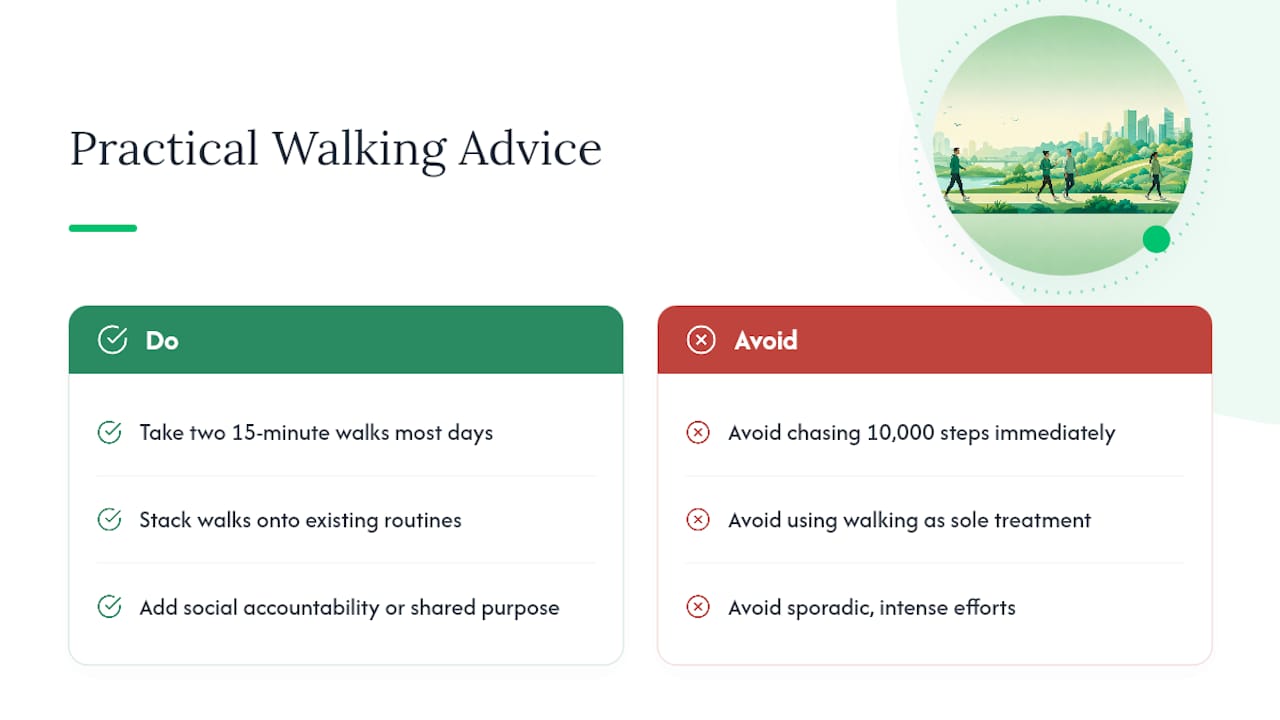
What’s overrated is step-count perfectionism. Chasing 10,000 steps daily when you’re starting from zero is a good way to quit by week two. What’s underrated is habit stacking and social accountability. Charity Miles’s own data on workplace participation suggests that adding shared purpose to a walking habit does more for adherence than adding intensity ever will.
If you take one thing from the research, take this: start smaller than feels ambitious, and give the habit a reason to outlast your motivation. That combination, not the perfect walking plan, is what actually changes outcomes.
— Gene
Turning Your Walk Into Something Bigger
Once walking becomes a habit, the next question is what to do with that momentum. Charity Miles is a free app for individuals who want their daily walk to fund a cause they care about, and its Employee Empowerment Program gives HR and CSR leaders a structured way to build company-wide participation without running a top-down mandate.

It’s a good fit for two kinds of people: individuals who need one more reason to lace up on a low-motivation day, and companies building employee engagement programs that connect wellbeing directly to measurable social impact. Employers can configure sponsorship terms and choose donation destinations within a private team environment. If you’re evaluating corporate wellness options for the year ahead, start by seeing how a walking-based program could fit your team’s culture and CSR goals.
This article is general information, not a substitute for advice from a qualified doctor. Consult a qualified healthcare professional about your own circumstances before acting on anything here.
Sources
- Defeating depression naturally — American Psychological Association
- Benefits of physical activity — CDC
- Walking interventions and depressive symptom severity — systematic review and meta-analysis (journal excerpt)
- Systematic review of physical activity and burnout — PMC
- A walk in the woods may boost mental health — Harvard Medical School Magazine