
In this guide, workplace walking safety means something different than a slip-and-fall audit: it’s the practice of running structured, inclusive walking-for-charity programs that turn everyday movement into measurable wellbeing, engagement, and donations. The recommended path is straightforward. Launch a voluntary, CSR-linked walking program with accessible tracking and basic risk-aware routines, and you’ll see participation, morale, and charitable impact rise together.
TL;DR:
- Participation is inclusive, with no fitness level restrictions, and participation rates can significantly increase when employees see CSR as genuine and meaningful.
- Clear safety checks, flexible tracking options, and explicit voluntariness statements are essential to ensure a safe, accessible, and non-coercive walking experience.
- Launching a pilot challenge of four to eight weeks with defined sponsorship, then scaling based on engagement data, optimizes resource use and program effectiveness.
- Team-based formats and milestone recognition support remote participation and maintain momentum in ongoing challenges without fostering unhealthy competition.
- Tracking key metrics like active participants, miles logged, and funds donated provides measurable results that boost leadership and recruiting stories.
Table of Contents
- Why a Walking-for-Charity Program Advances CSR, Engagement, and Wellbeing
- Safety, Accessibility, and Inclusion Checklist for Workplace Walking Programs
- Design and Launch Playbook (Pilot to Scale) Using Charity Miles
- Ready-to-Run Challenge Formats and Operational Logistics
- Measure Impact: Metrics, Reporting, and Storytelling
- Ergonomic Tips and Proper Footwear for Safe Walking at Work
- Emergency Procedures and First Aid Related to Walking Injuries
- Training Employees on Walking Safety Protocols and Awareness
- Legal and Compliance Considerations Regarding Workplace Walking Safety
- Author Perspective: Practical Lessons and Common Pitfalls
- How Charity Miles’ Employee Empowerment Program Helps You Run Safe, Inclusive, Measurable Programs
- Sources
Why a Walking-for-Charity Program Advances CSR, Engagement, and Wellbeing
Employees who perceive their company as socially responsible show up differently. A meta-analysis of 143 studies covering nearly 90,000 employees found that perceived corporate social responsibility carries a medium-to-large effect on engagement, commitment, and job satisfaction. That’s not a soft correlation you can wave away in a budget meeting. It’s one of the more consistent findings in organizational research.
Walking is the easiest entry point into that CSR story because it asks nothing extra of anyone. No gym membership, no special skill, no early wake-up call required. A systematic review on workplace health promotion recommends folding exercise programs directly into CSR strategy, and specifically flags leadership visibility, clear communication, and inclusivity as the factors that separate programs people actually join from ones that quietly die after month one.
There’s a wellbeing case too. Daily stressor research shows that brief recovery opportunities, like a short walk between meetings, can buffer strain accumulation before it turns into burnout. Charity Miles has been building on that insight since 2012, and hundreds of companies now run private walking challenges through the platform.
What makes this work at scale:
- Any movement counts, so participation isn’t gated by fitness level
- Purpose reframes a chore (exercise) into a contribution
- Team-based formats add light competition without punishing slower walkers
The takeaway: perceived CSR moves the needle on engagement more reliably than most wellness perks HR budgets typically prioritize, according to the meta-analysis above.
Safety, Accessibility, and Inclusion Checklist for Workplace Walking Programs
Preventing slips at work and other hazardous walking conditions matters here mainly as a matter of due diligence for any group activity you organize, not as the program’s central theme. A short checklist covers most of what you need before launch:
- Walk any proposed outdoor or group walking-meeting route once yourself, checking for uneven pavement, poor lighting, and traffic crossings.
- Offer at least one indoor or low-mobility alternative for every outdoor challenge, since foot traffic safety measures should never exclude employees with mobility differences.
- Publish clear voluntariness language in every communication. No employee should feel their participation, or lack of it, is visible to managers in a way that affects performance reviews.
- Let employees choose their own tracking method (phone GPS, manual entry, wearable) so no one is forced into technology they don’t want to use.
- Post simple signage at building exits reminding walkers to watch for vehicle traffic in parking areas during dawn or dusk walking windows.
Pro Tip: Frame every challenge announcement around choice, not obligation. Something as small as swapping “employees must log 10 miles” for “log whatever miles fit your week” measurably reduces the sense of pressure that kills long-term participation.
Keep privacy simple too. Employees should know exactly what data (miles, not location history) gets shared with HR, and that sharing a favorite charity is optional, never mandatory.
Design and Launch Playbook (Pilot to Scale) Using Charity Miles
Start with a pilot, not a company-wide rollout. A four-to-eight-week private team challenge, with a defined sponsorship model, gives you clean data before you commit budget company-wide, based on how enterprise deployments typically perform on the platform.
During the pilot, decide your sponsorship structure early: a flat rate per mile, a total sponsorship cap, and whether funds flow to each employee’s chosen charity or one company-selected cause. Then move into rollout:
- Recruit team captains from different departments to spread ownership beyond HR
- Send a short launch communication explaining voluntariness and how tracking works
- Kick off with a walking meeting or lunchtime group walk to model the behavior
- Set a single KPI dashboard leadership reviews monthly, not quarterly
| KPI | What to Track | Reporting Cadence |
|---|---|---|
| Active participants | Unique employees logging miles | Weekly during pilot |
| Participation rate | Percent of eligible staff engaged | Monthly |
| Miles logged | Total distance across the team | Monthly |
| Funds raised | Dollars donated via sponsorship | Monthly |
| Retention | Percent still active after 90 days | Quarterly |
The results can be substantial. Since HARMAN launched its Charity Miles team in 2021, employee participation jumped 11 times over, with more than 1,200 employees generating over $120,000 for charity. That’s not a one-off spike. It’s what happens when a low-barrier activity gets paired with a cause people actually care about.
For enterprise privacy notes: Charity Miles tracks distance, not location history, and admin dashboards show aggregate team data rather than individual movement patterns, which keeps legal and compliance teams comfortable during procurement review.
Ready-to-Run Challenge Formats and Operational Logistics
You don’t need to invent a format. Four templates cover most workplace situations:
- Month-long mileage challenge. Every logged mile counts toward a team total, with a modest sponsorship rate per mile capped at a set budget.
- Team versus team. Split departments into competing groups; the losing team makes a symbolic donation to the winning team’s chosen charity.
- Walking-meeting week. Encourage one walking meeting per day for a week, tracked informally, to normalize movement without adding a separate challenge structure.
- Hybrid or global challenge. For distributed teams, run challenges on a rolling weekly cycle rather than a fixed calendar day, so time zones never determine who can “compete.”
For remote participants, drop the leaderboard obsession and lean on milestone recognition instead. A shoutout at 50 miles matters more to a remote employee than their rank on a list they only half-remember exists. Between big challenges, keep momentum with mini-challenges tied to a single cause, a charity spotlight in your newsletter, or a surprise sponsorship bump for a slow week. Programs like the corporate step challenge framework work well as a template if you want a defined structure rather than building one from scratch.
Measure Impact: Metrics, Reporting, and Storytelling
Five numbers tell most of the story leadership and recruiters want to hear: active participants, participation rate, miles logged, dollars donated, and 90-day retention. Track them consistently and you have a real narrative, not a vanity metric.
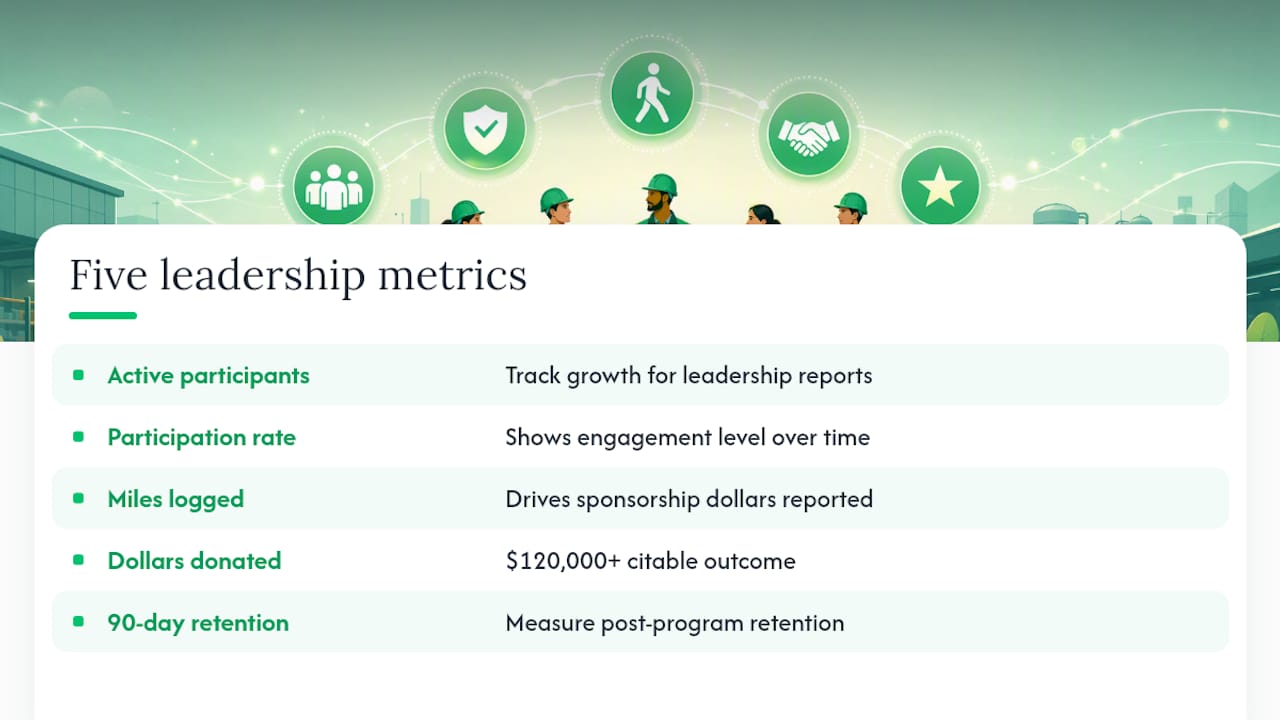
Charity Miles gives companies control over sponsorship terms and reporting, which matters when CSR disclosures need hard figures rather than vague wellness claims. That control is what turned HARMAN’s $120,000+ raised into a citable outcome rather than an anecdote.
For leadership reporting, frame the story around participation growth and dollars donated per quarter. For recruiting materials, the same numbers work differently: candidates respond to specifics like “our team walked its way to six figures for charity” far more than generic wellness-perk language.
Ergonomic Tips and Proper Footwear for Safe Walking at Work
Comfort determines whether a walking program survives its second week. Employees who show up in office shoes not built for movement tend to quit early, often citing foot pain rather than the program’s design.
Encourage supportive, cushioned walking shoes for anyone participating in daily miles, and remind employees that dress-code flexibility during “walking hours” removes a real barrier. Many offices already allow sneakers for commute; extending that grace period through lunch walks costs nothing and removes friction.
Posture matters as much as footwear. Walking with a phone held at chest height (rather than looking down) reduces neck strain over a long walking meeting, and it’s a habit worth mentioning once in your launch communication rather than assuming people already know it.
A few practical additions:
- Recommend moisture-wicking socks for employees walking multiple miles a day, since blisters are the most common early dropout reason
- Suggest a short calf and ankle stretch before longer group walks, especially for employees returning to regular movement after a sedentary stretch
- Point remote employees toward a simple standing desk break as a substitute walking option on days weather or workload prevents an actual walk
None of this requires a formal ergonomics consultation. It requires one clear paragraph in your launch email and a willingness to relax dress-code rigidity during program hours.
Emergency Procedures and First Aid Related to Walking Injuries
Minor walking injuries during workplace programs are uncommon, but having a clear response plan removes hesitation when something does happen. Rolled ankles, minor trips, and heat exhaustion during summer walking challenges are the most likely incidents, and each has a straightforward response.
For a rolled ankle or minor fall, the standard approach is rest, ice, compression, and elevation, along with a check for swelling that doesn’t improve within a day. Keep a basic first aid kit accessible near common walking routes or meeting rooms used for walking meetings, stocked with ice packs, bandages, and antiseptic wipes.
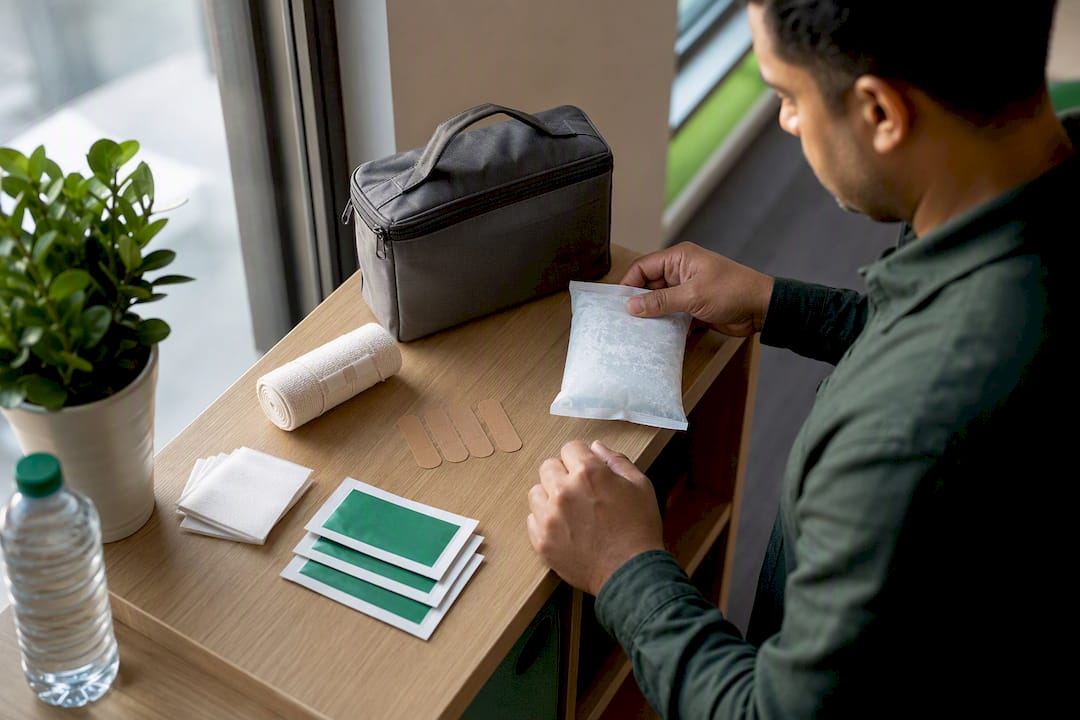
Heat related issues deserve their own attention during summer challenges. Symptoms like dizziness, nausea, or unusual fatigue during a walk should prompt an immediate stop, shade, and water, with a follow-up check from a colleague or building safety officer if symptoms persist. Employees with known heart or joint conditions should always have the option to decline any group walking activity without needing to explain themselves, a point worth stating outright in your program communications.
Designate one point of contact, typically whoever runs your facilities or safety desk, for reporting any incident during a company-organized walk. This isn’t about liability paperwork. It’s about making sure an employee who trips during a lunchtime walking meeting knows exactly who to tell and that the report takes two minutes, not twenty.
Training Employees on Walking Safety Protocols and Awareness
A five-minute briefing before launch does more for a program’s safety than a formal training module ever will. Employees don’t need a certification to walk safely. They need three or four clear reminders delivered once, and repeated briefly at the start of each new challenge cycle.
Cover the basics in your kickoff communication: watch for vehicle traffic when walking near parking lots or loading areas, use crosswalks rather than cutting across roads, and avoid wearing headphones at a volume that blocks awareness of surroundings during outdoor walks. For walking meetings held on-site, remind employees to stay aware of uneven flooring transitions between building sections, a detail easy to overlook indoors.
Team captains, the same volunteers who help run challenge logistics, are a natural channel for reinforcing these habits informally rather than through a mandatory course. A captain who mentions “watch the curb by the loading dock” in a team chat does more than a PDF nobody reads.
Awareness training works best when it’s folded into excitement, not delivered as a separate compliance exercise. Pair the safety reminder with the challenge announcement itself, so employees associate the guidance with something they’re looking forward to rather than another mandatory module competing for their attention.
Legal and Compliance Considerations Regarding Workplace Walking Safety
Voluntary wellness programs generally carry lighter compliance burdens than mandatory fitness requirements, but a few practices reduce risk regardless of company size. Document that participation is optional, and keep that language consistent across every communication tied to the program, from the launch email to any manager-facing materials.
Data privacy deserves specific attention. If your program tracks location or biometric data through wearables or an app, confirm what data your provider collects and how it’s stored, and communicate that plainly to participants rather than burying it in fine print. Charity Miles tracks mileage rather than continuous location history, which simplifies this conversation considerably for enterprise legal teams.
Consider how your program interacts with existing HR policies around workers’ compensation. Injuries during a company-organized walk held during work hours may fall under different coverage than a purely personal lunchtime walk, so a brief conversation with your legal or risk management team before launch is worth the half hour it takes. This isn’t about discouraging participation. It’s about making sure the policy language matches what actually happens during the program.
Finally, avoid tying any incentive or sponsorship dollar amount to individual performance metrics in a way that could resemble a mandatory fitness standard. Keep rewards team-based and participation-based rather than performance-ranked, which sidesteps most of the gray area that arises when wellness incentives start looking like disguised requirements.
Author Perspective: Practical Lessons and Common Pitfalls
The programs that last aren’t the ones with the cleverest incentive structure. They’re the ones that state clearly, every single time, that participation is optional, and then actually mean it.
The biggest pitfall I see leadership teams fall into is over-engineering the reward system before the program even launches, when the honest driver of participation is meaning, not prizes. A modest sponsorship tied to a cause someone chose themselves outperforms an elaborate points system nobody understands.
Accessibility beats perfection every time. A program that lets someone log a five-minute walk feels more inclusive than one built around 10,000-step targets, and inclusive is what actually drives the participation numbers HR leaders eventually report upward.
— Gene
How Charity Miles’ Employee Empowerment Program Helps You Run Safe, Inclusive, Measurable Programs
Charity Miles is the direct route to a walking program that’s already built for the safeguards this guide covers: voluntary framing, accessible tracking for every fitness level, and sponsorship terms your finance team can actually approve. Instead of assembling comms templates, tracking spreadsheets, and safety checklists from scratch, you get private team challenges, configurable sponsorship caps, and reporting dashboards in one place.
The program gives you control over the details that matter most: choose whether donations go to each employee’s own charity or a company-selected cause, set the rate per mile, and cap total spend before you launch. Reporting stays simple enough for a CSR disclosure and compelling enough for a recruiting deck, the same combination that helped HARMAN generate over $120,000 for charity after an 11 times jump in participation.
If you’re ready to move past planning and into a pilot, explore the best employee engagement software options built for programs like this, or reach out to scope a private team challenge sized to your company.
Sources
- The Relationship Between Perceived Corporate Social Responsibility and Employee-Related Outcomes: A Meta-Analysis
- Corporate social responsibility and workplace health promotion: A systematic review
- A Dynamic View of the Challenge-Hindrance Stressor Framework: a Meta-Analysis of Daily Diary Studies
- Boosting Engagement: Effects of Wellness Programs in Hospitality Workplaces