
A short, team-based bike challenge that converts employee miles into charity donations is one of the most reliable ways to lift engagement and prove CSR impact without a big budget. The verdict: run a 4 to 8 week pilot built around collaborative teams, not individual leaderboards, with your company sponsoring miles at a set rate and cap. Start today by creating a private team inside a platform like Charity Miles and inviting a handful of departments to test it.
TL;DR:
- A short, team-based bike challenge can significantly boost engagement and CSR impact with a well-structured 4 to 6-week pilot involving cross-functional planning.
- Using a GPS-enabled app with real-time dashboards and clear math on sponsorship caps ensures trust and reduces friction in logging miles.
- Engagement relies more on team inclusion, visible management support, and recognition than on high sponsorship rates or individual leaderboards.
- Tracking operational, wellness, and CSR metrics weekly and pre/post survey data provides a comprehensive view of the program’s success.
- Most challenges fail due to leaderboard demotivation or tracking issues, which can be fixed through tiered recognition, simplified logging, and transparent donation calculations.
Table of Contents
- What You Need To Run A Corporate Bike Challenge
- How To Launch A 6-Week Corporate Bike Challenge Pilot
- What Keeps Employees Engaged Through The Whole Challenge
- How Do You Measure And Report Challenge Results?
- Does A Charity-Linked Bike Challenge Actually Work?
- What Usually Goes Wrong And How To Fix It
- Why Charity-Linked Movement Changes Company Culture
- Starting Your Employee Empowerment Program Pilot
- Sources
What You Need To Run A Corporate Bike Challenge
Before you announce anything, line up four things: people, technology, budget, and timing.
You’ll want a cross-functional owner group, not a solo HR project. Pull in HR for enrollment and communications, CSR for charity selection and impact reporting, IT for app access and data privacy, and legal for a quick review of sponsorship terms. Appoint team captains early. They drive far more sustained participation than any email from leadership.
On the technology side, a mobile app with GPS and pedometer tracking removes the guesswork of manual logging, though you should always keep a manual-entry fallback for employees without smartphones or those who prefer walking indoors. An admin dashboard that shows real-time miles, team standings, and sponsorship totals matters more than any leaderboard graphic.
Budget basics:
- Set a per-mile sponsorship rate (start with a moderate, common range per mile)
- Cap total company spend so finance can approve it without back-and-forth
- Decide whether donations go to a single company-selected charity or each employee’s chosen cause
- Pick a pilot length of 4 to 6 weeks before committing to a full annual rollout
How To Launch A 6-Week Corporate Bike Challenge Pilot
Most employers find a compact pilot builds more momentum than a sprawling year-long program. Systematic-review evidence on workplace physical activity interventions shows many formal programs commonly run multi-week periods, and many successful employer pilots focus on shorter, several-week challenges that trade duration for energy and clarity. Here’s a week-by-week structure that works for most mid-size to enterprise teams.
- Week 0, planning. Set a participation goal, choose your charity or charities, finalize the sponsorship formula, and confirm the pilot’s scope (one office, one department, or company-wide). Set up the tracking app and test the admin dashboard before anyone enrolls.
- Week 1, onboarding. Enroll teams, train captains on how to invite members and check standings, and run a live demo of the app so employees can test logging a mile before the challenge officially starts. Share a short privacy notice explaining what data the app tracks and how it’s used.
- Weeks 2 to 5, execution. Give each week a light theme (commute week, lunch-ride week, family-mile week) to keep content fresh. Send a short recognition email every Friday spotlighting a team’s progress, not just the leader. Have a troubleshooting contact ready for app issues; friction in week two is the top reason participation drops off by week four.
- Week 6, wrap and reporting. Calculate total donations against your sponsorship formula, collect two or three short employee testimonials, and publish a one-page CSR impact summary for leadership. Send a feedback survey while the experience is still fresh. That input shapes whether you extend the format company-wide.
Pro Tip: Announce the exact per-mile rate and sponsorship cap before week one, not after. Employees who understand the math trust the results, and captains stop fielding “how much did we actually raise” questions during the final week.
What Keeps Employees Engaged Through The Whole Challenge
Team format decides whether your challenge sustains itself or fizzles by week three. Research on workplace vitality programs finds that motivation and removing structural barriers, not raw willpower, drive sustained participation, and that collaborative, team-based designs consistently outperform cutthroat individual rankings. A single top-of-leaderboard employee logging 40 miles a week can quietly demoralize everyone below them; a shared team goal spreads the motivation around instead.
Build inclusion into the scoring itself:
- Convert walking, running, and biking into one shared mile total so no activity type feels like the “real” one
- Offer a lower-effort participation tier for employees returning from injury or new to exercise
- Let captains set internal team goals that flex with team size, so a five-person team isn’t chasing a fifty-person team’s total
Recognition matters as much as scoring. Weekly team spotlights, manager shout-outs, and small badges for milestones (first 10 miles, most improved team) cost almost nothing and keep momentum alive between big announcements. A multi-employer physical activity pilot that enrolled a very large number of employees found social connection and visible management support drove participation more than cash incentives did. Story beats spreadsheet: tying miles to a specific charity outcome, like “our team’s miles funded 200 meals,” tends to move people more than a flat dollar figure ever will.
How Do You Measure And Report Challenge Results?
Track operational numbers alongside wellness and CSR outcomes, or your final report will read like an activity log instead of a business case. Enrollment rate, active-participant rate (people who logged at least one mile weekly), and total miles by team or region tell you whether the format is working operationally.
A short pre- and post-challenge survey on self-reported wellbeing and intent to stay adds the human dimension leadership actually cares about. On the CSR side, track total dollars donated, which charities received funds, and the split between employee-chosen and company-directed giving.
| Metric category | What to track | Reporting cadence |
|---|---|---|
| Operational | Enrollment, active-participant rate, miles logged | Weekly during challenge |
| Wellness | Self-reported wellbeing, intent to stay, sustained activity | Pre and post challenge |
| CSR | Total donated, charities supported, allocation split | Final report, then quarterly |
Feed this into a one-page executive dashboard rather than a raw spreadsheet dump. Most CSR leaders find a quarterly cadence after the pilot keeps the program visible without becoming another recurring meeting nobody wants.
Does A Charity-Linked Bike Challenge Actually Work?
The clearest enterprise proof point comes from HARMAN, which built its Charity Miles team in 2021 and saw participation jump 11 times over, with more than 1,200 employees generating over $120,000 for charity. That’s not an isolated marketing number. It lines up with what the broader research on workplace movement programs consistently finds.
A systematic review of physical activity workplace interventions reports improved activity levels across most studies along with measurable reductions in psychological stress, plus mixed but generally positive effects on clinical and productivity outcomes. Separately, a large employer pilot involving over 100,000 employees found that participation was driven far more by social connection and employer support than by any cash prize.
The strongest predictor of whether an employee keeps logging miles past week two isn’t the size of the sponsorship. It’s whether their manager mentioned the challenge out loud and whether their team felt like a team, not a leaderboard entry.
What this means if you implement the playbook:
- Expect activity levels to rise across most participants, not just the already-fit
- Expect stress-related feedback to improve modestly over the challenge window
- Expect participation to hinge on visible management involvement more than on your sponsorship rate
What Usually Goes Wrong And How To Fix It
Most corporate bike challenges don’t fail because employees dislike biking. They fail because of a handful of predictable, fixable design mistakes.
- Demotivating leaderboards. A single company-wide ranking discourages anyone outside the top ten. Fix it with tiered teams and recognition for most-improved, not just most-miles.
- Tracking friction. Employees give up when logging feels clunky. Fix it with a short live onboarding demo and a manual-entry option for anyone without a compatible device.
- Unclear donation math. If people can’t tell how their miles translate to dollars, they stop trusting the leaderboard. Fix it by publishing the per-mile rate, the company cap, and a worked example before day one.
- Momentum collapse after the finale. Participation often drops to zero the week the challenge ends. Fix it with a short monthly micro-challenge that keeps the app habit alive.
Pro Tip: Publish your donation formula as a single sentence employees can repeat to each other: “Every mile equals $0.15, up to $15,000 total.” Simple math travels through Slack channels far faster than a policy document ever will.
Why Charity-Linked Movement Changes Company Culture
The companies that get the most out of a bike challenge treat it as a culture investment, not a one-off event. When miles turn into visible dollars for a cause employees actually chose, purpose and metrics stop competing for attention. They reinforce each other.
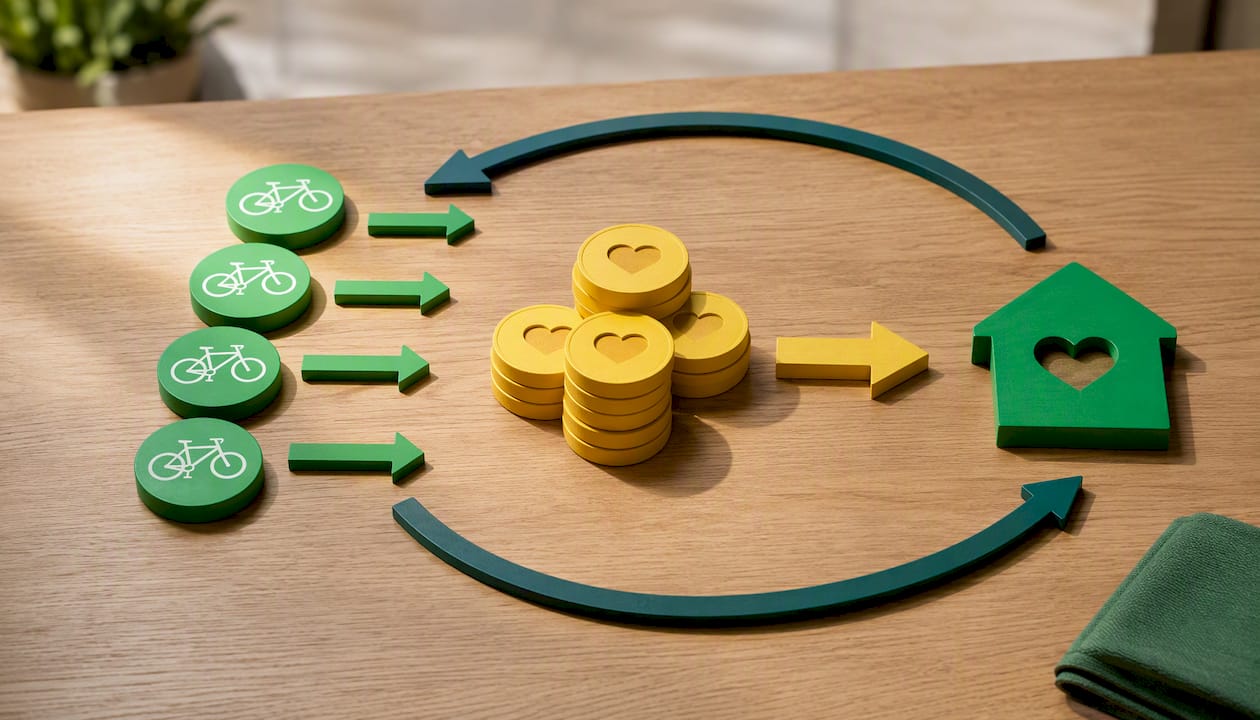
I’ve seen CSR leaders describe the same pattern after a pilot: employees who never showed up to a wellness webinar suddenly biking to work because their team needed the miles. That small shift, as it looks on a dashboard, tends to show up later in retention conversations, because people stay where their effort visibly matters.
If your organization is weighing whether to test this, the honest answer is that the format scales down easily. A pilot with two departments tells you almost everything you need to know before you commit company-wide, through a program like Charity Miles.
— Gene
Starting Your Employee Empowerment Program Pilot
Building the tracking, sponsorship math, and reporting dashboard from scratch takes months most HR teams don’t have. Charity Miles’ Employee Empowerment Program gives you all three already built, which is the real advantage over assembling a challenge with spreadsheets and a generic fitness app: private team creation, sponsorship terms your finance team controls (rate, cap, and charity choice), and admin reporting that turns miles into a CSR summary automatically.
Before you pick a vendor for any corporate wellness program, ask three questions: What does a pilot scope look like in the first 30 days? What reporting fields come standard on the dashboard? And can sponsorship terms change between a pilot and a full rollout without a new contract?
If those answers matter to your CSR roadmap this quarter, start a pilot conversation through Charity Miles’ corporate program and get a private team set up before your next planning cycle.
Sources
- From sign-up to sustained change: a mixed-methods study of participation patterns in a digital workplace vitality programme
- Effectiveness of Physical Activity-Led Workplace Health Promotion Interventions: A Systematic Review