
The fastest, highest-impact charity partnerships fall into three buckets: employee-engagement challenges, skills or pro-bono collaborations, and cause-linked promotions. Each one works best when you pilot it in 90 days with a small, measurable scope rather than launching a multi-year commitment cold. Charity Miles’ Employee Empowerment Program and the HBS framework for strategic CSR both point to the same lesson: partnerships that start small and prove impact fast are the ones that survive budget season.
TL;DR:
- Small pilot programs with measurable impact, such as a six-week employee fitness challenge or single-product cause promotion, tend to outperform large-scale, multi-year campaigns in early stages.
- Partnerships should be based on aligned values, shared audience, and capacity, with initial outreach focusing on warm contacts and concise co-design notes to secure quick approvals.
- Clear partnership agreements with specific scope, milestones, and reporting cadence are crucial to manage risk and avoid scope creep or reputational issues.
- Defining metrics upfront, such as funds raised, volunteer hours, or reach, and maintaining regular reporting ensures assessment and long-term sustainability of collaborations.
- Leveraging existing platforms like Charity Miles simplifies launching employee-engagement programs, with proven results like HARMAN’s 11-fold participation increase and over $120,000 raised from 1,200 employees.
Table of Contents
- Charity Partnership Ideas Worth Piloting First
- How Do You Find and Approach the Right Partner?
- Structuring the Agreement Without the Legal Headaches
- Measuring and Reporting Partnership Impact
- Case Study: Charity Miles and HARMAN’s Employee Engagement Results
- Quick Launch Checklist: An 8-Step 90-Day Pilot
- Legal Considerations and Compliance in Charity Partnerships
- Risk Management and Conflict Resolution Strategies
- Long-Term Sustainability and Scaling Partnerships
- Tips for Engaging Stakeholders and Community Involvement
- Pilots vs. Multi-Year Commitments: An Editorial Take
- A Ready-to-Run Option for Employee-Engagement Partnerships
- Sources
Charity Partnership Ideas Worth Piloting First
Most organizations overthink partnership selection. You don’t need ten strategic pillars and a steering committee. You need one idea that fits your capacity, a partner who shares your audience, and a way to measure whether it worked. Here are the concepts that consistently produce results, whether you’re a nonprofit approaching a company or a CSR lead building a proposal for leadership.
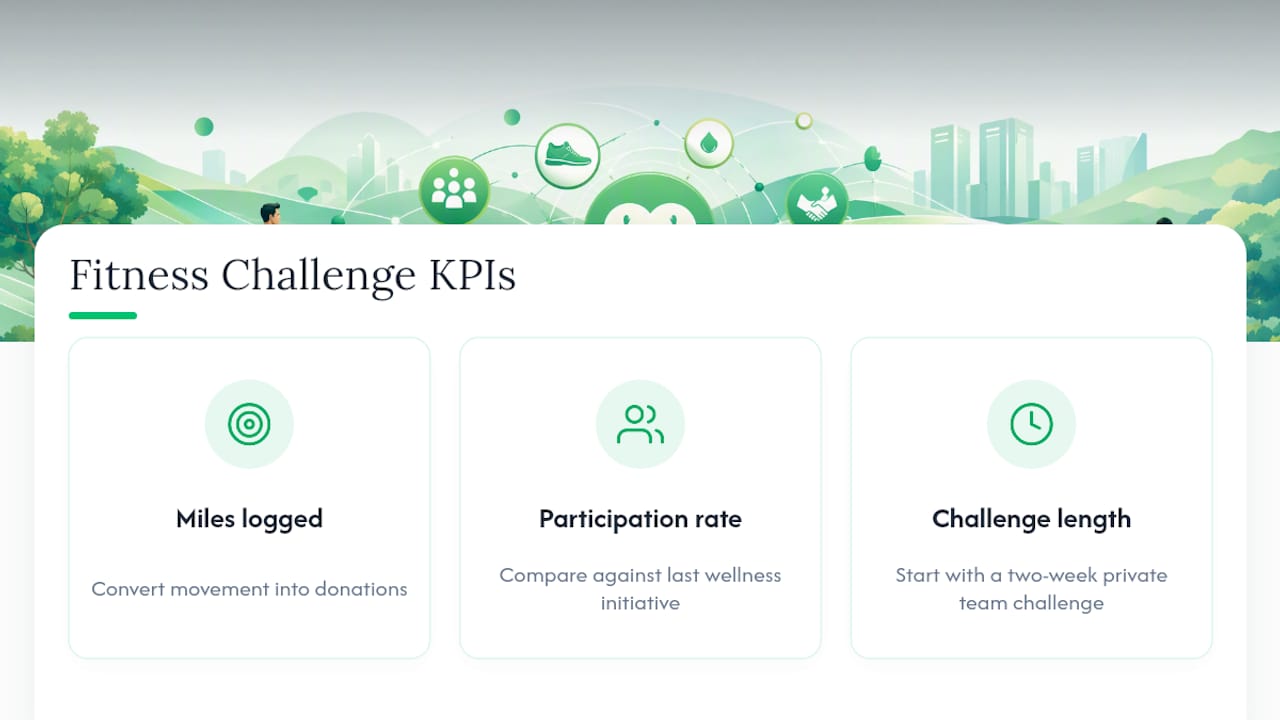
Employee-engagement fitness challenges. Convert everyday movement, walking, running, biking, into donations for a cause employees choose. This works for mid-size to enterprise employers wanting visible, inclusive CSR. Start with a two-week private team challenge and track total miles logged plus participation rate against your last wellness initiative.
Cause-related product or service promotions. A defined percentage of sales during a set window goes to a partner charity. Retailers and service brands use this well because it’s easy to explain to customers. Quick start: pick one SKU or service line, commit to a fixed donation share, and limit the promotion duration so you can evaluate before renewing.
Skills or pro-bono partnerships. Companies lend marketing, IT, legal, or data expertise instead of cash. Corporate volunteers helped IntoUniversity run data analysis that identified the highest-impact locations for new learning centers, work the charity likely couldn’t have afforded to commission. Track hours contributed and one concrete deliverable, like a finished dashboard or campaign asset.

Matching-gift and payroll giving amplifiers. Employers match employee donations dollar for dollar, or let staff give directly from payroll. This multiplies existing generosity without requiring a new program. Measure the match rate and the lift in average employee gift size.
Volunteer days with measurable outputs. Not just a day off, a specific output: 500 meals packed, 30 homes weatherized, 200 books sorted. Vague “volunteer day” events tend to underdeliver on both morale and impact. Set the output number before the day, not after.
In-kind or product donation programs. Medical supplies, tech equipment, and unsold inventory can matter more than cash, particularly for charities with logistics or equipment gaps. Organizations donating medical supplies or surplus equipment need to understand compliance and chain-of-custody requirements before committing, since improperly documented donations can create liability for both sides.
Co-branded awareness campaigns. Joint content, social pushes, or advocacy work that raises visibility for an issue rather than funds directly. Best for early-stage relationships where trust is still building. Success metric: reach and engagement lift, not dollars.
Coalitions for systemic issues. Multiple companies and charities pooling resources against one large problem, homelessness, food insecurity, disaster response. Slower to organize, but the combined leverage often outperforms solo efforts on policy-level issues.
Membership or loyalty tie-ins. Reward points, cashback, or tier upgrades convert into donations. This works particularly well for brands with an existing loyalty program that customers already trust, and it costs little incremental effort to attach a giving option.
Hybrid fundraising events. In-person plus virtual reach for the same event, a run, a gala, an auction, doubles the addressable audience without doubling venue costs. Measure registered participants across both formats and total funds raised per channel.
How Do You Find and Approach the Right Partner?
Not every willing partner is a good partner. Before you reach out, run candidates against a short checklist: values fit, audience overlap, operating capacity, legal or reputational no-go areas, and whether the collaboration maps to their CSR strategy or your mission. A mismatch on any of these tends to surface six months in, after both sides have already invested time.
The outreach sequence that works:
- Research the candidate’s public CSR reports, past partnerships, and stated priorities.
- Get a warm introduction through a board member, existing donor, or shared network contact rather than a cold email.
- Send a one-page co-design note, not a full proposal, outlining a shared outcome both sides care about.
- Ask for a small pilot, not a multi-year commitment, as the first ask.
Funders and grant-making foundations sometimes act as match-makers between charities and corporate partners, which is worth exploring if your own network is thin.
Pro Tip: Skip the polished slide deck for the first meeting. A one-page note that names a specific shared outcome gets a faster yes than a 20-slide pitch nobody has time to read.
Structuring the Agreement Without the Legal Headaches
A handshake and good intentions don’t survive a change in leadership. Every partnership agreement needs scope, responsibilities, deliverables, a reporting cadence, branding terms, a donation or payment schedule, exclusivity boundaries, and termination or wind-down terms.
Watch for these red flags before signing:
- Overbroad exclusivity that locks you out of other partners without corresponding compensation.
- No milestones, just a vague promise of “ongoing support” with nothing to measure against.
- Immediate termination clauses with no wind-down period, which can strand a program mid-cycle.
Good agreements convert aspirational language into enforceable deliverables with dates attached. Tie a portion of any payment to milestones rather than a single lump sum, and insist on a recurring review, quarterly at minimum, written into the contract itself.
Pro Tip: If a potential partner resists putting milestones in writing, treat that as information. It usually means they haven’t thought through what success looks like either.
Measuring and Reporting Partnership Impact
Pick metrics before you launch, not after. Five buckets cover almost every partnership type: funds raised, participation or volunteer hours, reach and impressions, outcome indicators (meals delivered, students served), and cost-efficiency (dollars raised per dollar spent running the program).
- Fitness challenges: donation dollars generated plus participation rate against your employee base.
- Pro-bono projects: hours contributed and number of deliverables completed.
- Cause promotions: total sales lift plus donation total.
- Volunteer days: output count (meals, homes, hours) against the target set beforehand.
A useful benchmark: strategic CSR initiatives that tie social programs to long-term business goals tend to produce cleaner reporting because the metrics were defined before launch, not retrofitted afterward.
Set a reporting rhythm and stick to it: monthly for internal operations, quarterly for stakeholder updates, and one annual strategic review to decide whether to renew, expand, or wind down. A simple dashboard tracking dollars raised, participants, hours logged, and one outcome metric covers most partnerships without building anything elaborate.
Case Study: Charity Miles and HARMAN’s Employee Engagement Results
Charity Miles’ Employee Empowerment Program lets companies build private teams where employees log walks, runs, or bike rides that convert into charitable donations. Companies control the sponsorship terms, choosing the rate per mile, the total cap, and whether funds go to each employee’s chosen charity or a company-selected cause. Because any movement counts, the program includes employees who’d never sign up for a 5K.
Since launching its Charity Miles team in 2021, HARMAN saw a large increase in employee participation, with many employees generating a significant amount for charity.
That kind of jump rarely comes from a one-off wellness event. It comes from making participation easy, ongoing, and personally meaningful rather than mandatory.
Pro Tip: Launch your team challenge alongside an existing company event, an all-hands meeting or wellness week, so the first wave of sign-ups happens while attention is already high.
Quick Launch Checklist: An 8-Step 90-Day Pilot
- Get internal alignment (leadership plus HR or CSR) in week one.
- Select one partner using the criteria above.
- Co-design the pilot scope together, not unilaterally.
- Draft a simple memorandum of understanding covering deliverables and dates.
- Build a lightweight marketing and communications plan.
- Run the pilot for 60 to 75 days.
- Measure against your predefined metrics.
- Review results and decide: renew, expand, or end.
A workable sample scope: a small charity partners with a 300-person employer for a six-week fitness challenge, sponsor cap set at $5,000, success measured by participation rate and total miles logged.
Legal Considerations and Compliance in Charity Partnerships
Charity partnerships touch several legal areas at once: charitable solicitation registration, tax treatment of donations, intellectual property for co-branded materials, and data privacy for any shared employee or donor information. Rules vary by state and by whether the charity solicits donations across state lines, so a partnership that looks simple on paper can still trigger registration requirements you didn’t anticipate.
Co-branding introduces its own risk. Both organizations need clear terms on how logos, names, and campaign materials get used, and for how long after the partnership ends. A charity that lets a corporate partner use its name in marketing without a written agreement has no real recourse if that partner’s reputation takes a hit later.
Donation processing carries its own compliance layer. Whoever collects and disburses funds needs to document the flow clearly, especially for matching-gift programs or point-of-sale promotions, so both parties can produce records if a donor or regulator asks. In-kind donations, particularly regulated products like medical supplies, carry additional documentation requirements around chain of custody and end use.
None of this requires a legal department the size of a Fortune 500 company. It requires a written agreement, clear on scope and use rights, and a habit of documenting what actually happened versus what was planned. When the relationship involves a foundation or grant-making intermediary, ask early whether they have standard templates. Most do, and reusing one saves weeks.
Risk Management and Conflict Resolution Strategies
Most partnership conflicts trace back to one root cause: someone assumed something the agreement never stated. Reputational risk sits at the top of the list. A corporate partner’s controversy can splash onto the charity’s name, and vice versa, particularly once co-branded materials are circulating publicly. Screen partners for obvious reputational red flags before signing, not after a headline forces the question.
Scope creep is the second-most common failure point. A pilot that starts as “help us with one campaign” quietly expands into ongoing expectations neither side budgeted for. The fix is written into the agreement structure covered earlier: defined deliverables, a review cadence, and a clear stop point if either side wants out.
When disagreements do surface, a scheduled quarterly review gives both sides a designated moment to raise concerns before they harden into resentment. Waiting for an annual renewal conversation to air six months of frustration rarely ends well. Build an escalation path into the agreement itself, who talks to whom, and by what date, so a disagreement has a process instead of becoming a standoff.
Financial risk deserves its own line item. Milestone-linked payments, recommended earlier for structuring agreements, also function as a risk-management tool: if a partner stalls or underdelivers, the financial exposure stays capped rather than front-loaded. Charities relying on a single corporate partner for a large share of revenue should treat that concentration itself as a risk worth diversifying against, regardless of how strong the relationship feels today.
Long-Term Sustainability and Scaling Partnerships
A successful pilot doesn’t automatically make a good five-year partnership. Scaling requires answering a different question: does this collaboration still make sense once the novelty wears off and the metrics need to hold steady quarter after quarter?
Save the Children’s analysis of business-charity partnership trends points to flexible, unrestricted funding as one of the clearest signals of a maturing relationship, since it gives the charity room to redirect resources as needs shift rather than staying locked into the original pilot’s terms. Multi-year unrestricted commitments also tend to deepen employee engagement over time, because staff see the relationship as a fixture rather than a campaign that will disappear next quarter.
Scaling well usually means expanding scope gradually, adding a second office location to an employee challenge, extending a pro-bono engagement from one project to a standing arrangement, rather than jumping straight from a 60-day pilot to a five-year contract. Build in a formal decision point at the one-year mark specifically to ask whether the original goals still apply or need revising.
The partnerships that last tend to share one trait: both sides keep renegotiating scope honestly instead of quietly letting the relationship drift. A charity that raises concerns early, about capacity, about mismatched expectations, tends to keep the partner longer than one that stays silent and lets frustration build until renewal season.
Tips for Engaging Stakeholders and Community Involvement
Internal buy-in matters as much as the partnership itself. A CSR initiative that leadership announces without consulting the employees expected to participate tends to produce disappointing turnout, no matter how generous the sponsorship terms. Involve a cross-section of staff, not just HR, in shaping the pilot before it launches.
Community involvement works the same way. A cause-related promotion or awareness campaign lands better when the charity’s own beneficiaries or local community members had a voice in how it was framed, rather than being the subject of a campaign designed entirely by a marketing team. Co-created initiatives consistently outperform one-way donation models because both sides feel ownership of the outcome, not just the funding.
Practical steps that help: run a short survey before launch to gauge what employees actually want to support, invite a representative from the charity to speak directly to staff rather than relying on a slide deck, and publish results back to everyone who participated, not just leadership. People who contributed miles, hours, or donations want to know what it added up to. Skipping that final loop is one of the fastest ways to kill enthusiasm for round two.
Pilots vs. Multi-Year Commitments: An Editorial Take
Most organizations default to pilots because they feel low-risk, and that instinct is usually right for a first partnership. But a pilot that succeeds and then quietly ends because nobody scheduled the renewal conversation is a wasted win. Companies chasing visibility alone tend to under-invest; the ones balancing recognition with real budget commitment get the deeper engagement. Co-design isn’t a nice-to-have, it’s what separates a partnership from a sponsorship with better branding.
— Gene
A Ready-to-Run Option for Employee-Engagement Partnerships
If you’ve read this far weighing pro-bono projects against cause promotions against fitness challenges, here’s the practical shortcut: Charity Miles already runs the infrastructure for the employee-engagement idea most companies pick first. Every walk, run, or bike ride an employee logs converts into a donation, and the movement itself counts regardless of pace or distance, so participation isn’t limited to people who already consider themselves athletes.
Companies set up private teams, choose the sponsorship rate per mile, cap the total spend, and decide whether donations flow to each employee’s chosen charity or a shared company cause. HARMAN used exactly this setup to grow participation 11x and generate more than $120,000 from over 1,200 employees, a result documented on Charity Miles’ Employee Empowerment Program for corporations page. If you’re weighing options for a wellness-linked CSR pilot, the best employee engagement platform alternatives page walks through how the program compares on setup time and reporting. Start there, review the sponsorship options, and scope a private team pilot for your next quarter.
Sources
- Types of corporate social responsibility — HBS Online
- How to leverage corporate-charity partnerships — Giving Compass