
Walking meetings work: they lift creative output, strengthen working relationships, and help employees hit daily activity targets, all without adding a single item to anyone’s calendar. The evidence is strongest for small, conversation-driven meetings and weakest for anything requiring a screen.
Use a walking meeting for:
- One-on-ones, coaching conversations, and difficult feedback
- Brainstorms and early-stage problem-solving
- Small-group check-ins (two to three people)
Skip it for:
- Presentations, slide reviews, or anything screen-dependent
- Groups larger than four
- Meetings requiring written notes in real time
Three data points anchor the case: Stanford researchers measured a 60% jump in creative output while walking versus sitting, federal guidance sets a 150-minute weekly activity target, and a workplace pilot found the format both feasible and well-received among office workers.
Key Takeaways
Walking meetings deliver measurable gains in creativity, activity minutes, and candid communication when matched to the right meeting type and run with clear accessibility safeguards.
| Point | Details |
|---|---|
| Creativity gains are real | Stanford measured a 60% average increase in creative output while walking versus sitting, strongest outdoors. |
| Small groups work best | Cap walking meetings at two to three people; larger groups fragment the conversation. |
| Activity adds up fast | A 30-minute walking meeting contributes meaningfully toward the 150-minute weekly activity guideline. |
| Consent comes first | Always give advance notice and offer an opt-out for mobility or accessibility reasons. |
| Charitymiles centralizes tracking | The Employee Empowerment Program turns individual walking meetings into measurable CSR and wellness impact. |
Table of Contents
- What the Research Says About Walking Meeting Benefits
- Productivity, Creativity, and Team Benefits of Walk and Talk Meetings
- Physical and Mental Health Benefits of Walking Meetings at Work
- How to Run an Effective Walking Meeting
- Safety, Accessibility, and Inclusivity in Outdoor Team Meetings
- Measuring the Impact of Walking Meetings
- Operationalizing Walking Meetings Across Your Organization
- Turn Walking Meetings Into a Measurable CSR Win
- Frequently Asked Questions
- Sources
What the Research Says About Walking Meeting Benefits
The Stanford finding is the one everyone cites, and it holds up under scrutiny. Researchers had participants walk on treadmills or outdoors and complete standard creativity tasks, comparing results to seated conditions. The 60% average increase in creative output showed up within minutes and was strongest outdoors, not on a treadmill facing a blank wall. That distinction matters for anyone planning an actual meeting: a walk around a parking garage is not the same intervention as a walk through a park.
60% — the average increase in creative output Stanford researchers observed when comparing walking to sitting, with the strongest gains recorded outdoors.
Beyond the lab, a pilot study of a structured walking-meeting protocol tested the idea with real office workers over several weeks. Two things stood out:
- Employees found the format acceptable and sustainable, not a novelty that faded after a week
- Moderate-to-vigorous activity minutes rose on walking-meeting days compared to baseline
A broader occupational-health review is more cautious, noting that large-scale, rigorous trials are still scarce and that results depend heavily on context, group size, and meeting purpose. The evidence supports walking meetings as a promising, low-cost tool. It does not support treating them as a universal replacement for every meeting on the books.
Productivity, Creativity, and Team Benefits of Walk and Talk Meetings
The creativity boost isn’t just a lab artifact. Walking engages divergent thinking, the mental mode responsible for generating options rather than evaluating them, which is exactly what a brainstorm needs and exactly what a budget review doesn’t.
Side-by-side walking also changes the social dynamics of a conversation. Because participants look ahead at a shared path instead of maintaining direct eye contact, walking reduces the formal pressure that can make candid feedback or a tense conversation harder to have across a conference table. That shift shows up most clearly in three formats:
- Brainstorming sessions, where movement supports idea generation over evaluation
- Coaching and one-on-ones, where reduced formality makes honest feedback easier to give and receive
- Conflict navigation, where side-by-side positioning lowers defensiveness compared to face-to-face seating
Practitioner accounts back this up: walking conversations tend to run shorter and sharper, partly because nobody can check a phone while navigating a sidewalk.
Physical and Mental Health Benefits of Walking Meetings at Work
Federal guidance recommends 150 minutes of moderate-intensity activity per week, and a single 30-minute walking meeting covers a meaningful slice of that goal without requiring anyone to carve out separate gym time. Stack three or four of these into a normal week, and an employee who otherwise sits through eight hours of back-to-back calls suddenly has a real activity habit.
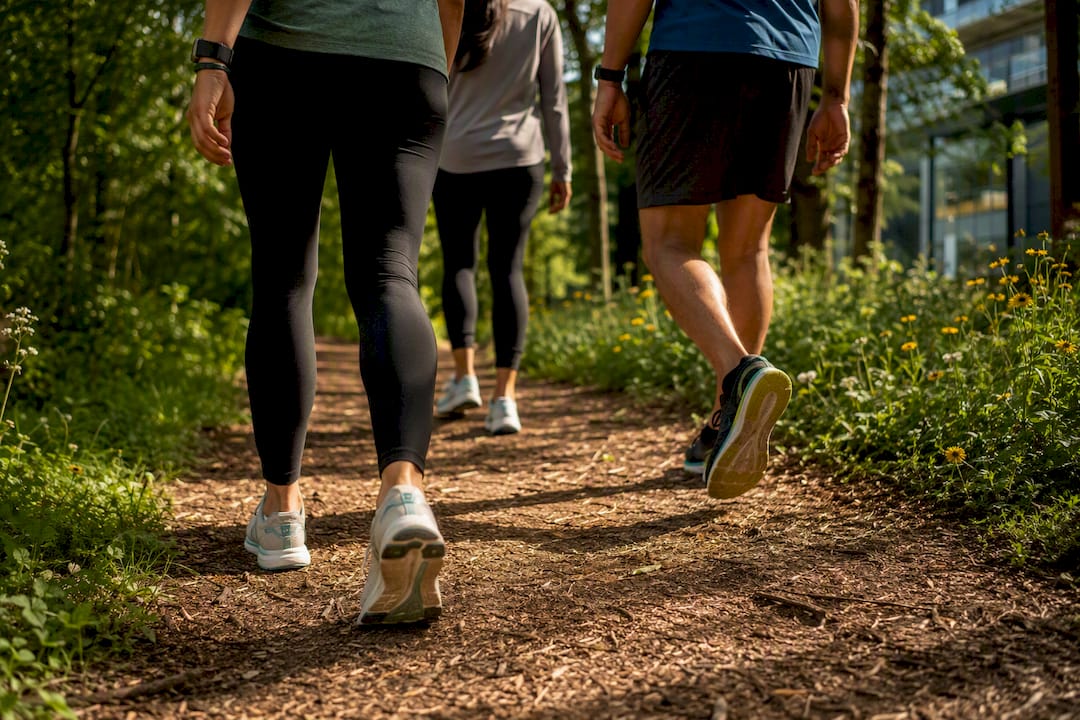
The mental-health case is just as strong. Outdoor walking, particularly through green or quiet spaces, produces stronger mood and cognitive benefits than walking a noisy urban block or a repetitive indoor hallway loop. That’s a practical detail worth building into route planning, not just a nice-to-have.
The benefits compound at the population level:
- Reduced sedentary time is linked to lower cardiovascular and metabolic risk over time
- Regular movement breaks correlate with lower reported stress and better afternoon energy
- Hybrid and remote employees get a rare dose of real-world contact, which eases the social isolation that video calls alone can’t fully address
How to Run an Effective Walking Meeting
Getting the format right takes more thought than just standing up and heading out the door. A poorly run walking meeting loses the agenda, loses the point, and probably loses ten minutes to someone tying their shoe. Here’s a checklist that keeps things tight:
- Cap the group at two or three people. Anything larger fragments the conversation and forces people to shout or fall behind, according to practitioner guidelines on walking meeting size.
- Keep it to 15 to 30 minutes. Long enough to cover one topic in depth, short enough to stay focused.
- Give advance notice. Never spring a walking meeting on someone who might need to swap shoes, grab a jacket, or flag a mobility concern.
- Set a single-topic agenda. Walking meetings aren’t built for multi-item status updates; save those for the conference room.
- Choose a pre-planned, moderate-pace route. A conversational pace matters more than distance covered, since very slow walking can actually dull the productivity effect.
- Capture notes efficiently. Voice-record key decisions on a phone, or block ten minutes immediately after the walk for a desk wrap-up.
- Build a rain plan. A short indoor loop or a rescheduled seated meeting keeps the habit alive when weather doesn’t cooperate.
Pro Tip: Send the invite like this: “Want to take this one outside? 20-minute loop around the block, back at your desk by 2:20.” Specificity removes the awkwardness of an unusual invite.
Safety, Accessibility, and Inclusivity in Outdoor Team Meetings
Walking meetings only work when nobody feels pressured to join. Always offer an opt-out for mobility limitations, chronic conditions, or personal preference, and never treat it as the default without asking first.
- Notify participants in advance so they can dress appropriately
- Choose routes with sidewalks, adequate lighting, and low traffic exposure
- Watch weather and heat conditions, and have an indoor alternative ready
- For hybrid teams, a phone-based walking call works as a reasonable substitute for a remote colleague
Pro Tip: Document accommodation requests the same way you would for any meeting format. Quiet, respectful handling builds trust faster than a blanket policy ever will.
Measuring the Impact of Walking Meetings
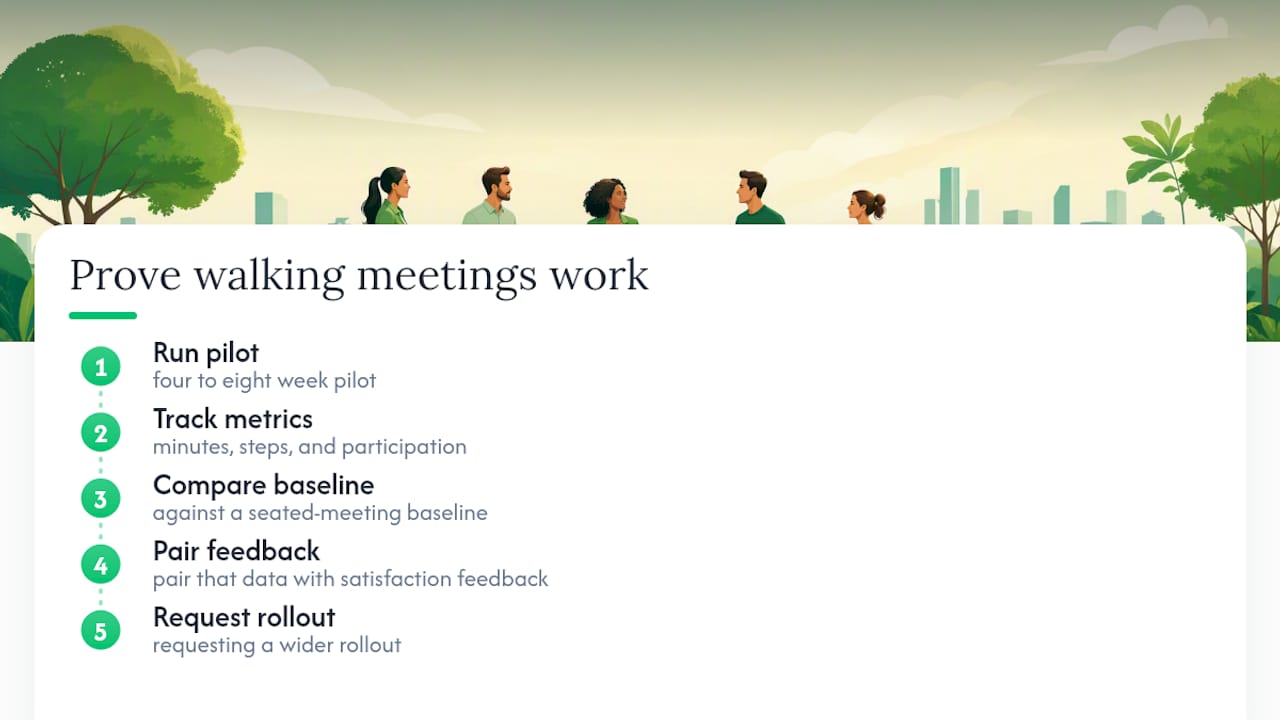
Numbers make the case to skeptical stakeholders far better than enthusiasm alone. Track a mix of hard and soft indicators over a four to eight week pilot window before rolling the format out further.
- Quantitative: total walking-meeting minutes, average steps or active minutes, participation rate, and meeting length versus your seated baseline
- Qualitative: participant satisfaction scores, perceived creativity or decision speed, and short written feedback after each pilot week
Compare pilot-period numbers against a two-week baseline of standard seated meetings, then present the shift in participation and self-reported energy alongside any measurable change in employee engagement. A short, honest pilot beats a long, undocumented rollout every time.
Operationalizing Walking Meetings Across Your Organization
Turning a good idea into a lasting habit takes structure, not just enthusiasm. Start small: pilot the format with a few willing managers, train them on the basics above, and write a one-page policy covering opt-ins, routing guidance, and accommodation handling.
- Build calendar templates that default to a 20-minute walking slot for one-on-ones
- Maintain a short list of pre-approved, safe routes near your office
- Fold participation data into existing employee wellness reporting rather than tracking it separately
- Keep personal data collection minimal. Track participation, not granular location history, and store accommodation notes with the same care as any HR record
Pro Tip: If your company already runs step challenges or activity tracking through a platform like Charity Miles, walking meetings slot in naturally. The minutes and miles count toward the same engagement and CSR reporting your team already reviews.
A note from a manager who made the switch
I stopped scheduling status updates in conference rooms two years ago. Now I text: “Got 20 minutes for a walk? Want your take on the Peterson account.” Nobody’s ever said no, and every one of those conversations has been sharper than its seated equivalent.
Turn Walking Meetings Into a Measurable CSR Win
A single manager swapping conference rooms for sidewalks is a nice habit. Getting that habit to scale across departments, with real reporting attached, is a different problem entirely. That’s where a structured program earns its keep instead of relying on individual managers remembering to send the right calendar invite.
Charitymiles’ Employee Empowerment Program centralizes exactly this kind of grassroots activity. Every walking meeting, lunchtime loop, or bike commute an employee logs converts into tracked miles and, if your company chooses to sponsor them, real charitable donations. HR and CSR leaders get a single dashboard showing participation and impact instead of scattered pilot spreadsheets, and employees get a tangible reason to keep choosing the walk over the conference room. Explore the Employee Empowerment Program and see how a pilot could look for your team, or review the corporate wellness blueprint for a step-by-step rollout plan.
Frequently Asked Questions
What are the main walking meeting benefits compared to sitting down?
Walking meetings boost creative output, ease candid conversation, and add activity minutes toward weekly health guidelines, benefits that seated meetings simply don’t offer.
How long should a walking meeting last?
Fifteen to thirty minutes works best. Long enough to cover one topic thoroughly, short enough to stay focused before energy or attention drifts.
Can walking meetings work for hybrid or remote teams?
Yes. A phone-based walking call gives remote employees the same movement benefit and helps reduce the isolation that video-only contact can create.
What if an employee can’t or doesn’t want to walk?
Always offer an opt-out with no explanation required. Accommodating mobility limitations or personal preference should be automatic, not a special request.
How do I show leadership that walking meetings are worth it?
Run a four to eight week pilot, track minutes, steps, and participation against a seated-meeting baseline, and pair that data with satisfaction feedback before requesting a wider rollout.
This article is general information, not a substitute for advice from a qualified doctor. Consult a qualified healthcare professional about your own circumstances before acting on anything here.
Sources
- Walking vs. Sitting: How walking boosts creative thinking (Stanford News)
- Physical activity guidelines and health benefits (PMC article)
- Study on walking, conversation dynamics, and social comfort (PubMed)