
A global team challenge is a company-wide, multinational employee activity that converts collective movement into measurable wellbeing and CSR outcomes. The single most effective approach: pick one clear objective (fundraising, wellbeing, or a blended model), pair it with a governance structure that hands employees real decision-making power, and launch a pilot within 12 weeks. Why does decision power matter so much? GlobeScan research finds that a large majority of employees believe they can help their organization improve societal impact, yet nearly half cite lack of decision-making power as the primary barrier to participating in CSR initiatives. That gap is not a messaging problem. It is a structural one.
Before anything else, convene four people this week:
- HR lead — owns program design and employee communications
- CSR lead — aligns the challenge to existing social-impact commitments
- Finance contact — approves budget and sponsorship structure
- Employee advisory group (3–5 volunteers across regions) — shapes design and builds grassroots buy-in
Key Takeaways
Running a successful global team challenge requires structural empowerment, not just better communications — give employees real decision power, localize by region, and measure both wellbeing and CSR outcomes from day one.
| Point | Details |
|---|---|
| Start with decision rights | Give an employee advisory group real authority over charity selection and challenge format before launch. |
| Fix structure before messaging | GlobeScan finds 47% of employees cite lack of decision-making power as the primary participation barrier. |
| Blended models widen participation | Combining fundraising and wellbeing objectives lets employees engage through whichever motivator resonates locally. |
| Localize every region | Appoint regional leads, offer local charity options, and translate core materials to lift engagement across cultures. |
| Measure three KPI categories | Track engagement (participation rate), CSR (donation totals), and wellbeing (self-reported health) every challenge. |
| Charitymiles for global rollouts | The Employee Empowerment Program covers global tracking, employee-directed giving, and enterprise reporting at no cost to employees. |
Table of Contents
- What does a global team challenge launch look like in 8–12 weeks?
- How do you choose the right challenge design and goals?
- What structural barriers actually block employee participation?
- How do you adapt one global challenge across cultures and regions?
- Which platform features are non-negotiable before you sign a vendor?
- What does a realistic timeline and budget look like?
- How do you measure success and report impact?
- What does the pilot-to-scale playbook look like in practice?
- What risks should you plan for before launch?
- What do real outcomes look like? Three case studies
- Why empowerment beats broadcast messaging every time
- Charitymiles turns movement into measurable CSR impact
- Sources
What does a global team challenge launch look like in 8–12 weeks?
A tight timeline is your best friend here. Ambiguity kills momentum, and a 12-week pilot window is short enough to maintain urgency and long enough to collect meaningful data.
- Weeks 1–2: Approval and budget. Secure executive sponsorship and a defined budget envelope. Assign a program owner with sign-off authority.
- Weeks 2–3: Form the employee advisory group. Recruit 3–5 volunteers from different regions and functions. Give them a real mandate: they co-design the challenge format, not just review it.
- Weeks 3–4: Platform selection. Run a vendor checklist (see Section 6). Confirm global activity tracking, multi-currency donation handling, privacy compliance, and reporting before signing anything.
- Weeks 4–5: Pilot region selection. Choose 2–3 regions that represent your workforce diversity. Prioritize regions with an engaged local HR contact who can serve as a regional lead.
- Weeks 5–7: Communications plan. Build a launch email, a manager briefing deck, and a mid-challenge nudge sequence. Translate core materials into local languages.
- Weeks 7–12: Baseline, launch, and measure. Collect pre-challenge wellbeing and engagement baselines. Launch the pilot. Track participation rate and active-user rate weekly.
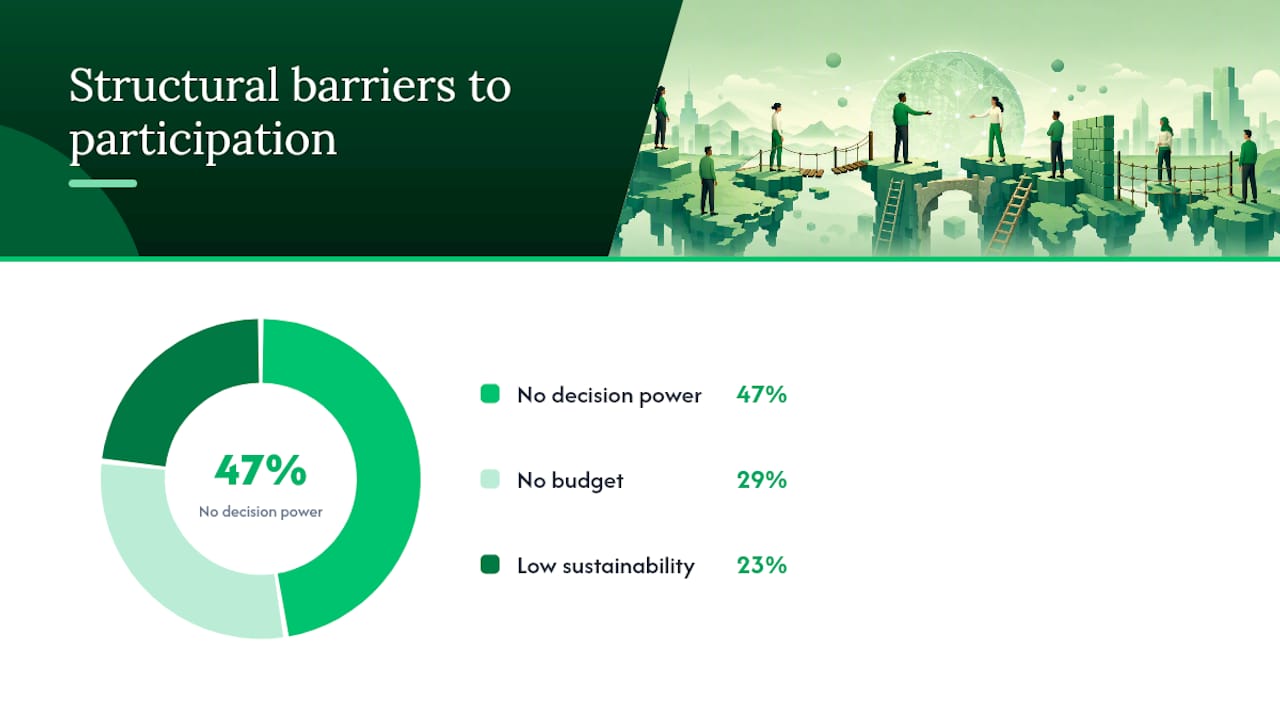
Statistic to anchor your business case: GlobeScan also identifies lack of budget (29%) and company not prioritizing sustainability (23%) as structural barriers alongside decision-power gaps — meaning your business case needs to address all three.
At week 12, success looks like: pilot launched on schedule, baseline metrics collected, and at least one regional lead ready to scale.
How do you choose the right challenge design and goals?
The design decision shapes everything downstream — your KPIs, your communications, and how employees experience the program.
Collective vs. individual goal models
A collective-target model sets one company-wide cumulative goal (for example, 1 million kilometers as a team). It builds shared identity and works well for fundraising narratives. The risk: high performers carry the load, and less active employees disengage early. An individual or team-based model sets personalized targets, which widens participation across fitness levels and geographies. The tradeoff is a more complex reporting structure.
Fundraising, wellbeing, or blended?
- Fundraising-only: KPIs are donation totals and funds delivered to charity partners. Strong for CSR reporting and external stakeholder stories.
- Wellbeing-only: KPIs are participation rate, active-user rate, and self-reported health scores. Strong for HR and benefits reporting.
- Blended: Combines both. Research on corporate fitness programs shows hybrid models widen participation because employees can engage through whichever motivator resonates locally.
Pro Tip: Start blended. You can always narrow the focus in year two once you know which metric your leadership team cares most about.
| Design Type | Primary KPIs | Best For |
|---|---|---|
| Collective fundraising | Donation totals, km logged | CSR reporting, external narrative |
| Individual wellbeing | Participation rate, self-reported health | HR, benefits, retention |
| Blended | All of the above | First-time global rollouts |
CSR activities for teams can help you pressure-test design choices before the advisory group meeting.
What structural barriers actually block employee participation?
Low participation is almost always misdiagnosed as a communications problem. The real blockers are organizational. GlobeScan’s finding is direct: 82% of employees want to contribute, but 47% say they lack the decision-making power to act.
Three fixes that move the needle:
- Employee advisory groups with real authority. Not a focus group. Give them a defined budget line and the power to choose the charity, the challenge format, and the local activation approach.
- Regional micro-budgets. Allocate a small, dedicated budget per region for local activation (printed materials, a regional kick-off event, small prizes). This signals that the program is real, not a head-office broadcast.
- Explicit leadership sponsorship. A senior leader who publicly logs miles and shares their progress removes the implicit permission barrier for employees who wonder whether participation is “allowed” during work hours.
Key finding: Beyond decision power, GlobeScan identifies lack of budget (29%) and company not prioritizing sustainability (23%) as the next two structural barriers. Solving all three simultaneously is what separates programs that scale from those that plateau.
Pro Tip: When redistributing decision rights, be explicit in writing. A one-page “challenge charter” that names the advisory group’s authority — including which decisions are theirs alone — prevents scope creep from managers who default to top-down control.
Employee advocacy resources offer additional frameworks for formalizing employee decision rights within CSR programs.
How do you adapt one global challenge across cultures and regions?
Academic research confirms that cultural diversity mediates the positive effects of CSR on employee wellbeing and engagement — but only when programs are adapted to local values. A single global template, pushed uniformly, underperforms.
Practical localization rules:
- Let each region nominate at least one local charity option alongside any global cause.
- Use image-heavy, language-light communications for global announcements; translate detailed instructions into local languages.
- Design activities that include all fitness levels — walking counts as much as running.
- Schedule challenge kick-offs and live events at times that respect local working hours.
- Appoint a regional lead in each pilot location who owns local communications and feedback collection.
Pro Tip: Before full rollout, run a 2-week cultural-fit test in one region. Ask the regional lead to share the draft communications with 5 colleagues and collect informal reactions. This catches tone and translation issues before they reach 10,000 inboxes.
Which platform features are non-negotiable before you sign a vendor?
Must-have features:
- Global activity tracking via GPS and pedometer (iOS and Android)
- Multi-currency donation handling and local charity selection
- Privacy and data compliance (GDPR, regional equivalents)
- Group and team configuration with region-level filters
- Robust reporting: participation rate, active users, distance, and donation totals
- SSO or API integration with existing HR systems
Nice-to-have features:
- Gamification and leaderboards with regional segmentation
- Integration with HRIS or employee benefits platforms
- Manager dashboards for team-level visibility
Charitymiles’s Employee Empowerment Program covers every must-have on this list: GPS and pedometer tracking, employee-directed charity selection, configurable company sponsorships, and enterprise reporting — with no cost to individual employees.
Enterprise employee experience solutions can help you map platform features to your existing HR tech stack.
What does a realistic timeline and budget look like?
Typical milestones
- Weeks 1–12: Pilot (2–3 regions, defined scope, baseline metrics)
- Months 3–6: Scale phase (remaining regions, regional coordinators, vendor SLA review)
- Month 6+: Sustain (annual cadence, post-challenge learning loop)
Common cost models
- Per-user subscription: Predictable cost, scales with headcount.
- Company-matched donation cap: Company sets a maximum sponsorship amount; employees generate donations up to that cap through movement.
- Sponsor-funded donation ladders: Milestone-based giving (for example, EUR 10,000 unlocked at 500,000 km logged).
| Budget Line | Pilot Phase | Scale Phase |
|---|---|---|
| Platform license | Per-user fee or flat pilot rate | Per-user subscription |
| Regional activation | Small per-region allocation | Regional coordinator budget |
| Communications | Internal design time | Translated toolkit production |
| Prizes and recognition | Modest per-region budget | Global recognition program |
How do you measure success and report impact?
KPI categories
- Engagement: Participation rate (% of eligible employees who logged at least one activity), active-user rate (weekly active participants)
- Wellbeing: Pre/post self-reported health and energy scores
- CSR: Donation totals, funds delivered to charity partners, number of charities supported
- Business: Retention lift (where HR data allows), recruitment mentions in candidate surveys
Reporting cadence
- Weekly ops dashboard for the program team (participation rate, active users, technical issues)
- Monthly leadership summary (aggregate KPIs, regional highlights, budget vs. actuals)
- Post-challenge impact story for external stakeholders (total distance, total donations, employee quotes, charity outcomes)
Weave individual stories into aggregate data. A number like EUR 700,000 raised lands harder when paired with a regional team’s specific story of choosing their local charity. CSR and employee engagement resources offer frameworks for building that narrative.
What does the pilot-to-scale playbook look like in practice?
Pilot phase
- Recruit pilot sites and confirm a regional lead at each.
- Set a 4–8 week challenge window with a defined start and end date.
- Run a mid-challenge check-in (week 3 or 4) to catch technical and cultural issues early.
- Collect post-pilot feedback via a short survey (5 questions maximum).
Scale phase
- Appoint regional coordinators with a defined role description and a direct line to the program owner.
- Establish vendor SLA expectations in writing: uptime, support response time, reporting delivery.
- Run a global kick-off event (virtual) with leadership participation to signal organizational commitment.
Sustain phase
- Set an annual challenge cadence so employees anticipate it.
- Run a post-challenge learning loop: advisory group debrief, regional lead debrief, and a written lessons-learned document.
- Recognize top contributors publicly and share the impact story within 30 days of the challenge closing.
Pro Tip: The single biggest sustain failure is silence after the challenge ends. Schedule the impact story publication date before the challenge launches — it forces the reporting process and gives employees something to look forward to.
Improving employee engagement in CSR initiatives covers communication templates and sustain-phase tactics in more detail.
What risks should you plan for before launch?
| Risk | Mitigation | Owner |
|---|---|---|
| Tech tracking failures | Test app on all device types in pilot regions before launch | Program owner + vendor |
| Cultural misalignment | Regional lead review of all communications; local charity options | Regional leads |
| Low local uptake | Manager briefing and explicit leadership endorsement in each region | HR lead |
| Improper charity vetting | Require vendor to confirm charity eligibility; maintain an approved list | CSR lead |
| Data privacy concerns | Confirm GDPR and regional compliance before vendor sign-off | Legal/compliance |
Escalation checklist if a risk materializes:
- Document the issue and notify the program owner within 24 hours.
- Assess whether the pilot should pause or continue with a workaround.
- Communicate transparently to participants — silence erodes trust faster than a delay.
What do real outcomes look like? Three case studies
voestalpine cares run
voestalpine’s global cares run logged more than 1.1 million kilometers across employees in under three months and converted that movement into EUR 700,000 in donations for aid projects. The collective-target model created a shared narrative that sustained participation across the full challenge window.
KAEFER Venuslauf
KAEFER’s Venuslauf reached approximately 5,000 participants across 27 countries and recorded 55,731 kilometers. The program’s inclusivity — any movement, any pace — is what drove participation across such a wide geographic and demographic spread.
HARMAN and Charitymiles
Since launching its Charitymiles team in 2021, HARMAN experienced a significant increase in employee participation, with many employees generating substantial charitable contributions.
The HARMAN result illustrates what happens when a platform removes friction: no cost to employees, any movement counts, and the company controls the sponsorship structure. The Employee Empowerment Program page details the full outcome.
Why empowerment beats broadcast messaging every time
The conventional wisdom in corporate CSR is that participation is a communications problem. Send a better email. Add a countdown timer. Hire an internal influencer. These tactics are not wrong, but they treat a structural problem as a surface one.
The GlobeScan data is unambiguous: employees want to participate. The barrier is organizational design, not awareness. Programs that give employees a real voice — in charity selection, in challenge format, in how their miles translate to impact — consistently outperform top-down mandates. It came from a model where employees chose their cause and saw their movement generate a real, trackable donation.
The other thing most guides understate: a global team challenge should be treated as an ongoing program, not a one-off event. A single annual challenge builds a moment. A sustained program builds culture.
Charitymiles turns movement into measurable CSR impact
Running a corporate step challenge across a multinational workforce means solving three problems at once: tracking activity across devices and geographies, connecting movement to real charitable donations, and giving employees a choice in where their impact goes. Charitymiles’s Employee Empowerment Program handles all three without adding cost for individual employees.
Companies set their own sponsorship rate and cap, choose whether donations go to a company-selected cause or employee-chosen charities, and get enterprise reporting that maps directly to CSR and HR KPIs. If you are ready to move from planning to pilot, explore the Employee Empowerment Program or contact the Charitymiles team to scope a pilot for your organization.
Sources
The sources below underpin this guide and are the ones most useful to cite in an internal business case.
- The Biggest Barrier to Employee Participation Is a Lack of Decision-making Power
- voestalpine cares run: employees raise EUR 700,000 for aid projects for the third time – voestalpine
- Venuslauf 2025 story – KAEFER