
A corporate charity challenge is a structured, team-based program that combines employee fundraising, physical activity or skills-based competition, and measurable CSR impact, typically run over 4–12 weeks. The recommended approach: choose an activity-based platform that handles registration, tracking, fundraising pages, and reporting, then run a short, well-supported campaign with an executive sponsor and a clear fundraising goal.
Who to involve: HR leads the logistics, CSR owns the charity partnership and reporting, and an executive sponsor provides visibility and momentum.
Immediate next step: Request a demo or pilot from your chosen platform before committing to a full rollout.
Top benefits: Higher employee engagement, measurable charitable giving, and a stronger employer brand.
Inclusivity is the single most important design decision you will make. Choose a format where walking, running, cycling, and virtual participation all count, so every employee can join regardless of fitness level or location.
Pro Tip: Set your charity selection before you announce the challenge. Employees engage more deeply when the cause is named and personal, not a placeholder.
Key Takeaways
A corporate charity challenge delivers the strongest outcomes when it combines an inclusive activity format, a clear fundraising goal, and a platform that handles tracking and reporting from day one.
| Point | Details |
|---|---|
| Choose an inclusive format | Mile-based or step challenges let every employee participate, regardless of fitness level. |
| Plan for 4–12 weeks | A 12-week timeline covers procurement, setup, launch, and a mid-campaign engagement boost. |
| Track the right KPIs | Measure participation rate, total dollars raised, average donation, and miles logged for CSR reporting. |
| Build mid-campaign momentum | Schedule a mini-challenge or executive shout-out at the two-thirds mark to prevent participation drop-off. |
| Charitymiles for scalable impact | The Employee Empowerment Program gives companies private teams, configurable sponsorships, and CSR-ready reporting. |
Table of Contents
- What makes a corporate charity challenge worth running?
- What formats work best for your team?
- What should a good program include?
- How do you design and launch a challenge from scratch?
- How does fundraising actually work, and what should you measure?
- What does a corporate charity challenge typically cost?
- What do real results look like?
- How do you get started with Charitymiles?
- Why activity-based challenges produce better outcomes
- What the data tells us that most programs miss
- Charitymiles turns everyday movement into measurable CSR impact
- Sources
What makes a corporate charity challenge worth running?
The business case for a workplace charity initiative is stronger than most HR teams realize. Done well, these programs move three metrics simultaneously: employee engagement, wellbeing, and external CSR impact.
On the engagement side, Gallup research shows companies with highly engaged employees are 21% more profitable. Charity challenges build that engagement by giving employees a shared goal, visible progress, and a reason to care about showing up. Cross-team competition creates camaraderie that a quarterly all-hands meeting simply cannot replicate.
The CSR outcomes are equally concrete. When employees personally generate donations for causes they care about, your company’s social impact becomes visible and personal, not just a line in an annual report. That visibility matters for recruitment: candidates increasingly evaluate employers on their values, and a well-run corporate social responsibility program is one of the clearest signals you can send.
Here is what the data looks like in practice. The Bay Street Games raised $520,070 against a $450,000 goal, with 300+ participants from 30+ firms in a single event. That is not an outlier; it reflects what happens when executive buy-in, easy registration, and a compelling cause align.
Pro Tip: Tie your charity selection to your company’s ESG pillars. A health-tech company supporting a children’s hospital, or a logistics firm backing environmental causes, makes the connection feel authentic and strengthens your CSR reporting narrative.
Key HR and CSR outcomes to expect from a well-run program:
- Participation rates that exceed typical wellness program benchmarks
- Improved cross-departmental collaboration through team competition
- Measurable donation totals and miles logged for CSR reporting
- Stronger employer brand visibility, especially on social media during the campaign
- Reduced burnout risk when physical activity is woven into the program design
What formats work best for your team?
The right format depends on your workforce geography, fitness range, and fundraising ambition. There is no single best structure, but there are clear patterns for what works in which context.
Step and mile-based app challenges are the most inclusive option. Any employee can participate by walking to lunch, cycling to work, or running on weekends. Platforms like Charitymiles track movement via GPS and convert miles into charitable donations, making the link between personal effort and community impact immediate and visible.
Field-day Corporate Cup events work well for single-location teams that want high energy and in-person camaraderie. The Lurie Children’s Corporate Cup is a strong example: teams of 8–20 participate in a structured field-day format where registration fees and fundraising totals directly support hospital projects.
Multi-week Olympic-style competitions sustain engagement over a longer arc. The Richardson Corporate Challenge runs 10 weeks with up to 25 athletic and non-athletic events, with fundraising directed to Special Olympics Texas. The non-athletic events matter: they keep employees who do not identify as athletes engaged throughout.
Short-duration fundraising events like the Playworks Corporate Kickball Tournament offer a lower-lift option with strong sponsor visibility. An afternoon event can still generate meaningful donations and significant brand recognition for participating companies.
Hybrid formats combine local meetups with virtual tracking, which is especially effective for distributed workforces. Foster Love’s team-building programs scale from 5 to 10,000 participants and include virtual options, demonstrating that hybrid delivery does not require sacrificing impact.
| Format | Best for | Scalability | Inclusivity |
|---|---|---|---|
| Mile-based app challenge | Distributed or hybrid teams | High (any size) | Very high (all fitness levels) |
| Field-day Corporate Cup | Single-location, high-energy culture | Medium (8–20/team) | Moderate (physical events) |
| Multi-week Olympic-style | Engaged, competitive cultures | Medium (city/region) | High (non-athletic events included) |
| Short-duration fundraiser | Quick wins, sponsor visibility | Low to medium | Moderate |
| Hybrid virtual + in-person | Remote-first or global teams | Very high | Very high |
Pro Tip: For distributed teams, pair a virtual mile-tracking challenge with one in-person kickoff event per office. The shared launch moment builds momentum that sustains virtual participation for weeks afterward.
What should a good program include?
Whether you are evaluating a vendor or building an internal program, the deliverables checklist is the same. A well-structured charity team building program should provide:
- Branded registration pages that reflect your company identity and make sign-up frictionless
- Participant dashboards showing individual miles, donations generated, and team standing
- Team leaderboards to drive friendly competition and sustained engagement
- Fundraising pages where employees can share their personal fundraising link with friends and family
- Admin reporting with participation rates, total miles, total donations, and per-team breakdowns
- Charity integrations that allow employees to select from a vetted list or direct funds to a company-chosen cause
- Employer matching or sponsorship tools so the company can amplify employee-generated donations
- Donation receipts for donors and tax documentation for the company
Building Teams has run 2,000+ events since 2003 and provides participation numbers and donation totals specifically formatted for CSR reporting, which reduces the internal workload for HR teams significantly. That kind of turnkey reporting is what separates a well-supported vendor from a DIY spreadsheet approach.
The platform UX matters more than most buyers anticipate. If employees need to jump through hoops to register or log activity, participation drops fast. Look for a dashboard that shows real-time team progress, sends automated milestone notifications, and requires no app training to use.
How do you design and launch a challenge from scratch?
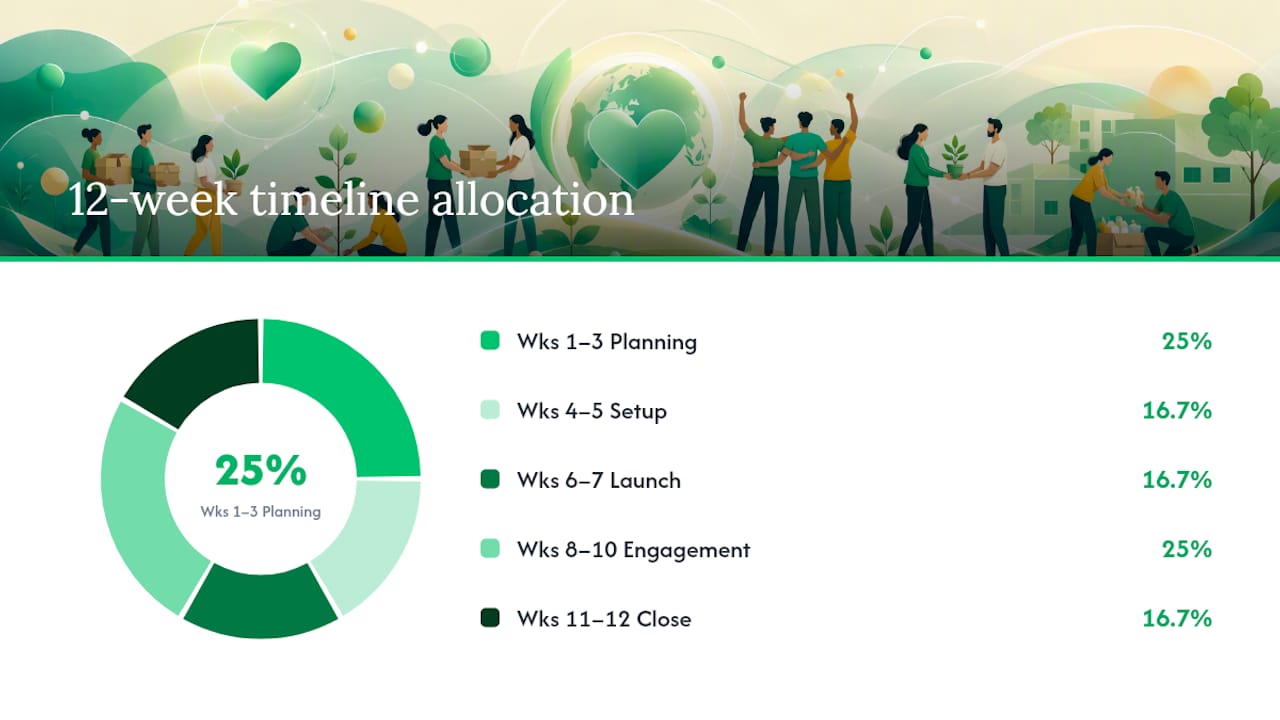
A 12-week timeline is the sweet spot for most corporate fundraising events. It gives you enough runway for planning and communications without losing urgency.
Weeks 1–3: Planning and approvals
- Define your primary objective: Is this primarily a fundraising event, an engagement program, or a wellness initiative? The answer shapes every decision that follows.
- Set measurable KPIs: total dollars raised, participation rate, average donation per employee, and miles logged.
- Select your format and platform based on team size, geography, and budget.
- Secure an executive sponsor who will visibly participate and communicate the program.
- Confirm legal and payroll requirements for employer matching or direct corporate donations.
- Select your charity partner and confirm their ability to receive funds and provide impact reporting.
Weeks 4–5: Setup and registration
- Build your branded registration page and test the donation flow end to end.
- Configure team structures, sponsorship rates, and fundraising targets.
- Prepare your internal communications plan: launch email, manager talking points, and a FAQ document.
Weeks 6–7: Launch
- Send the launch communication from the executive sponsor, not just HR.
- Open registration and set a clear deadline.
- Post the team leaderboard where employees can see it daily (Slack, intranet, or a shared screen in common areas).
Weeks 8–10: Mid-campaign engagement
- Run a mini-challenge or bonus week to re-engage employees who have gone quiet.
- Share milestone updates: “We’ve hit 10,000 miles and raised $8,000 — here’s what that means for [charity].”
- Recognize top teams and individuals publicly.
Weeks 11–12: Close and report
- Send a final fundraising push in the last 72 hours.
- Close the campaign and compile your reporting package: participation rate, total miles, total dollars, and per-team breakdown.
- Share results company-wide and thank participants by name where possible.
Pro Tip: Schedule your mid-campaign boost for Week 8, not Week 10. By Week 10, the energy is already fading. A well-timed mini-challenge at the two-thirds mark is what keeps the final push from feeling flat.
How does fundraising actually work, and what should you measure?
Donation flows in a corporate charity challenge typically follow one of four models, and most successful programs combine at least two.
Per-mile corporate sponsorship: The company pledges a fixed dollar amount per mile each employee logs. This model is highly motivating because employees can see exactly how their movement translates to dollars. Charitymiles’ Employee Empowerment Program lets companies set their own rate per mile and total sponsorship cap, giving full budget control.
Employee-led fundraising pages: Each participant has a personal fundraising page they share with their network. This model generates the highest per-employee totals when employees are motivated to ask for support.
Corporate-directed donations: The company makes a lump-sum donation to a chosen charity, tied to aggregate program participation. Simple to administer, but lower in personal engagement.
Hybrid model: Combine per-mile sponsorship with employee fundraising pages. The company contribution anchors the program, and employee fundraising adds upside.
| Sponsorship model | Pros | Cons | Ideal use case |
|---|---|---|---|
| Per-mile corporate sponsorship | Predictable budget, high motivation | Requires platform tracking | App-based or step challenges |
| Employee fundraising pages | High ceiling, personal engagement | Requires employee effort to share | Competitive, socially active teams |
| Corporate-directed donation | Simple, low admin | Lower personal engagement | First-time programs, tight timelines |
| Hybrid | Maximizes total raised | More complex to administer | Mature programs, high-engagement cultures |
Key metrics to track and report:
- Total dollars raised and percentage of goal
- Participation rate (employees enrolled vs. total eligible)
- Average donation per participant
- Total miles or steps logged
- Number of unique donors (internal and external)
- Engagement rate over the campaign arc (week-by-week activity)
A brief note on transparency: donors who give through employee fundraising pages should receive automated tax receipts. Confirm your platform handles this before launch, because chasing receipts post-campaign is an avoidable headache.
What does a corporate charity challenge typically cost?
Pricing varies widely depending on format, platform, and scale, but the common structures are predictable.
Per-participant subscription: A monthly or annual fee per enrolled employee. Works well for ongoing programs and step challenges. Costs scale with headcount, which makes budgeting straightforward.
Per-campaign flat fee: A single fee for a defined campaign window, regardless of participant count. Better for one-off events or annual challenges with a fixed scope.
Sponsorship-funded model: The company’s per-mile or per-event sponsorship commitment covers platform costs. Common in app-based programs where the sponsorship pool funds both the charity and the platform.
Custom enterprise licensing: For large organizations with specific integration, branding, or reporting requirements. Pricing is negotiated based on scope.
Budget scenarios to consider:
- Small team pilot (25–50 employees): A per-participant subscription or flat-fee campaign is usually the most cost-effective entry point. Focus on a single format and one charity partner.
- Mid-size rollout (100–500 employees): Budget for platform fees, communications design, and a modest employer matching contribution. A hybrid sponsorship model works well at this scale.
- Enterprise license (500+ employees): Custom pricing, dedicated support, and integration with HRIS or payroll systems for matching. Plan for a longer procurement cycle.
Recommended procurement-to-launch timeline:
- Weeks 1–2: Vendor evaluation and RFP
- Weeks 3–4: Contract and legal review
- Weeks 5–6: Platform setup and internal approvals
- Weeks 7–8: Communications build and registration
- Weeks 9–12: Active campaign
Custom integrations, payroll matching setup, and multi-region legal reviews are the most common reasons timelines extend beyond 12 weeks. Build in buffer if any of those apply to your organization.
What do real results look like?
The strongest proof that charity challenges work comes from programs with clear metrics and replicable conditions.
Bay Street Games: The Capitalize for Kids Bay Street Games raised $520,070 against a $450,000 goal, with 300+ participants from 30+ firms. The event exceeded its target by more than $70,000. What drove that outcome: a competitive format, strong firm-level participation incentives, and a cause with clear community relevance.
HARMAN and Charitymiles: Since launching its Charitymiles team program in 2021, HARMAN saw an 11x increase in employee participation, with 1,200+ employees generating over $120,000 for charity. The program’s success came from its inclusivity: any movement counted, so participation was not limited to athletes or fitness enthusiasts.
Lurie Children’s Corporate Cup: Teams of 8–20 employees compete in a field-day format where registration fees and fundraising directly support hospital projects. The structured team size keeps competition personal and the fundraising goal tangible.
What these programs share: executive visibility, frictionless registration, and a format that does not exclude employees based on fitness level. Remove any one of those three, and participation drops.
The programs that underperform share a different pattern: low executive visibility, complicated sign-up flows, and formats that feel designed for athletes rather than the whole workforce.
How do you get started with Charitymiles?
Getting a program off the ground with Charitymiles is designed to be fast and low-friction for HR and CSR teams.
Pilot options available:
- Team pilot (one department or business unit, 25–100 employees)
- Department-wide rollout (100–500 employees)
- Company-wide program (500+ employees, custom enterprise configuration)
What a demo includes:
- A live walkthrough of the participant dashboard and team leaderboard
- Examples of admin reporting outputs (participation, miles, donations, engagement rate)
- A review of sponsorship configuration options (rate per mile, cap, charity selection)
- Pricing options for your team size and program scope
- A sample 8–12 week campaign timeline
Contact and response:
Reach out via Charitymiles to request a demo or pilot. Enterprise inquiries typically receive a response within one business day.
Pro Tip: Start with a single department pilot before a company-wide rollout. A 6–8 week pilot gives you real participation data, a tested communications template, and a compelling internal case study to present to leadership.
Why activity-based challenges produce better outcomes
The behavioral mechanics behind activity-based charity challenges explain why they outperform one-off donation drives. Three forces work together: habit formation, social competition, and visible impact.
Habit formation: When employees log miles during their daily commute or lunch walk, the charitable act anchors to an existing routine. That anchoring is what drives sustained participation over weeks, not just a spike at launch.
Social competition: Team leaderboards activate intrinsic motivation in a way that individual donation asks do not. Employees who would never donate $50 unprompted will log an extra mile to keep their team in second place.
Visible impact: Seeing a real-time dollar total climb as miles accumulate makes the connection between personal effort and community benefit concrete. That visibility is what turns a wellness program into a CSR program employees actually care about.
Charitymiles has been building on these mechanics since 2012, and the Employee Empowerment Program reflects that experience directly. Companies control sponsorship terms, choose their charity partners, and get reporting that maps directly to CSR disclosure requirements.
| Program proof point | Detail |
|---|---|
| HARMAN participation lift | 11x increase in employee participation since 2021 |
| HARMAN dollars raised | 1,200+ employees generated over $120,000 for charity |
| Platform tenure | Active since 2012 |
| Sponsorship control | Companies set rate per mile, total cap, and charity direction |
Pro Tip: Combine a wellness incentive (a small prize for top milers) with the charitable goal. Extrinsic rewards like recognition or a gift card activate participation early; the intrinsic reward of visible charitable impact sustains it through the final weeks.
What the data tells us that most programs miss
Most corporate charity challenge programs focus on the launch and neglect the middle. The first week generates a spike in registrations. The last week generates a fundraising push. Everything in between is where programs quietly lose 30–40% of their participants.
The fix is not more emails. It is structural. Mid-campaign engagement needs to be built into the program design before launch, not improvised when participation dips. A scheduled mini-challenge in Week 8, a team shout-out from the executive sponsor in Week 9, and a real-time leaderboard visible in Slack or on a shared screen are not nice-to-haves. They are the architecture of sustained participation.
The second thing most programs miss is the reporting package. HR teams spend weeks running a challenge and then produce a two-line summary for the CSR report. A platform that delivers participation rates, total miles, total dollars, and per-team breakdowns in a single exportable report is not a luxury. It is what makes the program repeatable and defensible to leadership.
The programs that earn a second year of budget are the ones that can show, clearly and quickly, what the first year produced.
Charitymiles turns everyday movement into measurable CSR impact
If you are looking for a corporate wellness program that combines team-building, fundraising, and CSR reporting in one platform, Charitymiles’ Employee Empowerment Program is built for exactly that.
Unlike one-off event formats that require venue logistics and fixed dates, Charitymiles runs as an ongoing or campaign-based program where employees walk, run, or bike and every mile generates a charitable donation. Companies set their own sponsorship rate, choose their charity partners, and get a reporting dashboard that maps directly to CSR disclosure requirements. The HARMAN case is the clearest proof point: 1,200+ employees, $120,000+ raised, and an 11x participation lift after switching to the platform.
Features included in the Employee Empowerment Program:
- Private team challenges with configurable sponsorship terms
- Real-time leaderboards and participant dashboards
- Admin reporting for participation, miles, and donation totals
- Employee-selected or company-directed charity giving
- No cost to individual participants
Ready to see how it works for your team? Request a demo and get a live walkthrough of the platform, reporting examples, and pricing options for your organization’s size.
Sources
The following sources informed this article and offer useful follow-up reading for HR, CSR, and employee engagement professionals:
- Home | Corporate Cup 2026 | Lurie Children’s
- 2026 Playworks PacNW Corporate Kickball Tournament – Pacific Northwest
- Richardson Corporate Challenge |
- Charity Team Building & Corporate Charity Events | Building Teams
- Team Building Hub | Foster Love
- Bay Street Games — Capitalize for Kids (donate page)