
The fastest way to replace MoveSpring depends on whether you need CSR-first engagement, enterprise reporting, or low-cost fitness challenges. For most HR and wellness teams evaluating MoveSpring alternatives in 2026, the shortlist breaks down cleanly into three categories, and Charitymiles leads the CSR-first track by a clear margin.
Here is the quick verdict by buyer priority:
- CSR-first engagement — Charitymiles converts everyday movement into charitable donations, ties personal wellness to company purpose, and drives sustained participation without requiring athletic performance. Best for companies where ESG reporting and employee meaning matter as much as step counts.
- Enterprise wellbeing suites — Platforms like Wellable, Woliba, Personify Health, and Virgin Pulse offer deep analytics, HRIS integrations, and broad health-journey content. Best when security attestations (SOC 2, SSO) and admin reporting are procurement requirements.
- Gamified challenge platforms — Tools like Vantage Fit, WellRight, and Big Team Challenge focus on competition mechanics and rewards catalogs. Best for seasonal campaigns or teams that respond well to leaderboards.
- Rewards-first wellness providers — Platforms that anchor engagement in points, gift cards, and lifestyle spending accounts. Best for when extrinsic motivation is the primary driver.
Software directories including G2 and SaaSHub list more than ten viable alternatives across these categories, confirming that the market has matured well beyond a single-vendor choice. Enterprise buyers should verify SOC 2 compliance and SSO support before committing to any platform. If you are ready to act now, a two-week pilot on the CSR-first track with Charitymiles is the lowest-friction starting point.
Pro Tip: Before requesting demos, write down your top three non-negotiables: CSR impact, integration depth, or cost per employee. That single exercise cuts your vendor list in half before the first sales call.
Table of Contents
- How do the top MoveSpring alternatives compare side by side?
- Which platform is right for your company’s wellness goals?
- What features actually drive engagement and CSR impact?
- How do you choose and pilot a MoveSpring replacement?
- How Charitymiles delivered measurable results at HARMAN
- Key Takeaways
- Why most wellness programs underdeliver (and what actually fixes it)
- Charitymiles turns every mile into measurable CSR impact
- Sources and further reading
How do the top MoveSpring alternatives compare side by side?
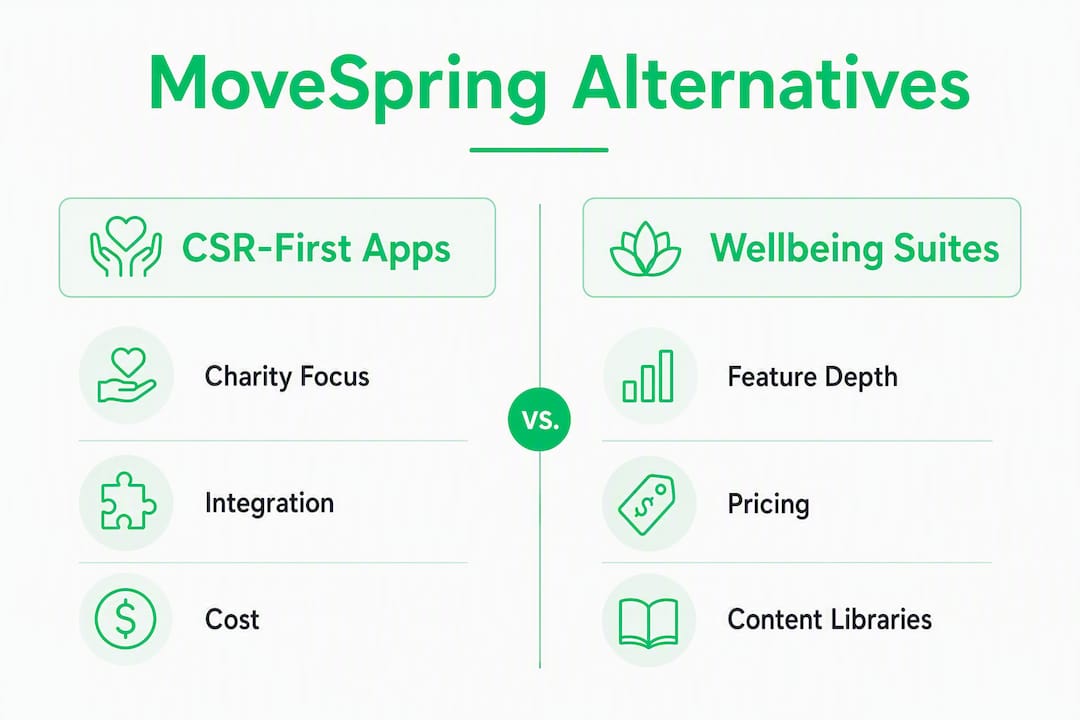
Pricing, integrations, and feature depth vary widely across platform categories, so a category-level view is more useful than a vendor-by-vendor grid at the shortlisting stage.
| Dimension | CSR-first movement apps | Enterprise wellbeing suites | Gamified challenge platforms | Low-cost step-challenge apps |
|---|---|---|---|---|
| Best for / primary use case | Purpose-driven engagement + CSR reporting | Holistic health journeys + deep analytics | Competitive team challenges + rewards | Seasonal campaigns, small teams |
| Core features | Movement tracking, private team challenges, configurable sponsorships | Health journeys, coaching, biometrics, challenges | Leaderboards, badges, points, team competitions | Step tracking, basic leaderboards |
| CSR & sponsorship support | Native: per-mile donations, charity selection, sponsorship caps | Limited or add-on only | Minimal | None typically |
| Rewards & incentives | Charitable donations as intrinsic reward; optional points | Points, gift cards, LSA reimbursements | Points, gift cards, merchandise catalogs | Basic points or gift cards |
| Reporting & admin | Participation, miles, donation totals, team dashboards | Biometric trends, program ROI, custom exports | Challenge leaderboards, participation rates | Basic participation reports |
| Integrations & SSO | SSO available; API and HRIS sync options | Broad HRIS connectors, SSO standard | SSO varies; limited HRIS | Minimal integrations |
| Pricing shape | Program/license fee; sponsorship cost is variable | Per-employee-per-month; annual contracts | Per-program or per-employee; tiered | Freemium or low monthly fee |
| Mobile & device support | iOS, Android, GPS + pedometer; wearable sync | iOS, Android; broad wearable support | iOS, Android; Fitbit, Garmin, Apple Watch | iOS, Android; basic tracker support |
| Security & compliance | SOC 2-aligned; US data residency | SOC 2 Type II, HIPAA options, ISO | Varies by vendor | Minimal attestations |
| Support & onboarding | Dedicated program support; enterprise onboarding | Dedicated CSM; implementation team | Self-serve to managed; varies | Self-serve primarily |
Pricing footnote: per-employee fees, per-program fees, and add-on charges for SSO or custom branding all appear across this market. Market commentary notes that single-challenge pricing on some platforms can run higher than sponsor-driven or subscription models, so always request a fully loaded quote. Negotiate on contract length, pilot scope, and included integrations before signing.
When CSR reporting ties directly to your company’s ESG goals, the CSR-first category is the only one where charitable impact is a native feature rather than an afterthought. If your procurement checklist is dominated by HRIS sync frequency, biometric data, and SOC 2 Type II documentation, an enterprise wellbeing suite will serve you better. Gamified platforms win when short-term engagement spikes matter more than year-round participation.
Pro Tip: Ask every vendor for a “fully loaded” price quote that includes SSO, custom branding, and dedicated program management. The base price rarely reflects what you will actually pay.
Which platform is right for your company’s wellness goals?
SoftwareWorld’s aggregated listings confirm that the best choice depends on company size and program goals. Here is how the leading platforms and categories stack up.

Charitymiles: the CSR-first employee empowerment platform
Charitymiles converts walking, running, and biking into charitable donations through GPS and pedometer tracking on iOS and Android. Corporate clients create private teams, run intra-company challenges, and configure sponsorships on their own terms: the rate per mile, the total cap, and whether donations flow to each employee’s chosen charity or a company-selected cause.
- Core features: Movement-for-good tracking, private team challenges, configurable corporate sponsorships, participation reporting, and donation dashboards.
- Best for: Companies where CSR, ESG reporting, and purpose-driven engagement are primary goals; HR teams that want a program inclusive of all fitness levels, not just competitive athletes.
- Pricing model: Program/license fee for the Employee Empowerment Program; the app itself is free for employees.
- Standout strength: Every mile generates a measurable, reportable charitable donation. That tangibility drives intrinsic motivation in a way that points and gift cards rarely sustain.
- Worth noting: Charitymiles is purpose-built for movement and CSR. Teams that need biometric screenings, coaching libraries, or mental-health content will want to pair it with a complementary platform.
Enterprise wellbeing suites (Wellable, Woliba, Personify Health, Virgin Pulse)
These platforms offer the broadest feature sets: health risk assessments, coaching, biometric integrations, mental-health content, and deep analytics dashboards. They typically sell on annual per-employee-per-month contracts and include dedicated customer success managers.
- Broad HRIS and SSO integrations are standard, making them easier to deploy at scale.
- SOC 2 Type II and HIPAA-aligned data handling are common, which matters for regulated industries.
- The tradeoff is cost and complexity. Implementation timelines can stretch to several months, and admin burden is higher.
- CSR features, where they exist, are usually add-ons rather than core functionality.
Typical pricing: annual contracts with per-employee-per-month fees; expect add-on charges for premium content libraries or biometric screening services.
Gamified challenge platforms (Vantage Fit, WellRight, Big Team Challenge)
These platforms lead with competition mechanics: team leaderboards, badges, points, and merchandise rewards. They work well for short-term engagement campaigns and companies with a competitive culture.
- Setup is generally faster than enterprise suites, and some offer self-serve challenge builders.
- Rewards catalogs (gift cards, merchandise, LSA reimbursements) provide strong extrinsic motivation.
- Participation tends to spike during challenges and drop between them, which limits year-round ROI.
- CSR integration is minimal or absent; charitable giving is not a native feature.
Typical pricing: per-program fees or tiered per-employee subscriptions; contract lengths vary from monthly to annual.
What to ask during vendor demos
Before you commit to a pilot, get clear answers on these points:
- Does SSO come standard, or is it a paid add-on?
- How frequently does the platform sync with your HRIS, and which systems are supported natively?
- Can admins export raw participation data via CSV or API?
- Which wearable trackers are supported (Apple Watch, Fitbit, Garmin, Samsung Health)?
- What security attestations does the vendor hold (SOC 2 Type II, HIPAA, ISO 27001)?
- Is a dedicated program manager included, or is support self-serve?
- What does a typical pilot look like, and what does it cost?
Pro Tip: Request a live admin demo, not just a sales deck. Watching an account manager pull a participation report in real time tells you more about usability than any feature checklist.
What features actually drive engagement and CSR impact?
Feature depth matters most when you are deciding what to test in a pilot. Here is how feature maturity maps to buyer scale.
| Feature area | Entry-level expectation | Mid-market expectation | Enterprise expectation |
|---|---|---|---|
| Challenge types | Step challenges, basic leaderboards | Team + individual challenges, custom goals | Configurable challenge types, multi-cohort management |
| Activity tracking | Manual entry or basic pedometer | GPS tracking, wearable sync | Multi-source tracking, data reconciliation |
| CSR & sponsorship | None or manual donation links | Configurable per-mile sponsorships | Native donation workflows, charity selection, reporting |
| Rewards & incentives | Points, basic gift cards | Points + LSA reimbursements, merchandise | Custom rewards catalogs, recognition programs |
| Reporting & analytics | Participation counts | Participation trends, challenge completion rates | Custom dashboards, HRIS-linked cohort analysis, export APIs |
| Integrations | Manual CSV upload | SSO, select HRIS connectors | Full HRIS sync, SSO standard, open API |
| Security & compliance | Basic data encryption | SOC 2 Type I | SOC 2 Type II, HIPAA, US data residency |
| Support & onboarding | Help center, email | Onboarding call, email support | Dedicated CSM, implementation team, SLA |
Challenge types and flexibility
The most engaging programs mix individual and team challenges, vary the activity type (steps, miles, active minutes), and run on a cadence that keeps participation fresh. Platforms that only support step-count leaderboards tend to exclude employees who cannot walk long distances, which quietly reduces participation among the people who need wellness support most.
CSR and sponsorship workflows
This is where Charitymiles separates from the field. Native per-mile donation tracking means every employee’s movement generates a reportable charitable outcome. Companies can set a sponsorship rate, cap total spend, and choose whether employees pick their own charity or contribute to a company-selected cause. That configurability turns a wellness program into a live CSR initiative with measurable impact.
Integrations: the checklist HR should validate
- SSO (SAML 2.0 or OAuth): Is it included, or does it cost extra?
- HRIS sync: Which platforms are supported (Workday, ADP, BambooHR, SAP SuccessFactors)? How often does it sync?
- Data export: Can admins pull CSV or API exports on demand?
- Wearable trackers: Apple Watch, Fitbit, Garmin, Samsung Health, Google Fit.
- Data residency: Where is employee data stored? Does it meet US requirements, and can you request a Data Processing Agreement?
- GDPR/CCPA: How does the platform handle employee consent and data deletion requests?
Poor SSO and HRIS integration is one of the most common causes of low adoption in enterprise rollouts. When employees have to create a separate login or manually sync their data, participation drops before the first challenge ends.
How do you choose and pilot a MoveSpring replacement?
A structured evaluation process saves weeks of back-and-forth and protects your budget. Here is a practical framework.
Step 1: Define your non-negotiables. Write down the three features or outcomes your program cannot succeed without. CSR reporting? HRIS sync? A specific wearable? This list eliminates most vendors before a single demo.
Step 2: Score your shortlist. Use a simple scorecard with five dimensions: engagement features, CSR alignment, integration depth, cost per employee, and admin load. Rate each vendor 1–5. The highest score rarely wins on every dimension, but the exercise surfaces trade-offs clearly.
Step 3: Run a structured pilot. A two-week quick test validates the mobile experience and basic participation mechanics. A 6–8 week pilot is long enough to measure week-on-week retention and test HRIS sync in a real environment.
Pilot KPIs to track:
- Activation rate: percentage of invited employees who complete registration.
- Weekly participation rate: percentage of active users who log at least one activity per week.
- Week-on-week retention: how participation changes from week 1 to week 6.
- CSR impact (if applicable): total miles logged, total donations generated.
Red flags to watch for during sales conversations:
- Pricing that changes significantly between the initial quote and the “fully loaded” quote.
- No published case studies or participation data from comparable companies.
- SSO and HRIS sync listed as “roadmap” features rather than available today.
- Reporting access that requires a vendor-side request rather than self-serve admin tools.
- No dedicated program manager included at your contract tier.
Typical pilot budget ranges: Costs vary by vendor, contract structure, and employee count. Always request a pilot-specific quote rather than extrapolating from published per-employee rates, since add-ons for SSO, custom branding, and program management materially affect the total.
Pro Tip: Build your pilot around a real company moment: a health awareness month, a charity campaign, or a team-building quarter. Pilots anchored to a calendar event generate higher activation rates than standalone technology tests.
How Charitymiles delivered measurable results at HARMAN
The most useful evidence for any platform evaluation is a real program with real numbers. Here is how Charitymiles performed at HARMAN, a global audio and connected-car technology company.
The challenge: HARMAN needed a way to increase employee participation in wellness and CSR initiatives across a large, distributed workforce. Participation in previous programs had been limited.
Implementation steps:
- Launched a private Charitymiles team for HARMAN employees in 2021.
- Configured corporate sponsorships so that employee miles generated donations to charity.
- Ran team challenges to build friendly competition and camaraderie.
- Communicated the program through internal channels, connecting movement to the company’s broader CSR mission.
Results:
HARMAN saw a significant increase in employee participation after launching its Charitymiles team in 2021, with over a thousand employees generating substantial donations for charity.
That outcome reflects what happens when wellness and purpose align. Employees did not participate because they had to. They participated because every mile they logged had a visible, reportable impact on causes they cared about.
How ROI was tracked: Participation rate, total active users, miles logged, and total donations generated. These metrics map directly to both wellness program KPIs and CSR reporting requirements, which makes the program easy to justify at the executive level.
Implementation checklist for new Charitymiles programs:
- Configure private team and set sponsorship rate and cap.
- Decide on charity selection model (employee choice vs. company-selected cause).
- Set challenge cadence (monthly, quarterly, or event-anchored).
- Plan internal communications: launch email, manager talking points, milestone updates.
- Schedule admin reporting cadence (weekly during pilot, monthly for ongoing programs).
For companies that want to see what this looks like for their specific workforce, the employee engagement solution page walks through program options and pilot availability.
Pro Tip: Pair your Charitymiles launch with a visible internal communications moment: a CEO message, a charity partner announcement, or a team challenge kickoff. Programs that launch with leadership visibility consistently outperform quiet rollouts.
Key Takeaways
For CSR-first companies, Charitymiles is the strongest MoveSpring alternative because it converts everyday employee movement into measurable charitable donations while driving year-round engagement without requiring athletic performance.
| Point | Details |
|---|---|
| Match platform to program goal | CSR-first buyers should prioritize native donation workflows; enterprise analytics buyers need HRIS sync and SOC 2. |
| Charitymiles leads the CSR track | HARMAN’s participation increase and donations illustrate what purpose-driven engagement delivers. |
| Pilot before you commit | A 6–8 week pilot tracking activation rate, weekly participation, and week-on-week retention gives you real data before a full contract. |
| Verify integrations early | SSO, HRIS sync, and data export capabilities should be confirmed in the demo stage, not after signing. |
| Admin load is a hidden cost | Platforms with dedicated program managers reduce HR staff time and improve pilot success rates significantly. |
Why most wellness programs underdeliver (and what actually fixes it)
Most corporate wellness programs fail quietly. Not because the technology is wrong, but because the program design treats all employees as athletes and all motivation as extrinsic. Points and gift cards work for the first few weeks. After that, participation drops to the employees who were already active.
The programs that sustain engagement year-round share one characteristic: they give employees a reason to move that is bigger than the reward. That is not a philosophical point. It is a behavioral one. Intrinsic motivation, the kind that comes from feeling that your actions matter, produces more durable behavior change than any leaderboard or merchandise catalog.
This is why the CSR-first model outperforms gamification-only platforms over a full program year. When an employee knows that their lunchtime walk generated a donation to a cause they chose, the activity carries meaning independent of any competitive ranking. That meaning is what brings them back the following week.
Equity matters here too. Step-count competitions quietly disadvantage employees with mobility limitations, demanding jobs, or caregiving responsibilities. A well-designed program counts any movement, sets team-based rather than individual targets, and avoids tying rewards to absolute performance. Pairing your wellness platform with thoughtful wellness incentives design closes that equity gap before it becomes a participation problem.
One practical tweak that costs almost nothing: replace individual leaderboards with team-based challenges where every mile contributed counts equally. Participation among lower-activity employees typically increases, and the competitive employees stay engaged because the team goal still requires their effort.
The measurement advice is equally simple. Baseline your participation rate before launch. Track activation rate in week one, weekly participation through the pilot, and retention at week six. Those four numbers tell you whether the program is working before you have spent a full budget cycle on it.
Charitymiles turns every mile into measurable CSR impact
If your company is evaluating MoveSpring alternatives and CSR impact is on your scorecard, Charitymiles offers something the other platforms on this list do not: every employee mile generates a real, reportable charitable donation, configured entirely on your terms.
The Employee Empowerment Program gives HR and wellness teams private team challenges, configurable sponsorship rates, donation caps, and participation dashboards, all wrapped in a free mobile app that employees actually use. There is no per-employee cost for your workforce. You set the sponsorship budget, choose the cause, and track the impact. Enterprise onboarding, reporting exports, and partnership sponsorship options are all available for larger programs.
Use cases include company-wide corporate step challenges tied to charitable donations, CSR campaign activations, employee recognition programs, and employer brand initiatives that show up in ESG reports. The program works for distributed teams, hybrid workforces, and companies of any size.
To see what a pilot looks like for your organization, visit the employee engagement solution page and request a tailored demo.
Sources and further reading
The following sources informed this article’s platform comparisons and evaluation framework.
- G2: MoveSpring alternatives and competitor reviews — Crowdsourced buyer reviews and feature comparisons across the employee wellness category.
- Gartner: MoveSpring alternatives — Market directory listing platform categories and verified buyer ratings.
- SaaSHub: MoveSpring alternatives — Aggregated competitor list with enterprise readiness notes including security and support levels.
- SoftwareSuggest: MoveSpring alternatives — Vendor aggregator with pricing transparency and integration guidance for buyers.
- SoftwareWorld: Top MoveSpring alternatives — Crowdsourced list emphasizing company-size fit and program goal alignment.
- Charitymiles: Corporate wellness ideas that boost engagement — Practical program design ideas for pilots and full rollouts.
- Charitymiles: Benefits of employee wellness programs — Business case and ROI framework for wellness program investment.
For a tailored comparison or to discuss your specific program requirements, the Charitymiles team is available through the employee engagement solution page.