
For HR and CSR leaders who want employees actively generating charitable impact through daily movement, Charitymiles is the recommended alternative to Benevity. Where Benevity centers on donation portals and grant management, Charitymiles converts walking, running, and biking into real donation dollars through a mobile-first Employee Empowerment Program that any employee can join, regardless of fitness level.
Three reasons this matters right now:
- HR and CSR teams cite high costs, rigid admin interfaces, and weak mobile engagement as the top pain points driving them away from legacy platforms.
- HARMAN’s Charitymiles program produced an 11x increase in employee participation, with 1,200+ employees generating over $120,000 for charity since 2021.
- Activity-based programs that tie daily habits to charitable impact consistently outperform passive donation portals on sustained participation.
Table of Contents
- What are the best Benevity alternatives for fitness-linked CSR?
- How the Charitymiles Employee Empowerment Program works
- Where Benevity works well and where it falls short
- Other approaches worth considering beyond platform swaps
- How to choose the right alternative for your program
- What does a 6-week pilot look like in practice?
- What HARMAN’s results tell us about fitness-linked giving
- Key Takeaways
- Why activity-based giving outperforms donation portals
- Charitymiles: the fitness-first employee giving program built for enterprise
- Useful sources and vendor documentation
What are the best Benevity alternatives for fitness-linked CSR?
The table below maps the main approaches across the dimensions that matter most for a fitness-first giving program.
| Dimension | Charitymiles | Benevity | Activity-challenge vendors | Custom pilot | Payroll/pledge models |
|---|---|---|---|---|---|
| Best for | Fitness + charity, all fitness levels | Broad CSR suite, grantmaking | Step/fitness competitions | Highly specific needs | Financial giving only |
| Pricing model | Corporate sponsorship, configurable per-mile rate | Annual license + ad-hoc fees | Per-user SaaS or event fee | Build cost + ongoing | Payroll deduction |
| Admin complexity | Low | High | Medium | Very high | Low |
| Mobile engagement | Native iOS/Android app, GPS tracking | Web-first, limited mobile | Varies by vendor | Custom build | Minimal |
| Inclusivity | Any movement counts | Donation-centric, not activity | Often competitive/athletic | Depends on design | Financial access required |
| Measurement/reporting | Miles, donations, participation, team leaderboards | Giving totals, volunteer hours | Steps, leaderboards | Custom metrics | Giving totals |
| Enterprise readiness | Yes, used by Fortune 500 companies | Yes | Varies | Depends on vendor | Yes |
| Sponsorship control | Full: rate, cap, charity selection | Limited to matching programs | Limited | Full | None |
| Typical rollout | 2–6 weeks | 3–6 months | 4 weeks | 6–12 months | 4 weeks |
Shortlist at a glance:
- Charitymiles — Best for fitness-first, inclusive employee giving with full sponsorship control
- Benevity — Best for complex enterprise CSR suites requiring grantmaking and volunteer management
- Activity-challenge vendors — Best for competitive step challenges without a charitable component
- Custom pilots — Best when you need a fully proprietary experience and have the budget and timeline
- Payroll/pledge models — Best for financial giving programs with no activity component
On enterprise signals: Charitymiles has operated since 2012, serves Fortune 500 companies, and offers configurable admin controls, privacy protections, and HR integration options that procurement teams expect.
How the Charitymiles Employee Empowerment Program works
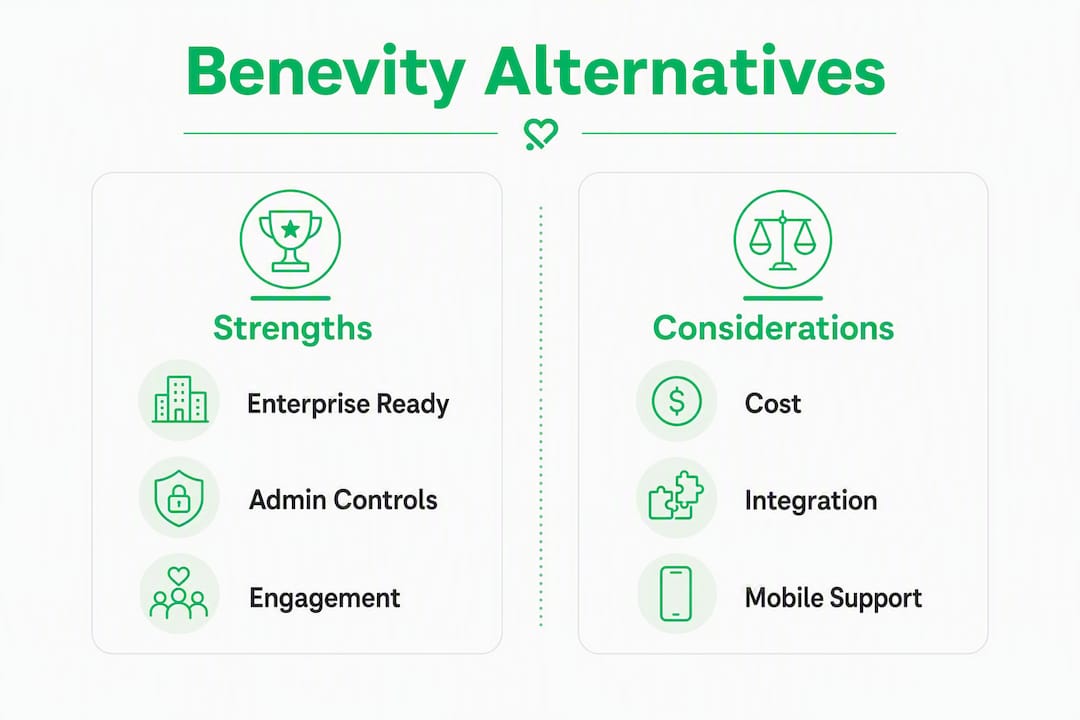
Charitymiles tracks employee movement via GPS and pedometer on iOS and Android. Every mile walked, run, or biked generates a donation to a charity of the employee’s choice, or to a company-selected cause. The company controls the sponsorship entirely: set a per-mile rate, a total budget cap, and the charity scope. That configuration flexibility is what separates it from a standard step challenge.
Engagement mechanics that drive sustained participation:
- Team challenges and leaderboards create friendly competition without requiring athletic ability
- Any movement counts, so warehouse workers, office employees, and remote staff all participate equally
- Employees receive recognition for tangible impact, which builds intrinsic motivation over time
- Gamification features reinforce daily habits rather than one-off events
For enterprise teams, Charitymiles offers admin controls for managing employee rosters, reporting dashboards that track miles logged, donations generated, and participation rates, and integration options for HR systems. Privacy is handled at the platform level; employees are not required to share personal health data beyond movement distance.
Pro Tip: Set a per-mile sponsorship rate that feels meaningful but cap the total budget at a comfortable ceiling. A modest rate with a visible running total on the leaderboard motivates employees more than a large lump-sum pledge they never see in action.

Where Benevity works well and where it falls short
Benevity, founded in 2008 and headquartered in Calgary, Canada, built its reputation on enterprise-grade giving infrastructure: payroll giving, gift matching, volunteer management, and grantmaking in a single platform. For large organizations running complex CSR portfolios, that breadth is genuinely useful.
Where Benevity performs well:
- Grantmaking and nonprofit vetting at scale
- Payroll deduction giving with matching workflows
- Volunteer hour tracking and reporting for compliance purposes
- Global giving across multiple currencies and charity registries
Where it underperforms for fitness-first programs:
- Mobile experience issues, including slow load times and limited activity-tracking features, reduce participation among employees who are not already motivated donors
- Admin complexity is high; teams without dedicated CSR staff often struggle with configuration
- Platforms lacking intuitive HR integrations create manual workflows that consume HR time and erode ROI
- No native activity-to-donation conversion; fitness-linked giving requires workarounds or third-party tools
- Hidden ad-hoc fees for off-cycle donations and extra support hours raise total cost of ownership beyond headline pricing
Benevity still makes sense when your primary need is grantmaking, multi-country payroll giving, or a full CSR orchestration suite. If daily employee movement and sustained wellness engagement are the goal, a fitness-first program is the better fit.
Other approaches worth considering beyond platform swaps
Not every organization needs a dedicated platform. Here is how the main alternatives compare:
- Activity-challenge vendors offer step competitions with leaderboards but rarely include a charitable giving component, making them wellness tools rather than CSR tools.
- Custom-built pilots give you full control but require significant development time, typically 6–12 months, and ongoing maintenance costs that rarely justify the investment for mid-size companies.
- Payroll/pledge models work well for financial giving but exclude employees who cannot afford regular payroll deductions, limiting inclusivity.
- Wellness vendor integrations (adding a giving layer to an existing wellness platform) can work but often produce fragmented experiences that reduce adoption.
- Global vendor suites cover multiple markets but add procurement complexity and often prioritize compliance over engagement. The broader market includes many newer entrants worth evaluating by feature fit and admin burden.
| Approach | Speed to launch | Cost shape | Admin burden | Engagement potential | Inclusivity |
|---|---|---|---|---|---|
| Charitymiles | 2–6 weeks | Sponsorship-based | Low | High | Very high |
| Activity-challenge vendor | 4 weeks | Per-user SaaS | Medium | Medium | Medium |
| Custom pilot | 6–12 months | High build cost | Very high | Variable | Variable |
| Payroll/pledge | 4 weeks | Admin + processing | Low | Low | Low (financial access) |
| Wellness vendor integration | 8 weeks | Add-on licensing | Medium | Medium | Medium |
How to choose the right alternative for your program
Practical selection guides consistently recommend prioritizing engagement mechanics, low-friction admin, and clear pricing over exhaustive feature lists. Here is a prioritized checklist:
- Mobile UX first. If the app is slow or clunky, participation drops. Test the employee experience yourself before signing anything.
- Sponsorship control. Can you set the per-mile rate, the budget cap, and the charity scope independently? Lack of control here limits your ability to align giving with company values.
- Inclusivity. Does the program work for employees who are not athletes? Successful programs are accessible to all fitness levels and job roles.
- HR/payroll/SSO integrations. Manual roster management is a hidden cost. Confirm integration depth before committing.
- Reporting depth. You need participation rates, miles logged, and donation dollars, not just giving totals.
- Security and compliance. Request SOC 2 documentation or equivalent during procurement.
- Total cost of ownership. Ask specifically about fees for off-cycle events, support hours, and data exports.
Questions to ask vendors during demos:
- How long does it take for employee donations to reach the charity?
- How many admin tasks per month does your team typically handle for a company our size?
- What does your SLA look like for support tickets?
- Can we export participation and donation data in CSV or API format?
- How do you handle employee data privacy and GDPR/CCPA compliance?
Red flags: opaque pricing, no native mobile app, no HR integration, donation processing times exceeding 90 days, and no way to export your own data.
Pilot KPIs to track: participation rate (target 30%+ in week one), miles logged per employee per week, total donation dollars generated, engagement frequency (days active per month), and employee NPS at pilot close.
What does a 6-week pilot look like in practice?
| Week | Owner | Key tasks |
|---|---|---|
| 1 | HR/IT | Platform setup, SSO/HR integration, sponsorship configuration |
| 2 | HR/Comms | Internal launch communications, manager briefing |
| 3 | All employees | Program launch, team challenge kickoff |
| 4 | HR | Mid-pilot check: participation rate, troubleshoot low-adoption teams |
| 5 | All employees | Final push, leaderboard visibility, recognition moments |
| 6 | HR/CSR | Data export, KPI review, decision on full rollout |
Budget guidance: Sponsorship costs depend entirely on the per-mile rate and cap you set, so you control the ceiling from day one. Budget separately for internal comms assets (one email series, one manager briefing deck) and any IT time for SSO setup. Corporate wellness programs that tie activity to giving typically show ROI through reduced absenteeism and improved engagement scores, which HR can track alongside donation dollars.
Before launch, confirm you have: employee roster in the platform, sponsorship terms finalized, charity selection approved, manager champions identified, and a two-week comms calendar ready.
What HARMAN’s results tell us about fitness-linked giving
Since launching its Charitymiles team in 2021, HARMAN saw an 11x increase in employee participation, with 1,200+ employees generating over $120,000 for charity — demonstrating that a fitness-linked giving program can drive both engagement and measurable social impact at enterprise scale.
Key outcomes from the HARMAN program:
- 11x participation increase from baseline to active program enrollment
- 1,200+ employees actively logging miles and generating donations
- $120,000+ generated for charity through employee movement alone
- Sustained engagement over multiple years, not a one-off event spike
These numbers reflect what happens when a program is inclusive, mobile-first, and tied to daily habits rather than a one-time giving campaign.
Key Takeaways
Charitymiles is the strongest fitness-first alternative to Benevity for HR and CSR leaders who want sustained employee engagement, measurable charitable impact, and full sponsorship control.
| Point | Details |
|---|---|
| Fitness-first wins on engagement | Activity-based programs outperform passive donation portals on sustained participation and daily habit formation. |
| HARMAN proof point | 1,200+ employees generated $120,000+ for charity with an 11x participation increase using Charitymiles. |
| Benevity’s limits are specific | Benevity suits complex grantmaking; it underperforms for mobile-first, fitness-linked giving programs. |
| TCO requires scrutiny | Legacy platforms carry hidden fees for off-cycle events and support hours that raise true cost beyond headline pricing. |
| Charitymiles recommended | Charitymiles offers configurable sponsorship, inclusive movement tracking, and enterprise reporting in a 2–6 week rollout. |
Why activity-based giving outperforms donation portals
Most corporate giving programs fail quietly. Employees enroll, make one donation, and never return. The portal sits unused, the CSR report shows low numbers, and HR wonders why engagement did not move. The honest answer is that passive donation portals ask employees to do something extra, something that feels separate from their day. Activity-based giving does the opposite: it attaches to something employees already do.
A lunchtime walk becomes a donation. A bike commute generates impact. That shift from “extra task” to “daily habit” is what drives morale and retention in a way that a matching portal simply cannot replicate. The operational tip worth applying immediately: identify your manager champions before launch. Manager behavior is the single strongest predictor of team-level adoption in any new program. Brief them first, give them a team leaderboard to share, and participation follows.
Charitymiles: the fitness-first employee giving program built for enterprise
If you have spent time evaluating corporate giving platforms and found that most of them ask employees to donate money rather than generate it through movement, Charitymiles is the program worth piloting. It is the only employee engagement solution that converts daily walking, running, and biking into real charitable donations, with full company control over sponsorship terms, a 2–6 week rollout, and enterprise reporting built in.
HARMAN’s 11x participation increase and $120,000+ generated for charity is the benchmark. Your program can produce comparable results when the experience is mobile-first, inclusive, and tied to something employees already do every day. Request a pilot or demo at charitymiles.org/best-employee-engagement-software and see what your team can generate in six weeks.
Useful sources and vendor documentation
- Charitymiles Employee Empowerment Program — product overview, HARMAN case reference, and enterprise program details
- Charitymiles corporate wellness programs — wellness ROI context and program templates
- SelectHub: Top Benevity Alternatives & Competitors — third-party feature and pain-point analysis
- Groundswell: Benevity vs. YourCause vs. Groundswell — independent platform comparison including TCO and hidden fees
- PercentPledge: Benevity Alternatives for Mid-Market Companies — mid-market selection guidance and engagement mechanics
- CB Insights: Benevity Alternatives & Competitors — market landscape overview
Procurement note: always request SOC 2 Type II documentation, or an equivalent enterprise security certification, from any vendor during the procurement process before sharing employee data or finalizing a contract.