
Challenge medals work. When paired with a movement-for-charity program like Charitymiles, they drive measurable participation gains, extend CSR visibility beyond a single event, and give employees something worth talking about. Here is your three-step action plan to run a medal-backed challenge this quarter:
- Pick an inclusive format. Virtual distance challenges, month-long team sprints, or year-long accumulators all pair well with medals and accommodate every fitness level.
- Finalize a one-page design brief. Lock in shape, material, finish, ribbon style, and personalization before you contact any manufacturer.
- Run a vendor checklist. Confirm lead times, proof terms, minimums, and fulfillment SLA before signing anything.
Pro Tip: The moment an employee opens a medal package is your highest-leverage recognition touchpoint. Add a branded insert card with the employee’s name, miles logged, and the donation amount their movement generated. That single detail turns a physical award into a personal story worth sharing on LinkedIn or Slack.
Table of Contents
- Why do challenge medals increase participation and CSR impact?
- Which challenge formats pair best with medals?
- What design options should you put in your medal brief?
- How do medals get from artwork to your employees?
- What affects the cost of a corporate medal program?
- What should you ask every medal vendor before signing?
- How do you measure the ROI of a medal-backed movement program?
- Charitymiles and HARMAN: what a medal-backed challenge can achieve
- Key Takeaways
- The long game matters more than the launch
- How Charitymiles supports medal-backed movement challenges
- Useful sources
Why do challenge medals increase participation and CSR impact?
Physical awards tap into psychological ownership. Once someone earns a medal, it becomes a proxy for their effort and identity, which is why unique design and craftsmanship increase the likelihood participants display or share them long after the challenge ends. A medal sitting on a desk is a passive conversation starter that keeps your wellness program visible without any additional budget.
The unboxing moment amplifies this effect. Programs that treat fulfillment as a recognition moment see stronger downstream engagement because the physical receipt of an award converts a digital milestone into something tangible and personal. For CSR leaders, that tangibility matters: it makes the company’s charitable impact feel real to the employee, not just a line item in an annual report. Charitymiles has operated since 2012 and its enterprise clients consistently report that pairing movement tracking with physical recognition sustains participation well beyond a single challenge window.
Which challenge formats pair best with medals?
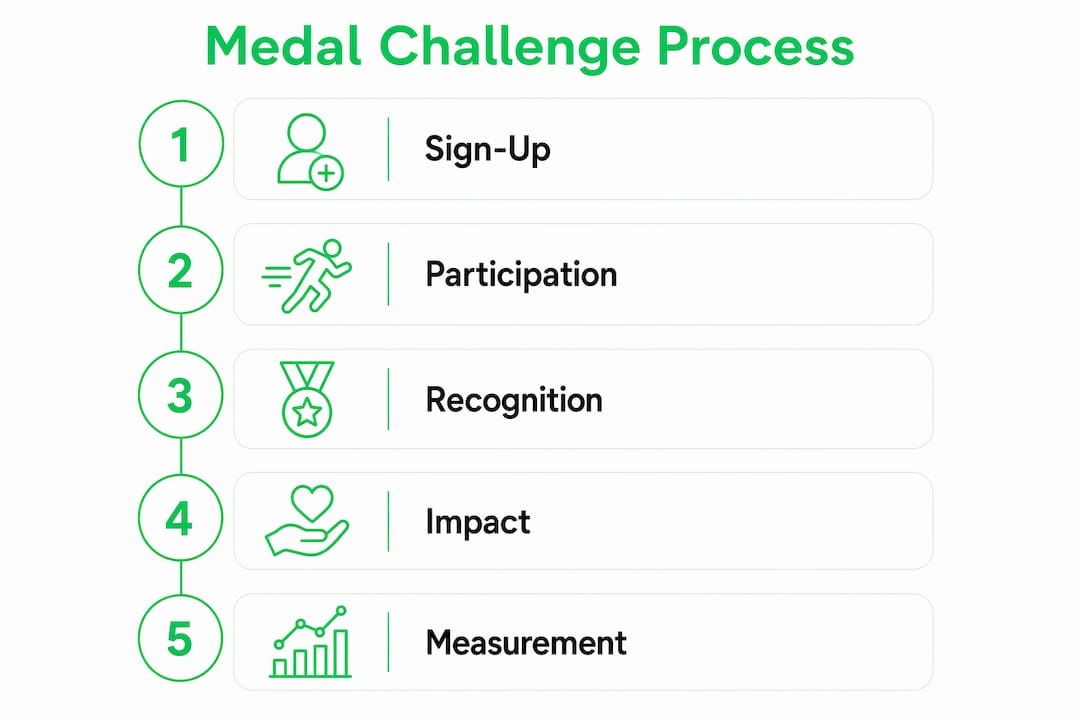
Inclusive formats produce higher sign-up and completion rates because they remove the “I’m not athletic enough” barrier. Virtual challenges that accept multiple activity types and offer extended completion windows, sometimes up to 12 months, are especially effective for diverse corporate populations.
Recommended formats for corporate medal programs:
- Virtual distance challenge: Employees log walking, running, cycling, or wheelchair miles via a mobile app over 30–90 days. Any movement counts, which keeps participation broad.
- Month-long team sprint: Small teams compete to log the most collective miles. Medal goes to every participant who hits a personal milestone, not just the top team.
- Miles-for-charity month: Each mile logged triggers a company donation. Medal reward is tied to a donation threshold, reinforcing the CSR connection.
- 12-month accumulator: Employees earn tiered medals (bronze, silver, gold) as they hit cumulative distance milestones across the year. Collectible tiers sustain engagement long after the initial launch.
Three ready-to-copy challenge templates for HR:
- Team relay: Divide employees into teams of five. Each member logs miles toward a shared team goal. Every team that hits the goal receives a medal.
- Steps pyramid: Employees start at 5,000 steps per day and increase by 1,000 steps each week. Medal awarded at the top tier.
- Miles-for-charity month: Set a company-wide miles goal. When the team hits it, every participant receives a finish line medal and the company donates to a chosen cause.
What design options should you put in your medal brief?
Prioritize memorable, brand-aligned elements that encourage display and sharing. A medal employees want to keep on their desk or hang on their wall does more for your culture than one that ends up in a drawer.
| Design Element | Options Available |
|---|---|
| Shape | Round, custom die-cut, geometric, logo-shaped |
| Material | Zinc alloy (fine detail, lightweight), steel (durable, heavier) |
| Finish | Bright gold/silver, antique bronze, dual plating |
| Surface detail | 3D relief sculpting, die-cast, die-struck |
| Fill options | Translucent enamel, glitter fill, epoxy coating |
| Special features | LED lights, spinners, cut-outs, inset stones, sequential numbering |
| Functional add-ons | Bottle opener, belt buckle attachment |
| Ribbon | Plain (pairs with busy medal designs), heat-transferred ribbon (pairs with simpler medals) |
| Packaging | Velvet pouch, branded box, tissue wrap, insert card |
| Personalization | Name engraving, miles logged, donation amount printed |

Sample one-paragraph design brief for an enterprise wellness challenge:
“We need 500 custom zinc alloy medals, approximately 3 inches in diameter, with a 3D relief of our company logo and an antique gold finish. Each medal should include a full-color heat-transferred ribbon in our brand colors (navy and green). We require individual name engraving on the reverse. Packaging: individual branded kraft box with a printed insert card. Delivery required within six weeks of proof approval.”
Pro Tip: Pairing a simple medal design with a highly detailed custom ribbon, or vice versa, is a low-cost way to increase perceived value without doubling production costs. Ribbon complexity and medal detail should balance each other visually.
How do medals get from artwork to your employees?
The operational timeline has five stages, and the biggest delays almost always happen at proof approval.
- Submit artwork and design brief to your manufacturer.
- Receive a digital or physical proof; review and approve (or request revisions).
- Sign off on the final proof. Production typically begins immediately after and takes roughly 3–4 weeks.
- Personalization (engraving, printing) is applied post-production or during a finishing stage.
- Medals are kitted, packaged, and shipped to a central HR address or directly to employees.
Fulfillment checklist before you place an order:
- Confirm order minimums and whether the vendor offers no-minimum options for pilots.
- Request a physical sample before full production, not just a digital proof.
- Clarify QA checkpoints: who inspects for finish defects, misaligned engraving, or ribbon errors.
- Collect employee shipping addresses early; international addresses need extra lead time.
- Confirm the vendor’s policy on lost shipments, damaged medals, and replacement timelines.
- Plan the unboxing moment: branded outer packaging, personalized insert card, and a digital announcement in your internal comms channel on the same day medals arrive.
What affects the cost of a corporate medal program?
Per-unit cost varies widely depending on material, size, complexity, and volume. Plan your budget across four categories: production, personalization, packaging, and shipping.
Cost drivers to itemize in your budget:
- Material and size: Zinc alloy costs less than steel for intricate designs; larger medals cost more per unit.
- Finish and plating: Dual plating, antique finishes, and epoxy coating add cost but increase perceived prestige.
- Special features: LED lights, spinners, inset stones, and sequential numbering each carry a per-unit premium.
- Ribbon type: Heat-transferred custom ribbons cost more than plain stock ribbons.
- Packaging: Branded boxes and insert cards add per-unit cost but significantly lift the recognition experience.
- Personalization: Name engraving or printed personalization is typically priced per piece.
- Volume: Unit costs drop substantially with larger orders; some US manufacturers offer no-minimum options for pilots at a higher per-unit rate.
- Expedited production: Rush fees apply when lead time is compressed below the standard 3–4 weeks.
- Shipping: Domestic ground is cheapest; direct-to-employee shipping multiplies fulfillment cost.
For collectible or tiered medal series, the per-employee ROI tends to be higher because employees stay engaged across multiple challenge windows to complete the set.
What should you ask every medal vendor before signing?
Lead with proofs, minimums, and fulfillment SLA. Those three factors determine whether your program launches on time.
- Do you provide a digital proof within 24–48 hours of brief submission?
- Can we order a physical sample before full production?
- What is your minimum order quantity, and what is the per-unit price at our expected volume?
- What is the standard production lead time after proof approval?
- Do you offer expedited production, and what is the additional cost?
- How do you handle personalization (engraving, printing) and at what stage?
- What QA process do you use, and what is your replacement policy for defective units?
- Who is liable for medals lost or damaged in transit?
- How do you handle employee data used for personalization (data privacy, storage, deletion)?
- Who retains IP rights to the medal artwork and design files?
Contract checklist before you sign:
- Change request policy and cutoff date after proof approval.
- Refund and cancellation terms.
- Replacement policy for production defects.
- Liability clause for lost or damaged shipments.
- Data privacy terms for personalization data.
- IP and branding rights for artwork files.
How do you measure the ROI of a medal-backed movement program?
Measure both participation and long-term behavior change, not just medals shipped. The most useful programs track a primary KPI set and a secondary set for stakeholder reporting.
Primary KPIs to track:
- Sign-up rate (employees enrolled vs. eligible)
- Challenge completion rate
- Active participation weeks (sustained engagement, not just sign-up)
- Miles logged per participant
- Donations generated
- Social shares (internal Slack/Teams posts, external LinkedIn)
- Retention rate of participants in subsequent challenges
| Metric | How to measure | Reporting cadence |
|---|---|---|
| Sign-up rate | Platform enrollment data | Week 1 of challenge |
| Completion rate | Platform milestone data | End of challenge |
| Active weeks | Weekly login or activity logs | Monthly |
| Miles logged | Platform GPS/pedometer data | Monthly |
| Donations generated | Platform CSR dashboard | Monthly and end-of-program |
| Social shares | Internal comms analytics | Monthly |
| Internal NPS | Post-challenge survey | End of challenge |
| Recruitment lift | HR applicant tracking data | Quarterly |
Charitymiles provides enterprise reporting that maps directly to these KPIs, making it straightforward to pull a one-page CSR impact summary for leadership. Pairing that data with corporate fitness challenge structures gives you a repeatable measurement framework across multiple challenge cycles.
Charitymiles and HARMAN: what a medal-backed challenge can achieve
The result speaks first: since HARMAN launched its Charitymiles team in 2021, the company saw an 11x increase in employee participation, with more than 1,200 employees generating over $120,000 for charity.
The mechanics behind that result: Charitymiles created a private team for HARMAN employees, tracked miles via GPS and pedometer across walking, running, and cycling, and gave the company configurable sponsorship controls. Medals tied to milestone distances gave employees a physical marker of their contribution, turning digital activity data into a tangible recognition moment. Stakeholders received clear reporting on miles logged and donations generated, which made the CSR case easy to communicate internally.
Key Takeaways
Challenge medals drive sustained participation when paired with inclusive formats, clear measurement, and a platform like Charitymiles that connects movement to charitable impact.
| Point | Details |
|---|---|
| Start with format | Choose virtual distance, team sprint, or year-long accumulator based on your workforce’s fitness range. |
| Brief before you buy | A one-page design brief covering shape, finish, ribbon, and personalization prevents costly revisions after proof. |
| Timeline is 3–4 weeks | Production begins after proof approval; request physical samples early to avoid last-minute delays. |
| Measure beyond medals shipped | Track completion rate, miles logged, donations generated, and social shares to prove CSR ROI. |
| Charitymiles as the platform | Charitymiles provides private team challenges, GPS tracking, configurable sponsorships, and enterprise reporting to support medal-backed programs. |
The long game matters more than the launch
Most HR teams treat a medal program as a one-time event. That is the wrong frame. The programs that sustain engagement year over year treat medals as a series, not a single award. A collectible tier system, where employees earn bronze, silver, and gold across multiple challenge windows, keeps people coming back without requiring a larger budget each cycle. The first medal earns attention; the second earns habit.
There is also a real tension between prestige and frequency. A heavy, beautifully finished medal with dual plating and a custom ribbon carries weight, literally and symbolically. But if you only distribute one per year, you lose the momentum that mid-year recognition creates. The smarter approach is a tiered model: one high-quality anchor medal for the annual milestone and lighter, lower-cost recognition drops (enamel pins, digital badges, donation certificates) at quarterly intervals. That cadence keeps the program alive without diluting the prestige of the main award.
How Charitymiles supports medal-backed movement challenges
Charitymiles runs private team challenges that track walking, running, and cycling miles via GPS and pedometer, connects each mile to a charitable donation, and gives HR and CSR leaders the enterprise reporting they need to prove impact. The platform lets you configure sponsorship terms, set a company-selected cause or let employees choose their own charity, and pull a clean CSR dashboard for leadership presentations.
For medal-backed programs specifically, Charitymiles reduces procurement friction by providing the movement data and milestone triggers that determine who has earned an award and when. You get the participation numbers, miles logged, and donations generated in one place, so your procurement team can fulfill medals with confidence rather than guesswork. Companies exploring employee engagement solutions through Charitymiles typically launch a pilot within four to six weeks. To see how a movement-for-charity challenge fits your workforce, visit the Employee Empowerment Program page and request a demo.
Useful sources
- Charitymiles Employee Empowerment Program — HARMAN case study, enterprise reporting, and program setup
- Always Advancing: Custom Finisher Medals — Design options, ribbon guidance, and functional add-ons
- First Place Pins: Finish Line Medals — Craftsmanship standards and social signaling research
- Colucci Custom Awards — US-based manufacturing, no-minimum options, and lead time benchmarks
- MedalMad Virtual Challenges — Inclusive format benchmarks and multi-activity acceptance windows
- The Conqueror Virtual Challenges — Fulfillment and unboxing best practices
- Charitymiles: Corporate Fitness Challenge — Challenge templates and CSR alignment guidance
- Charitymiles: Fitness Challenge Ideas for Employees — Practical templates for HR program planning