
Who are the top corporate wellness providers in the US right now?
The strongest corporate wellness providers in the United States for 2026 span a wide range of specializations, from clinical biometric programs to gamified digital platforms and on-site fitness classes. Choosing the right one depends on your workforce size, budget, and what you actually want employees to do differently. Here is a quick comparison of the eight leading providers to orient your search.
| Provider | Services Offered | Specializations | Employee Engagement Features | Wellness Program Types | Rating |
|---|---|---|---|---|---|
| Wellness Plan of America | Local wellness program delivery | Florida-based health programs | Health program events | Lifestyle management | 4.1★ (144) |
| Terryberry | Recognition, rewards, wellness challenges, listening surveys | Employee engagement and retention | Wellness challenges, milestone awards, charitable donations | Recognition-integrated wellness | 4.5★ (53) |
| Wellable | All-in-one wellness platform, gamified challenges, 24/7 video | Rewards integration, holistic health | Automated milestones, gift cards, custom rewards | Holistic wellness, preventive care | 4.5★ (38) |
| NW Corporate Wellness | Yoga, Boot Camp, Chair Yoga, mindfulness workshops, massage | On-site and virtual fitness, mindfulness | Custom measurable programs, wellness events | Fitness, mental, social, emotional wellness | 5★ (19) |
| Personify Health | Health plan admin, care navigation, wellbeing platform | Personalized health management, cost savings | Engagement and cost savings tools | Health plan, wellbeing, care navigation | 2.6★ (19) |
| US Wellness | Biometric screenings, clinical coaching, cancer screening, incentive management | Population wellbeing, CLIA certified lab | Wellness portal, incentive management | Clinical, screening, risk assessment | 4★ (5) |
| Health Fitness | Fitness center management, injury prevention, health coaching, dietitians | Corporate fitness facilities, ergonomics | Challenges, screenings, digital tools | Fitness management, injury prevention | 3★ (2) |
| BSDI | Wellness-related services (New Jersey) | Foundational wellness services | — | — | — |
A closer look at what each provider actually delivers
Wellable stands out for HR teams that want a single platform covering content, challenges, and rewards without stitching together multiple vendors. The platform offers gamified wellness challenges, automated reward milestones, preventive care tools like personal wellness assessments, and 24/7 wellness video access. Custom rewards can include health plan savings or paid time off, not just gift cards.
Terryberry takes a different angle. Rather than treating wellness as a standalone program, it weaves physical activity and wellbeing into a broader employee recognition ecosystem. Employees earn points through wellness challenges, service milestones, and peer recognition, and can redeem them for merchandise, experiences, or charitable donations. The employee listening surveys add a feedback loop most pure-play wellness platforms lack.
NW Corporate Wellness is the right call when you want live, instructor-led experiences rather than app-based content. Their catalog includes Yoga, Boot Camp, Zumba, Mindful Meditation, Chair Yoga, and on-site chair massage, delivered either virtually or in person. Programs are custom-built and measurable, which matters when you need to report outcomes to leadership.

Personify Health targets large employers that need health plan administration and care navigation alongside wellbeing tools. The platform connects personalized health engagement with cost-savings analytics, making it a fit for benefits teams managing complex populations.

US Wellness brings clinical depth that most digital platforms cannot match. Their staff includes licensed health professionals, and their laboratory holds CLIA certification. Services include biometric screenings, the Galleri multi-cancer blood test, flu shots, and clinical coaching, all tied to an incentive management system. For employers where workforce health risk is a real cost driver, that clinical infrastructure matters.
Health Fitness specializes in corporate fitness center management, covering staffing, facility design, health coaching, dietitian services, and injury prevention. Their job-specific injury prevention programs, which include ergonomic education and return-to-work strategies, address a gap most wellness platforms ignore entirely.
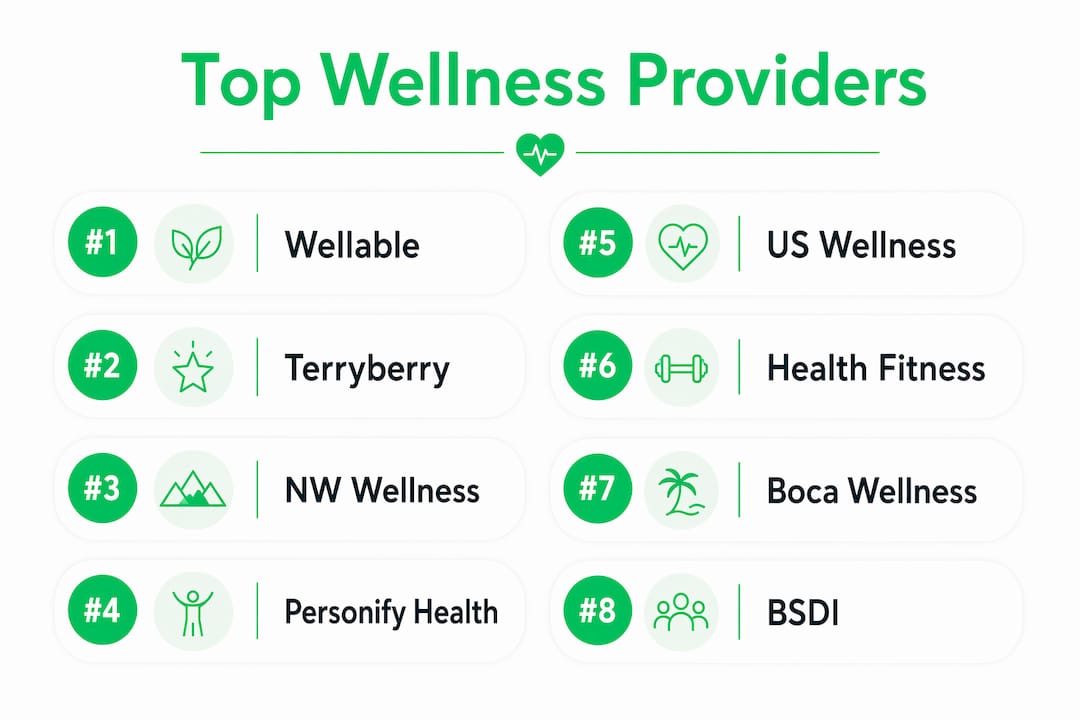
Wellness Plan of America operates locally in Boca Raton, Florida, serving employers in that region with health-focused wellness program delivery. It suits organizations in the area that prefer a local provider relationship.
BSDI, based in New Jersey, has a verified wellness-related business presence. Detailed public information on their specific services is not publicly listed.
How to choose the right corporate wellness provider for your organization
The US Department of Labor structures wellness programs around three pillars: health risk screening, lifestyle management, and disease management. Before you talk to any vendor, decide which of those three your workforce needs most. That single decision narrows the field considerably.
Key evaluation criteria:
- Service alignment: Does the provider cover your priority areas, whether clinical screenings, fitness programming, mental health support, or digital engagement?
- Program diversity: Can they serve a workforce with different fitness levels, locations, and schedules, including remote employees?
- Engagement features: What drives participation? Look for incentives, gamification, team challenges, and communication tools built into the platform.
- Pricing model: Most providers use per-employee-per-month (PEPM) pricing or annual contracts. Ask for a clear breakdown before comparing quotes.
- Data security: Any provider handling health data must be HIPAA-compliant. Verify this directly, not just from a sales deck.
- Contract terms: Watch for auto-renewal clauses, minimum employee counts, and fees for early termination.
Questions to ask every shortlisted vendor:
- How do you customize programs for our industry and workforce demographics?
- What integrations do you support with our existing HRIS or benefits platform?
- How is employee health data stored, accessed, and protected?
- What does implementation look like, and who owns the rollout?
Pro Tip: SHRM recommends aligning wellness programs with your company’s internal communication channels and culture from day one. A platform your employees never open delivers zero ROI, no matter how many features it has.
Expect three to five years to see the full return on a wellness program investment, according to SHRM guidance. Plan your vendor contract length accordingly, and build in annual review checkpoints rather than locking into a long-term deal without performance benchmarks.
What types of corporate wellness programs and services exist?
The CDC’s Workplace Health Promotion Model recommends using health assessments to establish a baseline before selecting program types. That baseline tells you whether your workforce needs clinical intervention, lifestyle support, or engagement-focused programming.
Common program types:
- Health risk assessments and biometric screenings
- Lifestyle management: nutrition coaching, fitness challenges, stress reduction
- Disease management: chronic condition support, clinical coaching
- Mental wellbeing: mindfulness workshops, employee assistance programs
- Fitness programming: on-site classes, fitness center management, virtual sessions
Typical delivery modes:
- Digital platforms with app-based challenges and content libraries
- On-site instructor-led classes and workshops
- Licensed clinical coaching and screenings
- Rewards and incentive systems tied to participation milestones
Incentives drive participation. Health insurance premium reductions are widely considered the most effective motivator, according to SHRM, followed by gift cards, HSA contributions, and paid time off. The key is tying incentives to meaningful behaviors, not just enrollment.
How Charitymiles blends wellness, giving, and employee engagement
Most corporate health and wellness programs treat physical activity as a compliance metric. Charitymiles treats it as a reason to show up. The platform converts everyday movement, walking, running, or biking, into charitable donations for causes employees actually care about. That purpose-driven layer is what separates it from a standard step challenge.
Companies using Charitymiles create private employee teams, run intra-company challenges, and set their own sponsorship terms: the rate per mile, the total cap, and whether funds go to a company-selected cause or each employee’s chosen charity. The program is free for individual employees and free for charities, which removes the friction that kills participation in most wellness initiatives.
Pro Tip: Pair Charitymiles with your existing employee wellness programs to add a CSR layer without replacing what already works. The two approaches reinforce each other.
Gallup research shows that companies with engaged employees are 21% more profitable. Charitymiles builds that engagement by connecting personal health goals to company mission, which is exactly the alignment SHRM identifies as the foundation of programs that actually last.
What do real wellness program results look like?
Concrete outcomes from corporate wellness programs vary by program type and workforce, but a few patterns hold across the field. HARMAN’s 11x participation increase through Charitymiles is one example of what happens when a program removes barriers and adds meaning. Terryberry clients report culture shifts when recognition and wellness are combined, because employees see their effort acknowledged in multiple ways simultaneously. NW Corporate Wellness builds custom measurable programs specifically so employers can track outcomes and report them internally.
The RAND Workplace Wellness Programs Study found that about half of employers with at least 50 employees offered a wellness program, and more than 90% of those with over 50,000 employees did. The programs that show the clearest ROI share one trait: they measure outcomes from the start, using health assessments, participation data, and claims analysis.
Red flags to watch for when evaluating a provider
Not every corporate wellness provider delivers what it promises. Watch for these warning signs before you sign anything.
- No HIPAA compliance documentation. Any provider handling clinical data must meet HIPAA standards. If they cannot produce documentation, walk away.
- Vague engagement metrics. “High participation” is not a number. Ask for specific participation rates from comparable clients.
- One-size programs. A provider that cannot customize for your industry, workforce size, or remote employees will struggle to move the needle.
- Auto-renewing contracts with no performance clauses. You should be able to exit or renegotiate if the program underperforms.
- No integration path. If the platform cannot connect to your HRIS or benefits system, you will spend more time on administration than on outcomes.
- Overreliance on incentives alone. Extrinsic rewards drive short-term spikes. Programs built only on gift cards and prizes tend to plateau after the first quarter.
Charitymiles: a different kind of wellness and engagement approach
If the providers above feel like a bigger commitment than your organization is ready for, Charitymiles offers a lighter-weight path to the same goals. Where traditional corporate wellness programs require vendor contracts, platform implementations, and clinical infrastructure, Charitymiles works through an app your employees already have on their phones.
The Employee Empowerment Program is used by hundreds of leading companies to connect daily movement with charitable giving and team camaraderie. You set the sponsorship terms, your employees move, and the impact is visible and measurable from day one. It complements a clinical wellness program or stands on its own as a low-friction engagement tool. Explore how it fits alongside your current strategy by reviewing the top engagement platform alternatives for 2026.
Key Takeaways
The strongest corporate wellness programs align with workforce culture, use health assessments to set a baseline, and combine clinical services with engagement tools that drive sustained participation.
| Point | Details |
|---|---|
| Match provider to program type | Choose based on whether your priority is clinical screening, lifestyle management, or digital engagement. |
| Verify HIPAA compliance | Any provider handling employee health data must meet HIPAA standards before you sign a contract. |
| Plan for a long ROI horizon | SHRM guidance sets three to five years as the realistic timeline to measure full program returns. |
| Engagement needs purpose | Programs tied to meaningful goals, like charitable giving, drive sustained participation beyond initial incentives. |
| Charitymiles as a complement | Charitymiles adds a CSR and movement layer to existing wellness programs, with HARMAN seeing an 11x participation increase after launch. |