
Artificial intelligence and corporate social responsibility (AI CSR) is the strategic application of AI technologies to advance social, environmental, and governance outcomes through data-driven insight and sustainable innovation. The industry standard term is “AI-enabled CSR,” though “AI CSR” has become the shorthand most corporate leaders use. Stakeholder expectations have shifted sharply: boards, investors, and employees now demand measurable proof of social impact, not just narrative commitments. AI delivers that proof by turning raw ESG data into precise forecasts, real-time monitoring, and transparent reporting. The challenge is doing it responsibly.
How AI CSR enhances sustainability and social impact measurement
AI’s most concrete contribution to CSR is precision. AI-driven carbon monitoring has increased renewable energy integration rates by 15–20% by enabling minute-level emissions tracing and smarter grid control. That is not a marginal gain. It means companies can make credible, auditable commitments to the Paris Agreement and the UN Sustainable Development Goals rather than relying on annual estimates that are already outdated by the time they are published.
Machine learning in corporate responsibility also drives process improvement. AI adoption boosts ESG outcomes primarily through green technology innovation and organizational process improvements, with effects varying by firm size and industry. A large manufacturer, for example, can use AI to model supply chain emissions across thousands of suppliers simultaneously, something no human team can do at that speed or scale.
The table below maps key AI applications to specific ESG impact areas.
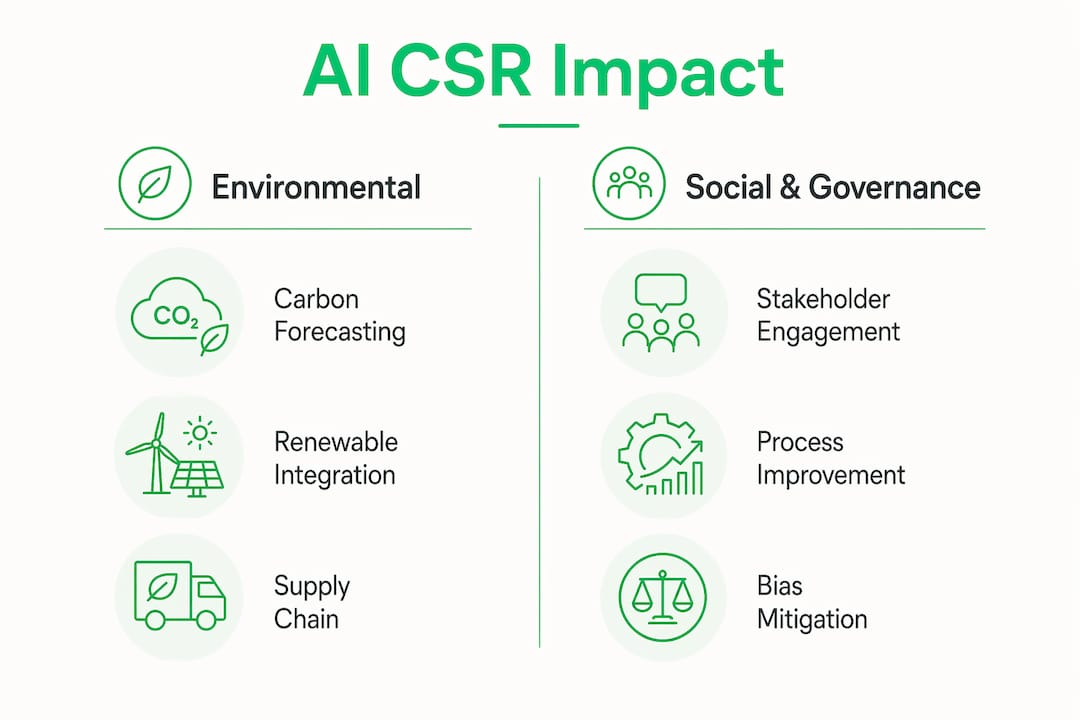
| AI application | ESG focus area | Expected impact |
|---|---|---|
| Carbon emissions forecasting | Environmental | Real-time monitoring, auditable reporting |
| Supply chain optimization | Environmental, Social | Reduced waste, fairer labor practices |
| ESG data aggregation | Governance | Faster, more accurate disclosure |
| Stakeholder sentiment analysis | Social | Improved community engagement |
| Energy grid management | Environmental | Higher renewable integration rates |
Transparency is the thread connecting all of these. AI-enabled ESG reporting replaces self-reported estimates with verified, continuous data streams. That shift matters enormously for corporate social responsibility examples where credibility with investors and regulators is non-negotiable.
Pro Tip: Anchor your AI sustainability program to a recognized framework such as the SDGs or the Science Based Targets initiative. This gives your AI-generated data a credible external reference point and makes reporting far more defensible to auditors and stakeholders.
What ethical considerations and governance challenges arise from using AI in CSR?
The biggest risk in AI-enabled CSR is not technical failure. It is AI-washing, which occurs when companies use AI superficially for marketing rather than embedding it authentically in decision-making. AI-washing diminishes real social impact and erodes stakeholder trust faster than any data error ever could.
Three governance challenges demand your attention:
- Environmental footprint of AI itself. AI computing is energy-intensive. The UNESCO 2026 AI governance toolkit frames this through “Green AI” principles, requiring organizations to operate within planetary boundaries and adopt policies that account for the carbon cost of their own AI systems.
- Opacity in AI systems. Black-box models produce outputs that CSR leaders cannot explain to employees, regulators, or community stakeholders. Explainability frameworks are not optional. They are the foundation of trustworthy AI in sustainability.
- Standard CSR governance often fails with AI because lifecycle assessments and AI carbon accounting are absent from most existing reporting structures. Conventional IT reporting does not capture the full carbon footprint of AI workloads.
AI literacy has become a core leadership skill for ethical CSR. Leaders who cannot read an AI model’s outputs critically cannot govern it responsibly. That means investing in training for your CSR and sustainability teams, not just your data scientists.
Pro Tip: Before publishing any AI-generated CSR metric, run it through a human review that checks for bias, data source quality, and alignment with your stated values. This single step separates authentic AI integration from AI-washing.
How do different AI applications impact various CSR subsectors?
AI does not affect all CSR subsectors equally. Corporate leaders map AI opportunities across 36 CSR subsectors to align commercial efficiency with social impact, covering climate, energy, natural capital, and social systems. The practical implication is that your AI CSR strategy should be sector-specific, not generic.
Labor-intensive organizations, such as retail or logistics companies, see the strongest AI impact in social metrics: worker safety monitoring, fair scheduling, and supply chain labor audits. Asset-intensive organizations, such as manufacturers or utilities, gain most from AI in environmental metrics: energy efficiency, emissions reduction, and predictive maintenance that extends equipment life and reduces waste.
| CSR subsector | AI application type | Primary impact |
|---|---|---|
| Energy and utilities | Grid optimization, demand forecasting | Emissions reduction |
| Manufacturing | Process automation, waste modeling | Resource efficiency |
| Retail and logistics | Supply chain auditing, scheduling | Labor fairness |
| Financial services | ESG scoring, risk modeling | Governance transparency |
| Healthcare | Community health analytics | Social equity |
Social-oriented AI applications also include stakeholder engagement tools such as AI-powered chatbots that handle community feedback at scale. These tools work best when they augment human judgment rather than replace it. Strong CSR functions, not AI sophistication alone, determine meaningful AI integration and social outcomes. The technology is only as good as the organizational commitment behind it.
For nonprofits and mission-driven organizations exploring AI’s role in stakeholder management, CRM platforms built for nonprofits increasingly incorporate AI features that support donor engagement and impact tracking.
What practical strategies can corporate leaders use to implement AI in CSR?
Responsible AI CSR implementation follows a clear sequence. Skipping steps produces the governance gaps that lead to AI-washing and reputational damage.
- Establish an AI governance charter aligned with your CSR values. Define which decisions AI can inform, which require human sign-off, and how you will handle model errors. This charter should reference the UNESCO AI Ethics framework and your existing CSR commitments.
- Build an AI carbon account. Standardized lifecycle assessments track the environmental cost of your AI systems accurately. Without this, your sustainability reporting has a blind spot that auditors will eventually find.
- Prioritize human-centered AI applications. Leaders who pair AI systems with human ethical judgment define next-generation CSR. AI should surface insights and flag anomalies. Humans should make the final call on social impact decisions.
- Engage stakeholders in AI-related CSR decisions. Employees, communities, and investors all have a stake in how you use AI. Transparent communication about your AI methods builds the trust that makes your CSR reporting credible. Review your CSR initiatives framework to identify where stakeholder input is currently missing.
- Measure AI’s contribution to social impact continuously, not annually. AI innovation reduces firm social irresponsibility most effectively when embedded in ongoing strategic frameworks rather than treated as a one-time project. Set quarterly review cycles for your AI CSR metrics.
Sustainability and financial returns coalesce when AI drives design-linked resource efficiency. This is the business case your board needs to hear: AI CSR is not a cost center. Done well, it reduces operational waste, lowers regulatory risk, and strengthens employer brand simultaneously.
Employee engagement is a critical and often overlooked dimension of AI-enabled CSR. Programs like Charitymiles translate CSR commitments into daily employee participation by turning physical activity into charitable donations. HARMAN saw an 11x increase in employee participation after launching its Charitymiles team in 2021, with 1,200+ employees generating over $120,000 for charity. That kind of visible, personal impact is exactly what AI-generated ESG reports cannot replicate on their own.

Key Takeaways
AI-enabled CSR delivers measurable social and environmental impact only when paired with ethical governance, transparent reporting, and genuine organizational commitment.
| Point | Details |
|---|---|
| AI improves ESG measurement | Carbon monitoring and supply chain AI produce auditable, real-time data that replaces unreliable estimates. |
| AI-washing is the primary risk | Superficial AI use for marketing erodes stakeholder trust and undermines real social impact. |
| Governance requires AI carbon accounting | Lifecycle assessments must track the environmental cost of AI systems themselves, not just the outcomes they measure. |
| Sector context shapes AI impact | Labor-intensive firms gain most in social metrics; asset-intensive firms gain most in environmental metrics. |
| Employee engagement amplifies AI CSR | Technology-driven data and human-centered programs like Charitymiles together make CSR visible and personal for employees. |
The uncomfortable truth about AI and CSR leadership
I have spent years watching companies announce AI-powered sustainability initiatives with great fanfare, only to produce the same vague annual reports they always did. The technology changed. The organizational commitment did not.
The honest reality is that AI amplifies whatever CSR culture already exists. If your CSR function is strong, AI makes it measurably stronger. If it is performative, AI makes the performance more sophisticated and harder to challenge. That is a governance problem, not a technology problem.
What I have found actually works is treating AI literacy as a non-negotiable leadership skill, the same way financial literacy became non-negotiable for executives after Sarbanes-Oxley. Every CSR leader should be able to ask: Where does this data come from? How was the model trained? What are its known failure modes? Those questions are not technical. They are accountability questions.
The most promising development I see is the shift toward continuous impact measurement. Companies that move from annual ESG reports to real-time AI dashboards are fundamentally changing the accountability relationship with their stakeholders. That is worth the investment. The companies that get there first will set the standard that everyone else has to meet.
— Gene
Charitymiles and the human side of AI-driven CSR
AI gives corporate leaders better data. Charitymiles gives employees a reason to care about what that data represents.

The Charitymiles Employee Empowerment Program connects your AI-enabled CSR goals to daily employee behavior by turning walks, runs, and bike rides into real charitable donations. Companies control the sponsorship terms, track participation, and see measurable social impact that no algorithm generates on its own. For leaders building employee engagement strategies that complement their AI CSR programs, Charitymiles adds the human layer that technology alone cannot provide. Explore the top employee engagement platforms to see how Charitymiles fits your CSR strategy.
FAQ
What is AI CSR?
AI CSR is the application of artificial intelligence technologies to improve corporate social responsibility outcomes, including environmental monitoring, ESG reporting, and social impact measurement.
How does AI improve ESG performance?
AI improves ESG performance through green technology innovation and organizational process improvements, with the strongest effects seen in manufacturing and asset-intensive sectors.
What is AI-washing in CSR?
AI-washing occurs when companies use AI superficially for marketing purposes rather than embedding it authentically in CSR decision-making, which reduces real social impact and erodes stakeholder trust.
How should companies track AI’s own environmental impact?
Companies should establish an AI carbon account using standardized lifecycle assessments, since conventional IT reporting does not capture the full carbon footprint of AI computing workloads.
Why does AI literacy matter for CSR leaders?
AI literacy allows CSR leaders to evaluate model outputs critically, govern AI systems responsibly, and maintain the transparency and auditability that stakeholders require from AI-driven social impact claims.