
Corporate wellness benefits are defined as employer-sponsored programs designed to improve employee health, reduce organizational costs, and drive measurable productivity gains. These programs span physical fitness, mental health support, financial counseling, and preventive screenings. The business case is no longer theoretical. Comprehensive wellness programs yield an estimated $6 return for every $1 invested, including $3.27 in medical cost savings and $2.73 in reduced absenteeism. That return positions wellness spending not as a perk budget line, but as a capital allocation decision with a documented payback period of 18–24 months.
What measurable impact do corporate wellness benefits have?
The numbers on wellness program outcomes are consistent and striking. 95% of organizations that measure wellness ROI report positive returns, 91% say wellness improves productivity, and 85% say it aids retention. These are not marginal gains. They represent the difference between a workforce that shows up engaged and one that quietly disengages.
“Wellness programs that measure outcomes consistently report positive ROI, with the majority of organizations citing productivity and retention as the two clearest areas of improvement. The data no longer supports treating wellness as optional.”
Healthcare cost reduction is the most direct financial benefit. When employees participate in preventive screenings, smoking cessation programs, and fitness activities, they generate fewer high-cost medical claims. Absenteeism drops because healthier employees miss fewer days. Workers’ compensation and disability claims also fall, though these savings take longer to appear in the data.
Presenteeism is the less visible cost that wellness programs address. An employee who shows up physically but cannot focus costs the organization nearly as much as one who stays home. Physical activity, mental health support, and stress reduction programs all reduce presenteeism by improving energy levels and cognitive function. The role of physical activity in sustaining focus and morale is well documented across workforce health research.

Retention gains compound over time. Replacing a mid-level employee costs roughly one to two times their annual salary when recruiting, onboarding, and lost productivity are factored in. A wellness program that meaningfully improves retention pays for itself many times over, even before healthcare savings are counted.
Which wellness program components deliver the strongest results?
Not all wellness benefits produce equal returns. The component mix matters, and the data points to clear leaders.
| Wellness Component | Typical Cost | ROI Timeline | Key Participation Driver |
|---|---|---|---|
| Mental health support (EAP) | $1–$3/employee/month | 6–12 months | Confidentiality and ease of access |
| Fitness stipends | $25–$75/employee/month | 12–18 months | Flexibility to choose activity |
| Biometric screenings | $150–$600 per participant | 12–24 months | Employer incentive attached |
| Smoking cessation | Low per-participant cost | 6–18 months | Structured program with coaching |
| Financial wellness | Varies | 12–24 months | Relevance to daily stress |
Mental health programs show fast payback of 6–12 months and strong ROI because they directly reduce absenteeism and disability claims. Smoking cessation delivers the highest per-participant savings, estimated at $1,100–$2,200 annually per participant. These figures make smoking cessation one of the most cost-efficient investments in any wellness portfolio.
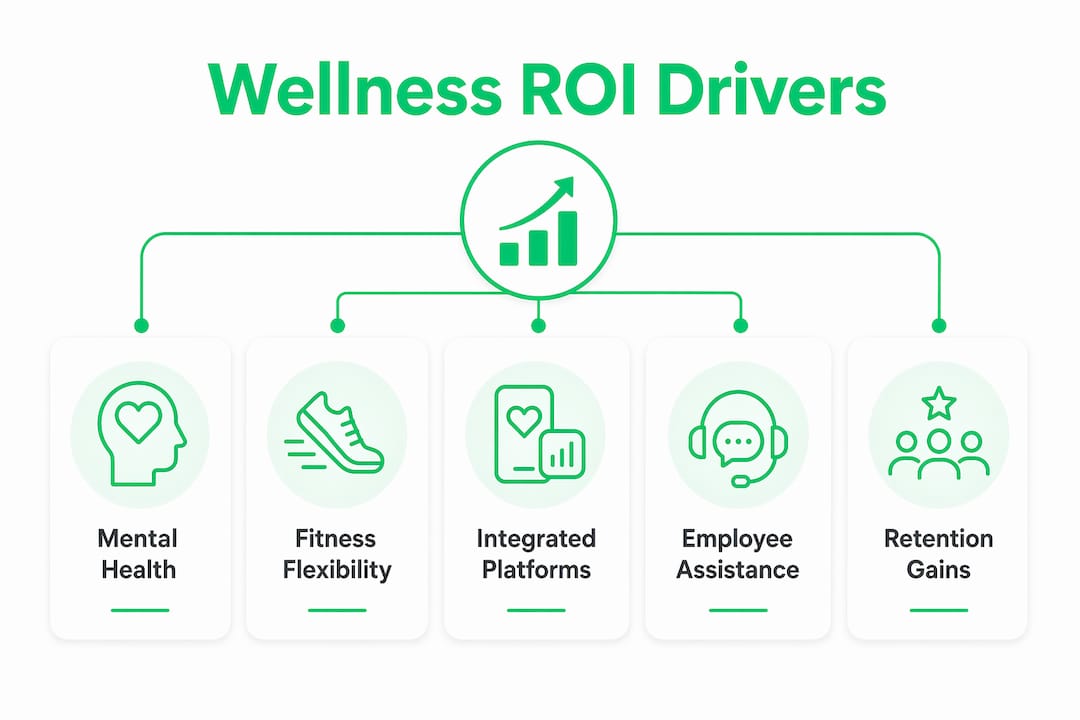
Fitness stipends work because they give employees choice. A $50 monthly stipend covers a gym membership, a yoga app, a cycling class, or a walking program. Flexibility drives participation, and participation drives outcomes. Biometric screenings catch health risks early, which prevents expensive interventions later. The incentive structure attached to screenings, typically $150–$600 in rewards, significantly increases uptake.
Integrated wellness platforms combining physical, mental, financial, and social supports achieve ROI averages of 4x–6x over three years. Single-intervention programs rarely reach those multiples. The compounding effect of addressing the whole employee, not just one health dimension, is where the strongest returns live.
Pro Tip: Anchor your mental health offering to an Employee Assistance Program (EAP) first. EAPs cost $1–$3 per employee per month and provide immediate access to counseling, legal advice, and financial guidance. They are the lowest-cost, fastest-payback component in any wellness portfolio.
How do costs and budgeting affect wellness program design?
Budgeting for wellness benefits requires matching investment level to organizational goals. The data provides clear guidance on what different spending levels produce.
Spending $300–$600 per employee annually delivers 2.4x–3.2x returns and covers the most impactful program components. Organizations that spend below this threshold often see lower participation and weaker outcomes, which creates a false impression that wellness programs do not work.
Key budgeting considerations for HR leaders:
- Stipends over memberships. A monthly wellness stipend of $25–$75 is simpler to administer than negotiating corporate gym contracts. Employees spend it on what actually motivates them, which increases utilization.
- Start with EAPs. At $1–$3 per employee per month, an EAP is the most cost-efficient entry point. It covers mental health, financial counseling, and legal support in one package.
- Tie incentives to biometric screenings. Incentive structures of $150–$600 per participant dramatically increase screening participation, which generates the data needed to target future wellness spending.
- Plan for 18–24 months before measuring full ROI. Programs that are evaluated too early often appear to underperform. The financial returns from reduced claims and lower turnover take time to accumulate.
- Account for compliance requirements. The Americans with Disabilities Act (ADA) and the Health Insurance Portability and Accountability Act (HIPAA) both govern how wellness programs can be structured, particularly around incentives tied to health outcomes. Legal review of program design is not optional.
More than a third of employees report they lack access to or awareness of employer-provided wellness resources. This means a significant portion of your wellness budget produces zero return simply because employees do not know the benefit exists. Communication is not a soft add-on. It is a financial efficiency issue.
Pro Tip: Small and mid-size employers achieve strong results with a simple $200/month wellness stipend. It requires no vendor contracts, no app integrations, and no administrative overhead. Employees submit receipts or use a prepaid card. The flexibility alone drives higher participation than most structured programs.
What strategies help HR leaders maximize wellness program value?
Designing a wellness program is the easy part. Getting employees to use it consistently is where most programs fail. These strategies address the utilization gap directly.
- Communicate benefits at every touchpoint. Send wellness benefit reminders during onboarding, open enrollment, quarterly all-hands meetings, and manager one-on-ones. Employees who hear about a benefit once rarely act on it. Repetition drives utilization.
- Integrate wellness into the broader benefits package. Employees should see their medical plan, EAP, fitness stipend, and financial wellness tools as one connected system, not separate programs. Benefits that feel connected get used more consistently.
- Use participation rates as your primary leading indicator. Participation predicts future ROI before health outcomes or cost savings appear in the data. Track enrollment, active usage, and program completion monthly.
- Prioritize mental health as a workforce continuity issue. Mental health has moved from a nice-to-have to a critical factor in absence management and disability outcomes. Organizations that treat mental health support as optional will see it show up in their absenteeism and turnover data instead.
- Build team-based challenges to sustain engagement. Individual wellness programs plateau. Team challenges create social accountability and friendly competition, which sustain participation over months rather than weeks. Platforms like Charitymiles run team challenges that connect physical activity to charitable giving, giving employees a reason to keep moving that goes beyond personal fitness.
- Measure retention and productivity alongside health metrics. HR leaders who track only healthcare cost savings miss the larger ROI story. Retention improvements and productivity gains often represent the majority of total program value.
- Align wellness with your CSR commitments. Employees who see their wellness activity connected to a larger organizational purpose report higher engagement and stronger program loyalty. This alignment also strengthens your employer brand in recruiting.
Gene’s take: wellness is now a finance conversation, not just an HR one
The shift I find most significant in recent wellness data is this: 96% of finance leaders now report that their finance departments significantly influence workforce planning decisions related to wellness. That is not an HR statistic. That is a capital allocation statistic.
When finance gets involved, the conversation changes. Programs need measurable objectives, defined payback periods, and quarterly reporting. That is actually good news for HR leaders who have always believed in wellness. It means the budget conversation gets easier when you show up with ROI data rather than engagement surveys.
The area I see most consistently underinvested is mental health. Organizations spend heavily on gym subsidies and biometric screenings, then wonder why absenteeism stays flat. The research is clear: mental health drives absence management outcomes more directly than physical fitness programs do. An employee with untreated anxiety or depression will miss work regardless of whether they have a gym membership.
The other common mistake is under-communication. I have seen well-designed programs with strong vendor partnerships deliver poor results simply because employees did not know the benefit existed. A program that goes unused is not a wellness investment. It is a sunk cost. Treat communication as a program component with its own budget and accountability metrics.
The organizations getting the best returns treat wellness as a business initiative with financial objectives, not a perk designed to make employees feel appreciated. Both outcomes matter. But the framing determines whether the program survives the next budget cycle.
— Gene
How Charitymiles supports your wellness strategy
Wellness programs work best when they connect individual behavior to something larger than a personal health goal. Charitymiles does exactly that by turning everyday movement into charitable donations, giving employees a reason to stay active that goes beyond step counts.

The Charitymiles Employee Empowerment Program lets companies create private teams, run intra-company challenges, and sponsor employee miles at terms they control. HARMAN launched its Charitymiles team in 2021 and saw an 11x increase in employee participation, with 1,200+ employees generating over $120,000 for charity. That kind of result sits at the intersection of physical wellness, team engagement, and CSR. HR leaders looking to strengthen all three at once can explore employee engagement platform options that complement a broader wellness strategy, or see how physical activity drives morale in organizations that have made movement a core part of their culture.
Key takeaways
Corporate wellness benefits deliver the strongest returns when they combine mental health support, fitness flexibility, and integrated communication into a single, measurable program.
| Point | Details |
|---|---|
| ROI is documented and fast | Wellness programs return $6 per $1 invested, with payback typically within 18–24 months. |
| Mental health drives the biggest gains | EAPs cost $1–$3/month per employee and show payback within 6–12 months. |
| Spend $300–$600 per employee annually | This spending level delivers 2.4x–3.2x returns and covers the highest-impact components. |
| Communication is a financial issue | More than a third of employees are unaware of their wellness benefits, which destroys ROI. |
| Finance now owns the wellness conversation | 96% of finance departments influence wellness planning, so HR must present measurable objectives. |
FAQ
What are corporate wellness benefits?
Corporate wellness benefits are employer-sponsored programs that support employee health across physical, mental, financial, and social dimensions. They include offerings like EAPs, fitness stipends, biometric screenings, and smoking cessation programs.
Why are employee wellness programs important for business?
Wellness programs reduce healthcare costs, lower absenteeism, and improve retention. Research shows 95% of organizations that measure wellness ROI report positive returns, with productivity and retention as the clearest gains.
How much should a company spend on wellness benefits per employee?
Spending $300–$600 per employee annually delivers 2.4x–3.2x returns and covers the most impactful program components. Smaller employers can start with a simple monthly wellness stipend and scale from there.
What wellness benefit has the highest ROI?
Smoking cessation programs deliver the highest per-participant savings, estimated at $1,100–$2,200 annually per participant. Mental health programs through EAPs show the fastest payback, typically within 6–12 months.
How do you measure the success of a corporate wellness program?
Track participation rates as the primary leading indicator, then monitor absenteeism, retention rates, healthcare claims, and productivity metrics over 18–24 months to capture the full financial return.